



Telavancin hydrochloride
Based on 1 publication(s) in Google Scholar
Telavancin hydrochloride (TD-6424 hydrochloride) is a bactericidal agent that exhibits inhibitory activity against Staphylococcus aureus. Telavancin hydrochloride inhibits bacterial cell wall synthesis by binding to the lipid-linked N-acetylglucosamine-N-muramyl pentapeptide (with a D-Ala-D-Ala terminus), a peptidoglycan precursor, and blocks the transglycosylation and transpeptidation steps. Telavancin hydrochloride disrupts bacterial membrane barrier function, induces dissipation of bacterial membrane potential, and causes leakage of cytoplasmic ATP and potassium ions, with its activity restricted exclusively to bacterial membranes. Telavancin hydrochloride can be used in research on bacterial infections, central venous catheter-related bloodstream infections, and Gram-positive bacterial pneumonia.
For research use only. We do not sell to patients.
- Purity: 99.88%
- CAS No.: 560130-42-9
- Formula: C80H107Cl3N11O27P
- Molecular Weight:1792.10
-
Storage:
4°C, sealed storage, away from moisture
* In solvent : -80°C, 6 months; -20°C, 1 month (sealed storage, away from moisture)


To place orders, for customer services and technical support, please contact: MedChemExpress USA
Tel: 609-228-6898 E-mail: [email protected] [email protected]


-
 Biological Activity
-
Chemical Information
-
Solvent & Solubility
- Purity & Documentation
- References
-
 Help & FAQs


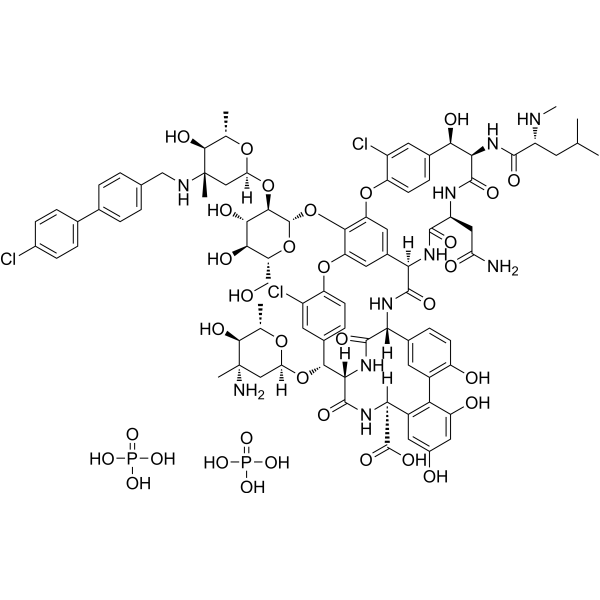
Publications Citing Use of MedChemExpress (MCE) Telavancin hydrochloride
MoreAll Antibiotic Isoforms
More

Biological Activity
Description
In Vitro
Telavancin hydrochloride (TD-6424 hydrochloride) exerts rapid, concentration-dependent bactericidal activity against extracellular and intracellular MRSA, MSSA, VISA, β-haemolytic streptococci, and viridans group streptococci in vitro, with a ≥3 log10 reduction in cfu/mL achieved at multiples of the MIC within 8-24 hours[1].
Telavancin hydrochloride exhibits a post-antibiotic effect of 0.3-3.9 hours against MRSA, streptococci, and Vancomycin (HY-B0671)-susceptible enterococci in vitro[1].
Telavancin hydrochloride achieves a ≥3 log10 reduction in MRSA and MSSA cfu/mL in vitro, including activity against nongrowing bacteria[1].
Telavancin hydrochloride displays potent in vitro activity against a broad range of gram-positive bacteria, including drug-resistant S. aureus strains, with MIC90 values ranging from 0.03 μg/mL (for S. pneumoniae) to 8 μg/mL (for Van A enterococci)[3].
Telavancin hydrochloride has bactericidal activity against S. aureus biofilms (including VISA strains) in a Sorbarod model[3].
Telavancin hydrochloride induces rapid, concentration-dependent bacterial membrane depolarization and cytoplasmic leakage, with specificity for bacterial rather than mammalian membranes[3].
Telavancin hydrochloride exhibits in vitro synergy with Gentamicin (HY-A0276A) and Rifampin (Rifampicin) (HY-B0272) against S. aureus[3].
Telavancin (2-5 mg/mL; 72 h at 37 °C) hydrochloride maintains >90% of its initial concentration and physical compatibility when combined with Heparin Sodium (Heparin sodium salt) (HY-17567A) 2500 units/mL, TSC 22 mg/mL, or TSC 40 mg/mL over 72 hours at 37 °C[2].
MedChemExpress (MCE) has not independently confirmed the accuracy of these methods. They are for reference only.
In Vivo
Telavancin (10 mg/kg; i.v.) demonstrates greater efficacy than vancomycin in reducing blood and spleen bacterial titers in immunocompromised mice with MRSA or VISA bacteremia[3].
Telavancin hydrochloride is highly bactericidal against penicillin-resistant Streptococcus pneumoniae in a rabbit meningitis model, producing a 6.12 log reduction in CSF bacterial counts and sterilizing CSF in 60% of treated rabbits[3].
Telavancin (30 mg/kg; every 12 h; 4 weeks) sterilizes 80% of tibial S. aureusMRSA osteomyelitis infections in rabbits[3].
MedChemExpress (MCE) has not independently confirmed the accuracy of these methods. They are for reference only.
-
Animal Model:Immunocompromised mice[3]
-
Dosage:10 mg/kg
-
Administration:i.v.
-
Result:Produced greater reductions in blood and spleen bacterial titers of MRSA and VISA strains compared with vancomycin.
-
Animal Model:Rabbits[3]
-
Dosage:30 mg/kg
-
Administration:every 12 h; 4 weeks
-
Result:Sterilized 12 of 15 (80%) tibial MRSA infections, a success rate similar to vancomycin and linezolid.


Chemical Information
-
CAS No. 560130-42-9
-
Appearance Solid
-
Molecular Weight 1792.10
-
Formula C80H107Cl3N11O27P
-
Color White to off-white
-
SMILES
ClC1=CC([C@H]([C@H](C(N[C@H](C(N[C@@]2([H])C(N[C@]3([H])C4=CC=C(O)C(C5=C(O)C(CNCP(O)(O)=O)=C(O)C=C5[C@H](NC([C@](NC3=O)([H])[C@@H](C6=CC=C(O7)C(Cl)=C6)O)=O)C(O)=O)=C4)=O)=O)CC(N)=O)=O)NC([C@H](NC)CC(C)C)=O)O)=CC=C1OC8=C(C7=CC2=C8)O[C@H]9[C@@H]([C@H]([C@@H]([C@H](O9)CO)O)O)O[C@H]%10C[C@@](C)([C@@H]([C@@H](O%10)C)O)NCCNCCCCCCCCCC.Cl
-
Synonyms
TD-6424 hydrochloride
-
Shipping
Room temperature in continental US; may vary elsewhere.
-
Storage
4°C, sealed storage, away from moisture
* In solvent : -80°C, 6 months; -20°C, 1 month (sealed storage, away from moisture)


Publications (1)
-
Journal Impact Factor
-
Most Recent
-
Adv Sci (Weinh)
SRSF5-Mediated Alternative Splicing of M Gene is Essential for Influenza A Virus Replication: A Host-Directed Target Against Influenza Virus. [Abstract]2022 Dec;9(34):e2203088. PMID: 36257906


Solvent & Solubility
In Vitro:
DMSO : 25 mg/mL (13.95 mM; ultrasonic and warming and heat to 60°C; Hygroscopic DMSO has a significant impact on the solubility of product, please use newly opened DMSO)
Please refer to the solubility information to select the appropriate solvent. Once prepared, please aliquot and store the solution to prevent product inactivation from repeated freeze-thaw cycles.
Storage method and period of stock solution: -80°C, 6 months; -20°C, 1 month (sealed storage, away from moisture). When stored at -80°C, please use it within 6 months. When stored at -20°C, please use it within 1 month.
Please refer to the solubility information to select the appropriate solvent. Once prepared, please aliquot and store the solution to prevent product inactivation from repeated freeze-thaw cycles.
Storage method and period of stock solution: -80°C, 6 months; -20°C, 1 month (sealed storage, away from moisture). When stored at -80°C, please use it within 6 months. When stored at -20°C, please use it within 1 month.
Concentration (start) × Volume (start) = Concentration (final) × Volume (final)
In Vivo:
Select the appropriate dissolution method based on your experimental animal and administration route.
- For the following dissolution methods, please ensure to first prepare a clear stock solution using an In Vitro approach and then sequentially add co-solvents:
- To ensure reliable experimental results, the clarified stock solution can be appropriately stored based on storage conditions. As for the working solution for In Vivo experiments, it is recommended to prepare freshly and use it on the same day.
- The percentages shown for the solvents indicate their volumetric ratio in the final prepared solution. If precipitation or phase separation occurs during preparation, heat and/or sonication can be used to aid dissolution.
Add each solvent one by one: 10% DMSO 90% (20% SBE-β-CD in Saline)
Solubility: ≥ 2.5 mg/mL (1.40 mM); Clear solution
This protocol yields a clear solution of ≥ 2.5 mg/mL (saturation unknown).
Taking 1 mL working solution as an example, add 100 μL DMSO stock solution (25.0 mg/mL) to 900 μL 20% SBE-β-CD in Saline, and mix evenly.
Preparation of 20% SBE-β-CD in Saline (4°C, storage for one week): 2 g SBE-β-CD powder is dissolved in 10 mL Saline, completely dissolve until clear.
In Vivo Dissolution Calculator
Please enter the basic information of animal experiments:
-
-
-
-
Recommended: Prepare an additional quantity of animals to account for potential losses during experiments.
Please enter your animal formula composition:
-
%DMSO +
Recommended: Keep the proportion of DMSO in working solution below 2% if your animal is weak.
-
%+
-
+%Tween-80 + +
-
%Saline +
The co-solvents required include: DMSO, . All of co-solvents are available by MedChemExpress (MCE). , Tween 80. All of co-solvents are available by MedChemExpress (MCE).
Working solution concentration: 0.22 mg/mL
Method for preparing stock solution: mg drug dissolved in μL DMSO. Stock solution concentration: mg/mL. * In solvent : -80°C, 6 months; -20°C, 1 month (sealed storage, away from moisture)
1. Take μL DMSO stock solution;
2. Add μL .
μL , mix evenly;
3. Then add μL Tween 80, mix evenly;
4. Then add μL
Please ensure that the stock solution in the first step is dissolved to a clear state, and add co-solvents in sequence. You can use ultrasonic heating (ultrasonic cleaner, recommended frequency 20-40 kHz), vortexing, etc. to assist dissolution.


Purity & Documentation
-
Data Sheet (287 KB)
-
SDS (252 KB)
- English - EN (252 KB)
- Français - FR (252 KB)
- Deutsch - DE (252 KB)
- Norwegian - NO (252 KB)
- Español - ES (252 KB)
- Swedish - SV (252 KB)
- Italian - IT (252 KB)
- Korean - KR (252 KB)
- Portuguese - PT (252 KB)
-
Handling Instructions (2659 KB)
References
[1]. Lyseng-Williamson KA, et al. Telavancin. Drugs. 2009;69(18):2607-20. [Content Brief]
[2]. Bookstaver PB, et al. Stability and compatibility of antimicrobial lock solutions. American journal of health-system pharmacy : AJHP : official journal of the American Society of Health-System Pharmacists. 2013 Dec 15;70(24):2185-98. [Content Brief]
[3]. Saravolatz LD, et al. Telavancin: a novel lipoglycopeptide. Clinical infectious diseases : an official publication of the Infectious Diseases Society of America. 2009 Dec 15;49(12):1908-14. [Content Brief]


Complete Stock Solution Preparation Table
Please refer to the solubility information to select the appropriate solvent. Once prepared, please aliquot and store the solution to prevent product inactivation from repeated freeze-thaw cycles.
Storage method and period of stock solution: -80°C, 6 months; -20°C, 1 month (sealed storage, away from moisture). When stored at -80°C, please use it within 6 months. When stored at -20°C, please use it within 1 month.
| Optional Solvent | Concentration Solvent Mass | 1 mg | 5 mg | 10 mg | 25 mg |
|---|---|---|---|---|---|
| DMSO | 1 mM | 0.5580 mL | 2.7900 mL | 5.5800 mL | 13.9501 mL |
| 5 mM | 0.1116 mL | 0.5580 mL | 1.1160 mL | 2.7900 mL | |
| 10 mM | 0.0558 mL | 0.2790 mL | 0.5580 mL | 1.3950 mL |


Telavancin hydrochloride Related Classifications
HY-16485 Related Classifications
 Powered by Bioz
Keywords
- Telavancin
- 560130-42-9
- TD-6424
- TD6424
- TD 6424
- Antibiotic
- Bacterial
- peptidoglycan precursor lipid-linked N-acetyl-glucosamine-N-muramylpentapeptide
- Clostridium species
- Peptococcus anaerobius
- Bacillus anthracis
- vancomycin-intermediate Staphylococcus aureus
- linezolid-resistant Staphylococcus aureus
- Gram-positive bacteria
- daptomycin-nonsusceptible Staphylococcus aureus
- Staphylococcus aureus
- methicillin/oxacillin-resistant Staphylococcus aureus
- Inhibitor
- inhibitor
- inhibit