8 Results for "

hGR

" in MedChemExpress (MCE) Product Catalog:
Products (8)

8 Results for "hGR" in MCE Product Catalog:

Cat. No.: HY-W028142
CAS No.: 4774-24-7
Target:  

5-HT Receptor SARS-CoV

Research Areas:  

Neurological Disease

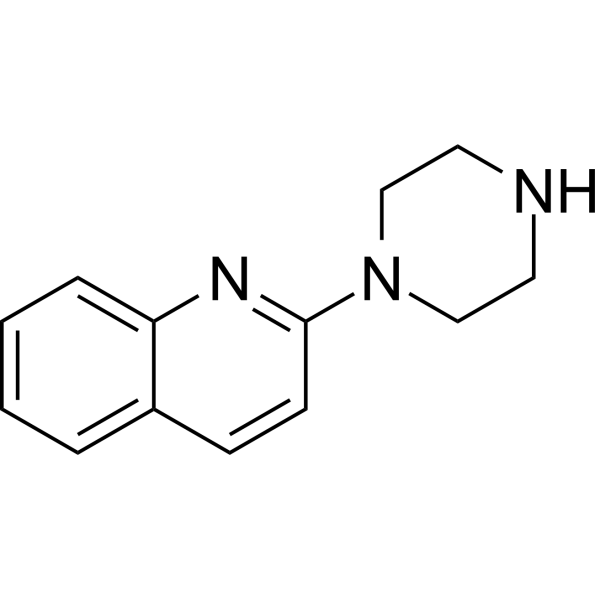
Quipazine is a 5-HT agonist with a Ki value of 1.4 nM for displaces [3H]GR65630 from 5-HT3R in rat. Quipazine shows antiviral activity against SARS-CoV-2 with an EC50 of 31.64 μM. Quipazine behaves as a 5-HT3R agonist in peripheral models. Quipazine can be used for neurological disease research .
loading...
    loading...
Cat. No.: HY-101046
CAS No.: 150323-78-7
Purity:  99.87%
Target:  

5-HT Receptor SARS-CoV

Research Areas:  

Neurological Disease

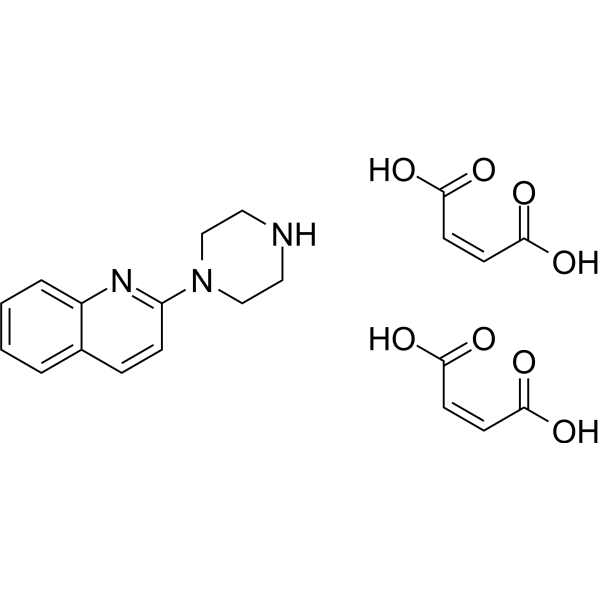
Quipazine dimaleate is a 5-HT agonist with a Ki value of 1.4 nM for displaces [3H]GR65630 from 5-HT3R in rat. Quipazine dimaleate shows antiviral activity against SARS-CoV-2 with an EC50 of 31.64 μM. Quipazine dimaleate behaves as a 5-HT3R antagonist in peripheral models. Quipazine dimaleate can be used for neurological disease research .
loading...
    loading...
Cat. No.: HY-107691
CAS No.: 158848-32-9
Purity:  ≥99.0%
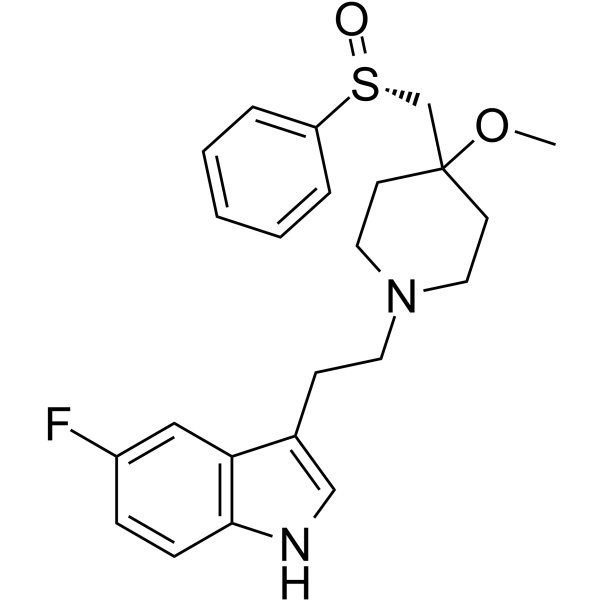
GR 159897 is a highly potent, selective, competitive, brain-penetrated non-peptide neurokinin 2 (NK2) receptor antagonist. GR 159897 has little or no affinity for NK1 and NK3 receptors. GR 159897 inhibits binding of [ 3H]GR100679 to human NK2 (hNK2)-CHO cells and rat colon membranes with pKis of 9.51 and 10, respectively. Antagonizes bronchoconstriction. Anxiolytic-like and anti-tumor effects .
loading...
    loading...
Cat. No.: HY-W028142R
CAS No.: 4774-24-7
Quipazine is a 5-HT agonist with a Ki value of 1.4 nM for displaces [3H]GR65630 from 5-HT3R in rat. Quipazine shows antiviral activity against SARS-CoV-2 with an EC50 of 31.64 μM. Quipazine behaves as a 5-HT3R agonist in peripheral models. Quipazine can be used for neurological disease research .
loading...
    loading...
Cat. No.: HY-162134
CAS No.: 3037664-05-1
Target:  

Parasite

Research Areas:  

Infection

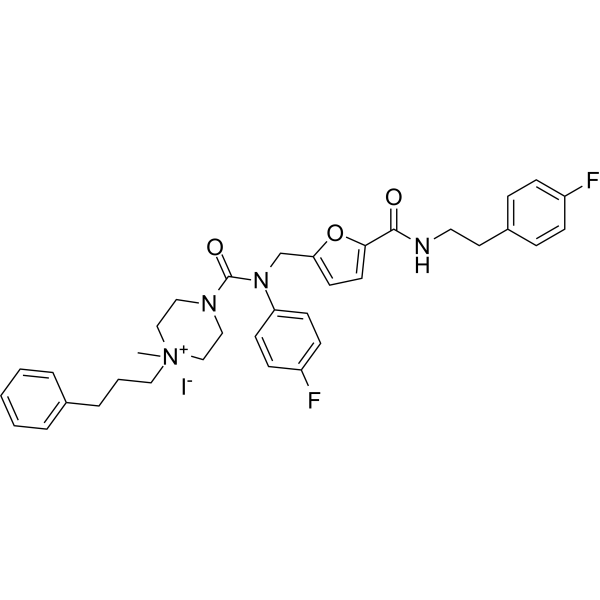
Trypanothione synthetase-IN-5 (compound 9) is a trypanothione reductase (TR) inhibitor, with an IC50 of 20.5 μM for Leishmania infantum TR. Trypanothione synthetase-IN-5 also has inhibitory activity for human glutathione reductase (hGR), with an IC50 of 62.4 μM .
loading...
    loading...
Cat. No.: HY-164083
CAS No.: 113140-33-3
Target:  

5-HT Receptor

Research Areas:  

Neurological Disease

GR65630 is a potent and selective 5-hydroxytryptamine (5-HT) type 3 receptor antagonist. GR65630 can be used to study the expression patterns of 5-HT3 receptors in different brain regions and their possible functions in the central nervous system. GR65630 and its radiolabeled form [ 3H]GR65630 can be used to study the distribution, density and affinity of the receptors .
loading...
    loading...
Cat. No.: HY-183518
CAS No.: 179894-84-9
Research Areas:  

Endocrinology

LG-120753 is an orally active nonsteroidal progesterone receptor (PR) antagonist, with an IC50 of 38 nM against hPR-B, a Ki of 19 nM against hPR-A, an IC50 of 227 nM against hAR, and IC50 values greater than 1000 nM against hGR, hER and hMR. LG-120753 blocks the action of progesterone, binds to and antagonizes hPR-A, and shows limited cross-reactivity with other steroid receptors. LG-120753 blocks blastocyst implantation, prevents the establishment of pregnancy, exhibits dose-dependent antiprogestogenic activity in vivo, and induces reversible antifertility effects .
loading...
    loading...
Cat. No.: HY-119080
CAS No.: 532435-68-0
Target:  

Progesterone Receptor

Research Areas:  

Endocrinology Cancer

CP8754 is an orally active, selective human progesterone receptor (hPR) antagonist that blocks progesterone-mediated signaling pathways. CP8754 competitively inhibits the binding of [ 3H]-progesterone to hPR. And in vitro, CP8754 inhibits progesterone-dependent exogenous luciferase and endogenous alkaline phosphatase expression; while in vivo, CP8754 inhibits rabbit endometrial transformation. CP8754 does not significantly bind to human glucocorticoid receptors (hGR), estrogen receptors (hER), or rat androgen receptors (rAR). CP8754 can be used in the study of progesterone-related diseases such as breast cancer, endometriosis, uterine fibroids, and meningioma, as well as hormone-dependent tumors .
loading...
    loading...

