8 Results for "

hepatic stages

" in MedChemExpress (MCE) Product Catalog:
Products (8)

8 Results for "hepatic stages" in MCE Product Catalog:

3
3 Cited Publications
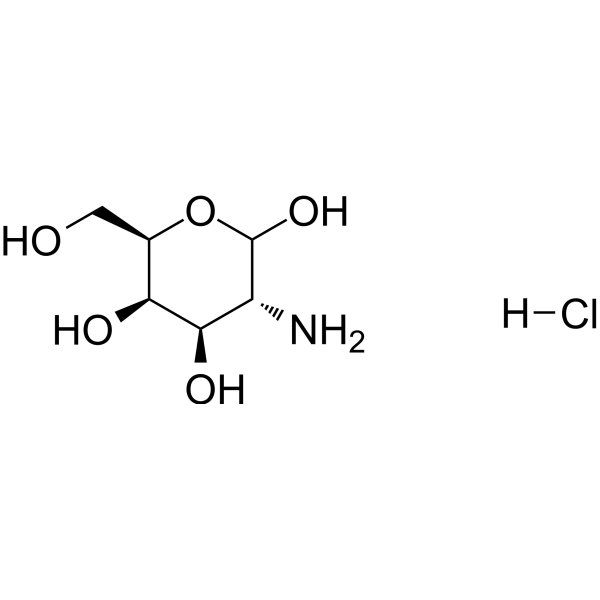
Cat. No.: HY-42682
CAS No.: 1772-03-8
Synonyms: D-Galactosamine HCl
D(+)-Galactosamine (D-Galactosamine) hydrochloride, which is an established experimental toxin, primarily causes liver injury by the generation of free radicals and depletion of UTP nucleotides. D(+)-Galactosamine hydrochloride intoxication also induces renal dysfunction thus, renal failure is often associated with the end-stage of the liver damage. Lipopolysaccharide/D(+)-Galactosamine-induced acute liver injury is a known animal model of fulminant hepatic failure .
loading...
    loading...
1
1 Cited Publications
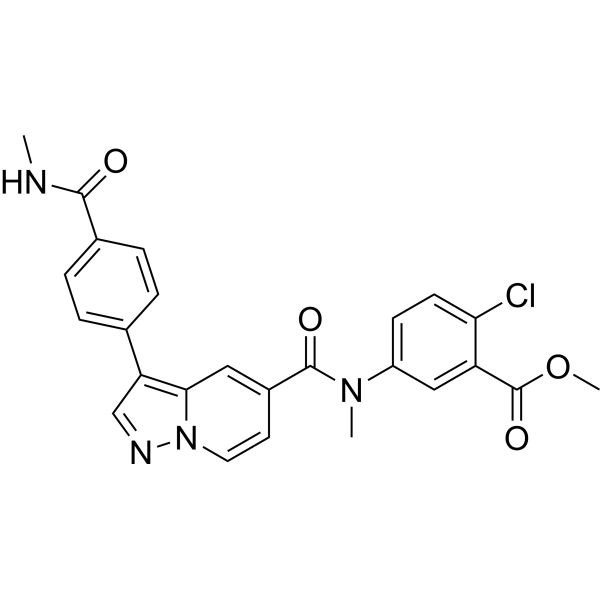
Cat. No.: HY-156685
CAS No.: 2767264-57-1
Purity:  99.86%
Target:  

PI4K Parasite

Research Areas:  

Infection Metabolic Disease Cancer

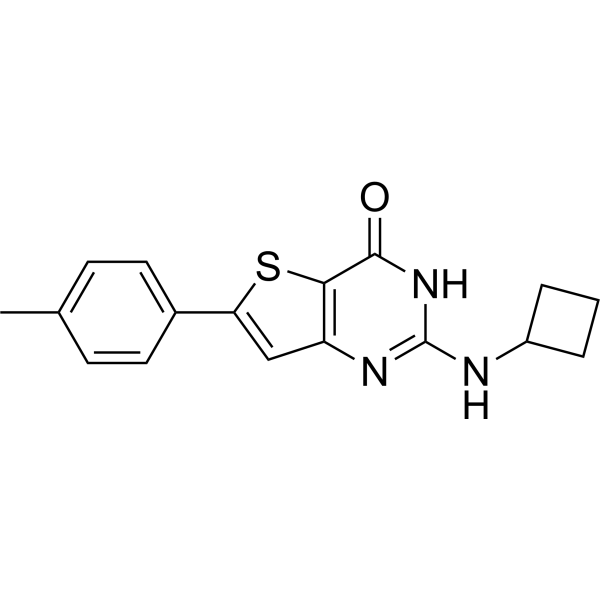
EDI048 is an orally active, gut-restricted parasiticidal agent. EDI048 specifically binds to the ATP-binding site of Cryptosporidium phosphatidylinositol 4-kinase (CpPI (4) K), blocks parasite membrane biogenesis, arrests the pathogen at the schizont stage, and thus irreversibly clears the infection. EDI048 is rapidly converted to an inactive carboxylic acid metabolite via hepatic first-pass metabolism, with extremely low systemic exposure, good safety profile, and no cardiotoxicity, genotoxicity or off-target effects. EDI048 is used in studies of intestinal cryptosporidiosis in children .
loading...
    loading...
Cat. No.: HY-P2989
CAS No.: 9014-19-1
Target:  

Endogenous Metabolite

Research Areas:  

Metabolic Disease Cancer

Pyruvate carboxylase is a key mitochondrial anaplerotic enzyme that catalyzes the conversion of pyruvate to oxaloacetate. Pyruvate carboxylase not only maintains tricarboxylic acid cycle activity and redox homeostasis, but also drives hepatic gluconeogenesis and fatty acid synthesis. The activity of Pyruvate carboxylase is upregulated in insulin-resistant states, exacerbating hepatic glucose production. Pyruvate carboxylase also shows significantly enhanced expression in early-stage non-small cell lung cancer (NSCLC). Pyruvate carboxylase promotes tumor proliferation by supporting nucleotide and lipid synthesis, and its functional deficiency cannot be compensated by glutaminolysis. Pyruvate carboxylase can be used in the research of prediabetes type 2 and NSCLC .
loading...
    loading...
Cat. No.: HY-17656
CAS No.: 91042-00-1
Target:  

Parasite

Research Areas:  

Infection

C3361 is a moderate specific Plasmodium falciparum hexose transporter 1 (PfHT1) and Plasmodium berghei hexose transporter 1 (PbHT1) inhibitor with Ki values of 8.6 and 9.4 μM. C3361 inhibits TgGT1 with a Ki of 82 μM. C3361 attenuates hepatic (IC50 = 15 μM) and ookinete development of P. berghei. C3361 can suppress the growth of blood-stage parasites. C3361 can be used for the research of infection, such as malaria .
loading...
    loading...
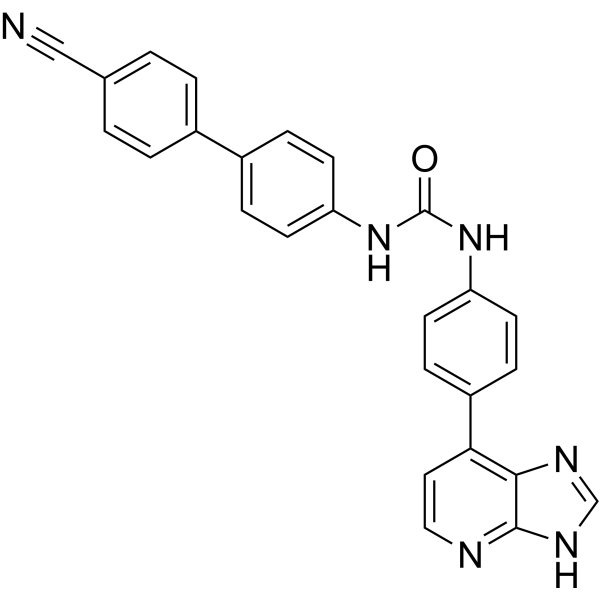
Cat. No.: HY-120696
CAS No.: 1361414-26-7
Purity:  98.06%
Synonyms: ML368
Research Areas:  

Infection Cancer

SR9186 (ML368) is a selective CYP3A4 inhibitor with IC50 values of 9, 4, and 38 nM for Midazolam → 1'-hydroxymidazolam, Testosterone → 6β-hydroxytestosterone, and Vincristine → Vincristine M1, respectively. SR-9186 inhibits the development of hepatic-stage P. falciparum and blocks ivermectin metabolism. SR-9186 can be used in breast cancer research .
loading...
    loading...
Cat. No.: HY-42682R
CAS No.: 1772-03-8
Synonyms: D-Galactosamine HCl (Standard)
D(+)-Galactosamine (hydrochloride) (Standard) is the analytical standard of D(+)-Galactosamine (hydrochloride). This product is intended for research and analytical applications. D(+)-Galactosamine (D-Galactosamine) hydrochloride, which is an established experimental toxin, primarily causes liver injury by the generation of free radicals and depletion of UTP nucleotides. D(+)-Galactosamine hydrochloride intoxication also induces renal dysfunction thus, renal failure is often associated with the end-stage of the liver damage. Lipopolysaccharide/D(+)-Galactosamine-induced acute liver injury is a known animal model of fulminant hepatic failure .
loading...
    loading...
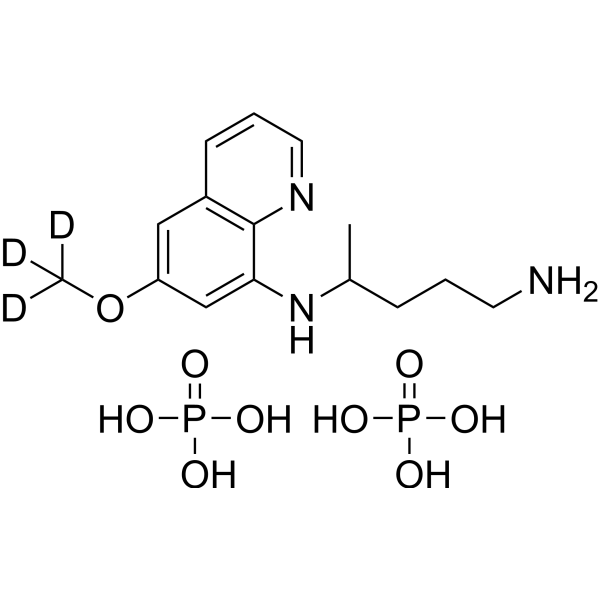
Cat. No.: HY-12651S
Primaquine-d3 (diphosphate) is the deuterium labeled Primaquine diphosphate. Primaquine Diphosphate (Primaquine phosphate), an 8-aminoquinoline, exerts a broad spectrum of activities against various stages of parasitic malaria. Primaquine Diphosphate remains as the only agent that destroys late hepatic stages and latent tissue forms of Plasmodium vivax and Plasmodium ovale .
loading...
    loading...
Cat. No.: HY-155354
CAS No.: 3053680-00-2
Purity:  99.13%
Target:  

Parasite

Research Areas:  

Infection

Antimalarial agent 33 (compound 5g) has antiplasmodial activity against erythrocytic and hepatic stages of Plasmodium with an EC50 of 1.1 μM for K1 P. falciparum strain. Antimalarial agent 33 demonstrats enhanced microsomal stability (T1/2=29 min). Antimalarial agent 33 has no significant cytotoxicity against primary hepatocytes .
loading...
    loading...

