12 Results for "

histiocytic lymphoma

" in MedChemExpress (MCE) Product Catalog:
Products (12)

12 Results for "histiocytic lymphoma" in MCE Product Catalog:

1
1 Cited Publications
Cat. No.: HY-N0732
CAS No.: 37905-08-1
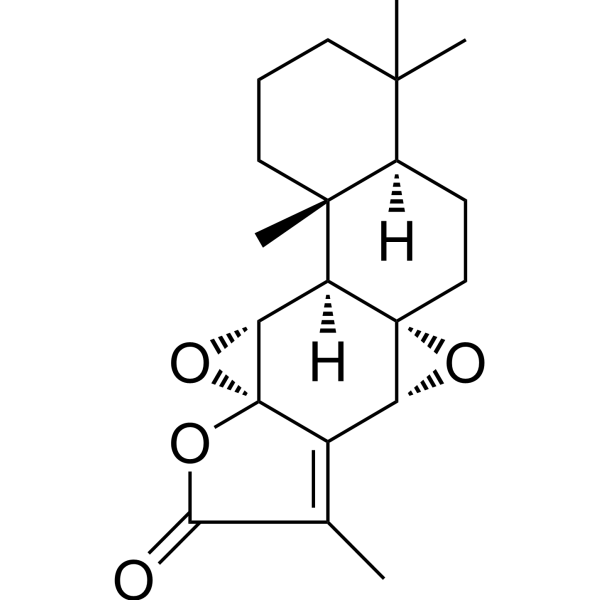
Jolkinolide B is a bioactive diterpene isolated from the roots of Euphorbia fischeriana Steud with oral activity. Jolkinolide B downregulates XIAP, cIAP1, cIAP2, and phosphorylated Akt, upregulates Smac, activates caspase-3 and caspase-9, and inhibits NF-κB, TGFβ/smad3 and JAK/STAT3 pathways. Jolkinolide B exerts comprehensive biological effects including inducing cancer cell apoptosis, suppressing inflammatory responses, improving lung function, alleviating hepatic steatosis and eliminating intracellular Mycobacterium tuberculosis. Jolkinolide B can be used for the research of leukemia, histiocytic lymphoma, asthma, metabolic dysfunction-associated steatotic liver disease and tuberculosis .
loading...
    loading...
Cat. No.: HY-124108
CAS No.: 1191-85-1
Purity:  ≥99.0%
Synonyms: ETYA
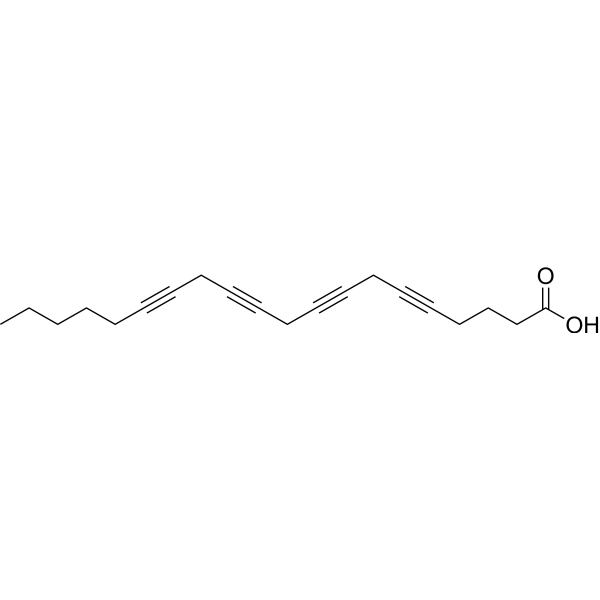
Eicosatetraynoic acid (ETYA) is a non-metabolizable analog of Arachidonic acid (HY-109590) and also an inhibitor of the lipoxygenase (LOX)/cyclooxygenase (COX) pathway (ID50 = 8 μM and 4 μM). Eicosatetraynoic acid acts as a suicide substrate to inhibit the production of inflammatory mediators such as leukotrienes and prostaglandins. Eicosatetraynoic acid acts directly on cell membranes and membrane proteins to exert a wide range of effects, including blocking potassium channels, increasing cell membrane fluidity, elevating intracellular calcium levels, inhibiting DNA synthesis in tumor cells, inducing differentiation of certain cells, and specifically inhibiting the assembly and replication of orthopoxviruses. Eicosatetraynoic acid alleviates acute lung injury induced by chemicals such as phosgene .
loading...
    loading...
Cat. No.: HY-15264
CAS No.: 126860-83-1
Purity:  91.48%
Synonyms: Impurity A of Calcipotriol
Target:  

VD/VDR

Research Areas:  

Cancer

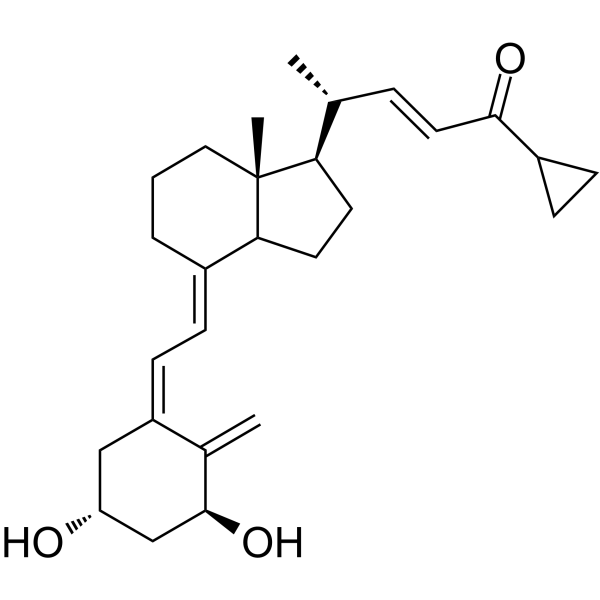
MC 1046 (Impurity A of Calcipotriol) is a hepatic metabolite and an impurity of Calcipotriol (HY-10001). MC 1046 induces differentiation of histiocytic lymphoma cells. MC 1046 can be used for the research of histiocytic lymphoma .
loading...
    loading...
Cat. No.: HY-150513
Purity:  99.40%
Target:  

SphK

Research Areas:  

Cancer

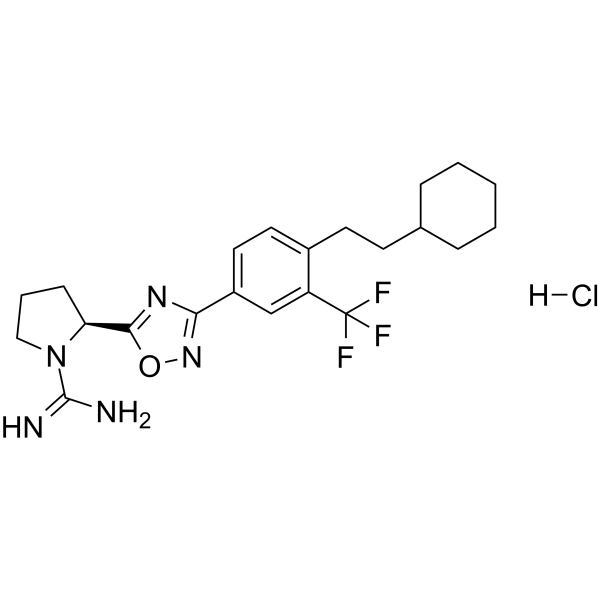
SLP9101555 (compound 14c) is a potent and selective SphK2 (sphingosine kinase 2) inhibitor (Ki=90 nM) with 200-fold selectivity over SphK1. SLP9101555 markedly decreases extracellular S1P (sphingosine 1-phosphate) levels .
loading...
    loading...
Cat. No.: HY-N0732R
CAS No.: 37905-08-1
Jolkinolide B (Standard) is the analytical standard of Jolkinolide B (HY-N0732). This product is intended for research and analytical applications. Jolkinolide B is a bioactive diterpene isolated from the roots of Euphorbia fischeriana Steud with oral activity. Jolkinolide B downregulates XIAP, cIAP1, cIAP2, and phosphorylated Akt, upregulates Smac, activates caspase-3 and caspase-9, and inhibits NF-κB, TGFβ/smad3 and JAK/STAT3 pathways. Jolkinolide B exerts comprehensive biological effects including inducing cancer cell apoptosis, suppressing inflammatory responses, improving lung function, alleviating hepatic steatosis and eliminating intracellular Mycobacterium tuberculosis. Jolkinolide B can be used for the research of leukemia, histiocytic lymphoma, asthma, metabolic dysfunction-associated steatotic liver disease and tuberculosis .
loading...
    loading...
Cat. No.: HY-179399
Research Areas:  

Cancer

β-carboline-ACS81 is a β-carboline derivative with potent antitumor properties. β-carboline-ACS81 induces apoptosis through the collapse of mitochondrial membrane potential and arrests cell cycle at G2/M phase in HL-60 cells. β-carboline-ACS81 possesses potent antiproliferative activity against HL-60 cells (IC50 = 1.52 μM). β-carboline-ACS81 can be used for the research of leukemia, histiocytic lymphoma, hepatocellular carcinoma, malignant melanoma, colorectal carcinoma and lung carcinoma .
loading...
    loading...
Cat. No.: HY-179409
MC3817 is a selective DNMT1 inhibitor. MC3817 inhibits DNMT1 and DNMT3A/3L with IC50s of 0.044 μM and > 10μM, respectively. MC3817 inhibits P53-dependent cancer cell proliferation, induces apoptosis and DNA damage MC3817 elevates cleaved Caspase 3, P53, and γH2AX. MC3817 can be used in non-small cell lung cancer, colon cancer, cervical cancer, triple-negative breast cancer and histiocytic lymphoma research .
loading...
    loading...
Cat. No.: HY-179409A
MC3817 free base is a selective DNMT1 inhibitor. MC3817 free base inhibits DNMT1 and DNMT3A/3L with IC50s of 0.044 μM and > 10μM, respectively. MC3817 free base inhibits P53-dependent cancer cell proliferation, induces apoptosis and DNA damage. MC3817 free base elevates cleaved Caspase 3, P53, and γH2AX. MC3817 free base can be used in non-small cell lung cancer, colon cancer, cervical cancer, triple-negative breast cancer and histiocytic lymphoma research .
loading...
    loading...
Cat. No.: HY-185854
CAS No.: 3115940-40-1
Research Areas:  

Cancer

BRD4 degrader-8 is a BRD4-targeting degrader. BRD4 degrader-8 induces degradation of BRD4 protein via the ubiquitin-proteasome pathway. BRD4 degrader-8 can be used for the research of hematologic tumors, gastrointestinal stromal tumors, histiocytic lymphoma, non-small cell lung cancer, small cell lung cancer, lung adenocarcinoma, lung squamous cell carcinoma, pancreatic cancer, breast cancer, prostate cancer, liver cancer, skin cancer, epithelial cell carcinoma, colorectal cancer, kidney cancer, gastric cancer, head and neck cancer, nasopharyngeal cancer .
loading...
    loading...
Cat. No.: HY-187521
CAS No.: 102537-38-2
Target:  

c-Myc Topoisomerase

Research Areas:  

Cancer

MYCMI-7 hydrobromide is a potent and selective MYC/MYCN inhibitor, with a Kd of 4 μM for MYC and an IC50 of 10 μM for topoisomerase IIα (Topoisomerase IIα). MYCMI-7 hydrobromide binds directly to MYC, selectively inhibits the interactions of MYC:MAX and MYCN:MAX, reduces MYC-driven transcription levels, induces MYC/MYCN protein degradation, and blocks the binding of MYC to chromatin, thereby inducing tumor cell growth arrest, apoptosis and reducing cell viability, while only inducing G1 phase growth arrest in normal cells. MYCMI-7 hydrobromide can be used in research related to MYC-driven acute myeloid leukemia and breast cancer, MYCN-amplified neuroblastoma, glioblastoma, Burkitt's lymphoma, melanoma, colon cancer, osteosarcoma, cervical cancer and histiocytic lymphoma .
loading...
    loading...
Cat. No.: HY-13614
CAS No.: 610787-07-0
E7974 is a selective inhibitor of α-tubulin (α-tubulin) with an IC50 of 3.9 μM. E7974 disrupts mitotic spindle formation, induces G2-M phase cell cycle arrest, initiates apoptosis, activates caspase-3, and induces poly (ADP-ribose) polymerase cleavage. E7974 reduces the area of choroidal neovascularization in mouse models, and exerts anti-angiogenic effects when loaded in modified micelles. E7974 can be used in research related to cancer and choroidal neovascularization .
loading...
    loading...
Cat. No.: HY-180416
CAS No.: 242147-94-0
Target:  

Antibiotic

Research Areas:  

Cancer

TMC-169 is a potent antibiotic of the Aspochalasin group that can be isolated from Aspergillus flavipes. TMC-169 exhibits anti-tumor activity against multiple cancer cells. TMC-169 can be used for the research of cancer, such as hematologic malignancies, non-small cell lung cancer, breast cancer, and glioma .
loading...
    loading...
  • 1

