


10 Results for "

human classical pathway

" in MedChemExpress (MCE) Product Catalog:
Products (10)

10 Results for "human classical pathway" in MCE Product Catalog:

3
3 Cited Publications
Cat. No.: HY-P1036
CAS No.: 206645-99-0
Target:  

Complement System

Research Areas:  

Others

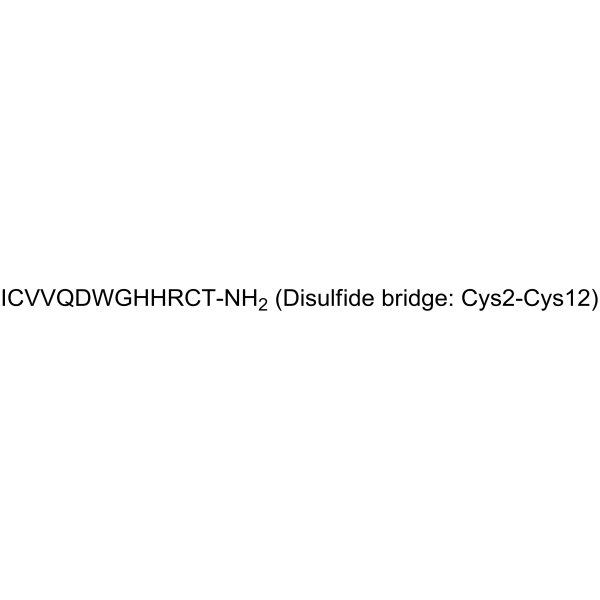
Compstatin, a 13-residue cyclic peptide, is a potent inhibitor of the complement system C3 with species specificity. Compstatin binds to baboon C3 and is resistant to proteolytic cleavage in baboon blood (similar to humans). Compstatin inhibits only the activation of primates’ complement system. Compstatin exhibits IC50 values of 63 μM and 12 μM for classical and alterative complement pathway, respectively .
loading...
    loading...
3
3 Cited Publications
Cat. No.: HY-P1036A
Target:  

Complement System

Research Areas:  

Others

Compstatin TFA, a 13-residue cyclic peptide, is a potent inhibitor of the complement system C3 with species specificity. Compstatin TFA binds to baboon C3 and is resistant to proteolytic cleavage in baboon blood (similar to humans). Compstatin TFA inhibits only the activation of primates’ complement system. Compstatin TFA exhibits IC50 values of 63 μM and 12 μM for classical and alterative complement pathway, respectively .
loading...
    loading...
Cat. No.: HY-P99965
CAS No.: 1917321-26-6
Synonyms: SKY59; RO7112689; RG-6107
Crovalimab (SKY59; RO7112689) is a novel humanized antibody against C5 in a pH-dependent manner with KDs of 15.2 nM and 16.8 μM at pH 7.4 and 5.8, respectively. Crovalimab binds human FcRn with great affinity (KD: 17 μM at pH 6.0). Crovalimab can block cleavage of C5 by the C5 convertase and inhibite the activity of a C5 variant (p.Arg885His). Crovalimab inhibits C5b-9 formation significantly in all three complement pathways, the classical pathway (CP), lectin pathway (LP), and alternative pathway (AP). Crovalimab has the potential for paroxysmal nocturnal hemoglobinuria (PNH) and complement-mediated diseases research .
loading...
    loading...
Cat. No.: HY-P990091
CAS No.: 2756228-76-7
Synonyms: SAR 445088
Riliprubart (SAR 445088) is a selective anti-C1s humanized IgG4 monoclonal antibody with mutations that enhance its binding to the neonatal Fc receptor. Riliprubart blocks activation of the classical complement pathway, prevents the formation of the C3 convertase C4b2a, and inhibits complement-mediated hemolytic activity. Riliprubart can be used in research related to classical complement-mediated diseases, cold agglutinin disease, and chronic inflammatory demyelinating polyneuropathy. For the isotype control of Riliprubart, refer to Human IgG4 (S228P) kappa, Isotype Control (HY-P99003) .
loading...
    loading...
Cat. No.: HY-P99358
CAS No.: 1662664-56-3
Synonyms: GSK 2398852; Anti-Serum Amyloid P/SAP Reference Antibody (dezamizumab)

Target:  

Complement System

Research Areas:  

Inflammation/Immunology

Dezamizumab (GSK 2398852) is a fully humanized clonal IgG1 antibody against serum amyloid P component (SAP) with complement activation and amyloid clearance-inducing activities. Dezamizumab binds to SAP associated with amyloid deposits to form complexes that activate complement and mediate phagocytic clearance, triggering activation of the classical complement pathway. Dezamizumab can be used for the research of systemic amyloidosis .
loading...
    loading...
Cat. No.: HY-P990955
CAS No.: 2839652-75-2
Synonyms: ADX-097

Target:  

CD3 Complement System

Research Areas:  

Inflammation/Immunology

Ebribafusp alfa (ADX-097) comprising a humanized anti-C3d monoclonal antibody linked to two moieties of the first five consensus repeats of factor H (fH1-5). Ebribafusp alfa binds C3d and related fragments, catalyzes AP convertase dissociation, acts as a factor I co-factor for C3b cleavage, and delivers fH1-5 moieties to C3d-deposited tissues for local complement inhibition without systemic blockade. Ebribafusp alfa reduces glomerular C3 deposition, proteinuria, urine albumin-creatinine ratios, and urine soluble C5b-9 levels, preserves podocyte foot-process architecture, inhibits skin complement activation, and localizes to UVB-damaged primate skin. Ebribafusp alfa can be used for the research of membranous nephropathy, bullous pemphigoid, discoid lupus erythematosus, C3 glomerulopathy, IgA nephropathy, and lupus nephritis .
loading...
    loading...
Cat. No.: HY-K6303

MCE Human iPSC/ESC Cardiomyocyte Induction Differentiation Kit is based on the classical GiWi system. By precisely modulating the Wnt/β-catenin signaling pathway in a temporally controlled manner (sequential activation and inhibition), the kit enables highly efficient directed differentiation of human pluripotent stem cells into cardiomyocytes. It is suitable for cardiac disease modeling, drug cardiotoxicity assessment, and mechanistic studies.

loading...
    loading...
Cat. No.: HY-N17326
CAS No.: 242794-72-5
Ilekudinol B is an inhibitor of ACAT and PTP1B, with an IC50 of 5.3 μM and a Ki of 11.6 μM against human PTP1B. Ilekudinol B inhibits the classical pathway of the complement system, with an IC50 of 51 μM. Ilekudinol B inhibits TNF-α-induced cellular IL-8 secretion, promotes glucose uptake in skeletal muscle myotubes, and acts as an insulin mimetic and insulin sensitizer. Ilekudinol B can be used in research related to type 2 diabetes, obesity, and inflammatory diseases .
loading...
    loading...
Cat. No.: HY-P992463

Target:  

Ser/Thr Protease

Research Areas:  

Endocrinology

SHR-2010 is a fully humanized monoclonal antibody targeting MASP-2. SHR-2010 selectively inhibits lectin pathway activation without affecting classical or alternative complement pathways. SHR-2010 can be used for the research of IgA nephropathy .
loading...
    loading...
Cat. No.: HY-P991954

Target:  

Complement System Syk

Research Areas:  

Inflammation/Immunology Cancer

GT103 is a human-derived monoclonal antibody targeting complement factor H (CFH). GT103 binds to a conformationally distinct epitope of CFH on tumor cells. GT103 activates the classical complement pathway, induces complement-dependent cytotoxicity, and triggers antibody-dependent cellular phagocytosis (ADCP) of tumor cells. GT103 increases calreticulin translocation to tumor cell plasma membranes. GT103 mediates B-cell activation via Syk kinase phosphorylation. GT103 inhibits tumor growth and metastasis in animal models. GT103 can be used for the research of non-small cell lung cancer .
loading...
    loading...

