1. Search Result
Search Result
Pathways Recommended: MAPK/ERK Pathway
Results for "

intrinsic mitochondrial pathway

" in MedChemExpress (MCE) Product Catalog:

11

Inhibitors & Agonists

1

Natural
Products

Cat. No. Product Name Target Research Areas Chemical Structure
  • HY-137371

    Bacterial Apoptosis Antibiotic Infection Cancer
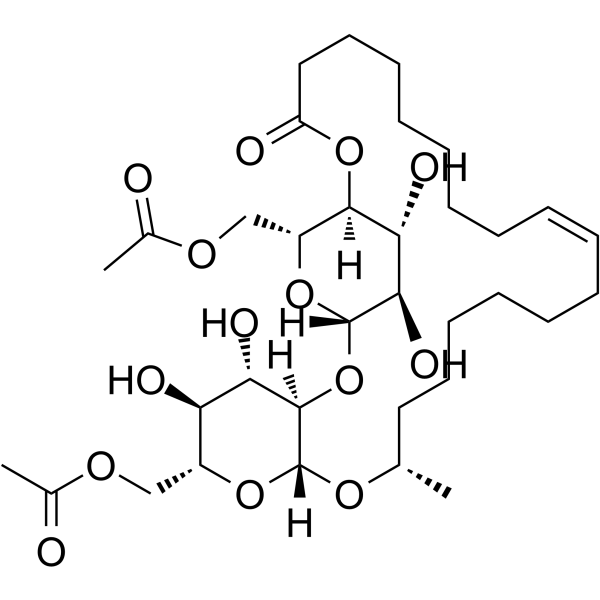
    Lactonic sophorolipid is an apoptosis inducer and antimicrobial surfactant with antitumor activity. Lactonic sophorolipid regulates Bax/Bcl-gene expression through caspase-3/9 and induces apoptosis in tumor cells. Lactonic sophorolipid can disrupt cell membrane permeability and exert antibacterial effects (MIC for oral pathogens is 100-400 μg/mL). Lactonic sophorolipid promotes mitochondrial membrane potential depolarization, activates the intrinsic apoptotic pathway, and can synergize with antibiotics to enhance the antibacterial effect. Lactonic sophorolipid can be used in liver cancer research and the development of oral hygiene antibacterial agents[1][2][3].
    Lactonic sophorolipid
  • HY-34614

    Tricyclohexylphosphane

    Drug Intermediate Reactive Oxygen Species (ROS) Cancer
    Tricyclohexylphosphine (Tricyclohexylphosphane) is a chemical intermediate. The Tricyclohexylphosphine gold (I) n-mercaptobenzoate complex synthesized from Tricyclohexylphosphine induces ROS production and exhibits antiproliferative activity against breast cancer cells .
    Tricyclohexylphosphine
  • HY-125677

    Caspase Reactive Oxygen Species (ROS) Apoptosis Cancer
    SHetA2 is a derivative of heteroarotinoid, that exhibits cytotoxicity in cancer cells with IC50 of 0.37–4.6 μM. SHetA2 regulates cancer cells differentiation, induces apoptosis through the intrinsic mitochondrial pathway, and arrest cell cycle at G2 phase. SHetA2 exhibits good pharmacokinetic characteristics and antitumor efficacy in mice. SHetA2 is orally active .
    SHetA2
  • HY-131710

    Phosphodiesterase (PDE) EGFR Wnt Apoptosis Cancer
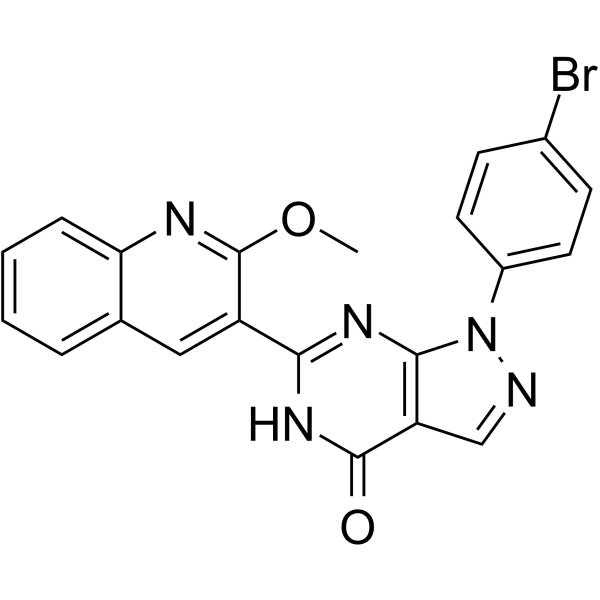
    PDE5-IN-3 (compound 11j) is a potent PDE5 inhibitor with an IC50 of 1.57 nM. PDE5-IN-3 shows moderate EGFR inhibition with IC50 of 5.827 µM. PDE5-IN-3 significantly inhibits the Wnt/β-catenin pathway (IC50=1286.96 ng/mL). PDE5-IN-3 induces the intrinsic apoptotic mitochondrial pathway in HepG2 cells. PDE5-IN-3 has strong antitumor activity .
    PDE5-IN-3
  • HY-163435

    Apoptosis Caspase PARP Bcl-2 Family Cancer
    Anticancer agent 201 (Compound 2f) has IC50 values in the low micromolar range for multiple tumor cell lines. Anticancer agent 201 is highly cytotoxic to CCRF-CEM cells in vitro, inducing apotosis by activating caspase-3 in the intrinsic mitochondrial pathway and lysis of PARP, as well as reducing the expression of Bcl-2 and Bcl-XL proteins. Anticancer agent 201 can be used in cancer research .
    Anticancer agent 201
  • HY-155974
    MeOIstPyrd
    1 Publications Verification

    MDM-2/p53 Cancer
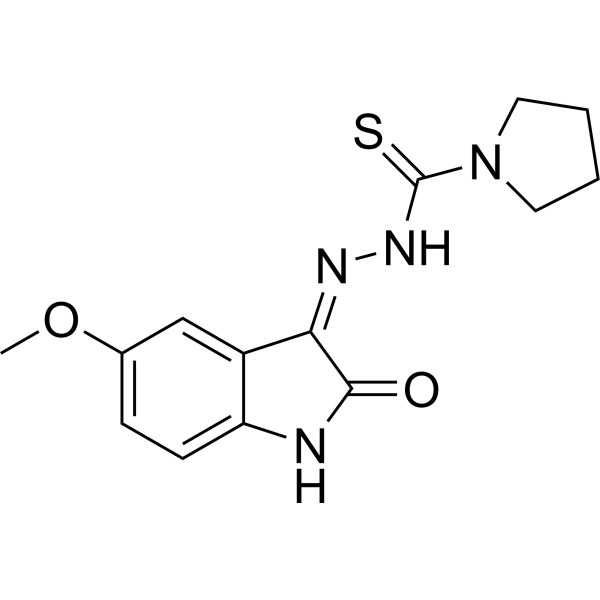
    MeOIstPyrd is an anti-skin cancer agent. MeOIstPyrd inhibits cell proliferation, migration, and spheroid formation by activating the mitochondrial intrinsic apoptotic pathway. MeOIstPyrd induces DNA damage. MeOIstPyrd activates p53, and increases the half-life of p53 and stabilizes p53 by phosphorylating it at ser15. MeOIstPyrd binds to MDM2 in the p53 sub-pocket and blocks p53-MDM2 interaction .
    MeOIstPyrd
  • HY-183317

    Indoleamine 2,3-Dioxygenase (IDO) Interleukin Related Apoptosis Caspase PARP Cancer
    IDO1-IN-34 is a selective IDO1 inhibitor with an IC50 of 0.093 μM. IDO1-IN-34 exhibits cytotoxicity against various cancer cell lines. IDO1-IN-34 inhibits the kynurenine (kynurenine) pathway and activates IL-2. IDO1-IN-34 induces cell apoptosis via the endogenous mitochondrial pathway, while increasing the levels of cytochrome c, caspase-3, caspase-9 and PARP-1. IDO1-IN-34 can be used for research on liver cancer, lung cancer, breast cancer, prostate cancer, colon cancer and leukemia .
    IDO1-IN-34
  • HY-183373

    EGFR PARP Cancer
    EGFR/PARP-1-IN-1 is a dual EGFR and PARP-1 inhibitor with IC50 values of 64 nM and 12 nM, respectively. EGFR/PARP-1-IN-1 binds to the ATP-binding pocket of EGFR and interacts with the catalytic domain of PARP-1, inhibiting kinase and enzymatic activity via hydrogen bond formation with key residues in both targets. EGFR/PARP-1-IN-1 induces apoptosis through the endogenous mitochondrial pathway, arrests the cell cycle at the G2 phase, and inhibits cell proliferation. EGFR/PARP-1-IN-1 can be used for research on triple-negative breast cancer .
    EGFR/PARP-1-IN-1
  • HY-183580

    Cancer
    CAIX/CAXII-IN prodrug-1 is a subtype-dependent prodrug inhibitor of carbonic anhydrase IX and XII (CAIX/CAXII). CAIX/CAXII-IN prodrug-1 itself shows no activity against carbonic anhydrases, and after hydrolysis, it exhibits Ki values of 54 nM and 62 nM against hCA IX and hCA XII, respectively. CAIX/CAXII-IN prodrug-1 exerts antiproliferative activity against cancer cells and induces cell apoptosis (apoptosis) via the endogenous mitochondrial pathway. CAIX/CAXII-IN prodrug-1 can be used in the research of breast cancer, colorectal adenocarcinoma and prostate cancer .
    CAIX/CAXII-IN prodrug-1
  • HY-181675

    Microtubule/Tubulin Apoptosis Bcl-2 Family Caspase Cancer
    CHNQD-01522 is a microtubule inhibitor targeting the colchicine binding site on β-tubulin. CHNQD-01522 binds to the colchicine binding site on β-tubulin, inhibits microtubule polymerization, and evades P-glycoprotein transport in cancer cells. CHNQD-01522 inhibits proliferation, suppresses tumor cell colony formation, arrests cell cycle in G2/M phases, and induces apoptosis in cancer cells. CHNQD-01522 upregulates of Bax and activation of caspase-9 and caspase-3. CHNQD-01522 shows anti-tumor efficacy in subcutaneous and orthotopic hepatocellular carcinoma xenograft tumor models. CHNQD-01522 can be used for the research of hepatocellular carcinoma .
    CHNQD-01522
  • HY-N17652

    Apoptosis Mitochondrial Metabolism Cancer
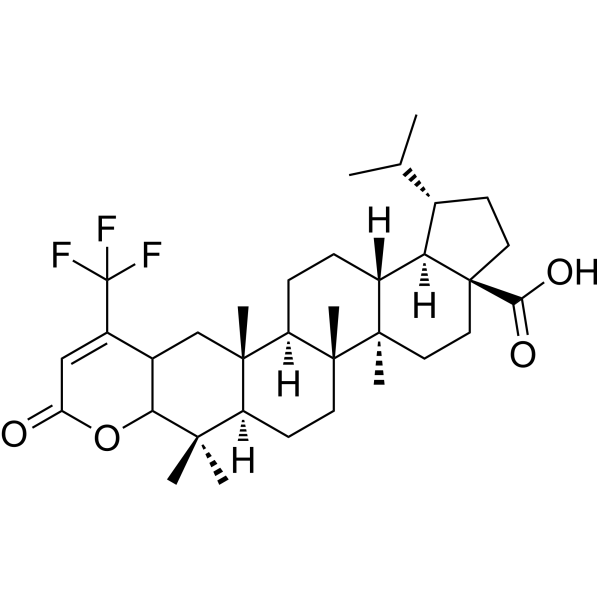
    13′-Hydroxy-δ-tocopherol is a metabolite of long-chain vitamin E. 13′-Hydroxy-δ-tocopherol can induces cells apoptosis and minor reduction in mitochondrial membrane potential. 13′-Hydroxy-δ-tocopherol can be used for the research of hepatocellular carcinoma .
    13′-Hydroxy-δ-tocopherol

Inquiry Online

Your information is safe with us. * Required Fields.

Salutation


Country or Region *

Applicant Name *


Organization Name *

Department *


Email Address *


Product Name *

Cat. No.


Requested quantity *

Phone Number *


Remarks

Inquiry Online

Inquiry Information

Product Name:
Cat. No.:
Quantity:
MCE Japan Authorized Agent:

