



7-Epi 10-desacetyl paclitaxel

Based on 1 Customer Validation
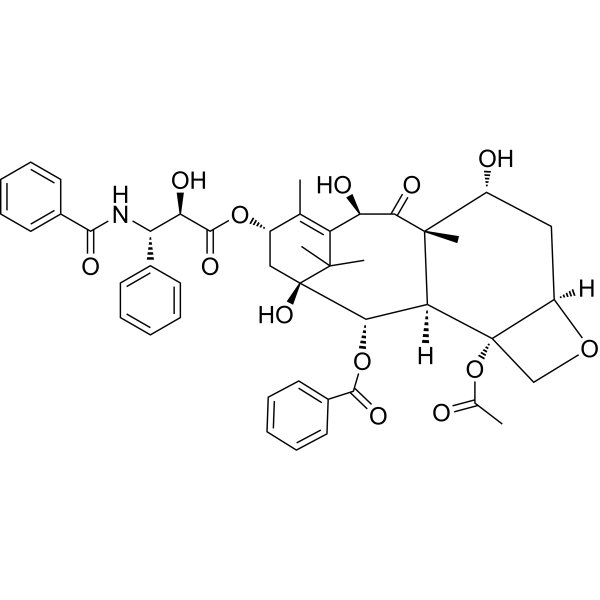
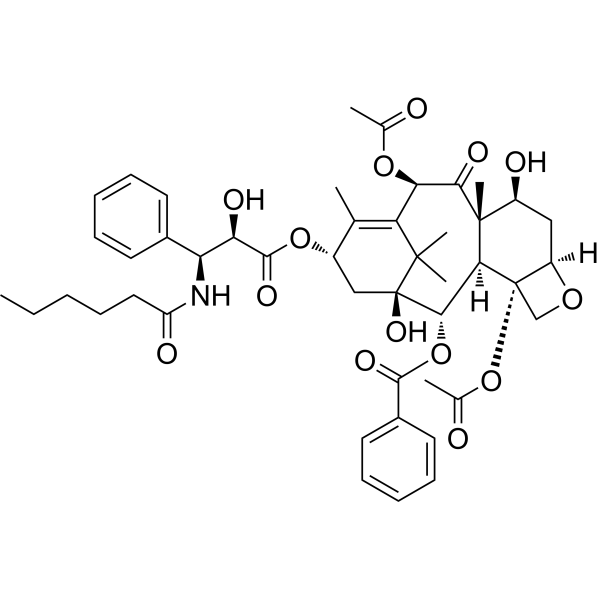
7-Epi 10-desacetyl paclitaxel (7-epi-10-deacetyltaxol; 10-Deacetyl-7-epipaclitaxel) is a taxane diterpenoid that can be found in Taxus species and is also produced by the endophytic fungus Pestalotiopsis microspora. 7-Epi 10-desacetyl paclitaxel inhibits cancer cell proliferation and induces apoptosis and cell cycle arrest. 7-Epi 10-desacetyl paclitaxel induces apoptosis through the intrinsic mitochondrial pathway, a process associated with ROS generation, an increased Bax/Bcl-2 ratio, and PARP cleavage. 7-Epi 10-desacetyl paclitaxel can be used in research on hepatocellular carcinoma.
For research use only. We do not sell to patients.
- Purity: 99.76%
- CAS No.: 78454-17-8
- Formula: C45H49NO13
- Molecular Weight:811.87
-
Storage:
4°C, protect from light
* In solvent : -80°C, 6 months; -20°C, 1 month (protect from light)

To place orders, for customer services and technical support, please contact: MedChemExpress USA
Tel: 609-228-6898 E-mail: [email protected] [email protected]


-
 Biological Activity
-
Chemical Information
-
Solvent & Solubility
- Purity & Documentation
- References
-
 Help & FAQs


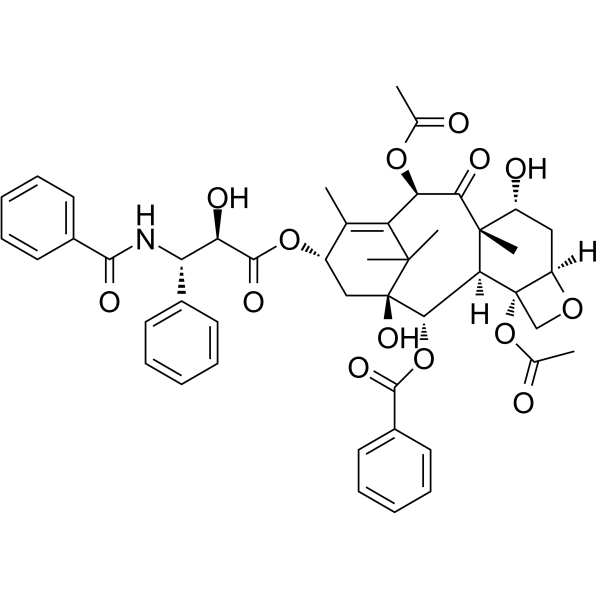
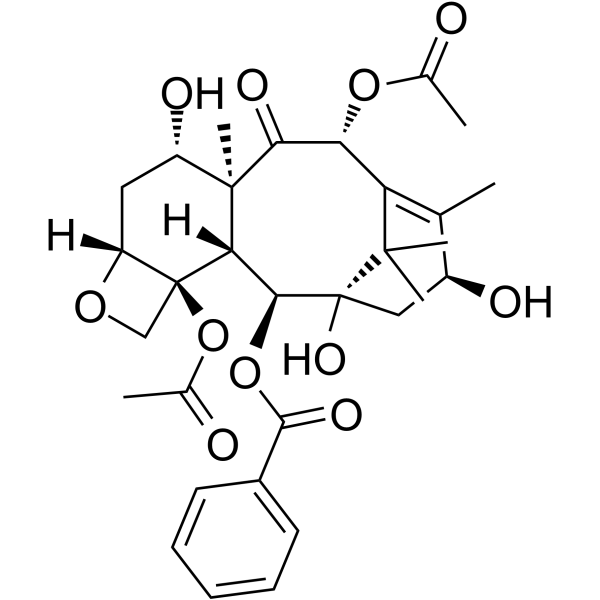
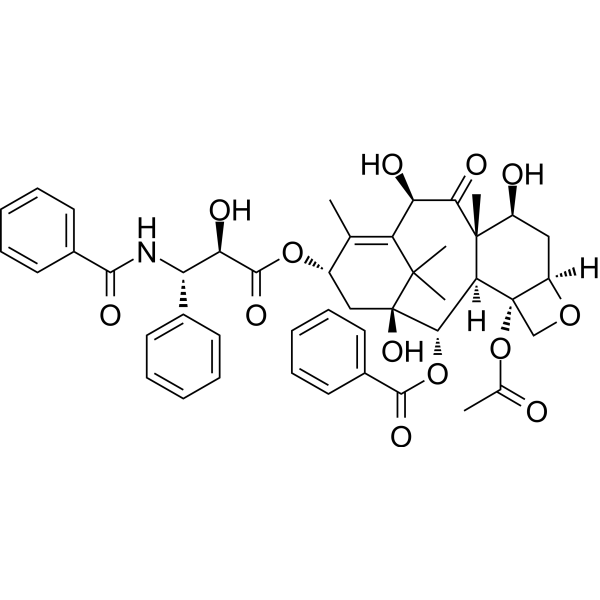



All Endogenous Metabolite Isoforms
More

Biological Activity
Description
IC50 & Target
[1]|
Bax |
Bcl-2 |
PARP-1 |
Cellular Effect
|
Cell Line

|
Type | Value | Description | References |
|---|---|---|---|---|
| HepG2 | IC50 |
32.1 μM
|
Inhibition of cell viability against human hepatocellular carcinoma HepG2 cells incubated for 24 h assessed by MTT assay with absorbance measured at 570 nm.
Inhibition of cell viability against human hepatocellular carcinoma HepG2 cells incubated for 24 h assessed by MTT assay with absorbance measured at 570 nm.
|
PMC6142684 |
In Vitro
7-Epi 10-desacetyl paclitaxel (7-Epi-10-deacetyltaxol) (0-128.4 μM; 24 h) potently inhibits the viability of HepG2 cells, with an IC50 of 32.1 μM after 24 hours of treatment[1].
7-Epi 10-desacetyl paclitaxel (32.1-128.4 μM; 24 h) induces apoptosis in HepG2 cells in a dose-dependent manner; it triggers dose-dependent nuclear condensation and fragmentation in HepG2 cells; it also induces internucleosomal DNA fragmentation in HepG2 cells[1].
7-Epi 10-desacetyl paclitaxel (32.1-128.4 μM; 24 h) induces dose-dependent PARP cleavage, an increased Bax/Bcl-2 ratio, and upregulation of p38 MAPK in HepG2 cells, which is consistent with activation of the intrinsic apoptotic pathway[1].
7-Epi 10-desacetyl paclitaxel (32.1-128.4 μM; 24 h) arrests HepG2 cells at the G2/M phase of the cell cycle in a dose-dependent manner[1].
7-Epi 10-desacetyl paclitaxel (32.1-128.4 μM; 24 h) induces dose-dependent ROS production in HepG2 cells[1].
MedChemExpress (MCE) has not independently confirmed the accuracy of these methods. They are for reference only.
-
Cell Line:HepG2 (human hepatocellular carcinoma)
-
Concentration:1, 2, 4.02, 8.02, 16.05, 32.1, 64.2, 128.4 μM
-
Incubation Time:24 h
-
Result:Inhibited the growth and survival of HepG2 cells in a concentration-dependent manner.
Exhibited an IC50 value of 32.1 μM for HepG2 cells after 24 h.
-
Cell Line:HepG2 (human hepatocellular carcinoma)
-
Concentration:32.1, 62.4, 128.4 μM
-
Incubation Time:24 h
-
Result:Induced dose-dependent reduction in green fluorescence, accumulation of red fluorescence, and condensed nuclei indicative of apoptosis.
Resulted in 38.02% apoptotic cells at 32.1 μM, 75.36% at 62.4 μM, and 98.03% at 128.4 μM.\nInduced chromatin condensation in the form of punctate foci and nuclear pyknosis.
Resulted in 26.32% apoptotic cells with nuclear condensation at 32.1 μM, 59.03% at 62.4 μM, and 77.32% at 128.4 μM.
-
Cell Line:HepG2 (human hepatocellular carcinoma)
-
Concentration:32.1, 64.2, 128.4 μM
-
Incubation Time:24 h
-
Result:Induced apoptosis in a dose-dependent manner.
Caused a shift from G1 phase to G2/M phase at 32.1 μM.
Resulted in 50.08% of cells stalled at G2/M phase at 64.2 μM and 80.16% at 128.4 μM.
-
Cell Line:HepG2 (human hepatocellular carcinoma)
-
Concentration:32.1, 64.2, 128.4 μM
-
Incubation Time:24 h
-
Result:Induced dose-dependent changes in the expression of apoptosis-related proteins.
Caused PARP cleavage starting from 32.1 μM.
Upregulated the pro-apoptotic protein Bax and downregulated the anti-apoptotic protein Bcl-2, leading to an increased Bax/Bcl-2 ratio.
Significantly increased p38 MAPK levels in a dose-dependent manner.


Chemical Information
-
CAS No. 78454-17-8
-
Appearance Solid
-
Molecular Weight 811.87
-
Formula C45H49NO13
-
Color White to yellow
-
SMILES
O=C(N[C@@H](C1=CC=CC=C1)[C@@H](O)C(O[C@H]2C[C@@](O)([C@@H](OC(C3=CC=CC=C3)=O)[C@@]4([H])[C@@]5(C)[C@H](O)C[C@]6([H])[C@@]4(OC(C)=O)CO6)C(C)(C)C([C@@H](O)C5=O)=C2C)=O)C7=CC=CC=C7
-
Synonyms
7-epi-10-deacetyltaxol; 10-Deacetyl-7-epipaclitaxel
-
Structure Classification
-
Initial Source
-
Shipping
Room temperature in continental US; may vary elsewhere.
-
Storage
4°C, protect from light
* In solvent : -80°C, 6 months; -20°C, 1 month (protect from light)


Solvent & Solubility
In Vitro:
DMSO : 50 mg/mL (61.59 mM; ultrasonic and warming and heat to 60°C; Hygroscopic DMSO has a significant impact on the solubility of product, please use newly opened DMSO)
Please refer to the solubility information to select the appropriate solvent. Once prepared, please aliquot and store the solution to prevent product inactivation from repeated freeze-thaw cycles.
Storage method and period of stock solution: -80°C, 6 months; -20°C, 1 month (protect from light). When stored at -80°C, please use it within 6 months. When stored at -20°C, please use it within 1 month.
Please refer to the solubility information to select the appropriate solvent. Once prepared, please aliquot and store the solution to prevent product inactivation from repeated freeze-thaw cycles.
Storage method and period of stock solution: -80°C, 6 months; -20°C, 1 month (protect from light). When stored at -80°C, please use it within 6 months. When stored at -20°C, please use it within 1 month.
Concentration (start) × Volume (start) = Concentration (final) × Volume (final)
In Vivo:
Select the appropriate dissolution method based on your experimental animal and administration route.
- For the following dissolution methods, please ensure to first prepare a clear stock solution using an In Vitro approach and then sequentially add co-solvents:
- To ensure reliable experimental results, the clarified stock solution can be appropriately stored based on storage conditions. As for the working solution for In Vivo experiments, it is recommended to prepare freshly and use it on the same day.
- The percentages shown for the solvents indicate their volumetric ratio in the final prepared solution. If precipitation or phase separation occurs during preparation, heat and/or sonication can be used to aid dissolution.
Add each solvent one by one: 10% DMSO 40% PEG300 5% Tween-80 45% Saline
Solubility: ≥ 2.5 mg/mL (3.08 mM); Clear solution
This protocol yields a clear solution of ≥ 2.5 mg/mL (saturation unknown).
Taking 1 mL working solution as an example, add 100 μL DMSO stock solution (25.0 mg/mL) to 400 μL PEG300, and mix evenly; then add 50 μL Tween-80 and mix evenly; then add 450 μL Saline to adjust the volume to 1 mL.
Preparation of Saline: Dissolve 0.9 g sodium chloride in ddH₂O and dilute to 100 mL to obtain a clear Saline solution.
In Vivo Dissolution Calculator
Please enter the basic information of animal experiments:
-
-
-
-
Recommended: Prepare an additional quantity of animals to account for potential losses during experiments.
Please enter your animal formula composition:
-
%DMSO +
Recommended: Keep the proportion of DMSO in working solution below 2% if your animal is weak.
-
%+
-
+%Tween-80 + +
-
%Saline +
The co-solvents required include: DMSO, . All of co-solvents are available by MedChemExpress (MCE). , Tween 80. All of co-solvents are available by MedChemExpress (MCE).
Working solution concentration: 0.22 mg/mL
Method for preparing stock solution: mg drug dissolved in μL DMSO. Stock solution concentration: mg/mL. * In solvent : -80°C, 6 months; -20°C, 1 month (protect from light)
1. Take μL DMSO stock solution;
2. Add μL .
μL , mix evenly;
3. Then add μL Tween 80, mix evenly;
4. Then add μL
Please ensure that the stock solution in the first step is dissolved to a clear state, and add co-solvents in sequence. You can use ultrasonic heating (ultrasonic cleaner, recommended frequency 20-40 kHz), vortexing, etc. to assist dissolution.


Purity & Documentation
-
Data Sheet (283 KB)
-
SDS (418 KB)
- English - EN (418 KB)
- Français - FR (418 KB)
- Deutsch - DE (418 KB)
- Norwegian - NO (418 KB)
- Español - ES (418 KB)
- Swedish - SV (418 KB)
- Italian - IT (418 KB)
- Korean - KR (418 KB)
- Portuguese - PT (418 KB)
-
Handling Instructions (2659 KB)
References


Complete Stock Solution Preparation Table
Please refer to the solubility information to select the appropriate solvent. Once prepared, please aliquot and store the solution to prevent product inactivation from repeated freeze-thaw cycles.
Storage method and period of stock solution: -80°C, 6 months; -20°C, 1 month (protect from light). When stored at -80°C, please use it within 6 months. When stored at -20°C, please use it within 1 month.
| Optional Solvent | Concentration Solvent Mass | 1 mg | 5 mg | 10 mg | 25 mg |
|---|---|---|---|---|---|
| DMSO | 1 mM | 1.2317 mL | 6.1586 mL | 12.3172 mL | 30.7931 mL |
| 5 mM | 0.2463 mL | 1.2317 mL | 2.4634 mL | 6.1586 mL | |
| 10 mM | 0.1232 mL | 0.6159 mL | 1.2317 mL | 3.0793 mL | |
| 15 mM | 0.0821 mL | 0.4106 mL | 0.8211 mL | 2.0529 mL | |
| 20 mM | 0.0616 mL | 0.3079 mL | 0.6159 mL | 1.5397 mL | |
| 25 mM | 0.0493 mL | 0.2463 mL | 0.4927 mL | 1.2317 mL | |
| 30 mM | 0.0411 mL | 0.2053 mL | 0.4106 mL | 1.0264 mL | |
| 40 mM | 0.0308 mL | 0.1540 mL | 0.3079 mL | 0.7698 mL | |
| 50 mM | 0.0246 mL | 0.1232 mL | 0.2463 mL | 0.6159 mL | |
| 60 mM | 0.0205 mL | 0.1026 mL | 0.2053 mL | 0.5132 mL |


7-Epi 10-desacetyl paclitaxel Related Classifications
HY-77572 Related Classifications
 Powered by Bioz
Keywords
- 7-Epi 10-desacetyl paclitaxel
- 78454-17-8
- 7-epi-10-deacetyltaxol
- 10-Deacetyl-7-epipaclitaxel
- Endogenous Metabolite
- Apoptosis
- Reactive Oxygen Species (ROS)
- Bcl-2 Family
- PARP
- G2/M phase cell cycle arrest
- Pestalotiopsis microspora
- PARP cleavage
- p38 MAPK
- Bax/Bcl-2 ratio
- Taxus species
- taxane diterpenoid
- intrinsic mitochondrial pathway
- HepG2 cells
- reactive oxygen species
- Inhibitor
- inhibitor
- inhibit