8 Results for "

m6A level

" in MedChemExpress (MCE) Product Catalog:
Products (8)

8 Results for "m6A level" in MCE Product Catalog:

2
2 Cited Publications
Cat. No.: HY-156773
CAS No.: 2499664-52-5
Purity:  98.71%
Target:  

Apoptosis METTL3

Research Areas:  

Cancer

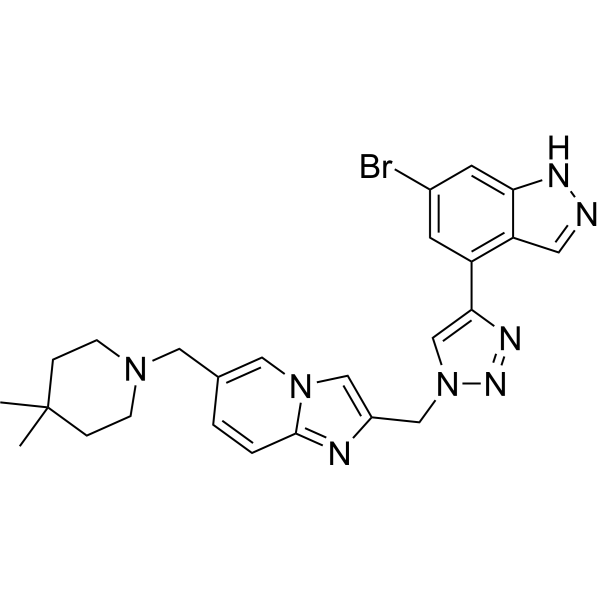
STM3006 is a highly potent, selective, and orally active inhibitor of METTL3 (IC50: 5 nM). STM3006 can reduce the m6A level, promote the formation of dsRNA, trigger a cell-intrinsic interferon response, and enhance the killing effect of T cells on tumors. STM3006 has anti-tumor activity, and its combination with anti-PD-1 immunotherapy yields better results .
loading...
    loading...
Cat. No.: HY-165422
CAS No.: 1505579-77-0
Research Areas:  

Cancer

ALKBH5-IN-3 is a selective, cell active ALKBH5 inhibitor with an IC50 of 0.021 μM. ALKBH5-IN-3 stabilizes ALKBH5 in HepG2 cells, and increases m 6A level in intact cells. ALKBH5-IN-3 can be used as a versatile chemical probe to explore the biological function of ALKBH5. ALKBH5-IN-3 can be used for the research of Cancer .
loading...
    loading...
Cat. No.: HY-148334
CAS No.: 2855085-25-3
Purity:  99.95%
Research Areas:  

Cancer

MS8815 is a EZH2 PROTAC degrader, with a DC50 of 140 nM in MDA-MB-453 triple-negative breast cancer (TNBC) cells and an IC50 of 8.6 nM against human EZH2. MS8815 induces ubiquitin-proteasome system-mediated degradation of EZH2, reduces the levels of EED, SUZ12, FOXM1, H3K27me3 and global m6A, and increases the protein level of HMGCS2. MS8815 can be used in the research of breast cancer and prostate cancer .
loading...
    loading...
Cat. No.: HY-N4031
CAS No.: 82375-29-9
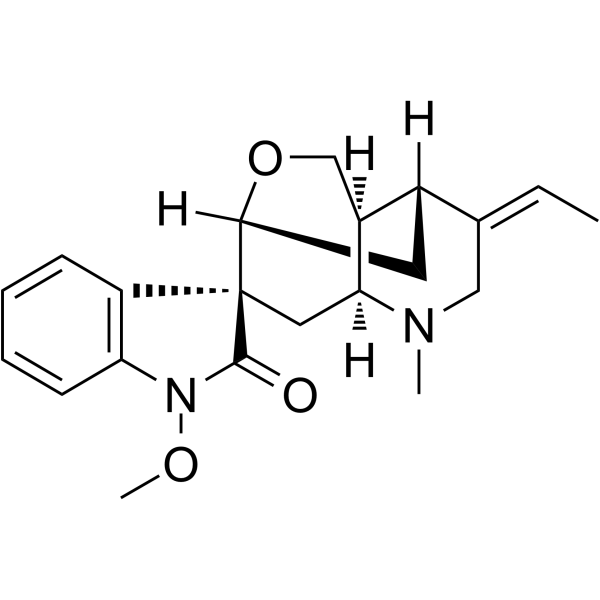
Humantenine is a highly toxic indole alkaloid from Gelsemium elegans (Gardn. & Champ.) Benth. that binds to RNA m6A modification regulatory proteins (ALKBH5, METTL). Humantenine stably binds via hydrogen bonding and hydrophobic interactions and disrupts the m6A methylation level of target genes, thereby impairing the expression of intestinal epithelial cell tight junction and cytoskeleton-related genes, causing intestinal barrier dysfunction and significant intestinal cytotoxicity. The intraperitoneal injection LD50 values of Humantenine are <1 mg/kg in mice, 1.2 mg/kg in male rats and 1.5 mg/kg in female rats, respectively. Species differences exist in the metabolism of Humantenine in human, porcine, goat and rat liver microsomes, and demethylation, dehydrogenation and oxidation occur in liver microsomes .
loading...
    loading...
Cat. No.: HY-174873
Research Areas:  

Cancer

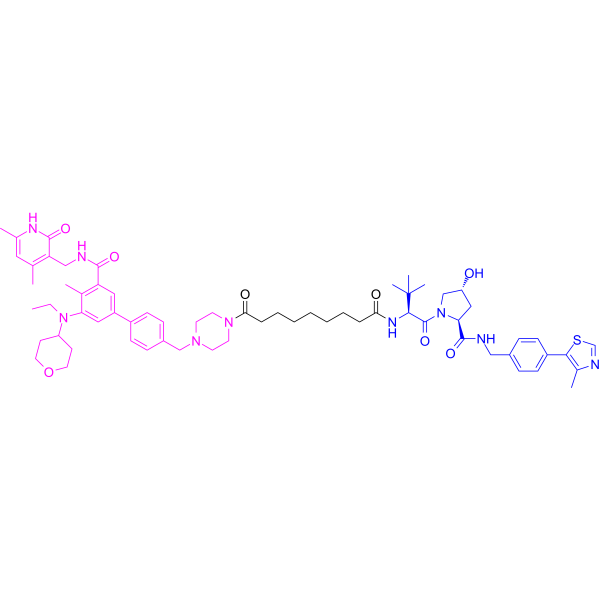
AF151 is a METTL3 PROTAC degrader with the DC50 of 0.43 μM in MOLM-13 cells. AF151 inhibits cell growth by significantly degrading METTL3 protein and reducing m6A levels. AF151 can induce cell apoptosis and reduce the level of Bcl-2 protein. AF151 can be used for research on cancer such as acute myeloid leukemia (AML). (Pink: METTL3 Ligand (HY-174874); Blue: VHL Ligand (HY-125845); Black: Linker; VHL Ligand+Linker (HY-174875)) .
loading...
    loading...
Cat. No.: HY-131871
CAS No.: 1808089-27-1
Purity:  99.25%
Research Areas:  

Cancer

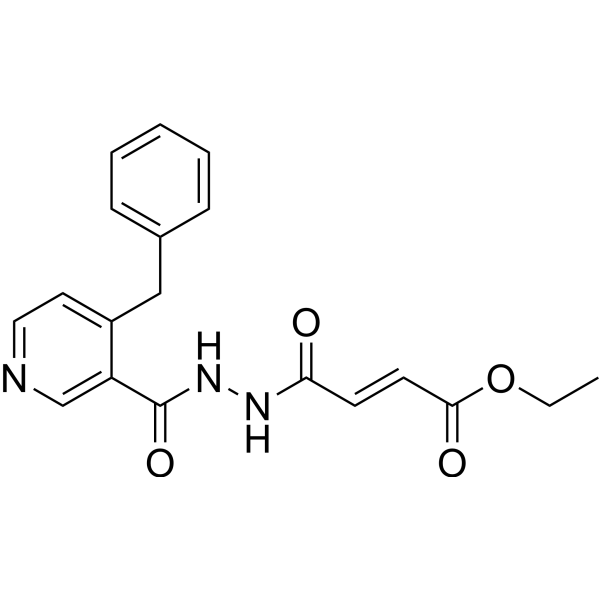
Ethyl LipotF is a selective FTO inhibitor that significant increases modified N6-methyladenosine (m6A) levels in HeLa cells in a concentration-dependent manner .
loading...
    loading...
Cat. No.: HY-178446
CAS No.: 3069369-05-4
Target:  

METTL3 c-Myc Bcl-2 Family

Research Areas:  

Cancer

METTL3-IN-11 is an excellent, selective METTL3 inhibitor (IC50 = 45.31 nM). METTL3-IN-11 exhibits high selectivity towards METTL3 compared to DNMT1, EZH1, MLL1, and PRMT1. METTL3-IN-11 reduces the m6A level of total RNA in MOLM-13 and SKOV3 cells, induces cell apoptosis, and inhibits cell migration. METTL3-IN-11 can reduce the expression of m6A downstream target genes (c-MYC and BCL2). METTL3-IN-11 can be used for the study of ovarian cancer and acute myeloid leukemia .
loading...
    loading...
Cat. No.: HY-183325
CAS No.: 1434867-98-7
FTO-IN-17 is an orally active and brain-penetrant FTO (m6A RNA demethylase) inhibitor with an IC50 of 1.1 μM. FTO-IN-17 stably binds the FTO catalytic pocket. FTO-IN-17 protects against Aβ1-42-induced toxicity while increasing global m6A levels and dampening pro-inflammatory gene (CXCL10, TNF-α) expression. FTO-IN-17 ameliorates anxiety-like behavior and rescues hippocampal-dependent spatial, recognition memory and neuroinflammation in Alzheimer's disease mice models .
loading...
    loading...

