11 Results for "

marine fungi

" in MedChemExpress (MCE) Product Catalog:
Products (11)

11 Results for "marine fungi" in MCE Product Catalog:

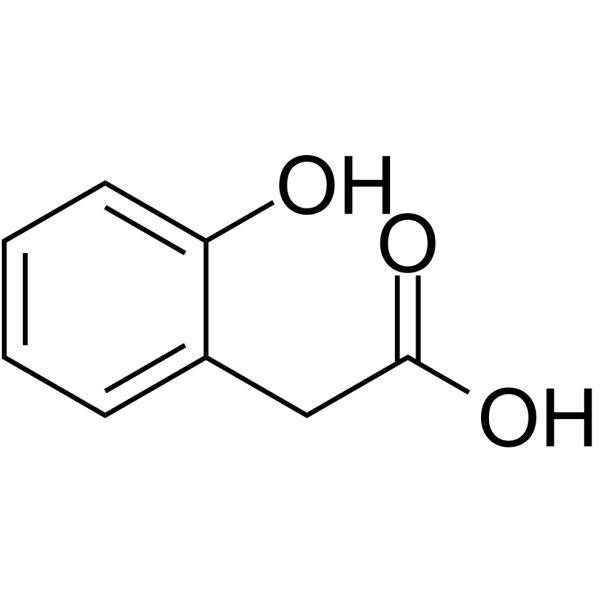
Cat. No.: HY-W015590
CAS No.: 614-75-5
2-Hydroxyphenylacetic acid is a metabolite of Phenylalanine and Tyrosine, as well as a product of the biotransformation of Phenylacetonitrile by marine fungi. 2-Hydroxyphenylacetic acid acts as a potential biomarker for food. 2-Hydroxyphenylacetic acid slightly induces the expression of green fluorescent protein. 2-Hydroxyphenylacetic acid is used in the research of phenylketonuria and related hyperphenylalaninemia .
loading...
    loading...
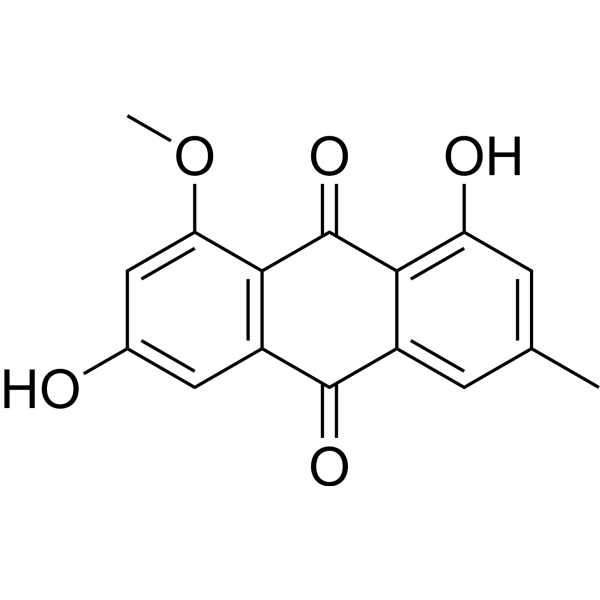
Cat. No.: HY-137990
CAS No.: 3774-64-9
Purity:  97.75%
Questin is an anthraquinone compound and antibacterial agent. Questin can be isolated from marine-derived fungi and plants. Questin inhibits Cdc25B phosphatase. Questin exhibits antibacterial activity against V. harveyi, V. anguillarum, V. cholerae, and V. parahemolyticus with MIC values of 31.25 µg/mL, 62.5 µg/mL, 62.5 µg/mL, and 125 µg/mL. Questin displays antiprotozoal activity against the animal protozoan pathogen Tritrichomonas foetus, with a MIC of 12.5 µg/mL. Questin has anticancer activity against lung and colon cancer .
loading...
    loading...
Cat. No.: HY-105751
CAS No.: 11048-15-0
Synonyms: Kalamycin; U-19718
Kalafungin is an antibiotic, antimicrobial agent and a β-lactamase inhibitor from marine Streptomyces, with IC50 of 225.37 μM. Kalafungin destroys cell membranes. Kalafungin shows inhibitory activities against a variety of pathogenic fungi, yeasts, protozoa, gram-positive bacteria (such as S. aureus ATCC 33591 and S. aureus ATCC 23591), and, to a lesser extent, gram-negative bacteria .
loading...
    loading...
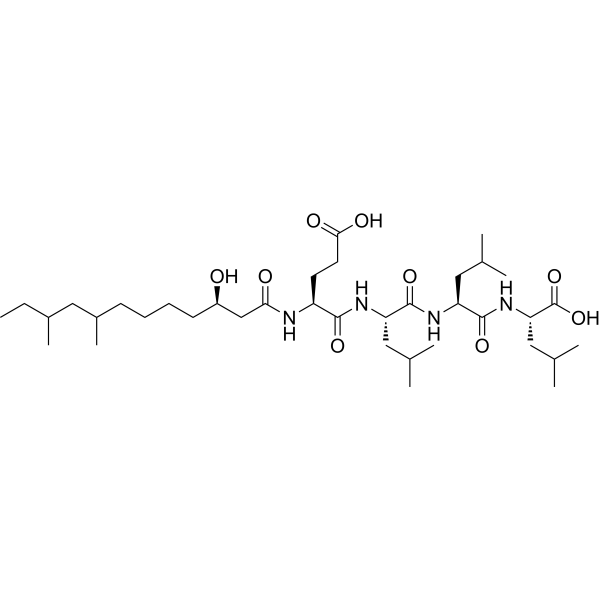
Cat. No.: HY-P5646
CAS No.: 1536405-84-1
Target:  

Bacterial

Research Areas:  

Infection

Gageotetrin C is an antimicrobial peptide derived from the marine bacterium Bacillus subtilis. Gageotetrin C is more active against fungi (MIC value is 0.02-0.04 μM) .
loading...
    loading...
Cat. No.: HY-119465
CAS No.: 135357-96-9
Restricticin is a compound obtained from marine fungi, whose structure contains alkene, tetrahydropyran ring and glycine ester functional groups, and has anti-neuroinflammatory effects in lipopolysaccharide-induced BV-2 microglia by inhibiting the production of proinflammatory mediators.
loading...
    loading...
Cat. No.: HY-W015590R
CAS No.: 614-75-5
2-Hydroxyphenylacetic acid (Standard) is an analytical standard for 2-Hydroxyphenylacetic acid (HY-W015590). This product is intended for research and analytical applications. 2-Hydroxyphenylacetic acid is a metabolite of Phenylalanine and Tyrosine, and is also a product of the biotransformation of Phenylacetonitrile by marine fungi. 2-Hydroxyphenylacetic acid can be used as a potential biomarker for food. 2-Hydroxyphenylacetic acid can be used in the study of phenylketonuria and related hyperphenylalaninemias .
loading...
    loading...
Cat. No.: HY-W414697
CAS No.: 40289-37-0
Synonyms: D-Ribo-phytosphingosine (C17 base)
Target:  

Bacterial

Research Areas:  

Others

4-Hydroxysphinganine C17 base (D-Ribo-phytosphingosine C17 base), also known as D-ribo-phytosphingosine or PHS, is a crucial compound present in the membranes of fungi, plants, bacteria, marine organisms, and mammalian tissues. It plays a vital role in preserving the structural integrity of membranes, regulating cellular growth, and mediating the heat stress response in yeast. Additionally, PHS serves as a precursor for the synthesis of important lipid mediators such as PHS 1-phosphate, inositol phosphorylceramide, and KRN7000 (the α-anomer of galactosylceramide). Furthermore, this phospholipid promotes keratinocyte differentiation, making it a valuable active ingredient in cosmetic formulations.
loading...
    loading...
Cat. No.: HY-182477
CAS No.: 22944-03-2
Research Areas:  

Infection

Siccayne, found in the marine basidiomycete Halocyphina villosa and deuteromycete Helminthosporium siccans, is an antibiotic. Siccayne interferes with nucleotide incorporation into DNA and RNA, precursor transport enzymatic reactions, and essential macromolecule synthesis. Siccayne inhibits Gram-positive bacteria and some fungi. Siccayne can be used for research on infections caused by bacteria and fungi .
loading...
    loading...
Cat. No.: HY-N19131
CAS No.: 160219-85-2
Aquastatin B is a PTP1B inhibitor. Aquastatin B is isolated from marine fungi. Aquastatin B exhibits anti-diabetic activity. Aquastatin B can be used in the research of diabetes .
loading...
    loading...
Cat. No.: HY-L143
60 compounds

Oceans cover more than 70% of the Earth’s surface and host a huge species diversity. Marine organisms are considered the most recent source of bioactive natural products after terrestrial plants and nonmarine microorganisms. Marine biological sources are taxonomically diverse and include sponges, tunicates, corals, mollusks, fungi, and sediment-derived bacteria.

Marine organisms can produce a plethora of small molecules with novel chemical structures and potent biological properties, being a rich source for the discovery of pharmacologically active compounds, already with several marine-derived agents approved as drugs. Ziconotide, a peptide originally discovered in a tropical cone snail, was the first marine-derived compound to be approved in the United States in December 2004 for the treatment of pain. Then, in October 2007, Trabectedin became the first marine anticancer drug to be approved in the European Union.

MCE offers a unique collection of 60 marine-sourced natural products which can be used for drug discovery for high throughput screening (HTS) and high content screening (HCS). MCE marine-sourced natural product library is an important source for drug discovery and development.

Cat. No.: HY-N22076
CAS No.: 232922-23-5
Circumdatin F is a benzodiazepine alkaloid found in Aspergillus fungi (such as Aspergillus ochraceus and A. westerdijkiae DFFSCS013). Circumdatin F has antifouling activity, inhibiting the attachment of bryozoan (Bugula neritina) larvae and exhibiting low toxicity to its larvae. Circumdatin F can be used in research related to marine biofouling .
loading...
    loading...
  • 1

