22 Results for "

mouse L1210 cell

" in MedChemExpress (MCE) Product Catalog:
Products (22)

22 Results for "mouse L1210 cell" in MCE Product Catalog:

3
3 Cited Publications
Cat. No.: HY-128744
CAS No.: 4408-78-0
Purity:  ≥98.0%
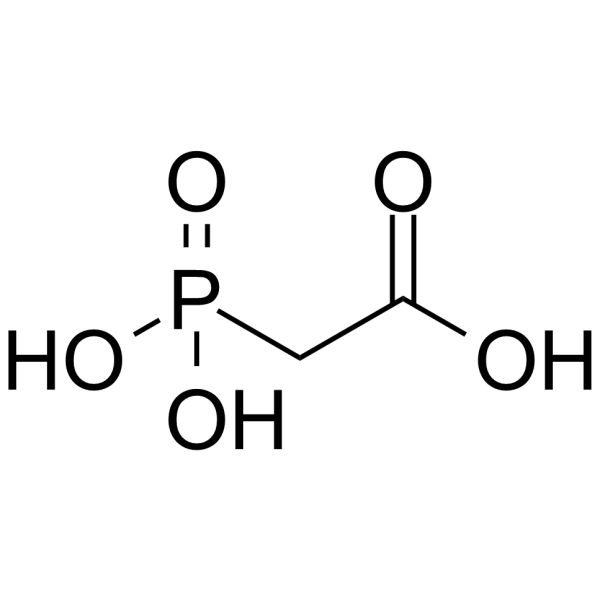
Phosphonoacetic acid is a potent antiviral agent. Phosphonoacetic acid inhibits a variety of herpesviruses, orthopoxviruses, and retroviruses. Phosphonoacetic acid strongly inhibits viral and cellular DNA polymerase, reverse transcriptase, and terminal deoxynucleotidyl transferase activities in a non-competitive or uncompetitive manner by binding to the pyrophosphate site of the enzyme. Phosphonoacetic acid is useful for research related to lymphoid leukemia, herpesvirus infection, and vaccinia virus skin lesions .
loading...
    loading...
Cat. No.: HY-129356A
CAS No.: 152785-82-5
Purity:  ≥99.0%
Target:  

Drug Isomer

Research Areas:  

Cancer

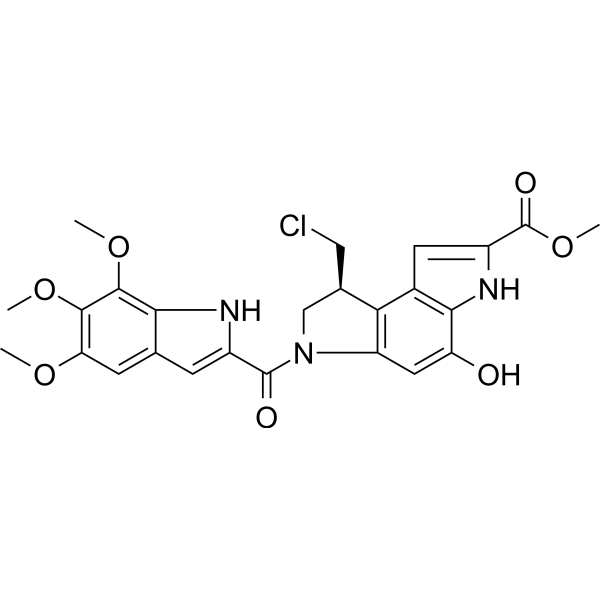
(S)-Seco-Duocarmycin SA is the S-enantiomer of Seco-Duocarmycin SA (HY-129356). Seco-Duocarmycin SA can be used for cancer research .
loading...
    loading...
Cat. No.: HY-118917
CAS No.: 297730-05-3
Target:  

IMPDH

Research Areas:  

Inflammation/Immunology

VX-148 is an orally active immunosuppressant, which is a non-competitive inosine-5'-monophosphate dehydrogenase (IMPDH) inhibitor with Ki values for IMPDH Ⅱ and IMPDH Ⅰ of 6 and 14 nM respectively. VX-148 can significantly inhibit the proliferation of human peripheral blood mononuclear cells (PBMC) stimulated by T-cell mitogen (PHA) or B-cell mitogen (SPAS). VX-148 has high selectivity for lymphocytes (such as L1210, Jurkat T cells, and Raji B cells), but has no significant toxicity to non-lymphoid cells. VX-148 can inhibit antibody responses in mouse models and significantly prolong the survival time of transplanted skin in allogeneic skin transplantation models. VX-148 can be used in the research of autoimmune diseases (such as rheumatoid arthritis, psoriasis) and organ transplantation anti-rejection .
loading...
    loading...
Cat. No.: HY-118834
CAS No.: 70497-14-2
Synonyms: Lyngbyatoxin A
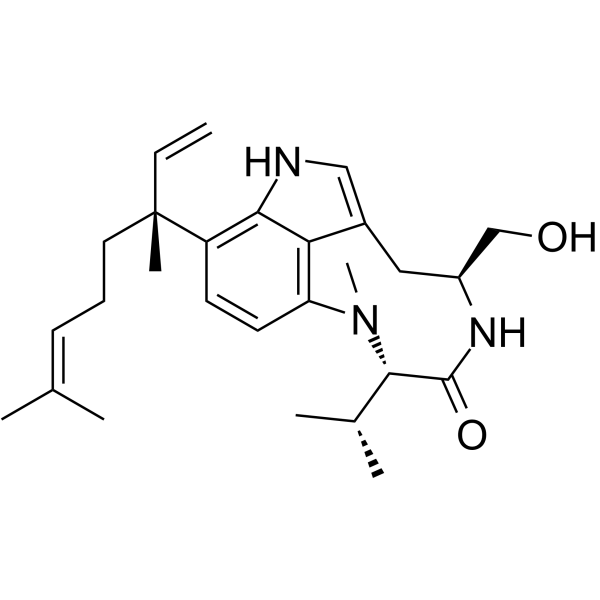
Teleocidin A1 (Lyngbyatoxin A) is a PKC activator with a Ki value of 0.11 nM for binding to the PKCδ-C1B peptide. Teleocidin A1 exhibits anticancer activity against cervical cancer and leukemia. Teleocidin A1 can induce seaweed dermatitis, food poisoning and local skin toxicity. Teleocidin A1 can be used in studies related to cervical cancer, seaweed dermatitis and food poisoning .
loading...
    loading...
Cat. No.: HY-N8519
CAS No.: 104542-46-3
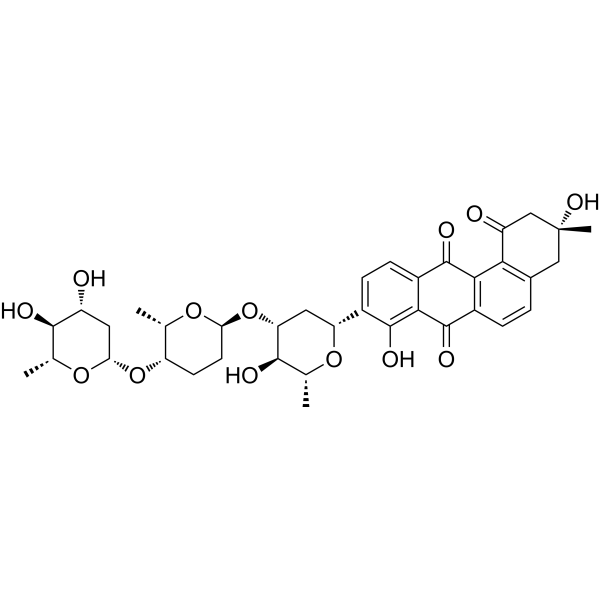
Urdamycin B is an antibiotic that effectively inhibits fungi and bacteria. Urdamycin B also exhibits anti-proliferative activity against mouse leukemia cells L1210. Urdamycin B can be obtained from the metabolic products of Streptomyces fradiae. Urdamycin B can be used for research on cancer as well as bacterial and fungal infections .
loading...
    loading...
Cat. No.: HY-N14787
CAS No.: 82501-56-2
Basidalin has the ability of anti-Gram-positive bacteria, negative bacteria and inhibition of mouse leukemia L-1210 cell.
loading...
    loading...
Cat. No.: HY-P991016
CAS No.: 2928515-21-1
Synonyms: PT-217

Target:  

CD47

Research Areas:  

Inflammation/Immunology

Peluntamig (PT-217) is a bispecific antibody targeting DLL3 and CD47. The antibody arms of Peluntamig specifically bind to DLL3 on small cell lung cancer tumor cells while blocking the CD47-SIRPa interaction, thereby effectively stimulating macrophage phagocytosis and inducing NK cell-mediated cytotoxicity. Peluntamig exhibits significant anti-tumor activity against small cell lung cancer and also has favorable safety profiles. Peluntamig can be used in a variety of tumor-related studies including those on small cell lung cancer and L1210 leukemia .
loading...
    loading...
Cat. No.: HY-10823
CAS No.: 139987-54-5
Synonyms: GW1843; 1843U89; OSI-7904
Research Areas:  

Cancer

OSI-7904L (GW1843; 1843U89; OSI-7904) is a thymidylate synthase (TS) inhibitor with a Ki of 90 pM. OSI-7904L blocks de novo synthesis of thymidine nucleotides, DNA synthesis and induces cell death. OSI-7904L inhibits the growth of human cells, induces tumor regression, and achieves durable antitumor effects in mouse xenograft models. OSI-7904L can be used in research related to colon adenocarcinoma .
loading...
    loading...
Cat. No.: HY-N14747
CAS No.: 97218-42-3
Elloramycin has weak activity against Gram-positive bacteria, streptomycete and L-1210 leukemic cells, but has no effect on mouse leukemic P388 cells in vivo, and also has a strong inhibition of Streptomyces (including the production of bacteria themselves) activity .
loading...
    loading...
Cat. No.: HY-N14144
CAS No.: 182285-29-6
Cremimycin has anti-Gram-positive bacteria activity including methicillin-resistant Staphylococcus aureus (MRSA), MIC is 0.2-0.39 μg/mL. Cremimycin shows cytotoxicity to mouse tumor cell lines P388, L1210, IMC, S180, B16 and SS3 in vitro .
loading...
    loading...
Cat. No.: HY-130059
CAS No.: 5227-68-9
Synonyms: Guanine 7-N-oxide
Guanine-7-oxide (Guanine 7-N-oxide) is an antitumor antibiotic with anti-tumor, anti-Candida albicans activity, and can inhibit viral replication effect of herpes virus, infectious blood virus (IHNV), infectious pancreatic necrosis virus (IPNV) and so on. Guanine-7-oxide has good activity against mouse L1210 leukemia cells .
loading...
    loading...
Cat. No.: HY-117285
CAS No.: 60227-09-0
Synonyms: Lactoquinomycin A; LQM-A
Lactoquinomycin A is a quinone antibiotic. Lactoquinomycin A has the activity of anti-Gram-positive bacteria and some Gram-negative bacteria, but the effect of anti-Gram-negative bacteria is weak and has no effect on fungi. Lactoquinomycin A inhibits a variety of cell lines including lymphoma L5178Y progenitor, Adriamycin resistant, Bleomycin-resistant, human leukemia K562, mouse leukemia L-1210 and mouse leukemia P 388 with ID50 (μg/mL) of 0.02, 0.006, 0.008, 0.033, 0.013 and 0.03, respectively .
loading...
    loading...
Cat. No.: HY-N14774
CAS No.: 101342-94-3
Lactoquinomycin B is a quinone antibiotic. Lactoquinomycin B has the activity of anti-Gram-positive bacteria and some Gram-negative bacteria, but the effect of anti-Gram-negative bacteria is weak and has no effect on fungi. Lactoquinomycin B inhibits a variety of cell lines including lymphoma L5178Y progenitor, Adriamycin resistant, Bleomycin-resistant, human leukemia K562, mouse leukemia L-1210 and mouse leukemia P 388 with ID50 (μg/mL) of 0.43, 0.21, 0.19, 0.16, 0.2 and 0.12, respectively .
loading...
    loading...
Cat. No.: HY-128744R
CAS No.: 4408-78-0
Phosphonoacetic acid Standard is the analytical standard of Phosphonoacetic acid (HY-128744). This product is intended for research and analytical applications. Phosphonoacetic acid is a potent antiviral agent. Phosphonoacetic acid inhibits a variety of herpesviruses, orthopoxviruses, and retroviruses. Phosphonoacetic acid strongly inhibits viral and cellular DNA polymerase, reverse transcriptase, and terminal deoxynucleotidyl transferase activities in a non-competitive or uncompetitive manner by binding to the pyrophosphate site of the enzyme. Phosphonoacetic acid is useful for research related to lymphoid leukemia, herpesvirus infection, and vaccinia virus skin lesions .
loading...
    loading...
Cat. No.: HY-N14530
CAS No.: 11050-22-9
Target:  

Bacterial

Cremeomycin has anti-Gram-positive bacteria activity including methicillin-resistant Staphylococcus aureus (MRSA), MIC is 0.2-0.39 μg/mL. Cremeomycin shows cytotoxicity to mouse tumor cell lines P388, L1210, IMC, S180, B16 and SS3 in vitro .
loading...
    loading...
Cat. No.: HY-159803
CAS No.: 128201-92-3
Synonyms: 6-O-(3-Ethoxypropionyl)-3',4'-O-exo-benzylidenechartreusin
Target:  

Endogenous Metabolite

Research Areas:  

Cancer

IST-622 (6-O-(3-Ethoxypropionyl)-3',4'-O-exo-benzylidenechartreusin) is an anti-tumor agent with significant growth inhibitory activity. IST-622 exhibits significant anti-tumor effects against a variety of mouse tumors such as P388 and L1210 leukemias, B16 melanoma, Lewis lung carcinoma, Colon 26 and Colon 38 adenocarcinomas, and M5076 reticulum cell sarcoma. IST-622 was orally administered and the results showed efficacy in different tumor types. In addition, IST-622 provided significant inhibitory effects against two human tumor xenograft models: large cell lung carcinoma (Lu-116) and gastric adenocarcinoma (St-4). IST-622 also exhibited significant growth inhibitory activity against P388 leukemia in vitro, with a half inhibitory concentration (IC50) more than 20 times lower than CT .
loading...
    loading...
Cat. No.: HY-182258
CAS No.: 74839-81-9
Target:  

DNA/RNA Synthesis

Research Areas:  

Cancer

Ulicyclamide is a cytotoxic cyclic peptide found in the tunicate Lissoclinum patella.Ulicyclamide inhibits DNA and RNA synthesis in leukemia cells. Ulicyclamide can be used for the research of leukemia .
loading...
    loading...
Cat. No.: HY-119143
CAS No.: 32093-09-7
CB 3703 is an inhibitor of thymidylate synthase (TS) and dihydrofolate reductase (DHFR). CB 3703 has an IC50 of 0.25 μM against rat TS, a Ki of 0.47 μM against mouse TS, an IC50 of 6.8 nM against rat DHFR, and a Ki of 0.6 pM against mouse DHFR. CB 3703 is transported via the reduced folate pathway, has a short plasma half-life, and can prolong the survival of tumor-bearing mice. CB 3703 can be used in the research of L1210 ascites tumors .
loading...
    loading...
Cat. No.: HY-P991745

Target:  

CCR

Research Areas:  

Cancer

Anti-Mouse CCR2 Antibody (C2Mab-6) is a monoclonal antibody targeting mouse CC chemokine receptor type 2 (mCCR2), with a KD value of 0.18-1.6 nM. Anti-Mouse CCR2 Antibody (C2Mab-6) exhibits high binding affinity to cells expressing mCCR2 and shows no reactivity to parental CHO-K1 cells. Anti-Mouse CCR2 Antibody (C2Mab-6) recognizes the amino acid region spanning positions 1-19 of mCCR2, and its key binding epitope includes Asp3, Asn4, Met6, Pro8, Gln9 and Phe10. Anti-Mouse CCR2 Antibody (C2Mab-6) can be used in leukemia-related research .
loading...
    loading...
Cat. No.: HY-128744A
CAS No.: 36983-81-0
Phosphonoacetic acid sodium is a potent antiviral agent. Phosphonoacetic acid sodium inhibits a variety of herpesviruses, orthopoxviruses, and retroviruses. Phosphonoacetic acid sodium strongly inhibits viral and cellular DNA polymerase, reverse transcriptase, and terminal deoxynucleotidyl transferase activities in a non-competitive or uncompetitive manner by binding to the pyrophosphate site of the enzyme. Phosphonoacetic acid sodium is useful for research related to lymphoid leukemia, herpesvirus infection, and vaccinia virus skin lesions .
loading...
    loading...

