



Phosphonoacetic acid
Based on 3 publication(s) in Google Scholar
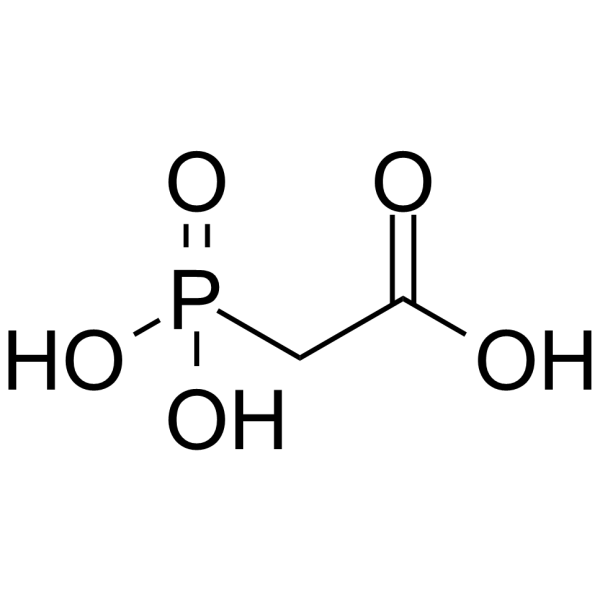
Phosphonoacetic acid is a potent antiviral agent. Phosphonoacetic acid inhibits a variety of herpesviruses, orthopoxviruses, and retroviruses. Phosphonoacetic acid strongly inhibits viral and cellular DNA polymerase, reverse transcriptase, and terminal deoxynucleotidyl transferase activities in a non-competitive or uncompetitive manner by binding to the pyrophosphate site of the enzyme. Phosphonoacetic acid is useful for research related to lymphoid leukemia, herpesvirus infection, and vaccinia virus skin lesions.
For research use only. We do not sell to patients.
- Purity : 98.0%
- CAS No.: 4408-78-0
- Formula: C2H5O5P
- Molecular Weight:140.03
-
Storage:
4°C, sealed storage, away from moisture
* In solvent : -80°C, 6 months; -20°C, 1 month (sealed storage, away from moisture)

To place orders, for customer services and technical support, please contact: MedChemExpress USA
Tel: 609-228-6898 E-mail: [email protected] [email protected]


-
 Biological Activity
-
Chemical Information
-
Solvent & Solubility
- Protocols
- Purity & Documentation
- References
-
 Help & FAQs


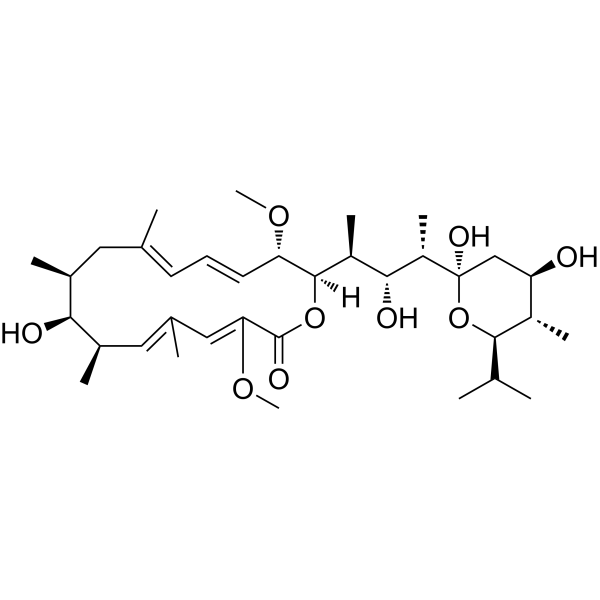

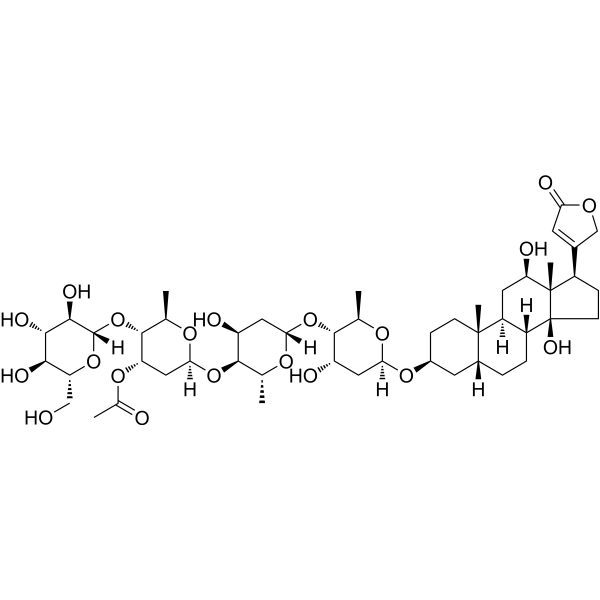


Publications Citing Use of MedChemExpress (MCE) Phosphonoacetic acid
MoreAll DNA/RNA Synthesis Isoforms
More

Biological Activity
Description
IC50 & Target
[1]|
HSV-1 |
DNA Polymerases |
Cellular Effect
|
Cell Line

|
Type | Value | Description | References |
|---|---|---|---|---|
| Vero | CC50 |
3500 μM
Compound: Phosphonoacetic acid (PAA)
|
In vitro cytotoxic concentration in vero cells.
In vitro cytotoxic concentration in vero cells.
|
[PMID: 14584951] |
| Vero | ED50 |
240 μM
Compound: Phosphonoacetic acid (PAA)
|
Inhibitory activity against HSV-1 in vero cells
Inhibitory activity against HSV-1 in vero cells
|
[PMID: 14584951] |
In Vitro
Phosphonoacetic acid (1 h) sodium inhibits purified DNA polymerases α, β, and γ from L1210 cells, HSV-induced DNA polymerase, SSV reverse transcriptase, L1210 C-type virus reverse transcriptase, and terminal deoxynucleotidyl transferase from acute lymphoblastic leukemia leukocytes, with the strongest inhibitory potency observed against L1210 DNA polymerase α and HSV-induced DNA polymerase (IC50 ≈ 25 μM)[1].
Phosphonoacetic acid (0.5 mM; 15-60 min) sodium transiently and time-dependently inhibits DNA polymerase α and β in L1210 cells[1].
Phosphonoacetic acid (50-200 μg/mL; 1-6 days) sodium inhibits cell growth and C-type virus production in the mouse lymphoid leukemia cell line L1210[1].
Phosphonoacetic acid (14.3-357 μM; 1-6 days) sodium dose-dependently inhibits HHV-6 infection in cord blood mononuclear cells, with near-complete inhibition achieved at a concentration of 71.4 μM (10 μg/mL)[2].
Phosphonoacetic acid (14.3-357 μM; 90 min) sodium inhibits HHV-6-specific DNA polymerase activity in in vitro enzymatic assays[2].
Phosphonoacetic acid (24 h) sodium exhibits an inhibitory effect on HSV-1 infection in BHK-21 cells [3].
Phosphonoacetic acid (50-500 μg/mL; 20-75 h) sodium exhibits an inhibitory effect on cell growth in uninfected BHK-21 cells[3].
Phosphonoacetic acid (50-500 μg/mL; up to 18 h) sodium inhibits the growth of herpes simplex virus (sensitive and resistant strains) in BHK-21 cells, and this effect depends on the time of drug addition[3].
Phosphonoacetic acid (50-200 μg/mL) sodium has a role in determining the percentage of surviving plaques for screening and assaying PAA-resistant HSV-1 variants in BHK-21 cells[3].
Phosphonoacetic acid (up to 50 μg/mL; 60 min) sodium inhibits the virus-specific DNA polymerase activity of PAA-sensitive HSV-1 in in vitro biochemical reactions, but does not inhibit PAA-resistant mutant strains[3].
Phosphonoacetic acid sodium (50 μg/mL-1.0 mg/mL; radiolabeling 1.5-22 h) selectively inhibits late (γ) viral protein synthesis of HSV-1-sensitive strains in HEp-2 cells[3].
MedChemExpress (MCE) has not independently confirmed the accuracy of these methods. They are for reference only. Further protocols information, click here.
-
Cell Line:L1210 (V) murine lymphoid leukemia cells (producers of type C virus)
-
Concentration:50, 100, 200 μg/mL
-
Incubation Time:1, 2, 3, 4, 5, 6 days
-
Result:Had no noticeable effect on L1210 cell growth but inhibited type C virus production by more than 50% on day 3 (while cell growth was only reduced by 16%) at 50 μg/mL.
Reduced L1210 cell growth considerably at 100 μg/mL and 200 μg/mL, with a more profound inhibitory effect on type C virus production than on cell growth at all concentrations tested above 50 μg/mL.
-
Cell Line:Uninfected BHK-21 cells
-
Concentration:50, 100, 150, 200, 500 μg/ml
-
Incubation Time:75 h
-
Result:Reduced the cell growth rate, and cell division was completely inhibited at higher concentrations.
In Vivo


Chemical Information
-
CAS No. 4408-78-0
-
Appearance Solid
-
Molecular Weight 140.03
-
Formula C2H5O5P
-
Color White to off-white
-
SMILES
O=C(O)CP(O)(O)=O
-
Structure Classification
-
Initial Source
-
Shipping
Room temperature in continental US; may vary elsewhere.
-
Storage
4°C, sealed storage, away from moisture
* In solvent : -80°C, 6 months; -20°C, 1 month (sealed storage, away from moisture)


Publications (3)
-
Journal Impact Factor
-
Most Recent
-
PLoS Pathog
Anti-orthopoxvirus drugs inhibit lumpy skin disease virus replication by targeting viral DNA polymerase. [Abstract]2026 Jan 26;22(1):e1013903. PMID: 41587213 -
Microbiol Spectr
2026 Jun 2;14(6):e0160825. PMID: 41995456 -
J Virol
Pseudorabies virus infection triggers mitophagy to dampen the interferon response and promote viral replication. [Abstract]2024 Oct 22;98(10):e0104824. PMID: 39212384


Solvent & Solubility
In Vitro:
H2O : 260 mg/mL (1856.74 mM; Need ultrasonic)
Please refer to the solubility information to select the appropriate solvent. Once prepared, please aliquot and store the solution to prevent product inactivation from repeated freeze-thaw cycles.
Storage method and period of stock solution: -80°C, 6 months; -20°C, 1 month (sealed storage, away from moisture). When stored at -80°C, please use it within 6 months. When stored at -20°C, please use it within 1 month.
* Note: If you choose water as the stock solution, please dilute it to the working solution, then filter and sterilize it with a 0.22 μm filter before use.
Please refer to the solubility information to select the appropriate solvent. Once prepared, please aliquot and store the solution to prevent product inactivation from repeated freeze-thaw cycles.
Storage method and period of stock solution: -80°C, 6 months; -20°C, 1 month (sealed storage, away from moisture). When stored at -80°C, please use it within 6 months. When stored at -20°C, please use it within 1 month.
* Note: If you choose water as the stock solution, please dilute it to the working solution, then filter and sterilize it with a 0.22 μm filter before use.
Concentration (start) × Volume (start) = Concentration (final) × Volume (final)
In Vivo:
For the following dissolution methods, please prepare the working solution directly:
It is recommended to prepare fresh solutions and use them promptly within a short period of time.
The percentages shown for the solvents indicate their volumetric ratio in the final prepared solution. If precipitation or phase separation occurs during preparation, heat and/or sonication can be used to aid dissolution.
Add each solvent one by one: PBS
Solubility: 100 mg/mL (714.13 mM); Clear solution; Need ultrasonic

Protocols
-
Research Protocol for Infectious Diseases
Infectious-disease experiments test how pathogens interact with host barriers, innate immune receptors, inflammatory signaling, pathogen replication, and tissue injury; pattern-recognition receptors such as TLRs, RIG-I-like receptors, NOD-like receptors, and inflammasomes detect microbial molecules and activate NF-κB, interferon, and cytokine responses. The central hypothesis is that infection severity reflects the balance between pathogen burden and host response: protective inflammation restricts pathogen growth, whereas excessive or mislocalized inflammation contributes to tissue damage and disease phenotype. Unresolved questions include which host pathways are protective versus pathogenic, why some infection models fail to translate to human disease, and which combined readouts best predict clinically relevant infection outcomes.


Purity & Documentation
-
Data Sheet (287 KB)
-
SDS (477 KB)
- English - EN (477 KB)
- Français - FR (477 KB)
- Deutsch - DE (477 KB)
- Norwegian - NO (477 KB)
- Español - ES (477 KB)
- Swedish - SV (477 KB)
- Italian - IT (477 KB)
- Korean - KR (477 KB)
- Portuguese - PT (477 KB)
-
Handling Instructions (2659 KB)
References
[3]. Honess RW, et al. Herpes simplex virus resistance and sensitivity to phosphonoacetic acid. Journal of virology. 1977 Feb;21(2):584-600. [Content Brief]
[4]. Smee DF, et al. A review of compounds exhibiting anti-orthopoxvirus activity in animal models. Antiviral research. 2003 Jan;57(1-2):41-52. [Content Brief]


Complete Stock Solution Preparation Table
Please refer to the solubility information to select the appropriate solvent. Once prepared, please aliquot and store the solution to prevent product inactivation from repeated freeze-thaw cycles.
Storage method and period of stock solution: -80°C, 6 months; -20°C, 1 month (sealed storage, away from moisture). When stored at -80°C, please use it within 6 months. When stored at -20°C, please use it within 1 month.
| Optional Solvent | Concentration Solvent Mass | 1 mg | 5 mg | 10 mg | 25 mg |
|---|---|---|---|---|---|
| H2O | 1 mM | 7.1413 mL | 35.7066 mL | 71.4133 mL | 178.5332 mL |
| 5 mM | 1.4283 mL | 7.1413 mL | 14.2827 mL | 35.7066 mL | |
| 10 mM | 0.7141 mL | 3.5707 mL | 7.1413 mL | 17.8533 mL | |
| 15 mM | 0.4761 mL | 2.3804 mL | 4.7609 mL | 11.9022 mL | |
| 20 mM | 0.3571 mL | 1.7853 mL | 3.5707 mL | 8.9267 mL | |
| 25 mM | 0.2857 mL | 1.4283 mL | 2.8565 mL | 7.1413 mL | |
| 30 mM | 0.2380 mL | 1.1902 mL | 2.3804 mL | 5.9511 mL | |
| 40 mM | 0.1785 mL | 0.8927 mL | 1.7853 mL | 4.4633 mL | |
| 50 mM | 0.1428 mL | 0.7141 mL | 1.4283 mL | 3.5707 mL | |
| 60 mM | 0.1190 mL | 0.5951 mL | 1.1902 mL | 2.9756 mL | |
| 80 mM | 0.0893 mL | 0.4463 mL | 0.8927 mL | 2.2317 mL | |
| 100 mM | 0.0714 mL | 0.3571 mL | 0.7141 mL | 1.7853 mL |
* Note: If you choose water as the stock solution, please dilute it to the working solution, then filter and sterilize it with a 0.22 μm filter before use.


Phosphonoacetic acid Related Classifications
HY-128744 Related Classifications
 Powered by Bioz
Keywords