18 Results for "

null

" in MedChemExpress (MCE) Product Catalog:
Products (18)

18 Results for "null" in MCE Product Catalog:

3
3 Cited Publications
Cat. No.: HY-134904
CAS No.: 2382769-46-0
Purity:  95.54%
Synonyms: RM-006
Target:  

mTOR

Research Areas:  

Cancer

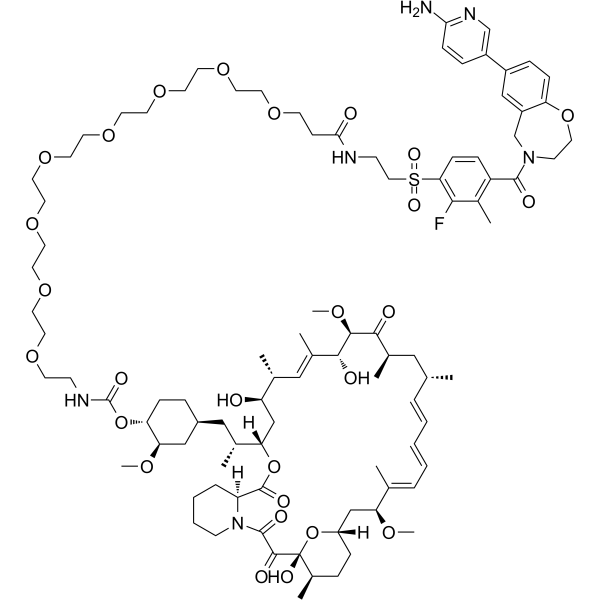
RMC-6272 (RM-006) is a bi-steric mTORC1-selective inhibitor. RMC-6272 exhibits potent and selective (> 10-fold) inhibition of mTORC1 over mTORC2. RMC-6272 shows improved inhibition of mTORC1 in comparison to Rapamycin, and induces more cell death in TSC2 null tumors .
loading...
    loading...
1
1 Cited Publications
Cat. No.: HY-100886
CAS No.: 1375469-38-7
Purity:  98.02%
Target:  

PI3K Apoptosis

Research Areas:  

Cancer

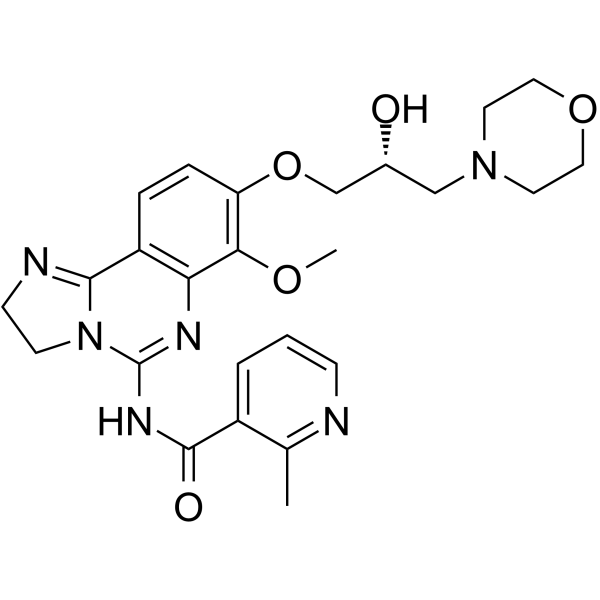
BAY1082439 is an orally bioavailable, selective PI3Kα/β/δ inhibitor. BAY1082439 also inhibits mutated forms of PIK3CA. BAY1082439 is highly effective in inhibiting Pten-null prostate cancer growth .
loading...
    loading...
1
1 Cited Publications
Cat. No.: HY-145778
CAS No.: 2377492-26-5
Purity:  99.94%
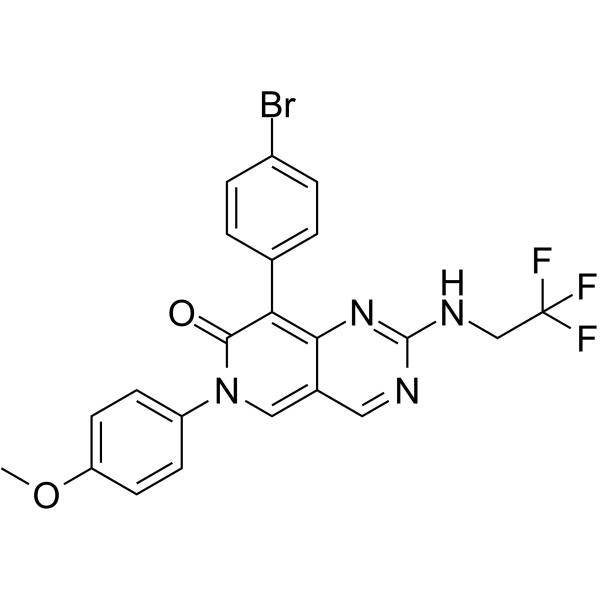
AGI-41998 is a potent and orally active inhibitor of methionine adenosyltransferase 2A (MAT2A) that effectively penetrates the blood-brain barrier. AGI-41998 exhibits inhibitory activities against MAT2A and S-adenosyl methionine (SAM) in HCT-116 MTAP-null cells with IC50s of 22 nM and 34 nM. AGI-41998 can significantly inhibit the proliferation of HCT-116 cells and tumor growth. AGI-41998 can be used to study the role of SAM regulation in the central nervous system (CNS) and colon cancer .
loading...
    loading...
Cat. No.: HY-145777
CAS No.: 2377491-54-6
Purity:  99.51%
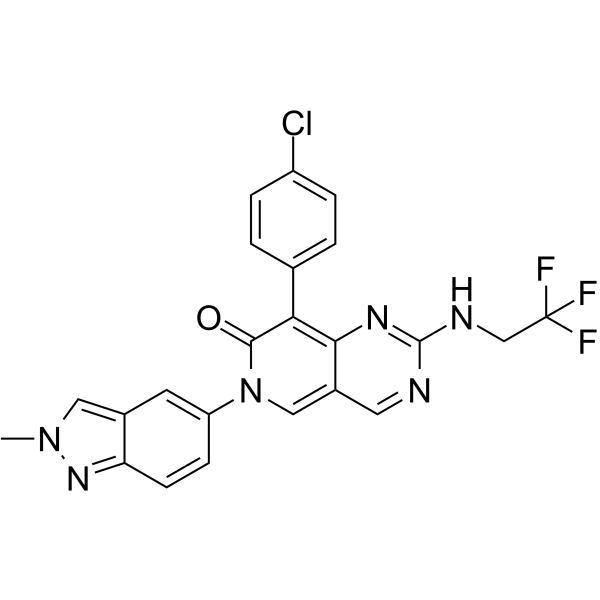
AGI-43192 is a potent and orally active inhibitor of methionine adenosyltransferase 2A (MAT2A) that limitedly penetrates the blood-brain barrier. AGI-43192 exhibits inhibitory activitity against MAT2A and S-adenosyl methionine (SAM) in HCT-116 MTAP-null cells with IC50s of 32 and 14 nM. AGI-43192 can significantly inhibit the proliferation of HCT-116 cells and tumor growth. AGI-43192 can be used to study the role of SAM regulation in the central nervous system (CNS) and colon cancer .
loading...
    loading...
Cat. No.: HY-161431
CAS No.: 3035072-48-8
Target:  

DNA/RNA Synthesis

Research Areas:  

Cancer

RTx-152 traps Polθ on DNA and is an allosteric Polθ-pol inhibitor (IC50: 6.2 nM). RTx-152 selectively kills HR-deficient cancer cells, and suppresses PARP inhibitor resistance in multiple genetic backgrounds, including homologous recombination (HR)-proficient cells. RTx-152 selectively kills BRCA2-null cells .
loading...
    loading...
Cat. No.: HY-124791
CAS No.: 709009-15-4
Target:  

MDM-2/p53 PARP

Research Areas:  

Cancer

MMRi6 is a Mdm2-MdmX RING domain inhibitor that can disrupt Mdm2-MdmX RING-RING interaction in vitro. MMRi6 inhibits MdmX-stimulated Mdm2 autoubiquitination and Mdm2-MdmX-mediated p53 polyubiquitination in vitro without affecting NEDD4-1 autoubiquitination. MMRi6 induces p53 stabilization and accumulation and induces PARP cleavage in wt-p53 Emu-myc lymphoma cells. MMRi6 inhibits the growth of wt-p53 and p53-null Emu-myc lymphoma cells with IC50s of approximately 0.5 μM and 3 μM, respectively. MMRi6 can be used for the study of leukemia/lymphoma .
loading...
    loading...
Cat. No.: HY-173062
CAS No.: 2994635-04-8
Research Areas:  

Others

BRD4 Inhibitor-40 (Compound 23) is the inhibitor for BRD that inhibits BRD4-BD1, BRD4-BD2, BRD2-BD1 and BRD2-BD2 with IC50s of 16.1, 142.18, 29.35 and 302.35 nM, respectively. BRD4 Inhibitor-40 modulates the expression of c-Myc and p21, arrests cell cycle at G1 phase, inhibits Pkd1-null (PN) renal cystic epithelial cells, and blocks the renal cysts formation in Madin-Darby canine kidney and embryonic kidney vesicle models. BRD4 Inhibitor-40 exhibits renal cysts inhibitory activity in mouse models .
loading...
    loading...
Cat. No.: HY-179507
Target:  

MDM-2/p53 Apoptosis

Research Areas:  

Cancer

p53 Activator 17 is a p53-Y220C activator. p53 Activator 17 exhibits selective cytotoxicity and pro-apoptotic activity in p53-Y220C mutant cancer cell lines, with minimal effects in wild-type or p53-null cells. p53 Activator 17 induces a mutant-to-wild-type conformational shift in cellular p53-Y220C, accompanied by transcriptional activation of canonical p53 target genes, including BBC3 (PUMA) and MDM2. p53 Activator 17 can be used for the study of hepatocellular carcinoma and breast cancer .
loading...
    loading...
Cat. No.: HY-183951
CAS No.: 2962087-36-9
Research Areas:  

Neurological Disease Cancer

TNG456 is an orally active, CNS-penetrant, selective, MTA-cooperative PRMT5 inhibitor. TNG456 drives dose-dependent antitumor activity in mouse xenograft models. TNG456 can be used for the research of MTAP-null solid tumors, including gliomas, and CNS metastases .
loading...
    loading...
Cat. No.: HY-182400
CAS No.: 2201065-84-9
Research Areas:  

Cancer

AGI-25696 is an orally active ethionine adenosyltransferase 2A (MAT2A) inhibitor with an IC50 of 97 nM. AGI-25696 reduces intracellular SAM levels in cancer cells. AGI-25696 inhibits tumor growth in mice bearing subcutaneous KP4 MTAP-null pancreatic xenografts. AGI-25696 can be used for the research of mtap-deleted pancreatic cancer .
loading...
    loading...
Cat. No.: HY-100886R
CAS No.: 1375469-38-7
Research Areas:  

Cancer

BAY1082439 (Standard) is the analytical standard of BAY1082439 (HY-100886). This product is intended for research and analytical applications. BAY1082439 is an orally bioavailable, selective PI3Kα/β/δ inhibitor. BAY1082439 also inhibits mutated forms of PIK3CA. BAY1082439 is highly effective in inhibiting Pten-null prostate cancer growth .
loading...
    loading...
Cat. No.: HY-181821
Target:  

Parasite Na+/K+ ATPase

Research Areas:  

Infection

MMV1581361 is a PfATP4 inhibitor and an orally active, transmission-blocking agent with nanomolar activity against Plasmodium falciparum blood-stage isolates. MMV1581361 disrupts sodium ion (Na +) homeostasis in Plasmodium falciparum. MMV1581361 inhibits male gamete exflagellation, reduces oocyst intensity, and blocks transmission of Plasmodium falciparum. MMV1581361 demonstrates efficacy in the humanized Plasmodium falciparum NOD scid IL2Rγ null mouse model. MMV1581361 can be used for the research of malaria .
loading...
    loading...
Cat. No.: HY-184434
CAS No.: 3064280-41-4
Research Areas:  

Cancer

PRMT5-IN-57 is an orally active andselective MTA-cooperative PRMT5 inhibitor, with an IC50 of 8.39 nM against PRMT5/MTA complex. PRMT5-IN-57 exhibits potent and selective antiproliferative activity against MTAP-null cancer cells. PRMT5-IN-57 demonstrates significant in vivo antitumor efficacy in an HCT116 MTAP-/- CDX model. PRMT5-IN-57 can be used for the research of MTAP-deleted cancers .
loading...
    loading...
Cat. No.: HY-P992162
23ME-00610 is a humanized effector-function-null IgG1 antibody targeting CD200R1, with a Kd of <0.1 nM for hCD200R1. 23ME-00610 blocks the binding of CD200 to CD200R1 and inhibits the recruitment of the downstream adaptor protein DOK2 to CD200R1. 23ME-00610 restores IL-2 production suppressed by CD200. 23ME-00610 induces cytokine production in cells. 23ME-00610 enhances cell-mediated tumor cell killing in vitro. 23ME-00610 can be used for melanoma research .
loading...
    loading...
Cat. No.: HY-186151
CAS No.: 1372406-51-3
Target:  

MDM-2/p53 Apoptosis

Research Areas:  

Cancer

UCI-LC0019 is a mutant p53 reactivator. UCI-LC0019 binds to mutant p53, induces wild-type-like conformational change, restores sequence-specific DNA binding activity, activates p53-dependent transcription programs, and does not act via thiol reactivity or glutathione depletion. UCI-LC0019 inhibits proliferation and induces apoptosis in cancer cells harboring mutant p53, with no significant effect on p53 null or wild-type p53 tumors cells. UCI-LC0019 exhibits anti-tumor activity in xenograft mouse models carrying p53R175H mutant tumors. UCI-LC0019 can be used for the research of cancer, such as ovarian cancer .
loading...
    loading...
Cat. No.: HY-49637
CAS No.: 2909471-62-9
Research Areas:  

Others

Biotin-PEG6-PO (F)-C16 is an activity-based proteomics probe .
loading...
    loading...
Cat. No.: HY-116516
CAS No.: 1392202-91-3
Target:  

LPL Receptor SphK

Research Areas:  

Cancer

VPC03090 is an orally active prodrug of S1P1/3 antagonist. VPC03090 is phosphorylated by sphingosine kinase 2 (SK2) to form its active form VPC03090-P. VPC03090 reduces tumor volume in mouse breast cancer models. VPC03090 can be used in research related to breast cancer .
loading...
    loading...
Cat. No.: HY-W1143867
CAS No.: 2226-71-3
4’-Phosphopantetheine is an orally active coenzyme A (CoA) precursor. 4’-Phosphopantetheine is membrane-permeable and acts as a CoA precursor, a prosthetic group, and a reactive oxygen species (ROS) inhibitor. 4’-Phosphopantetheine binds covalently to rat liver fatty acid synthase, modifies the conserved serine residue in the PKS/NRPS carrier protein domain, and serves as a substrate for CoA synthase and PPAT. 4’-Phosphopantetheine undergoes non-catalytic exchange on rat liver fatty acid synthase, with a faster turnover rate than that of the enzyme complex, and restores intracellular CoA levels in cells with impaired de novo biosynthesis. 4’-Phosphopantetheine rescues phenotypes induced by CoA deficiency, normalizes PKAN-related biomarkers, restores mitochondrial enzyme activity, and alleviates vascular endothelial damage. 4’-Phosphopantetheine shows biological stability in serum, acts as a prosthetic group and degradation product of ACP, and inhibits the formation of atherosclerotic plaques. 4’-Phosphopantetheine can be used in the research of brain iron accumulation neurodegenerative diseases, pantothenate kinase-associated neurodegeneration, CoASY protein-associated neurodegenerative diseases, coronary heart disease, and atherosclerosis .
loading...
    loading...
  • 1

