7 Results for "

phenyl radical

" in MedChemExpress (MCE) Product Catalog:
Products (7)

7 Results for "phenyl radical" in MCE Product Catalog:

5
5 Cited Publications
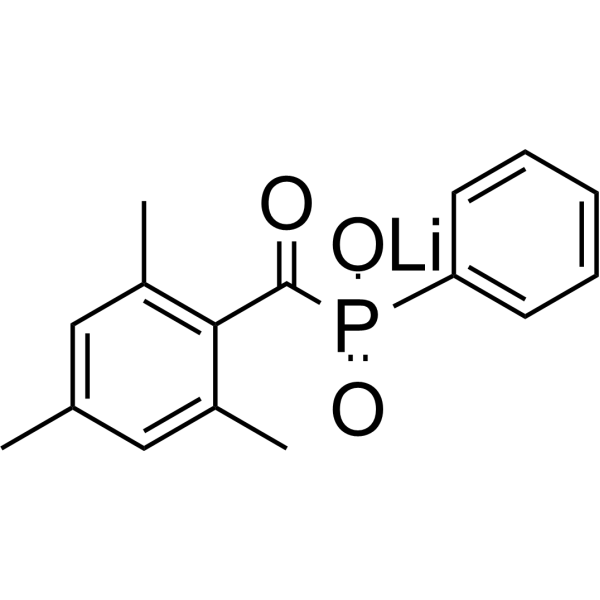
Cat. No.: HY-44076
CAS No.: 85073-19-4
Synonyms: Lithium phenyl-2,4,6-trimethylbenzoylphosphinate
LAP (Lithium phenyl-2,4,6-trimethylbenzoylphosphinate) is a free radical initiator. The free radicals produced by LAP under bioprinting conditions are potentially cytotoxic and mutagenic. In addition, the concentration of LAP affects the mechanical strength of 3D printed scaffolds. Generally, the concentration range of LAP used for curing is 0.05%-1%. The elastic modulus produced at a concentration of 0.1% is the highest, with enhanced mechanical properties and excellent biocompatibility .
loading...
    loading...
1
1 Cited Publications
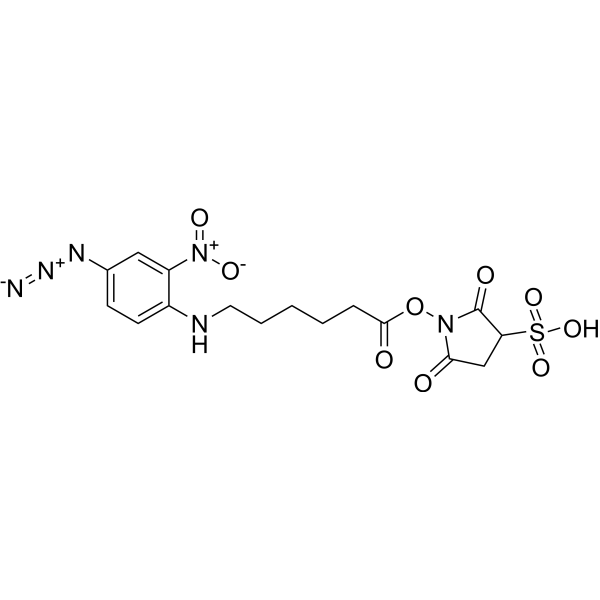
Cat. No.: HY-137383
CAS No.: 102568-43-4
Purity:  99.72%
Sulfo-SANPAH is a primary amine-nitrobenzene azide cross-linker. Sulfo-SANPAH improves the functionalization process of PDMS surfaces, is covalently bound to the PAAm gel surface. Sulfo-SANPAH is widely used to crosslink ECM proteins to various substrates, including acrylic-based hydrogels, such as polyacrylamide hydrogels. Sulfo-SANPAH facilitates covalent binding through its negatively charged sulfonate group on its N-hydroxysuccinimide ester ring and a photoactivated phenyl azide group that is highly reactive with nucleophiles and free radicals .
loading...
    loading...
Cat. No.: HY-W008598
CAS No.: 403-29-2
Synonyms: p-Fluorophenacyl bromide
Target:  

DNA/RNA Synthesis

Research Areas:  

Cancer

2-Bromo-4'-fluoroacetophenone (p-Fluorophenacyl bromide) is a photoinducible DNA cleavage inducer.2-Bromo-4'-fluoroacetophenone generates fluorine-substituted phenyl radicals upon excitation and irradiation to cleave DNA, converting circular supercoiled DNA to circular relaxed and linear DNA forms.2-Bromo-4'-fluoroacetophenone exhibits concentration-dependent DNA cleaving activity.2-Bromo-4'-fluoroacetophenone can be used for the research of cancer .
loading...
    loading...
Cat. No.: HY-D3401
CAS No.: 3121511-17-6
Research Areas:  

Others

LHA585 is a fluorescent probe targeting the lipid hydrogen abstraction process for the early detection of ferroptosis (Ferroptosis). Its detection mechanism relies on the reactivity of its own 4-phenyl-3-methylbut-2-enyl moiety with biologically relevant oxidative radicals, including peroxyl radicals (ROO·), alkoxyl radicals (RO·), hydroxyl radicals (HO·), and peroxynitrite anions (ONOO−); upon hydrogen abstraction from this structure, radical rearrangement and radical cleavage occur, releasing a xanthene radical which converts into a highly fluorescent rhodamine dye in biological environments, thereby achieving a fluorescence turn-on ratio of up to 360-fold. LHA585 is non-fluorescent in its native state, possesses excellent membrane permeability due to its non-polar property, and the rhodamine dye generated after oxidation diffuses into mitochondria. The excitation wavelength of LHA585 is 561 nm, and its emission wavelength ranges from 570 to 620 nm .
loading...
    loading...
Cat. No.: HY-D3402
CAS No.: 3121511-18-7
Research Areas:  

Others

LHA675 is a fluorescent probe for early detection of ferroptosis. LHA675 mimics polyunsaturated lipids via a 4-phenyl-3-methylbut-2-enyl group to specifically detect highly oxidative radicals associated with ferroptosis, and releases a fluorophore after the reaction. LHA675 has excitation and emission wavelengths of 647 nm and 663-738 nm, respectively. LHA675 enables wash-free labeling of ferroptosis in living cells; the generated fluorophore localizes to mitochondria and emits deep red fluorescence. LHA675 can be used in studies related to the early detection of ferroptosis .
loading...
    loading...
Cat. No.: HY-D3403
CAS No.: 3121511-19-8
Research Areas:  

Metabolic Disease

LHA930 is a fluorescent probe for in vivo detection of early-stage ferroptosis. By introducing a 4-phenyl-3-methylbut-2-enyl reactive group responsive to lipid hydrogen abstraction, LHA930 exhibits fluorescence turn-on upon the action of oxidative radicals associated with lipid peroxidation, enabling detection of lipid peroxidation during the early stage of ferroptosis. The detection wavelength of LHA930 is Ex/Em = 860/930 nm. LHA930 can be used for near-infrared fluorescence imaging studies of ferroptosis in APAP-induced mouse liver injury models .
loading...
    loading...
Cat. No.: HY-79587
CAS No.: 134-81-6
Research Areas:  

Others

Benzil is a 1,2-diketone compound with multiple functions including photo-peroxidation initiator, crosslinking initiator and pattern-forming agent, and is commonly used as a precursor for photodegradable network crosslinkers. In oxygen-purged polymer films or glassy matrices, Benzil reacts with molecular oxygen under illumination at wavelengths greater than 370 nm or 400 nm, and converts to benzoyl peroxide in nearly quantitative yield. Subsequently, the generated benzoyl peroxide groups produce free radicals via thermal or photochemical decomposition, thereby enabling crosslinking of polymer chains, grafting of new monomers, and preparation of patterned polymers on solid surfaces using mask irradiation. Benzil also induces crosslinking of photodegradable poly (phenyl vinyl ketone) to form a stable photodegradable polymer network .
loading...
    loading...

