Search Result
Results for "
physiological solutions
" in MedChemExpress (MCE) Product Catalog:
17
Biochemical Assay Reagents
| Cat. No. |
Product Name |
Target |
Research Areas |
Chemical Structure |
-
- HY-D0858
-
MES
4 Publications Verification
2-Morpholinoethanesulphonic acid
|
Biochemical Assay Reagents
|
Others
|
|
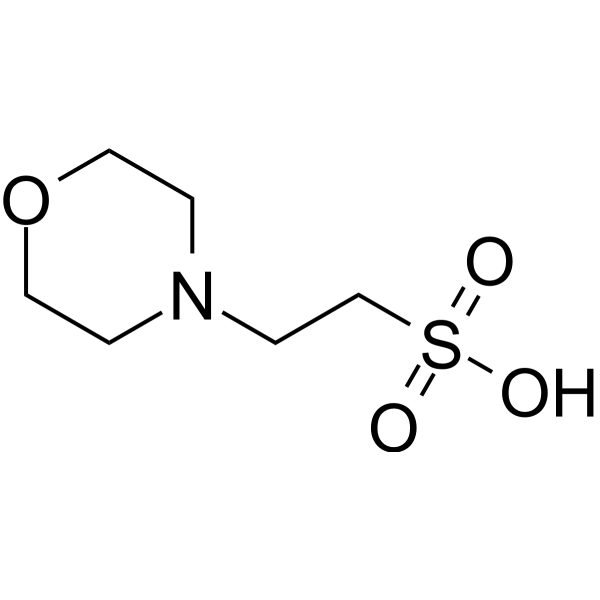
MES (2-Morpholinoethanesulphonic acid) is a kind of amphoteric ion buffer, the buffer capacity ranging pH 5.5-7.0. As a Good's buffer, MES is widely used in biochemistry and molecular biology experiments, such as cell culture, enzyme activity determination, electrophoresis and protein studies .
|
-
-
- HY-D0858A
-
|
2-Morpholinoethanesulphonic acid monohydrate
|
Biochemical Assay Reagents
|
Others
|
|
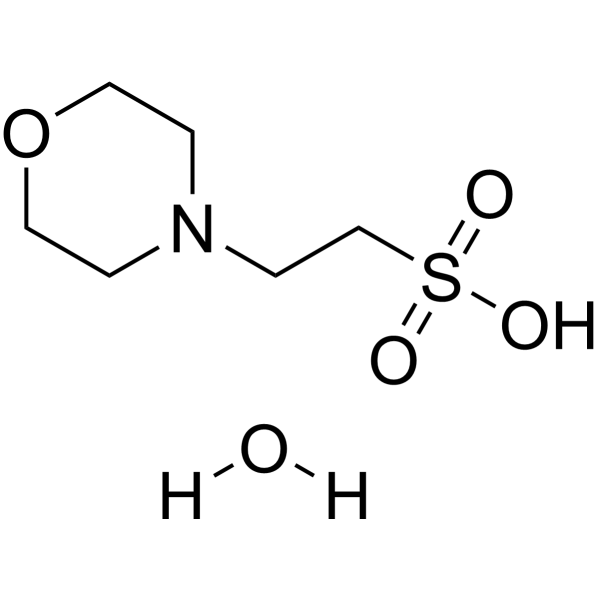
MES (2-Morpholinoethanesulphonic acid) monohydrate is a kind of amphoteric ion buffer, the buffer capacity ranging pH 5.5-7.0. As a Good's buffer, MES monohydrate is widely used in biochemistry and molecular biology experiments, such as cell culture, enzyme activity determination, electrophoresis and protein studies .
|
-
-
- HY-DY1004
-
|
|
Fluorescent Dye
|
Others
|
BODIPY 493/503 (solution) is a BODIPY dye. BODIPY dye is a small molecule dye with strong ultraviolet absorption ability, its fluorescence peak is relatively sharp, and the quantum yield is high. They are relatively insensitive to the polarity and pH of the environment and are relatively stable under different physiological conditions. Due to its structural asymmetry, BODIPY derives a variety of structural products. BODIPY lipid droplet dyes can well pass through the cell membrane into the cell, and localize the neutral lipids in the cell to specifically stain the lipid droplets, which can be used for labeling of live cells and fixed cells . Maximum excitation/emission wavelength: 493/503 nm.
Solvent and concentration: DMSO: 5 mM.
|
-

-
- HY-D0858C
-
|
2-Morpholinoethanesulphonic acid hydrate
|
Biochemical Assay Reagents
|
Others
|
|
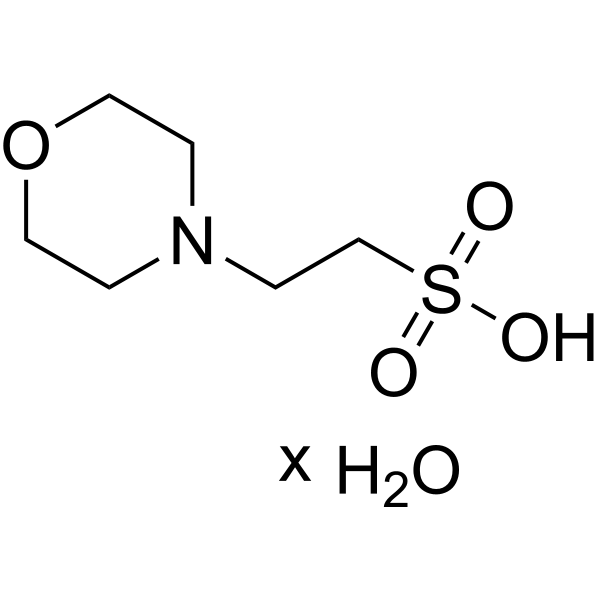
MES (2-Morpholinoethanesulphonic acid) hydrate is a kind of amphoteric ion buffer, the buffer capacity ranging pH 5.5-7.0. As a Good's buffer, MES hydrate is widely used in biochemistry and molecular biology experiments, such as cell culture, enzyme activity determination, electrophoresis and protein studies .
|
-
-
- HY-D0858E
-
|
2-Morpholinoethanesulphonic acid potassium
|
Biochemical Assay Reagents
|
Others
|
|
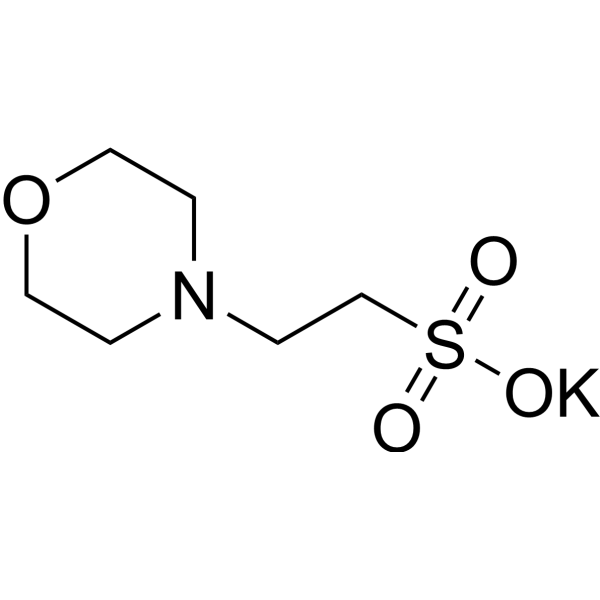
MES (2-Morpholinoethanesulphonic acid) potassium is a kind of amphoteric ion buffer, the buffer capacity ranging pH 5.5-7.0. As a Good's buffer, MES potassium is widely used in biochemistry and molecular biology experiments, such as cell culture, enzyme activity determination, electrophoresis and protein studies .
|
-
-
- HY-D0874
-
|
|
Biochemical Assay Reagents
|
Others
|
|
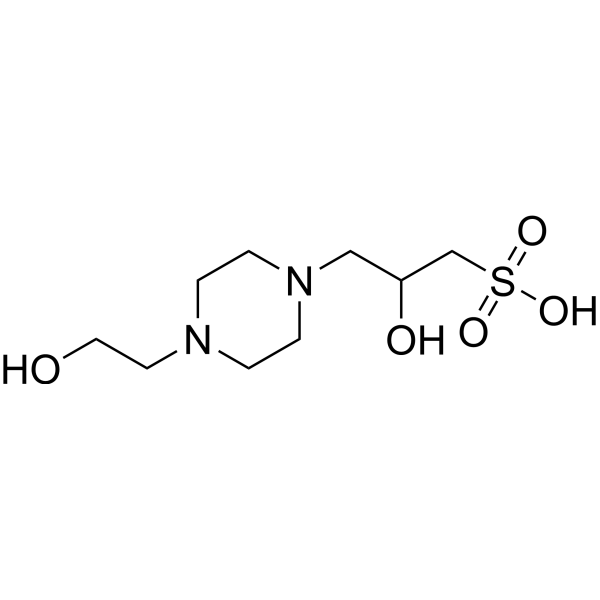
HEPPSO is a zwitterionic Good's buffer suitable for physiological pH conditions. HEPPSO forms high-order oligomers in aqueous solutions and can form a 1:1 complex with Cu 2+ via its hydroxyalkyl and tertiary amine groups. However, HEPPSO contains a structurally similar trace impurity lacking an alkanesulfonic acid side chain. The complex formed by this impurity and Cu 2+ has a very low Ka; therefore, HEPPSO may interfere with studies on copper speciation analysis in natural water bodies .
|
-
-
- HY-D0858B
-
|
2-Morpholinoethanesulphonic acid sodium salt
|
Biochemical Assay Reagents
|
Others
|
|
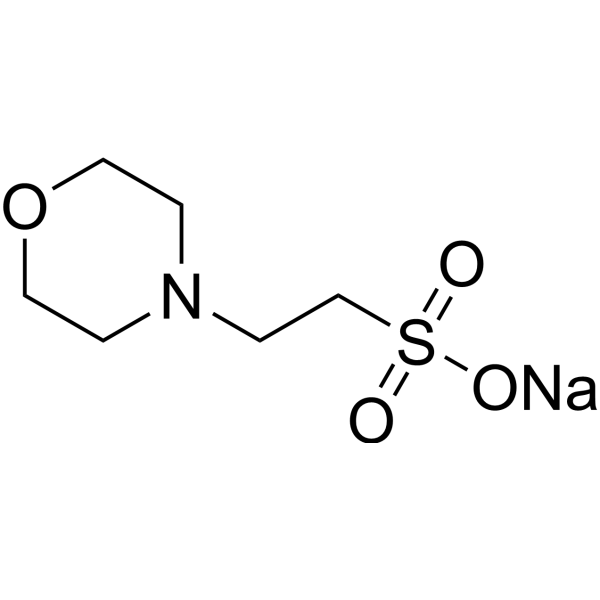
MES sodium salt (2-Morpholinoethanesulphonic acid) is a kind of amphoteric ion buffer, the buffer capacity ranging pH 5.5-7.0. As a Good's buffer, MES sodium salt is widely used in biochemistry and molecular biology experiments, such as cell culture, enzyme activity determination, electrophoresis and protein studies .
|
-
-
- HY-DY1020
-
|
|
Fluorescent Dye
|
Others
|
Rhod-2 (solution) is a high-affinity visible light excitation wavelength Ca 2+ fluorescent probe, Rhod-2, AM is an acetyl methyl ester derivative of Rhod-2, which has cell membrane permeability and can easily enter cells with simple culture. Once it enters the cell, it is sheared by its lactesterase to produce Rhod-2 without membrane permeability, which remains in the cell to perform the corresponding physiological functions. Maximum excitation/emission wavelength: 549/578 nm .
Solvent and concentration: DMSO: 1 mM
|
-

-
- HY-DY1061
-
|
|
Fluorescent Dye
|
Others
|
BODIPY 558/568 C12 (solution) is a BODIPY dye. BODIPY dye is a small molecule dye with strong ultraviolet absorption ability, its fluorescence peak is relatively sharp, and the quantum yield is high. They are relatively insensitive to the polarity and pH of the environment and are relatively stable under different physiological conditions. Due to its structural asymmetry, BODIPY derives a variety of structural products. BODIPY lipid droplet dyes can well pass through the cell membrane into the cell, and localize the neutral lipids in the cell to specifically stain the lipid droplets, which can be used for labeling of live cells and fixed cells . Maximum excitation/emission wavelength: 558/568 nm .
Solvent and concentration: DMSO: 2 mM
|
-

-
- HY-D0858AR
-
|
2-Morpholinoethanesulphonic acid monohydrate (Standard)
|
Biochemical Assay Reagents
Reference Standards
|
Others
|
|
MES (monohydrate) (Standard) is the analytical standard of MES (monohydrate). This product is intended for research and analytical applications. MES (2-Morpholinoethanesulphonic acid) is a kind of amphoteric ion buffer, the buffer capacity ranging pH 5.5-7.0. As a Good's buffer, MES is widely used in biochemistry and molecular biology experiments, such as cell culture, enzyme activity determination, electrophoresis and protein studies .
|
-

-
- HY-W127629
-
-
-
- HY-D0858D
-
|
2-Morpholinoethanesulphonic acid hemisodium
|
Biochemical Assay Reagents
|
Others
|
|
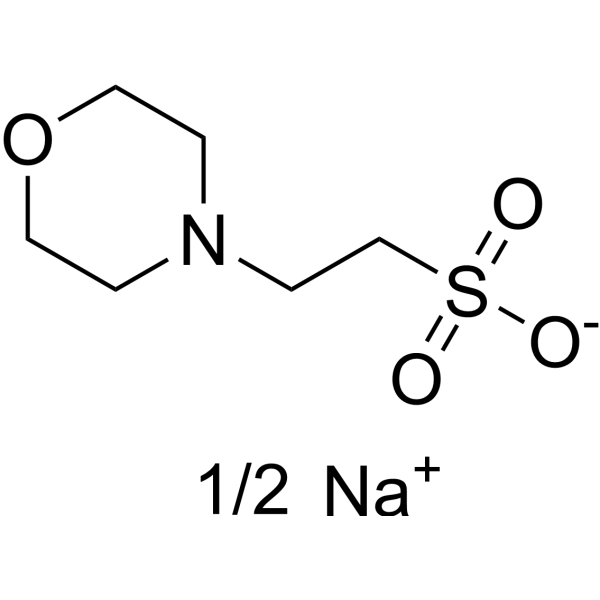
MES (2-Morpholinoethanesulphonic acid) hemisodium is a kind of amphoteric ion buffer, the buffer capacity ranging pH 5.5-7.0. As a Good's buffer, MES hemisodium is widely used in biochemistry and molecular biology experiments, such as cell culture, enzyme activity determination, electrophoresis and protein studies .
|
-
-
- HY-DY1068
-
|
|
Fluorescent Dye
|
Others
|
Cyanine5 DBCO (DBCO-Cy5) hexafluorophosphate (solution) is a low-toxicity azide reactive probe (NIR fluorescent dye) , for imaging azide-labeled biomolecules via a copper-free "click-through" reaction. Cyanine5 DBCO hexafluorophosphate has no apparent cytotoxicity or animal toxicity and shows no damage to the physiological functions of cells other than the target cells (azide-labeled cells). Cyanine5 DBCO hexafluorophosphate can be used to label and track cells in vitro and in vivo (Ex=635 nm, Em=650-700 nm) .
Solvent and concentration: DMSO: 10 mM
|
-

-
- HY-W579346
-
|
|
Biochemical Assay Reagents
|
Others
|
|
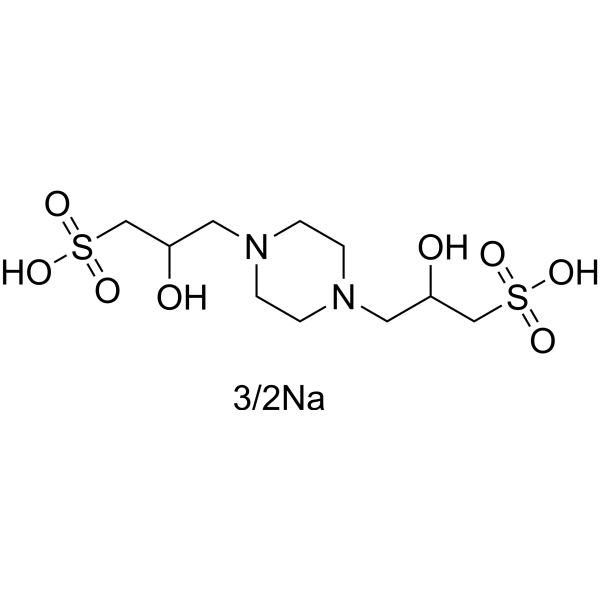
POPSO sesquisodium is a water-soluble zwitterionic buffer. POPSO sesquisodium is commonly used in biological and biochemical studies to maintain the acidity or alkalinity (pH value) of solutions, especially within the physiological pH range of 7.0 to 8.5 .
|
-
-
- HY-172190A
-
|
|
Biochemical Assay Reagents
|
Others
|
|
MS Medium (Agar-Free, Sucrose-Free) is a culture medium with a high concentration of inorganic salts and ions, making it a relatively stable balanced solution. The quantity and ratio of nutrients in MS Medium (Agar-Free, Sucrose-Free) are suitable to meet the nutritional and physiological needs of plants.
|
-

-
- HY-D2379A
-
|
|
Fluorescent Dye
|
|
|
closed-HMRG is HMRG with closed spirocyclic structure. Ac-HMRG, an acetylated derivative of Hydroxymethyl rhodamine green, exists as a closed spirocyclic structure in aqueous solution at physiological pH, whereas HMRG itself takes an open nonspirocyclic structure. Ac-HMRG is colorless and nonfluorescent and HMRG is strongly fluorescent .
|
-

-
- HY-182733A
-
|
|
Biochemical Assay Reagents
|
Others
|
|
Yoshida Rice Nutrient Solution is a hydroponic nutrient solution for rice that can be used in rice physiology, genetic breeding, and nutritional research.
|
-

-
- HY-182733K
-
|
|
Biochemical Assay Reagents
|
Others
|
|
Plant Acidic Salt Solution is an acidic salt solution used for plant physiology and can be used to study the selective absorption of ions by plant roots.
|
-

-
- HY-182733M
-
|
|
Biochemical Assay Reagents
|
Others
|
|
Plant Control Salt Solution is a control reagent specifically designed for plant physiological research. It is primarily used to study the absorption and selectivity of salts in plants and to analyze the effects of salt solutions on plants.
|
-

-
- HY-DY1098
-
|
2′,7′-Bis(2-carboxyethyl)-5(6)-carboxyfluorescein (solution)
|
Fluorescent Dye
|
Others
|
BCECF (solution) (2′,7′-Bis(2-carboxyethyl)-5(6)-carboxyfluorescein (solution)) is a cell-impermeant pH-sensitive fluorescent dye. BCECF allows measurements in the physiological pH range 6.0-8.0. Excitation ratio: 490/440 nm; Emission intensity: 535 nm.
Solvent and concentration: DMSO: 10 mM
|
-

-
- HY-DY1104
-
|
CF4 (solution)
|
Fluorescent Dye
|
Others
|
Copper Fluor-4 (solution) (CF4 (solution)) is a Cu +-specific fluorescent probe based on a rhodol dye scaffold. Copper Fluor-4 solution has high copper selectivity with a Kd value of 2.9×10 ?13 M, particularly over zinc and iron, as well as abundant cellular alkali and alkaline earth metals. Copper Fluor-4 solution is stable in a physiologically relevant pH regime between 6 and 8 (wavelengths of 415 nm for excitation and 660 nm for emission) .
Solvent and concentration: DMSO: 5 mM
|
-

-
- HY-D0858DR
-
|
2-Morpholinoethanesulphonic acid hemisodium (Standard)
|
Biochemical Assay Reagents
|
Others
|
|
MES (hemisodium) (Standard) is the analytical standard of MES (hemisodium). This product is intended for research and analytical applications. MES (2-Morpholinoethanesulphonic acid) hemisodium is a kind of amphoteric ion buffer, the buffer capacity ranging pH 5.5-7.0. As a Good's buffer, MES hemisodium is widely used in biochemistry and molecular biology experiments, such as cell culture, enzyme activity determination, electrophoresis and protein studies .
|
-

-
- HY-172190C
-
|
|
Biochemical Assay Reagents
|
Others
|
|
MS Medium (Calcium-Free) is a culture medium with a high concentration of inorganic salts and ions, making it a relatively stable balanced solution. The quantity and ratio of nutrients in MS Medium (Calcium-Free) are suitable to meet the nutritional and physiological needs of plants.
|
-

-
- HY-172190B
-
|
|
Biochemical Assay Reagents
|
Others
|
|
MS Medium (Agar-Free) is a culture medium with a high concentration of inorganic salts and ions, making it a relatively stable balanced solution. The quantity and ratio of nutrients in MS Medium (Agar-Free) are suitable to meet the nutritional and physiological needs of plants.
|
-

-
- HY-D3230
-
|
|
Fluorescent Dye
|
Others
|
|
FLCS1 is a BODIPY-based Fluorescent probe and selective copper (I) ion binder (λex = 630 nm, λemis = 660 nm). Binding of FLCS1 to copper (I) ions induces fluorescence turn-on. Addition of copper (I) to a methanolic solution of FLCS1 causes a slight red shift (4 nm) in the maximum absorption wavelength (λmax) in the UV-Vis spectrum .
|
-

-
- HY-D3200
-
|
|
Fluorescent Dye
Cuproptosis
|
Others
|
|
Dns-LLC is a cell-permeable Cu +-selective fluorescent probe that forms a 1:1 complex with Cu +. The thiol group of Dns-LLC plays a key binding role, while the sulfonamide and amide groups jointly contribute to the stabilization of the complex. Upon binding to Cu + in aqueous buffer solutions, Dns-LLC generates a turn-on fluorescence response, which can be used for the detection of Cu + in the Golgi apparatus .
|
-

-
- HY-DY1090
-
|
|
Fluorescent Dye
|
Others
|
BODIPY 493/503 methyl bromide (solution) is a BODIPY dye. BODIPY dye is a small molecule dye with strong ultraviolet absorption ability, its fluorescence peak is relatively sharp, and the quantum yield is high. They are relatively insensitive to the polarity and pH of the environment and are relatively stable under different physiological conditions. Due to its structural asymmetry, BODIPY derives a variety of structural products. BODIPY lipid droplet dyes can well pass through the cell membrane into the cell, and localize the neutral lipids in the cell to specifically stain the lipid droplets, which can be used for labeling of live cells and fixed cells . Maximum excitation/emission wavelength: 493/503 nm .
Solvent and concentration: DMSO: 5 mM
|
-

-
- HY-172754
-
|
|
Fluorescent Dye
|
Cancer
|
|
ICAAc is a solvatochromic fluorophore with reduced basicity. ICAAc demonstrates significant solvatochromic behavior across solvents of varying polarity, with a large dipole moment difference and low quantum yield in water, making it a tunable solvatochromic fluorophore. ICAAc enables pH sensing via UV-vis/fluorescence detection and in microenvironments including sodium lauryl sulfate micelle Stern layers. ICAAc acts as a supravital cell stain for epifluorescence imaging of live cancer cells .
|
-

| Cat. No. |
Product Name |
Type |
-
- HY-DY1004
-
|
|
Fluorescent Dyes
|
BODIPY 493/503 (solution) is a BODIPY dye. BODIPY dye is a small molecule dye with strong ultraviolet absorption ability, its fluorescence peak is relatively sharp, and the quantum yield is high. They are relatively insensitive to the polarity and pH of the environment and are relatively stable under different physiological conditions. Due to its structural asymmetry, BODIPY derives a variety of structural products. BODIPY lipid droplet dyes can well pass through the cell membrane into the cell, and localize the neutral lipids in the cell to specifically stain the lipid droplets, which can be used for labeling of live cells and fixed cells . Maximum excitation/emission wavelength: 493/503 nm.
Solvent and concentration: DMSO: 5 mM.
|
-
- HY-DY1020
-
|
|
Fluorescent Dyes
|
Rhod-2 (solution) is a high-affinity visible light excitation wavelength Ca 2+ fluorescent probe, Rhod-2, AM is an acetyl methyl ester derivative of Rhod-2, which has cell membrane permeability and can easily enter cells with simple culture. Once it enters the cell, it is sheared by its lactesterase to produce Rhod-2 without membrane permeability, which remains in the cell to perform the corresponding physiological functions. Maximum excitation/emission wavelength: 549/578 nm .
Solvent and concentration: DMSO: 1 mM
|
-
- HY-DY1061
-
|
|
Fluorescent Dyes
|
BODIPY 558/568 C12 (solution) is a BODIPY dye. BODIPY dye is a small molecule dye with strong ultraviolet absorption ability, its fluorescence peak is relatively sharp, and the quantum yield is high. They are relatively insensitive to the polarity and pH of the environment and are relatively stable under different physiological conditions. Due to its structural asymmetry, BODIPY derives a variety of structural products. BODIPY lipid droplet dyes can well pass through the cell membrane into the cell, and localize the neutral lipids in the cell to specifically stain the lipid droplets, which can be used for labeling of live cells and fixed cells . Maximum excitation/emission wavelength: 558/568 nm .
Solvent and concentration: DMSO: 2 mM
|
-
- HY-DY1068
-
|
|
Fluorescent Dyes
|
Cyanine5 DBCO (DBCO-Cy5) hexafluorophosphate (solution) is a low-toxicity azide reactive probe (NIR fluorescent dye) , for imaging azide-labeled biomolecules via a copper-free "click-through" reaction. Cyanine5 DBCO hexafluorophosphate has no apparent cytotoxicity or animal toxicity and shows no damage to the physiological functions of cells other than the target cells (azide-labeled cells). Cyanine5 DBCO hexafluorophosphate can be used to label and track cells in vitro and in vivo (Ex=635 nm, Em=650-700 nm) .
Solvent and concentration: DMSO: 10 mM
|
-
- HY-D2379A
-
|
|
Fluorescent Dyes
|
|
closed-HMRG is HMRG with closed spirocyclic structure. Ac-HMRG, an acetylated derivative of Hydroxymethyl rhodamine green, exists as a closed spirocyclic structure in aqueous solution at physiological pH, whereas HMRG itself takes an open nonspirocyclic structure. Ac-HMRG is colorless and nonfluorescent and HMRG is strongly fluorescent .
|
-
- HY-DY1098
-
|
2′,7′-Bis(2-carboxyethyl)-5(6)-carboxyfluorescein (solution)
|
Fluorescent Dyes
|
BCECF (solution) (2′,7′-Bis(2-carboxyethyl)-5(6)-carboxyfluorescein (solution)) is a cell-impermeant pH-sensitive fluorescent dye. BCECF allows measurements in the physiological pH range 6.0-8.0. Excitation ratio: 490/440 nm; Emission intensity: 535 nm.
Solvent and concentration: DMSO: 10 mM
|
-
- HY-DY1104
-
|
CF4 (solution)
|
Fluorescent Dyes
|
Copper Fluor-4 (solution) (CF4 (solution)) is a Cu +-specific fluorescent probe based on a rhodol dye scaffold. Copper Fluor-4 solution has high copper selectivity with a Kd value of 2.9×10 ?13 M, particularly over zinc and iron, as well as abundant cellular alkali and alkaline earth metals. Copper Fluor-4 solution is stable in a physiologically relevant pH regime between 6 and 8 (wavelengths of 415 nm for excitation and 660 nm for emission) .
Solvent and concentration: DMSO: 5 mM
|
-
- HY-D3230
-
|
|
Fluorescent Dyes
|
|
FLCS1 is a BODIPY-based Fluorescent probe and selective copper (I) ion binder (λex = 630 nm, λemis = 660 nm). Binding of FLCS1 to copper (I) ions induces fluorescence turn-on. Addition of copper (I) to a methanolic solution of FLCS1 causes a slight red shift (4 nm) in the maximum absorption wavelength (λmax) in the UV-Vis spectrum .
|
-
- HY-D3200
-
|
|
Fluorescent Dyes
|
|
Dns-LLC is a cell-permeable Cu +-selective fluorescent probe that forms a 1:1 complex with Cu +. The thiol group of Dns-LLC plays a key binding role, while the sulfonamide and amide groups jointly contribute to the stabilization of the complex. Upon binding to Cu + in aqueous buffer solutions, Dns-LLC generates a turn-on fluorescence response, which can be used for the detection of Cu + in the Golgi apparatus .
|
-
- HY-DY1090
-
|
|
Fluorescent Dyes
|
BODIPY 493/503 methyl bromide (solution) is a BODIPY dye. BODIPY dye is a small molecule dye with strong ultraviolet absorption ability, its fluorescence peak is relatively sharp, and the quantum yield is high. They are relatively insensitive to the polarity and pH of the environment and are relatively stable under different physiological conditions. Due to its structural asymmetry, BODIPY derives a variety of structural products. BODIPY lipid droplet dyes can well pass through the cell membrane into the cell, and localize the neutral lipids in the cell to specifically stain the lipid droplets, which can be used for labeling of live cells and fixed cells . Maximum excitation/emission wavelength: 493/503 nm .
Solvent and concentration: DMSO: 5 mM
|
-
- HY-172754
-
|
|
Fluorescent Dyes
|
|
ICAAc is a solvatochromic fluorophore with reduced basicity. ICAAc demonstrates significant solvatochromic behavior across solvents of varying polarity, with a large dipole moment difference and low quantum yield in water, making it a tunable solvatochromic fluorophore. ICAAc enables pH sensing via UV-vis/fluorescence detection and in microenvironments including sodium lauryl sulfate micelle Stern layers. ICAAc acts as a supravital cell stain for epifluorescence imaging of live cancer cells .
|
| Cat. No. |
Product Name |
Type |
-
- HY-D0858
-
MES
4 Publications Verification
2-Morpholinoethanesulphonic acid
|
Biochemical Assay Reagents
|
|
MES (2-Morpholinoethanesulphonic acid) is a kind of amphoteric ion buffer, the buffer capacity ranging pH 5.5-7.0. As a Good's buffer, MES is widely used in biochemistry and molecular biology experiments, such as cell culture, enzyme activity determination, electrophoresis and protein studies .
|
-
- HY-D0858A
-
|
2-Morpholinoethanesulphonic acid monohydrate
|
Biochemical Assay Reagents
|
|
MES (2-Morpholinoethanesulphonic acid) monohydrate is a kind of amphoteric ion buffer, the buffer capacity ranging pH 5.5-7.0. As a Good's buffer, MES monohydrate is widely used in biochemistry and molecular biology experiments, such as cell culture, enzyme activity determination, electrophoresis and protein studies .
|
-
- HY-D0858C
-
|
2-Morpholinoethanesulphonic acid hydrate
|
Biochemical Assay Reagents
|
|
MES (2-Morpholinoethanesulphonic acid) hydrate is a kind of amphoteric ion buffer, the buffer capacity ranging pH 5.5-7.0. As a Good's buffer, MES hydrate is widely used in biochemistry and molecular biology experiments, such as cell culture, enzyme activity determination, electrophoresis and protein studies .
|
-
- HY-D0858E
-
|
2-Morpholinoethanesulphonic acid potassium
|
Biochemical Assay Reagents
|
|
MES (2-Morpholinoethanesulphonic acid) potassium is a kind of amphoteric ion buffer, the buffer capacity ranging pH 5.5-7.0. As a Good's buffer, MES potassium is widely used in biochemistry and molecular biology experiments, such as cell culture, enzyme activity determination, electrophoresis and protein studies .
|
-
- HY-D0874
-
|
|
Biochemical Assay Reagents
|
|
HEPPSO is a zwitterionic Good's buffer suitable for physiological pH conditions. HEPPSO forms high-order oligomers in aqueous solutions and can form a 1:1 complex with Cu 2+ via its hydroxyalkyl and tertiary amine groups. However, HEPPSO contains a structurally similar trace impurity lacking an alkanesulfonic acid side chain. The complex formed by this impurity and Cu 2+ has a very low Ka; therefore, HEPPSO may interfere with studies on copper speciation analysis in natural water bodies .
|
-
- HY-D0858B
-
|
2-Morpholinoethanesulphonic acid sodium salt
|
Biochemical Assay Reagents
|
|
MES sodium salt (2-Morpholinoethanesulphonic acid) is a kind of amphoteric ion buffer, the buffer capacity ranging pH 5.5-7.0. As a Good's buffer, MES sodium salt is widely used in biochemistry and molecular biology experiments, such as cell culture, enzyme activity determination, electrophoresis and protein studies .
|
-
- HY-D0858AR
-
|
2-Morpholinoethanesulphonic acid monohydrate (Standard)
|
Biochemical Assay Reagents
|
|
MES (monohydrate) (Standard) is the analytical standard of MES (monohydrate). This product is intended for research and analytical applications. MES (2-Morpholinoethanesulphonic acid) is a kind of amphoteric ion buffer, the buffer capacity ranging pH 5.5-7.0. As a Good's buffer, MES is widely used in biochemistry and molecular biology experiments, such as cell culture, enzyme activity determination, electrophoresis and protein studies .
|
-
- HY-W127629
-
|
|
Biochemical Assay Reagents
|
|
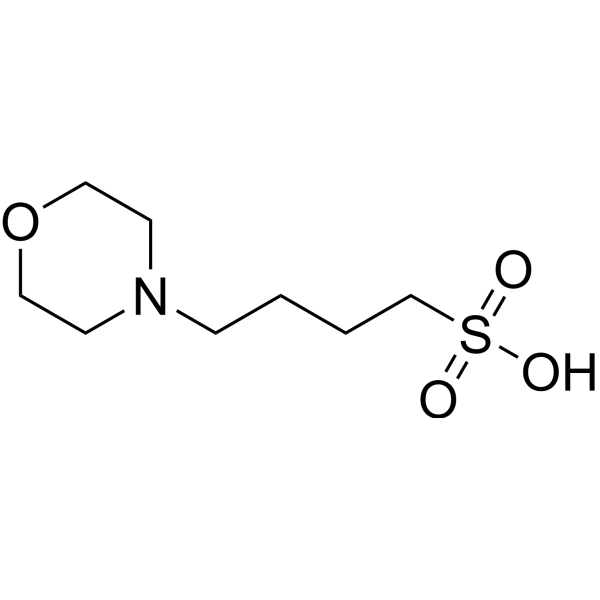
MOBS is a zwitterionic compound and biological buffer. MOBS is compatible with common biological media .
|
-
- HY-D0858D
-
|
2-Morpholinoethanesulphonic acid hemisodium
|
Biochemical Assay Reagents
|
|
MES (2-Morpholinoethanesulphonic acid) hemisodium is a kind of amphoteric ion buffer, the buffer capacity ranging pH 5.5-7.0. As a Good's buffer, MES hemisodium is widely used in biochemistry and molecular biology experiments, such as cell culture, enzyme activity determination, electrophoresis and protein studies .
|
-
- HY-W579346
-
|
|
Biochemical Assay Reagents
|
|
POPSO sesquisodium is a water-soluble zwitterionic buffer. POPSO sesquisodium is commonly used in biological and biochemical studies to maintain the acidity or alkalinity (pH value) of solutions, especially within the physiological pH range of 7.0 to 8.5 .
|
-
- HY-172190A
-
|
|
Biochemical Assay Reagents
|
|
MS Medium (Agar-Free, Sucrose-Free) is a culture medium with a high concentration of inorganic salts and ions, making it a relatively stable balanced solution. The quantity and ratio of nutrients in MS Medium (Agar-Free, Sucrose-Free) are suitable to meet the nutritional and physiological needs of plants.
|
-
- HY-182733A
-
|
|
Biochemical Assay Reagents
|
|
Yoshida Rice Nutrient Solution is a hydroponic nutrient solution for rice that can be used in rice physiology, genetic breeding, and nutritional research.
|
-
- HY-182733K
-
|
|
Biochemical Assay Reagents
|
|
Plant Acidic Salt Solution is an acidic salt solution used for plant physiology and can be used to study the selective absorption of ions by plant roots.
|
-
- HY-182733M
-
|
|
Biochemical Assay Reagents
|
|
Plant Control Salt Solution is a control reagent specifically designed for plant physiological research. It is primarily used to study the absorption and selectivity of salts in plants and to analyze the effects of salt solutions on plants.
|
-
- HY-D0858DR
-
|
2-Morpholinoethanesulphonic acid hemisodium (Standard)
|
Biochemical Assay Reagents
|
|
MES (hemisodium) (Standard) is the analytical standard of MES (hemisodium). This product is intended for research and analytical applications. MES (2-Morpholinoethanesulphonic acid) hemisodium is a kind of amphoteric ion buffer, the buffer capacity ranging pH 5.5-7.0. As a Good's buffer, MES hemisodium is widely used in biochemistry and molecular biology experiments, such as cell culture, enzyme activity determination, electrophoresis and protein studies .
|
-
- HY-172190C
-
|
|
Biochemical Assay Reagents
|
|
MS Medium (Calcium-Free) is a culture medium with a high concentration of inorganic salts and ions, making it a relatively stable balanced solution. The quantity and ratio of nutrients in MS Medium (Calcium-Free) are suitable to meet the nutritional and physiological needs of plants.
|
-
- HY-172190B
-
|
|
Biochemical Assay Reagents
|
|
MS Medium (Agar-Free) is a culture medium with a high concentration of inorganic salts and ions, making it a relatively stable balanced solution. The quantity and ratio of nutrients in MS Medium (Agar-Free) are suitable to meet the nutritional and physiological needs of plants.
|
Your information is safe with us. * Required Fields.
Inquiry Information
- Product Name:
- Cat. No.:
- Quantity:
- MCE Japan Authorized Agent:








