1. Search Result
Search Result
Results for "

plant bacterial diseases

" in MedChemExpress (MCE) Product Catalog:

13

Inhibitors & Agonists

1

Screening Libraries

3

Biochemical Assay Reagents

4

Natural
Products

1

Isotope-Labeled Compounds

Targets Recommended:
Cat. No. Product Name Target Research Areas Chemical Structure
  • HY-N9497

    Galectin Fungal Infection
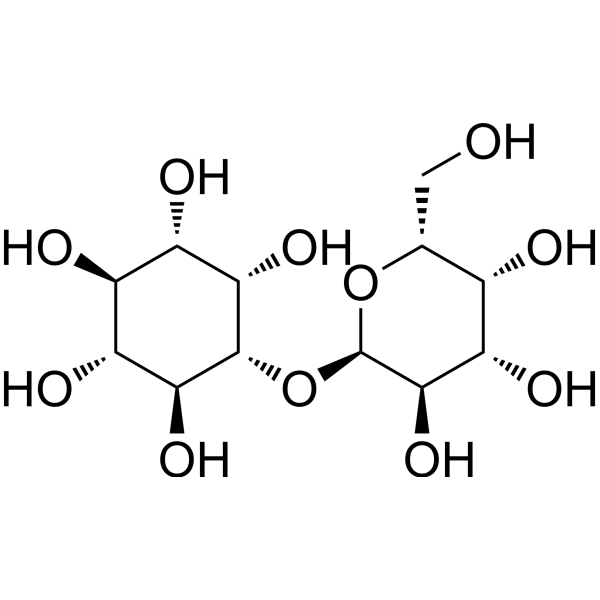
    Galactinol is a disaccharide carbohydrate serving as a galactosyl donor, which belongs to the raffinose family oligosaccharide pathway and acts as an important osmoprotectant. Galactinol not only induces disease resistance in plants against fungal and bacterial pathogens, but also significantly enhances plant tolerance to abiotic stresses such as drought, high salinity, low temperature and oxidative damage. In addition, Galactinol has the ability to scavenge hydroxyl radicals, can act as a signaling component for root colonization-induced systemic resistance, and is positively correlated with seed longevity in various crops, making it a potential biomarker for evaluating seed vigor. Therefore, Galactinol can be used in the research of various plant diseases including fungal leaf spot, bacterial angular leaf spot, gray mold and soft rot .
    Galactinol
  • HY-W015551

    (E)-Dec-2-enal

    Bacterial Reactive Oxygen Species (ROS) Infection
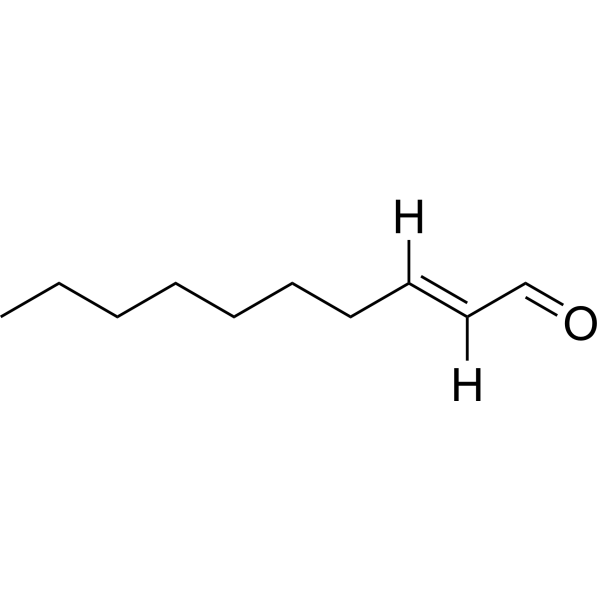
    trans-2-Decenal ((E)-Dec-2-enal) acts as a urease inhibitor and antibacterial agent against Helicobacter pylori, with an IC50 of 9.484 μg/mL against Helicobacter pylori urease. trans-2-Decenal reduces the urease activity of Helicobacter pylori, and possesses antibacterial, bactericidal, anti-biofilm and anti-migratory activities. It alters the morphology of Helicobacter pylori, induces bacterial rupture, inhibits biofilm formation, reduces the number of mature biofilms and impairs the migratory capacity of Helicobacter pylori. trans-2-Decenal disrupts the cell wall integrity of Phytophthora capsici, damages membrane integrity and permeability, triggers intracellular reactive oxygen species (ROS) accumulation, decreases glutathione levels and disrupts the mitochondrial membrane potential of Phytophthora capsici. trans-2-Decenal is applicable to studies related to Helicobacter pylori and plant diseases induced by and Phytophthora capsici .
    trans-2-Decenal
  • HY-116541

    ASM

    Environmental Pollutants Fungal Bacterial Infection
    Acibenzolar-S-methyl (ASM) is a plant resistance inducer that mimics pathogen-host interactions and leads to systemic acquired resistance in plants. Acibenzolar-S-methyl helps reduce the use of pesticides and can be used in research to prevent plant diseases .
    Acibenzolar-S-methyl
  • HY-130323

    Bacterial Infection
    13-HPOT is a linolenic acid hydroperoxide and an antibacterial agent. 13-HPOT interacts with lipid representatives of bacterial inner membranes. 13-HPOT exerts dose-dependent in vitro antibacterial activity against Pectobacterium carotovorum, Pseudomonas syringae pv. syringae DC3000, and Xanthomonas translucens pv. translucens .
    13-HPOT
  • HY-135258

    Galectin Fungal Others
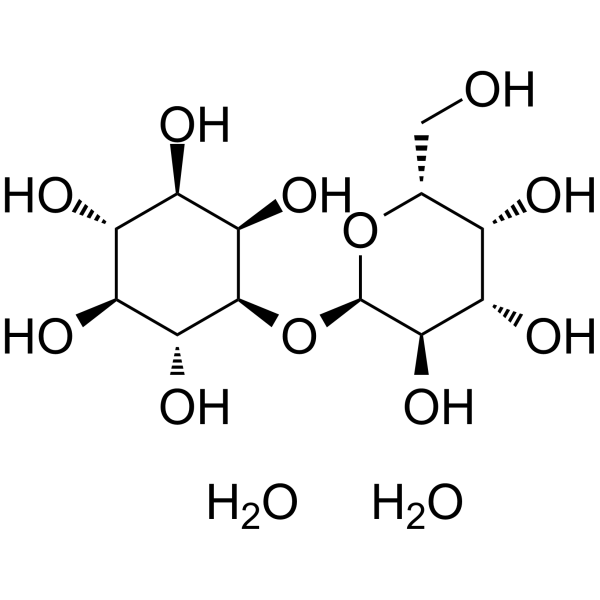
    Galactinol dihydrate is a disaccharide carbohydrate serving as a galactosyl donor, which belongs to the raffinose family oligosaccharide pathway and acts as an important osmoprotectant. Galactinol dihydrate not only induces disease resistance in plants against fungal and bacterial pathogens, but also significantly enhances plant tolerance to abiotic stresses such as drought, high salinity, low temperature and oxidative damage. In addition, Galactinol dihydrate has the ability to scavenge hydroxyl radicals, can act as a signaling component for root colonization-induced systemic resistance, and is positively correlated with seed longevity in various crops, making it a potential biomarker for evaluating seed vigor. Therefore, Galactinol dihydrate can be used in the research of various plant diseases including fungal leaf spot, bacterial angular leaf spot, gray mold and soft rot .
    Galactinol dihydrate
  • HY-116541R

    ASM (Standard)

    Bacterial Fungal Reference Standards Infection
    Acibenzolar-S-methyl (Standard) is the analytical standard of Acibenzolar-S-methyl. This product is intended for research and analytical applications. Acibenzolar-S-methyl (ASM) is a plant resistance inducer that mimics pathogen-host interactions and leads to systemic acquired resistance in plants. Acibenzolar-S-methyl helps reduce the use of pesticides and can be used in research to prevent plant diseases .
    Acibenzolar-S-methyl (Standard)
  • HY-155661

    Reactive Oxygen Species (ROS) Infection
    ROS inducer 2 (Compound I16) is a ROS inducer. ROS inducer 2 has good activity in vitro, with an EC50 of 3.43 μg/mL. ROS inducer 2 has outstanding bioactivities in vivo against Xanthomonas axonopodis pv. citri. ROS inducer 2, as a bactericidal agent, can be used for the research of intractable plant bacterial diseases .
    ROS inducer 2
  • HY-155662

    Reactive Oxygen Species (ROS) Infection
    ROS inducer 3 (Compound I6) is a ROS inducer. ROS inducer 3 has excellent in vitro bioactivity with an EC50 of 2.86 μg/mL. ROS inducer 3 has significant protective activity for preventing Pseudomonas syringae pv. actinidiae. ROS inducer 2, as a bactericidal agent, can be used for the research of intractable plant bacterial diseases .
    ROS inducer 3
  • HY-168844

    Bacterial Reactive Oxygen Species (ROS) Infection
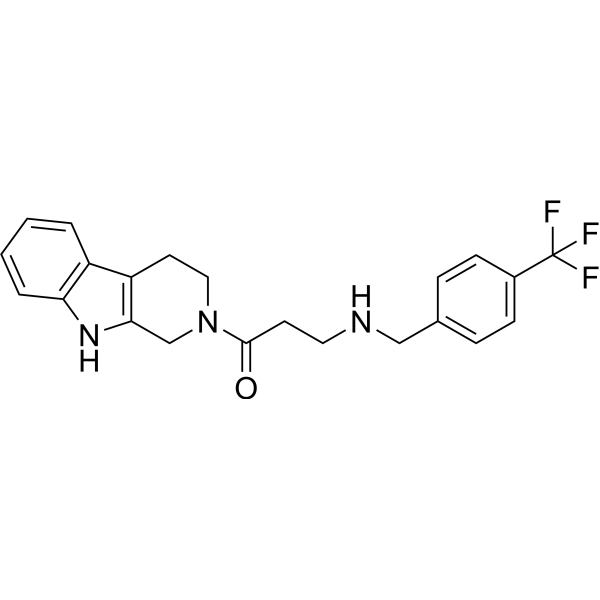
    Antibacterial agent 259 (K3) is a bactericide, with EC50 values ​​of 1.5, 1.7 and 4.9 mg/L for Xoo, Xoc and Xac, respectively. Antibacterial agent 259 can induce pathogens to produce reactive oxygen species (ROS), leading to their death. Antibacterial agent 259 can be used in the prevention and control of plant bacterial diseases .
    Antibacterial agent 259
  • HY-W015551R

    (E)-Dec-2-enal (Standard)

    Biochemical Assay Reagents Reference Standards Infection
    trans-2-Decenal ((E)-Dec-2-enal)) Standard is the analytical standard of trans-2-Decenal (HY-W015551). This product is intended for research and analytical applications. trans-2-Decenal ((E)-Dec-2-enal) acts as a urease inhibitor and antibacterial agent against Helicobacter pylori, with an IC50 of 9.484 μg/mL against Helicobacter pylori urease. trans-2-Decenal reduces the urease activity of Helicobacter pylori, and possesses antibacterial, bactericidal, anti-biofilm and anti-migratory activities. It alters the morphology of Helicobacter pylori, induces bacterial rupture, inhibits biofilm formation, reduces the number of mature biofilms and impairs the migratory capacity of Helicobacter pylori. trans-2-Decenal disrupts the cell wall integrity of Phytophthora capsici, damages membrane integrity and permeability, triggers intracellular reactive oxygen species (ROS) accumulation, decreases glutathione levels and disrupts the mitochondrial membrane potential of Phytophthora capsici. trans-2-Decenal is applicable to studies related to Helicobacter pylori and plant diseases induced by and Phytophthora capsici.
    trans-2-Decenal (Standard)
  • HY-W015551S

    (E)-Dec-2-enal-d2

    Biochemical Assay Reagents Isotope-Labeled Compounds Infection
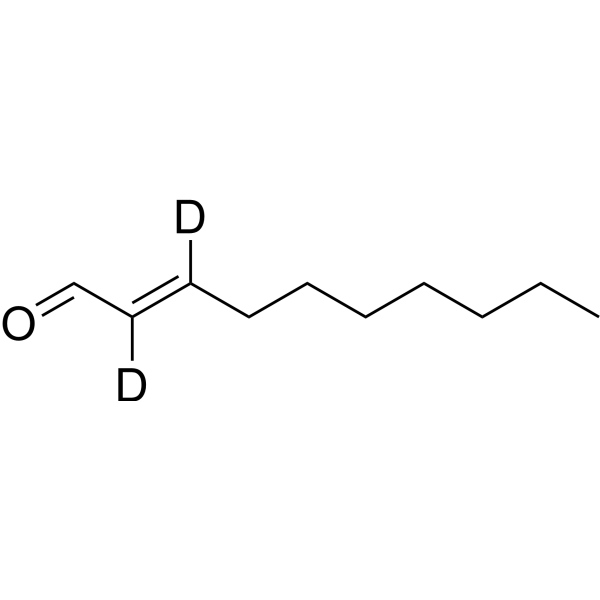
    trans-2-Decenal-d2 ((E)-Dec-2-enal-d2) is deuterated labeled trans-2-Decenal (HY-W015551). trans-2-Decenal ((E)-Dec-2-enal) acts as a urease inhibitor and antibacterial agent against Helicobacter pylori, with an IC50 of 9.484 μg/mL against Helicobacter pylori urease. trans-2-Decenal reduces the urease activity of Helicobacter pylori, and possesses antibacterial, bactericidal, anti-biofilm and anti-migratory activities. It alters the morphology of Helicobacter pylori, induces bacterial rupture, inhibits biofilm formation, reduces the number of mature biofilms and impairs the migratory capacity of Helicobacter pylori. trans-2-Decenal disrupts the cell wall integrity of Phytophthora capsici, damages membrane integrity and permeability, triggers intracellular reactive oxygen species (ROS) accumulation, decreases glutathione levels and disrupts the mitochondrial membrane potential of Phytophthora capsici. trans-2-Decenal is applicable to studies related to Helicobacter pylori and plant diseases induced by and Phytophthora capsici .
    trans-2-Decenal-d2
  • HY-162898

    Bacterial Infection
    Anti-virulence factor-IN-1 (Compound 4S) is a bacterial virulence factor inhibitor by interfering with the bacterial infection process. Anti-virulence factor-IN-1 exhibits an antibacterial activity against Xoo in vitro with an EC50 value of 0.28 µg/mL. Anti-virulence factor-IN-1 can be used to effectively manage rice bacterial leaf blight in vivo. Anti-virulence factor-IN-1 is promising for research of plant bacterial disease .
    Anti-virulence factor-IN-1
  • HY-N16462

    Bacterial Infection
    2-(2-Heptenyl)-3-methyl-4(1H)-quinolone is a quinoline alkaloid found in Burkholderia sp. VY81. 2-(2-Heptenyl)-3-methyl-4(1H)-quinolone is promising for research of bacterial diseases in rice (e.g., soft rot) and other plant pathogens (e.g., Pythium ultimum, Fusarium oxysporum) .
    2-(2-Heptenyl)-3-methyl-4(1H)-quinolone

Inquiry Online

Your information is safe with us. * Required Fields.

Salutation


Country or Region *

Applicant Name *


Organization Name *

Department *


Email Address *


Product Name *

Cat. No.


Requested quantity *

Phone Number *


Remarks

Inquiry Online

Inquiry Information

Product Name:
Cat. No.:
Quantity:
MCE Japan Authorized Agent:

