12 Results for "

polyurethane

" in MedChemExpress (MCE) Product Catalog:
Products (12)

12 Results for "polyurethane" in MCE Product Catalog:

2
2 Cited Publications
Cat. No.: HY-W002105
CAS No.: 3238-40-2
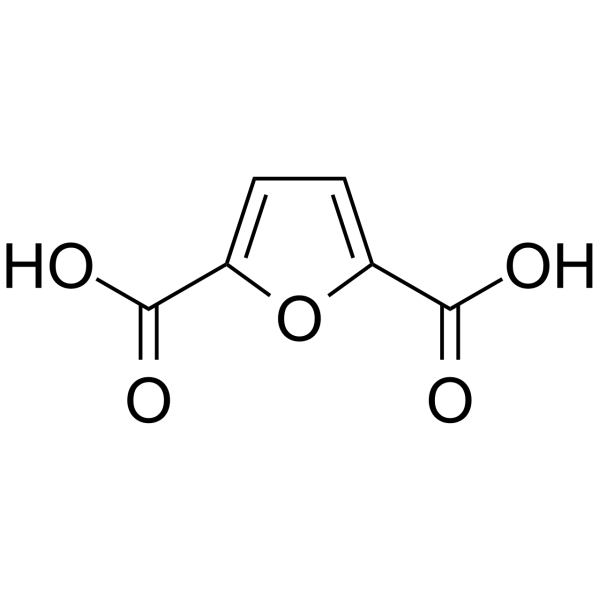
2,5-Furandicarboxylic acid is an endogenous metabolite that can be detected in human urine. 2,5-Furandicarboxylic acid serves as an environmentally friendly substitute for terephthalic acid in the production of polyesters. 2,5-Furandicarboxylic acid can be used as the raw material for various chemical intermediates to synthesize polymers, polyurethanes, thermosetting resins, and plasticizers .
loading...
    loading...
Cat. No.: HY-Y0338
CAS No.: 107-21-1
Ethylene glycol is an organic compound that is often used as an antifreeze agent and coolant. Ethylene glycol lowers the freezing point by forming hydrogen bonds with water molecules, exerting antifreeze activity. Ethylene glycol is also used as a raw material in the synthesis of polymers such as polyester fibers and polyurethanes .
loading...
    loading...
Cat. No.: HY-P11070
CAS No.: 1927877-75-5
Target:  

Peptides

Research Areas:  

Others

SDSSD is an osteoblast-targeting peptide. SDSSD selectively binds to periostin on osteoblasts and mediates targeted delivery to these cells. SDSSD can endow calcium phosphate nanocomposites with bone-targeting properties, and these materials exhibit osteointegrative capacity in both in vitro and in vivo models. When conjugated with polyurethane nanomicelles, SDSSD enables targeted delivery of siRNA/microRNA to osteoblasts .
loading...
    loading...
Cat. No.: HY-W020249
CAS No.: 97600-39-0
Research Areas:  

Others

Sodium ionophore X is a neutral ionophore that binds highly selectively to sodium ions (Na +) to form stable complexes. Sodium ionophore X can be used to construct ion-selective chemical sensors (including optical sensors and electrochemical sensors) .
loading...
    loading...
Cat. No.: HY-W392100C
CAS No.: 36890-68-3
Synonyms: PCL-diol (MW 10000)
Polycaprolactone diol (MW 10000) is a biocompatible, biodegradable polymer and also a castor oil-based polyurethane additive. Polycaprolactone diol (MW 10000) is used in studies of wound dressings and non-absorbable suture biomaterials .
loading...
    loading...
Cat. No.: HY-W017508
CAS No.: 629-41-4
1,8-Octanediol is an aliphatic diol and also a monomer used in the synthesis of polyesters and polyurethanes. As a monomer, 1,8-Octanediol participates in the lipase-catalyzed bulk polycondensation with adipic acid for the synthesis of aliphatic polyesters. 1,8-Octanediol can be applied in relevant studies in fields such as material synthesis .
loading...
    loading...
Cat. No.: HY-W051391
CAS No.: 96556-05-7
Synonyms: Me3TACN
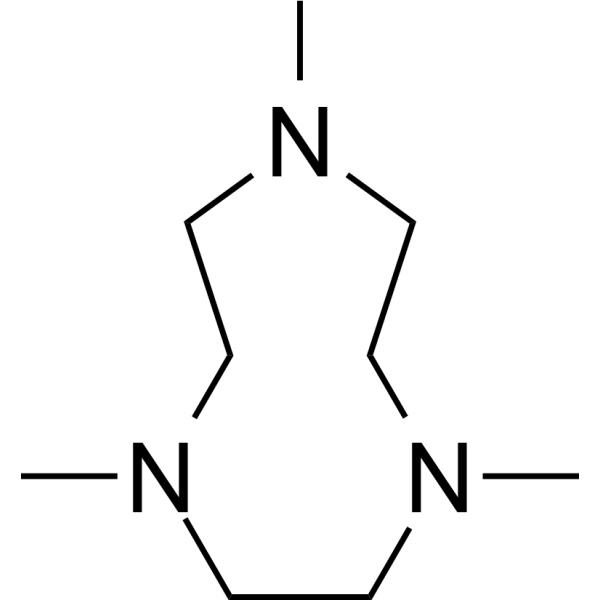
1,4,7-Trimethyl-1,4,7-triazonane, also known as TMT or trimethylenetris(aziridine), is a cyclic organic compound. TMT is commonly used as a crosslinking agent and a precursor for polymer and resin synthesis. In addition, it is used as a stabilizer in the production of polyurethane foam and as a curing agent for epoxy resins. Due to its high reactivity and stability, TMT is considered to be a versatile and efficient reagent in various applications.
loading...
    loading...
Cat. No.: HY-165864B
CAS No.: 4496-86-0
Synonyms: 12-Hydroxy-9(E)-octadecenol
Research Areas:  

Others

(E)-Octadec-9-ene-1,12-diol is a Castor oil (HY-107799)-derived diol and Chain Extender. (E)-Octadec-9-ene-1,12-diol acts as a ring-opening agent for epoxidized vegetable oils in polyurethane synthesis .
loading...
    loading...
Cat. No.: HY-W017508S
1,8-Octanediol-d12 is the deuterated-labeled 1,8-Octanediol (HY-W017508). 1,8-Octanediol is an aliphatic diol and also a monomer used in the synthesis of polyesters and polyurethanes. As a monomer, 1,8-Octanediol participates in the lipase-catalyzed bulk polycondensation with adipic acid for the synthesis of aliphatic polyesters. 1,8-Octanediol can be applied in relevant studies in fields such as material synthesis .
loading...
    loading...
Cat. No.: HY-W133921
CAS No.: 25265-71-8
Research Areas:  

Others

Dipropylene glycol is a mixture of three structural isomers (2-(2-hydroxypropoxy)-1-propanol, 1,1'-oxybis (2-propanol), and 2,2'-oxybis (1-propanol)). Dipropylene glycol induces liver and kidney damage as well as reproductive toxicity in rodents. Dipropylene glycol can be used in chemical industry-related research, such as for plasticizers, polyester resins, cosmetics, fragrances, polyurethane polyols, and alkyd resins .
loading...
    loading...
Cat. No.: HY-W002105R
CAS No.: 3238-40-2
2,5-Furandicarboxylic acid (Standard) is the analytical standard of 2,5-Furandicarboxylic acid (HY-W002105). This product is intended for research and analytical applications. 2,5-Furandicarboxylic acid is an endogenous metabolite that can be detected in human urine. 2,5-Furandicarboxylic acid serves as an environmentally friendly substitute for terephthalic acid in the production of polyesters. 2,5-Furandicarboxylic acid can be used as the raw material for various chemical intermediates to synthesize polymers, polyurethanes, thermosetting resins, and plasticizers .
loading...
    loading...
Cat. No.: HY-117007
CAS No.: 106-91-2
Research Areas:  

Others

Glycidyl methacrylate is a bifunctional monomer containing both a polymerizable methacrylate double bond and a reactive epoxy group. Glycidyl methacrylate can be introduced into polymer backbones via free radical polymerization, and its epoxy group undergoes ring-opening reactions with nucleophilic groups such as amines, carboxylic acids and thiols, thus being used for the preparation of functional polymers, surface-grafted materials and crosslinkable biomaterials. Glycidyl methacrylate is applicable to research related to polymer chemistry, biomaterials, surface modification and drug delivery materials .
loading...
    loading...
  • 1

