1. Search Result
Search Result
Results for "

repeated administration

" in MedChemExpress (MCE) Product Catalog:

9

Inhibitors & Agonists

2

Biochemical Assay Reagents

1

Oligonucleotides

Cat. No. Product Name Target Research Areas Chemical Structure
  • HY-162351

    Emopamil Binding Protein Metabolic Disease
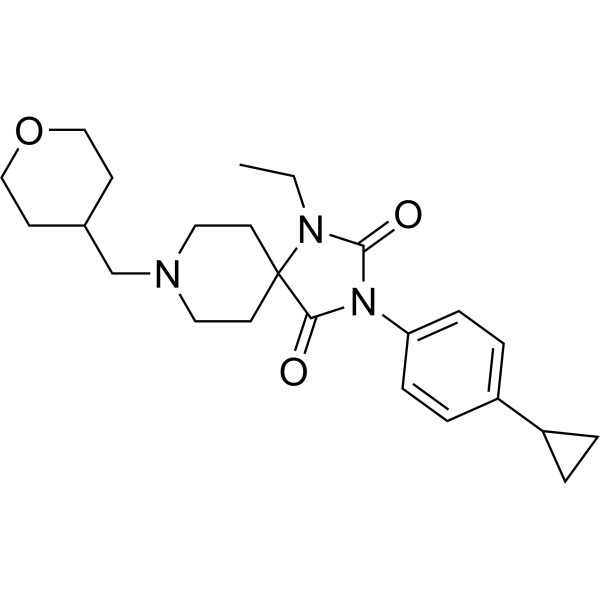
    EBP-IN-1 is an orally active, blood-brain barrier-permeable inhibitor of emopamil binding protein (EBP). EBP-IN-1 has an IC50 of 8.2 μM against human ERG potassium channels (in CHO background). By inhibiting the sterol isomerase activity of EBP, EBP-IN-1 causes the accumulation of Zymostenol (HY-113345), and exhibits strong target binding in the brain after repeated administration in rodents. EBP-IN-1 also promotes oligodendrocyte formation in human cortical organoids and can be used in research related to multiple sclerosis .
    EBP-IN-1
  • HY-147332

    Liposome Neurological Disease
    TCL053 is an ionizable lipid carrier and used to introduce active components, in particular nucleic acids, into cells with excellent efriciency. TCL053, together with DPPC (Dipalmitoylphosphatidylcholine), PEG-DMG (Polyethylene glycoldimyristoyl glycerol), and cholesterol, forms lipid nanoparticle (LNP) which is able to deliver Cas9 mRNA and sgRNA into skeletal muscle .
    TCL053
  • HY-Y0850U3

    Polyvinyl alcohol (Mw 125000, 98-99% hydrolyzed, ~2800 polymerization); Poly(Ethenol) (Mw 125000, 98-99% hydrolyzed, ~2800 polymerization)

    Biochemical Assay Reagents Others
    PVA (Polyvinyl alcohol) (Mw 125000, 98-99% hydrolyzed, ~2800 polymerization) is a water-soluble, biodegradable, biocompatible and non-immunogenic polymer. PVA (Mw 125000, 98-99% hydrolyzed, ~2800 polymerization) causes no irritation to rabbit eyes, no skin sensitization in guinea pigs, promotes the proliferation of human skin keratinocytes, and reduces the loss of corneal endothelial cells. The LD50 of PVA (Mw 125000, 98-99% hydrolyzed, ~2800 polymerization) in rats and dogs is greater than 10 g/kg. PVA (Mw 125000, 98-99% hydrolyzed, ~2800 polymerization) is hardly absorbed by the digestive system, causes no adverse effects upon long-term oral administration, and shows no mutagenicity or carcinogenicity. However, repeated intravenous or portal vein injection of PVA (Mw 125000, 98-99% hydrolyzed, ~2800 polymerization) may induce pathological changes such as glomerular lesions, anemia, hypertension or liver fibrosis in rats or dogs. Crosslinked nanofibers prepared by modifying PVA (Mw 125000, 98-99% hydrolyzed, ~2800 polymerization) can be used in studies related to wound dressings and other applications .
    PVA (Mw 125000, 98-99% hydrolyzed, ~2800 polymerization)
  • HY-W013762

    Environmental Pollutants Biochemical Assay Reagents Others
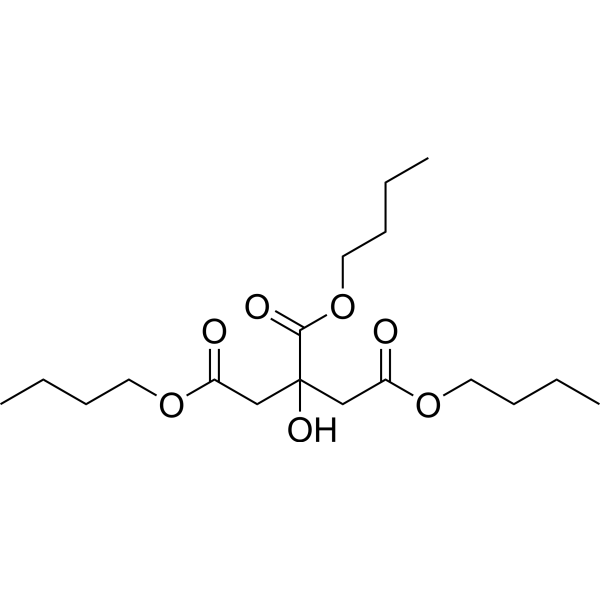
    Tributyl citrate is a low-toxicity and orally active citrate ester with no genotoxicity or skin sensitizing activity. Tributyl citrate also acts as a plasticizer, solvent, FDA-approved indirect food additive, and topical anesthetic, among other uses. Tributyl citrate induces a needle-prick insensitivity response that lasts for more than 2 hours, and a 5% suspension of it temporarily eliminates the corneal reflex in rabbits. Tributyl citrate causes no significant systemic toxicity in rats and cats at most tested doses, and only may cause growth retardation and gastrointestinal reactions such as diarrhea and nausea at high doses or with repeated oral administration .
    Tributyl citrate
  • HY-165529
    Camostat
    40+ Cited Publications

    Ser/Thr Protease Inflammation/Immunology
    Camostat is an orally active trypsin inhibitor. Camostat can reduce pancreatic fibrosis induced by repeated administration of superoxide dismutase inhibitors in rats, and decrease the proliferation and activation of pancreatic stellate cells (PSCs) .
    Camostat
  • HY-W762012

    OCDD

    Cytochrome P450 Environmental Pollutants Others
    Octachlorodibenzo-p-dioxin (OCDD) is an environmental contaminant but is not acutely toxic. In rats, Octachlorodibenzo-p-dioxin (50 μg/kg i.v. or 50-5000 μg/kg p.o.) has a systemic elimination half-life of 3-5 months and accumulates and concentrates in the liver and adipose tissue after low-dose, repeated exposure. Repeated administration of octachlorodibenzo-p-dioxin causes increases in 7-ethoxyresorufin-O-deethylase (7-EROD) activity and total cytochrome P-450 levels .
    Octachlorodibenzo-p-dioxin
  • HY-121550

    Angiotensin-converting Enzyme (ACE) Cardiovascular Disease
    ME3221 is an angiotensin AT1 receptor antagonist that effectively antagonizes the pressor response to angiotensin II in rats and marmosets without affecting the hypotensive response to bradykinin. It demonstrates potent antihypertensive effects in renal hypertensive rats and spontaneously hypertensive rats (SHR). ME3221's repeated administration in SHR results in sustained and stable hypotensive effects without affecting heart rate, indicating its potential for studying both renal and essential hypertension .
    ME3221
  • HY-W013762R

    Reference Standards Biochemical Assay Reagents Others
    Tributyl citrate (Standard) is the analytical standard of Tributyl citrate. This product is intended for research and analytical applications. Tributyl citrate is a low-toxicity and orally active citrate ester with no genotoxicity or skin sensitizing activity. Tributyl citrate also acts as a plasticizer, solvent, FDA-approved indirect food additive, and topical anesthetic, among other uses. Tributyl citrate induces a needle-prick insensitivity response that lasts for more than 2 hours, and a 5% suspension of it temporarily eliminates the corneal reflex in rabbits. Tributyl citrate causes no significant systemic toxicity in rats and cats at most tested doses, and only may cause growth retardation and gastrointestinal reactions such as diarrhea and nausea at high doses or with repeated oral administration .
    Tributyl citrate (Standard)
  • HY-182407

    Angiotensin-converting Enzyme (ACE) Cardiovascular Disease
    CV 5975 is an orally active angiotensin converting enzyme (ACE) competitive inhibitor with a rabbit lung ACE IC50 of 3.1 nM and Ki values of 2.6 nM. CV 5975 inhibits ACE in plasma, aorta, kidney, and brain, intensifying inhibition with repeated administration. CV 5975 inhibits Angiotensin I (HY-P1032)-induced pressor responses and ileum contraction, and augments bradykinin-induced ileum contraction and depressor responses. CV 5975 reduces blood pressure via ACE-independent mechanisms, with sustained action across multiple hypertensive and normotensive animal models, intensified by repeated dosing or Hydrochlorothiazide (HY-B0252) co-administration. CV 5975 can be used for the research of hypertension .
    CV 5975

Inquiry Online

Your information is safe with us. * Required Fields.

Salutation


Country or Region *

Applicant Name *


Organization Name *

Department *


Email Address *


Product Name *

Cat. No.


Requested quantity *

Phone Number *


Remarks

Inquiry Online

Inquiry Information

Product Name:
Cat. No.:
Quantity:
MCE Japan Authorized Agent:

