1. Search Result
Search Result
Results for "

retinal tissue

" in MedChemExpress (MCE) Product Catalog:

12

Inhibitors & Agonists

1

Isotope-Labeled Compounds

1

Antibodies

5

Oligonucleotides

Cat. No. Product Name Target Research Areas Chemical Structure
  • HY-14648A
    Dexamethasone acetate
    5+ Cited Publications

    Dexamethasone 21-acetate; Hexadecadrol acetate

    Glucocorticoid Receptor Inflammation/Immunology
    Dexamethasone acetate (Dexamethasone 21-acetate) is the acetate form of the glucocorticoid Dexamethasone (HY-14648). Dexamethasone acetate has a longer duration of action than Dexamethasone. Dexamethasone acetate can accumulate at inflammatory sites, in mouse liver and mouse lung via nanostructured lipid carriers. Dexamethasone acetate can be used to prepare topical formulations for studies related to sensorineural hearing loss, γ-carrageenan-induced paw edema, chronic active hepatitis, pulmonary diseases, and inflammation after vitreoretinal surgery .
    Dexamethasone acetate
  • HY-107661
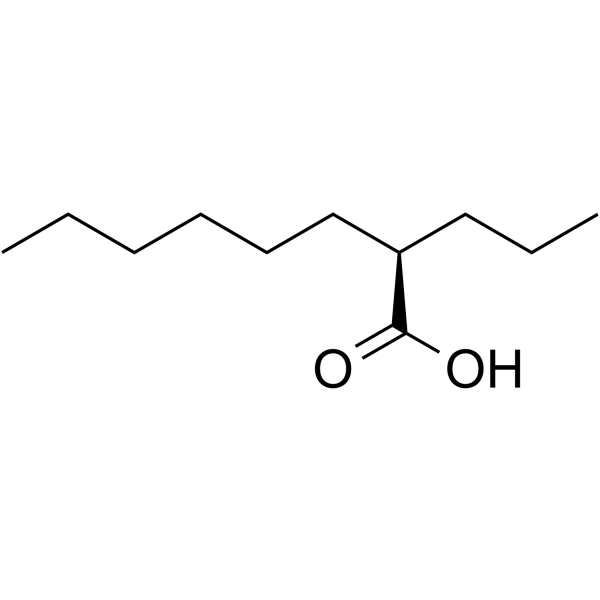
    Arundic Acid
    2 Publications Verification

    ONO-2506; (R)-2-Propyloctanoic acid

    ERK Akt NF-κB EAAT Cardiovascular Disease Neurological Disease
    Arundic Acid is an orally effective astrocyte function modulator and neuroprotective agent. Arundic Acid increases the expression and function of the astrocytic glutamate transporter EAAT1 by activating the ERK, Akt and NF-κB pathways. Arundic Acid attenuates retinal ganglion cell death in a normal-tension glaucoma model. Arundic Acid exerts neuroprotective effects in a mouse model of Parkinson's disease. Arundic Acid is a S100β protein synthesis inhibitor that prevents neurological deficits and brain tissue damage after intracerebral hemorrhage in rats. Arundic Acid downregulates neuroinflammation and astrocytic dysfunction after status epilepticus in immature rats. Arundic Acid is applicable to research related to Parkinson's disease, cerebral ischemia, glaucoma, intracerebral hemorrhage and epilepsy .
    Arundic Acid
  • HY-163684

    Complement System Inflammation/Immunology
    Zoracopan is a selective complement factor D (CFD) inhibitor. When administered systemically (orally or intravenously), Zoracopan accumulates and is sustained-released in ocular tissues, primarily in the choroid-retinal pigment epithelium (C-RPE) and/or iridociliary body (I-CB) .
    Zoracopan
  • HY-158821A

    TGF-beta/Smad Neurological Disease
    ISTH0036 sodium is a phosphorothioate LNA-modified antisense oligonucleotide gapmer that selectively targets and downregulates TGF-β2 mRNA. ISTH0036 sodium suppresses TGF-β2 expression, reduces choroidal neovascularization and vascular leakage, inhibits fibrosis, blocks epithelial-to-mesenchymal transition, and inhibits angiogenesis while promoting bleb survival. ISTH0036 sodium exhibits long-lasting, dose-dependent ocular tissue distribution and target engagement in rabbit and non-human primate eyes. ISTH0036 sodium can be used for the study of various ocular disorders, such as glaucoma and neovascular retinal diseases .
    ISTH0036 sodium
  • HY-158821

    TGF-beta/Smad Neurological Disease
    ISTH0036 is a phosphorothioate LNA-modified antisense oligonucleotide gapmer that selectively targets and downregulates TGF-β2 mRNA. ISTH0036 suppresses TGF-β2 expression, reduces choroidal neovascularization and vascular leakage, inhibits fibrosis, blocks epithelial-to-mesenchymal transition, and inhibits angiogenesis while promoting bleb survival. ISTH0036 exhibits long-lasting, dose-dependent ocular tissue distribution and target engagement in rabbit and non-human primate eyes. ISTH0036 can be used for the study of various ocular disorders, such as glaucoma and neovascular retinal diseases .
    ISTH0036
  • HY-122129

    Endogenous Metabolite Metabolic Disease
    Very long chain polyunsaturated fatty acids (VLCPUFA) are present in retina, sperm, and brain. Though little is known of their biosynthesis or functional roles in these tissues, recent studies using the elongation of very long-chain FA-4 protein suggest a unique role for VLCPUFA in retinal development and macular degeneration. Dotriaconta-14,17,20,23,26,29-hexaenoic acid is a C32:6 VLCPUFA whose specific biological actions are largely unknown, but are thought to involve normal photoreceptor cell function in the retina.
    Dotriaconta-14,17,20,23,26,29-hexaenoic acid
  • HY-122129S

    Isotope-Labeled Compounds Endogenous Metabolite Metabolic Disease
    Dotriaconta-14,17,20,23,26,29-hexaenoic acid-d6 is deuterium labeled Dotriaconta-14,17,20,23,26,29-hexaenoic acid. Very long chain polyunsaturated fatty acids (VLCPUFA) are present in retina, sperm, and brain. Though little is known of their biosynthesis or functional roles in these tissues, recent studies using the elongation of very long-chain FA-4 protein suggest a unique role for VLCPUFA in retinal development and macular degeneration. Dotriaconta-14,17,20,23,26,29-hexaenoic acid is a C32:6 VLCPUFA whose specific biological actions are largely unknown, but are thought to involve normal photoreceptor cell function in the retina .
    Dotriaconta-14,17,20,23,26,29-hexaenoic acid-d6
  • HY-W423707

    VEGFR Cardiovascular Disease
    TG 100948 is a dual VEGFR and tyrosine kinase Src inhibitor. TG 100948 reduces retinal edema and retinal thickening, and eliminates bullous edema cysts in a rat model of ischemic retinal vein occlusion. TG 100948 can be used for the research of ischemic retinal vein occlusion .
    TG 100948
  • HY-156184

    Endogenous Metabolite Neurological Disease Metabolic Disease Cancer
    Octanoylcarnitine is an orally active medium-chain acylcarnitine transport intermediate in fatty acid β-oxidation. Octanoylcarnitine is converted to octanoyl-CoA by carnitine acetyltransferase (CrAT), which then generates energy via β-oxidation in mitochondria of the heart and skeletal muscle. Octanoylcarnitine enhances grip strength and treadmill endurance, alleviates lactic acidosis, distributes in muscle and heart tissues, increases free carnitine levels, and mitigates mitochondrial stress. Octanoylcarnitine is associated with long-chain fatty acid metabolism, shows a positive correlation with subcutaneous fat area in patients with metastatic pancreatic ductal adenocarcinoma, and is closely related to central retinal artery occlusion (CRAO) .
    Octanoylcarnitine
  • HY-158821B

    TGF-beta/Smad Neurological Disease
    ISTH0036 sodium scrambled negative control is the sequence scrambled negative control of ISTH0036 sodium (HY-158821A). ISTH0036 sodium is a phosphorothioate LNA-modified antisense oligonucleotide gapmer that selectively targets and downregulates TGF-β2 mRNA. ISTH0036 sodium suppresses TGF-β2 expression, reduces choroidal neovascularization and vascular leakage, inhibits fibrosis, blocks epithelial-to-mesenchymal transition, and inhibits angiogenesis while promoting bleb survival. ISTH0036 sodium exhibits long-lasting, dose-dependent ocular tissue distribution and target engagement in rabbit and non-human primate eyes. ISTH0036 sodium can be used for the study of various ocular disorders, such as glaucoma and neovascular retinal diseases.
    ISTH0036 sodium scrambled negative control
  • HY-158821D

    Fluorescent Dye TGF-beta/Smad Neurological Disease
    Cy3 labled ISTH0036 sodium is a Cy3 labled ISTH0036 sodium (HY-158821A). ISTH0036 sodium is a phosphorothioate LNA-modified antisense oligonucleotide gapmer that selectively targets and downregulates TGF-β2 mRNA. ISTH0036 sodium suppresses TGF-β2 expression, reduces choroidal neovascularization and vascular leakage, inhibits fibrosis, blocks epithelial-to-mesenchymal transition, and inhibits angiogenesis while promoting bleb survival. ISTH0036 sodium exhibits long-lasting, dose-dependent ocular tissue distribution and target engagement in rabbit and non-human primate eyes. ISTH0036 sodium can be used for the study of various ocular disorders, such as glaucoma and neovascular retinal diseases.
    Cy3 labled ISTH0036 sodium
  • HY-158821C

    Fluorescent Dye TGF-beta/Smad Neurological Disease
    FAM labled ISTH0036 sodiumis a FAM labled ISTH0036 sodium (HY-158821A). ISTH0036 sodium is a phosphorothioate LNA-modified antisense oligonucleotide gapmer that selectively targets and downregulates TGF-β2 mRNA. ISTH0036 sodium suppresses TGF-β2 expression, reduces choroidal neovascularization and vascular leakage, inhibits fibrosis, blocks epithelial-to-mesenchymal transition, and inhibits angiogenesis while promoting bleb survival. ISTH0036 sodium exhibits long-lasting, dose-dependent ocular tissue distribution and target engagement in rabbit and non-human primate eyes. ISTH0036 sodium can be used for the study of various ocular disorders, such as glaucoma and neovascular retinal diseases.
    FAM labled ISTH0036 sodium

Inquiry Online

Your information is safe with us. * Required Fields.

Salutation


Country or Region *

Applicant Name *


Organization Name *

Department *


Email Address *


Product Name *

Cat. No.


Requested quantity *

Phone Number *


Remarks

Inquiry Online

Inquiry Information

Product Name:
Cat. No.:
Quantity:
MCE Japan Authorized Agent:

