1. Search Result
Search Result
Results for "

situations

" in MedChemExpress (MCE) Product Catalog:

13

Inhibitors & Agonists

3

Peptides

6

Natural
Products

1

Isotope-Labeled Compounds

Cat. No. Product Name Target Research Areas Chemical Structure
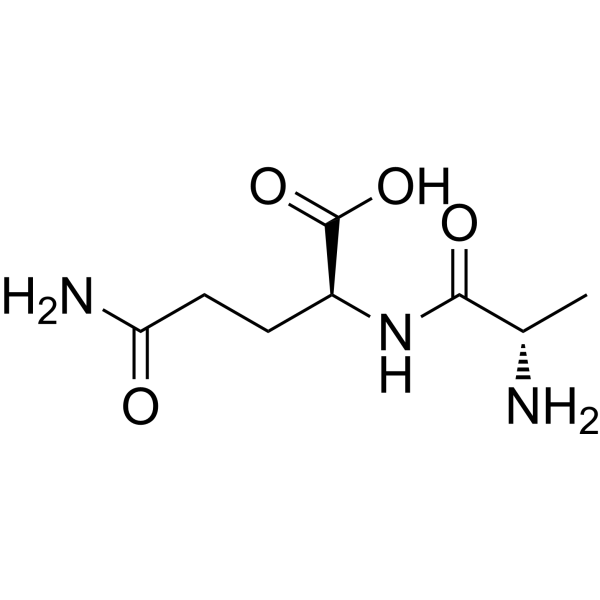
  • HY-W014102
    L-Alanyl-L-glutamine
    1 Publications Verification

    Endogenous Metabolite Metabolic Disease Inflammation/Immunology
    L-Alanyl-L-glutamine, a glutamine dipeptide, is benefit for the antioxidant system, attenuating inflammation, and may modulate the heat shock protein (HSP) response in catabolic situations .
    L-Alanyl-L-glutamine
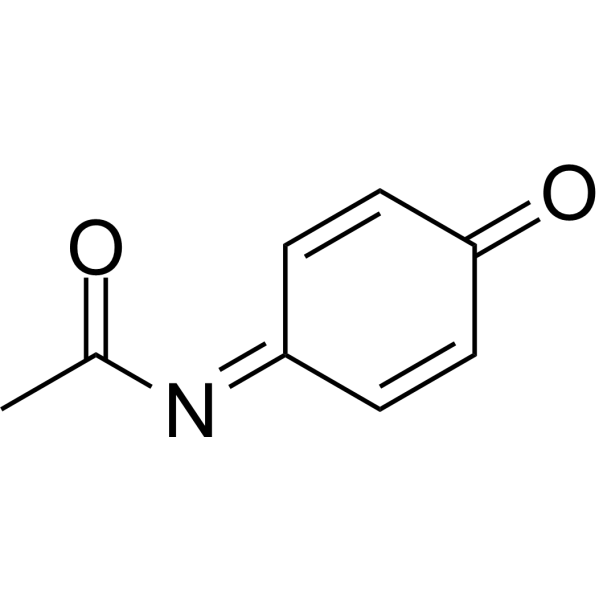
  • HY-W017464

    N-Acetyl-4-benzoquinone Imine

    Drug Metabolite Endogenous Metabolite Metabolic Disease
    NAPQI is the toxic metabolite of Acetaminophen (HY-66005). NAPQI is also an inhibitor of enzymes in the vitamin K cycle. NAPQI is rapidly detoxified by glutathione (GSH), but in situations of GSH deficiency, excess NAPQI reacts with cysteine residues in proteins, causing cell death and toxicity in the liver .
    NAPQI
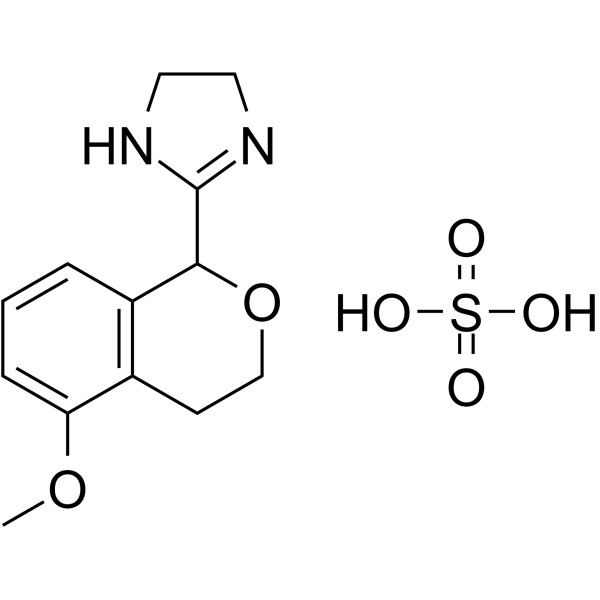
  • HY-109075A

    Adrenergic Receptor Neurological Disease
    Tasipimidine sulfate is an orally active and selective α2A-adrenoceptor agonist with a pEC50 of 7.57 for human α2A-adrenoceptors and an EC50 of 5.7 nM for rat α2-adrenoceptor. Tasipimidine sulfate can be utilized in research related to situational anxiety and fear .
    Tasipimidine sulfate
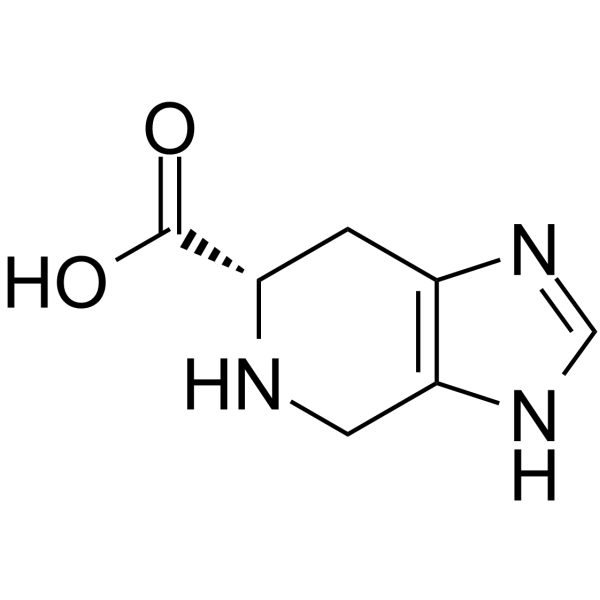
  • HY-W067716

    (S)-Spinacine

    GABA Receptor Neurological Disease
    Spinacine ((S)-Spinacine) is a GABA uptake inhibitor. Spinacine enhances synaptic GABA effects via inhibition of gamma-aminobutyric acid uptake in cerebral cortex slices. Spinacine inhibits reflex responses of ventral roots in isolated spinal cord. Spinacine inhibits motor activity and reduces approaches to water dispensers in conflict situations. Spinacine raises pain sensitivity threshold via subarachnoidal injection .
    Spinacine
  • HY-W775174

    C.I. Solvent red 80

    Fluorescent Dye
    Citrus red 2 (CI Solvent red 80) is a synthetic dye with coloring power and antioxidant activity. Citrus red 2 can be used in food and cosmetics to provide a bright color to the product. Citrus red 2 is also used as a reference substance for testing and analysis in certain situations.
    Citrus red 2
  • HY-109075

    Adrenergic Receptor Neurological Disease
    Tasipimidine is an orally active and selective α2A-adrenoceptor agonist with a pEC50 of 7.57 for human α2A-adrenoceptors and an EC50 of 5.7 nM for rat α2-adrenoceptor. Tasipimidine can be utilized in research related to situational anxiety and fear .
    Tasipimidine
  • HY-W067716R

    (S)-Spinacine (Standard)

    Reference Standards GABA Receptor Neurological Disease
    Spinacine (Standard) is the analytical standard of Spinacine (HY-W067716). This product is intended for research and analytical applications. Spinacine ((S)-Spinacine) is a GABA uptake inhibitor. Spinacine enhances synaptic GABA effects via inhibition of gamma-aminobutyric acid uptake in cerebral cortex slices. Spinacine inhibits reflex responses of ventral roots in isolated spinal cord. Spinacine inhibits motor activity and reduces approaches to water dispensers in conflict situations. Spinacine raises pain sensitivity threshold via subarachnoidal injection .
    Spinacine (Standard)
  • HY-W014102R

    Reference Standards Endogenous Metabolite Metabolic Disease Inflammation/Immunology
    L-Alanyl-L-glutamine (Standard) is the analytical standard of L-Alanyl-L-glutamine. This product is intended for research and analytical applications. L-Alanyl-L-glutamine, a glutamine dipeptide, is benefit for the antioxidant system, attenuating inflammation, and may modulate the heat shock protein (HSP) response in catabolic situations .
    L-Alanyl-L-glutamine (Standard)
  • HY-152632

    Cholinesterase (ChE) Neurological Disease
    BuChE-IN-7 is a highly selective inhibitor of hBuChe and eqBuChE with IC50 values of 40 nM, 80 nM respectively. BuChE-IN-7 can promote cognitive with blood-brain penetration and improves situational and phobic memory, showing preference for new things .
    BuChE-IN-7
  • HY-160021

    ROR Inflammation/Immunology
    RORγt agonist 4 (compound 14) is a potent and selective agonist of RORγt. RORγt agonist 4 significantly enhances metabolic stability. RORγt agonist 4 improves the situation of tumor models of mouse B16F10 melanoma and LLC lung adenocarcinoma .
    RORγt agonist 4
  • HY-B1116A

    (-)-Metaraminol; (-)-erythro-Metaraminol; (-)-m-Hydroxynorephedrine

    Adrenergic Receptor Neurological Disease
    Metaraminol ((-)-Metaraminol) is a sympathomimetic compound with activity that acts primarily at alpha-1 adrenergic receptors. Metaraminol is used to inhibit hypotension due to vasodilation, particularly in critically ill patients who do not respond well to volume resuscitation. Metaraminol may also be used as an adjunct to help improve cardiac contractility. The use of metaraminol may be supported by less evidence, but its effectiveness in specific situations remains of interest .
    Metaraminol
  • HY-W744265

    N-Acetyl-4-benzoquinone Imine-d3

    Isotope-Labeled Compounds Drug Metabolite Endogenous Metabolite Metabolic Disease
    NAPQI-d3 (N-Acetyl-4-benzoquinone Imine-d3) is the deuterium labeled NAPQI (HY-W017464). NAPQI is the toxic metabolite of Acetaminophen (HY-66005). NAPQI is also an inhibitor of enzymes in the vitamin K cycle. NAPQI is rapidly detoxified by glutathione (GSH), but in situations of GSH deficiency, excess NAPQI reacts with cysteine residues in proteins, causing cell death and toxicity in the liver .
    NAPQI-d3
  • HY-W017464R

    N-Acetyl-4-benzoquinone Imine (Standard)

    Drug Metabolite Reference Standards Endogenous Metabolite Metabolic Disease
    NAPQI (Standard) is the analytical standard of NAPQI (HY-W017464). This product is intended for research and analytical applications. NAPQI is the toxic metabolite of Acetaminophen (HY-66005). NAPQI is also an inhibitor of enzymes in the vitamin K cycle. NAPQI is rapidly detoxified by glutathione (GSH), but in situations of GSH deficiency, excess NAPQI reacts with cysteine residues in proteins, causing cell death and toxicity in the liver .
    NAPQI (Standard)

Inquiry Online

Your information is safe with us. * Required Fields.

Salutation


Country or Region *

Applicant Name *


Organization Name *

Department *


Email Address *


Product Name *

Cat. No.


Requested quantity *

Phone Number *


Remarks

Inquiry Online

Inquiry Information

Product Name:
Cat. No.:
Quantity:
MCE Japan Authorized Agent:

