7 Results for "

tail flick test

" in MedChemExpress (MCE) Product Catalog:
Products (7)

7 Results for "tail flick test" in MCE Product Catalog:

1
1 Cited Publications
Cat. No.: HY-P1441A
Target:  

Sodium Channel

Research Areas:  

Neurological Disease

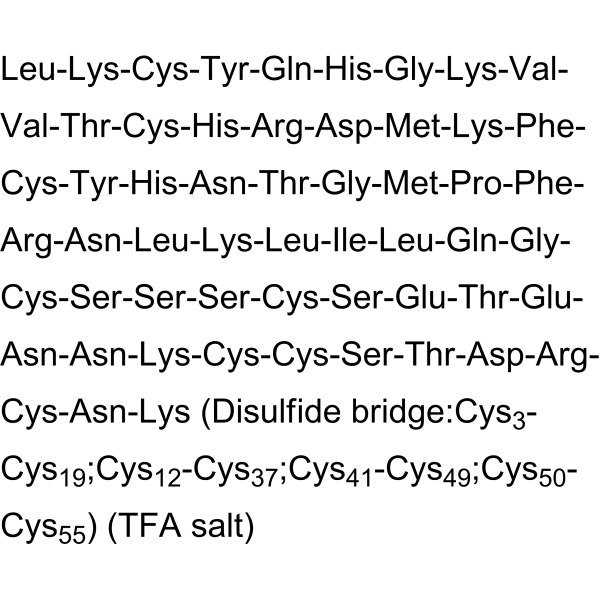
Mambalgin 1 TFA is a selective ASIC1a inhibitor (IC50 values are 192 and 72 nM for human ASIC1a and ASIC1a/1b dimer, respectively). Mambalgin 1 TFA binds to closed/inactive channel. Mambalgin 1 TFA is selective for ASIC1a over ASIC2a, ASIC3, TRPV1, P2X2, 5-HT3, Nav1.8, Cav3.2 and Kv1.2 channels. Mambalgin 1 TFA increases latency of withdrawal response in mouse tail-flick and paw-flick tests.
loading...
    loading...
Cat. No.: HY-122189
CAS No.: 3512-87-6
Synonyms: (-)-Akuammine; Vincamajoridine
Target:  

Others

Research Areas:  

Neurological Disease

Akuammine is an indole alkaloid that has been found in Picralima nitida and has analgesic activity. It selectively binds to the μ- and κ-opioid receptors over the δ-opioid receptor (Kis=0.3, 1.68, and 10.4 μM for the human receptors, respectively). Akuammine inhibits forskolin-induced cAMP production in HEK293 cells expressing human μ- or κ-opioid receptors (IC50s=2.6 and 0.073 μM, respectively). It increases the latency to withdrawal in the tail-flick or hot plate test in mice when administered at a dose of 60 mg/kg.
loading...
    loading...
Cat. No.: HY-112330
CAS No.: 161468-32-2
Target:  

PKA

Research Areas:  

Neurological Disease

4-Cyano-3-methylisoquinoline is an inhibitor for protein kinase A (PKA) with an IC50 of micromolar level. 4-Cyano-3-methylisoquinoline reverses morphine tolerance in mouse model .
loading...
    loading...
Cat. No.: HY-P10203
Target:  

Opioid Receptor

Research Areas:  

Inflammation/Immunology

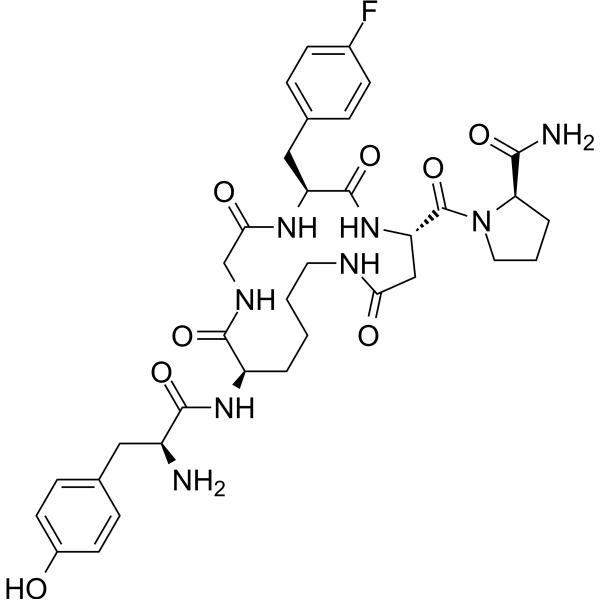
μ/κ/δ opioid receptor agonist 1 is a μ opioid receptor (MOR), κ opioid receptor (KOR), and δ opioid receptor (DOR) agonist. μ/κ/δ opioid receptor agonist 1 produces a strong and long-lasting analgesic effect through peripheral MOR and KOR in the tail-flick test .
loading...
    loading...
Cat. No.: HY-103216A
CAS No.: 245744-13-2
Target:  

Adrenergic Receptor

Research Areas:  

Neurological Disease

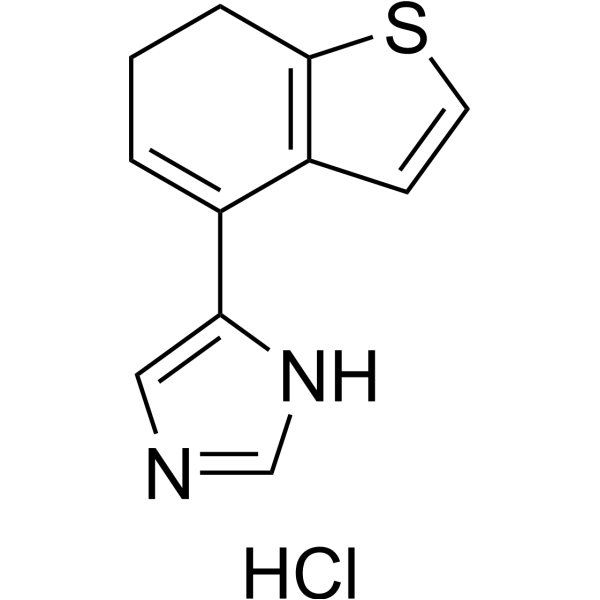
RWJ-52353 hydrochloride is an orally potent, highly selective α2D adrenergic receptor agonist (Ki: 1.5 nM) with potential analgesic effects. RWJ-52353 hydrochloride demonstrated analgesic activity in abdominal tests in rats and mice, and improved agitation in mice in the hot plate test and tail flick test. RWJ-52353 hydrochloride also regulates the organic cation transporter (OCT) subtype, inhibiting rOCT1 and rOCT2 with IC50s of 100 μM and 20 μM respectively; it also activates rOCT3, affecting [3H]-1- in cells. Methyl-4-phenylpyridinium ([3H]MPP) transport .
loading...
    loading...
Cat. No.: HY-119925
CAS No.: 6831-10-3
Amaralin is a sesquiterpene lactone with analgesic activity, which exists in the leaves and stems of Helenium amarum (Raf.) H. Rock. When administered subcutaneously, Amaralin produces analgesic effects in the mouse tail-flick test. When administered subcutaneously, Amaralin inhibits acetic acid-induced writhing syndrome in mice. Amaralin can be used for pain-related research .
loading...
    loading...
Cat. No.: HY-181605
CAS No.: 3075862-29-9
Target:  

Opioid Receptor

Research Areas:  

Neurological Disease

MOR antagonist 2 hydrochloride is a blood-brain barrier-permeable μ-opioid receptor (MOR) antagonist, with an IC50 of 28.37 nM, an EC50 of 4.25 nM, and a Ki of 0.18 nM against MOR. MOR antagonist 2 hydrochloride stabilizes the inactive conformation of MOR to reduce receptor activation levels. MOR antagonist 2 hydrochloride antagonizes analgesic effects in the mouse warm-water tail-flick test. MOR antagonist 2 hydrochloride induces fewer opioid withdrawal symptoms (wet dog shakes, paw tremors) in mice with opioid withdrawal symptoms. MOR antagonist 2 hydrochloride can be used for the research of opioid use disorder .
loading...
    loading...

