
1. Search Result
Search Result
Results for "

transcellular

" in MedChemExpress (MCE) Product Catalog:

14

Inhibitors & Agonists

2

Peptides

1

Isotope-Labeled Compounds

Cat. No. Product Name Target Research Areas Chemical Structure
  • HY-114299
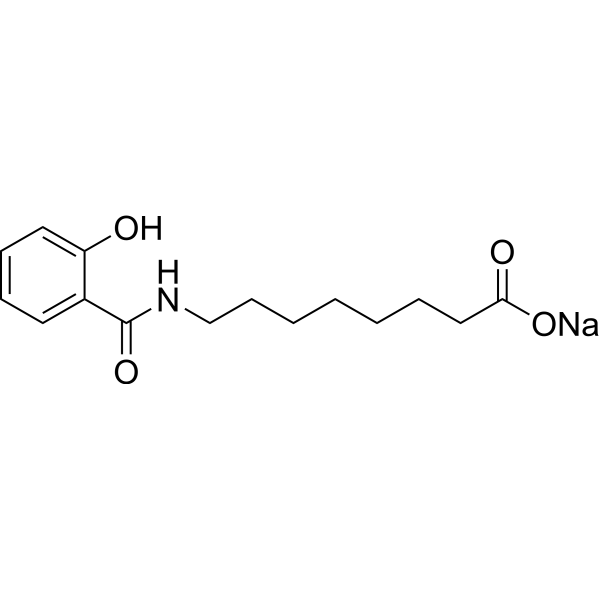
    Salcaprozate sodium
    4 Publications Verification

    SNAC

    Biochemical Assay Reagents Others
    Salcaprozate sodium (SNAC), an oral absorption promoter, and has the potential as a delivery agent for oral forms of heparin and insulin. Salcaprozate sodium could increase passive transcellular permeation across small intestinal epithelia based on increased lipophilicity arising from non-covalent macromolecule complexation .
    Salcaprozate sodium
  • HY-120475
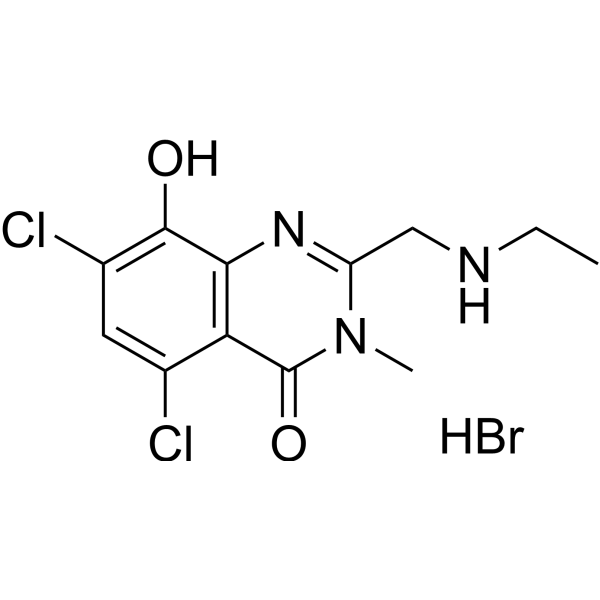
    PBT434
    2 Publications Verification

    ATH434

    α-synuclein Neurological Disease
    PBT434 is a potent, orally active and cross the blood-brain barrier α-synuclein aggregation inhibitor. PBT434 can be used as a iron chelator and modulates transcellular iron trafficking. PBT434 inhibits iron-mediated redox activity and iron-mediated aggregation of α-synuclein. PBT434 prevents the loss of substantia nigra pars compacta neurons (SNpc). PBT434 has the potential for the research of Parkinson’s disease (PD) .
    PBT434
  • HY-P4086

    RABV nAChR Neurological Disease Cancer
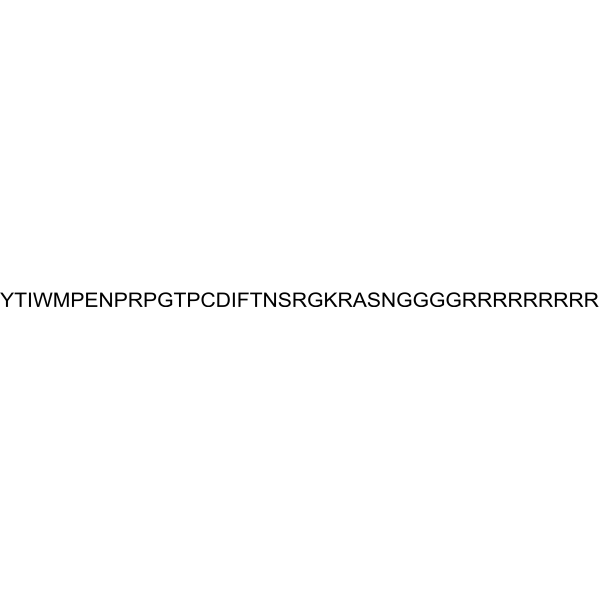
    Chimeric Rabies Virus Glycoprotein Fragment (RVG-9R) is a cell-penetrating peptide that is synthesized by adding nona-arginine motif to the carboxy terminus of RVG (rabies virus glycoprotein). Chimeric Rabies Virus Glycoprotein Fragment (RVG-9R) binds to
    nAChR
    on neuronal cells to mediate receptor-mediated endocytosis and targeted siRNA delivery. Chimeric Rabies Virus Glycoprotein Fragment (RVG-9R) protects complexed siRNA from degradation, enhances transcellular siRNA delivery in neuronal cells, and promotes efficient, pecific gene silencing. Chimeric Rabies Virus Glycoprotein Fragment (RVG-9R) can be used for the researches of neurological disease and cancer .
    Chimeric Rabies Virus Glycoprotein Fragment (RVG-9R)
  • HY-114299S

    SNAC-d4 sodium

    Isotope-Labeled Compounds Others
    Salcaprozate-d4 (sodium) is a deuterated labeled Salcaprozate (sodium) . Salcaprozate sodium (SNAC), an oral absorption promoter, and has the potential as a delivery agent for oral forms of heparin and insulin. Salcaprozate sodium could increase passive transcellular permeation across small intestinal epithelia based on increased lipophilicity arising from non-covalent macromolecule complexation .
    Salcaprozate-d4 sodium
  • HY-120475A
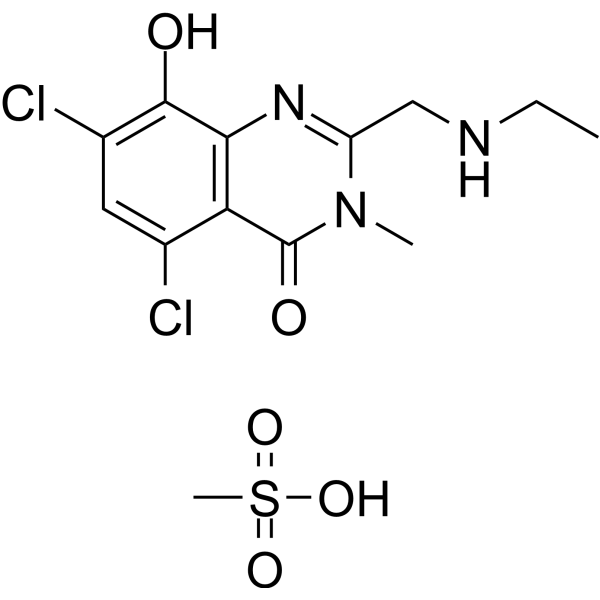
    PBT434 mesylate
    2 Publications Verification

    ATH434 mesylate

    α-synuclein Neurological Disease
    PBT434 methanesulfonate is a potent, orally active and cross the blood-brain barrier α-synuclein aggregation inhibitor. PBT434 methanesulfonate can be used as a iron chelator and modulates transcellular iron trafficking. PBT434 methanesulfonate inhibits iron-mediated redox activity and iron-mediated aggregation of α-synuclein. PBT434 methanesulfonate prevents the loss of substantia nigra pars compacta neurons (SNpc). PBT434 methanesulfonate has the potential for the research of Parkinson’s disease (PD) .
    PBT434 mesylate
  • HY-114299R

    SNAC (Standard)

    Biochemical Assay Reagents Reference Standards Others
    Salcaprozate (sodium) (Standard) is the analytical standard of Salcaprozate (sodium). This product is intended for research and analytical applications. Salcaprozate sodium (SNAC), an oral absorption promoter, and has the potential as a delivery agent for oral forms of heparin and insulin. Salcaprozate sodium could increase passive transcellular permeation across small intestinal epithelia based on increased lipophilicity arising from non-covalent macromolecule complexation .
    Salcaprozate sodium (Standard)
  • HY-P4856

    PTHR PKC Endocrinology
    pTH-Related Protein (1-40) (human, mouse, rat) stimulates calcium uptake in rat intestinal cells through PTHR1 receptor and PKCα/β signaling pathways. pTH-Related Protein (1-40) up-regulates parathyroid hormone 1 receptor (PTHR1) protein, four transcellular calcium transporters, potential vanillin member 6 (TRPV6), calcium-binding protein-D9K (CaBP-D9k), sodium-calcium Exchanger 1 (NCX1) and plasma membrane calcium ATPase 1 (PMCA1) .
    pTH-Related Protein (1-40) (human, mouse, rat)
  • HY-112621

    LTA4 methyl ester

    Biochemical Assay Reagents Inflammation/Immunology
    Leukotriene A4 methyl ester (LTA4 methyl ester) is synthesized in mast cells, eosinophils, and neutrophils from arachidonic acid by 5-lipoxygenase (5-LO), which exhibits both lipoxygenase and LTA4 synthase activities. LTA4 is rapidly metabolized by LTA4 hydrolase or LTC4 synthase to LTB4 or LTC4, respectively. LTA4, from leukocytes, is known to undergo transcellular metabolism in platelets, erythrocytes, and endothelial cells. Further metabolism of LTA4 by 15-LO leads to lipoxin biosynthesis. LTA4 as a free acid is highly unstable. The methyl ester is stable and can be readily hydrolyzed to the free acid as needed.
    Leukotriene A4 methyl ester
  • HY-401721

    Biochemical Assay Reagents Others
    5-CNAC is an orally active enhancer of absorption, with no pharmacological activity on its own. 5-CNAC can significantly enhance the absorption efficiency of the drug (such as Salmon calcitonin (HY-P0090)) when administered together with it in the gastrointestinal tract. 5-CNAC binds reversibly and non-covalently to peptide drugs, protecting them from degradation by gastrointestinal enzymes, increasing their lipid solubility, promoting passive transcellular absorption, and not damaging the integrity of the intestinal epithelium. 5-CNAC can be used in the research of adjuvants for orally administered peptide agents .
    5-CNAC
  • HY-120475B

    ATH434 free base

    α-synuclein Neurological Disease
    PBT434 (ATH434) free base is a potent, orally active and cross the blood-brain barrier α-synuclein aggregation inhibitor. PBT434 free base can be used as a iron chelator and modulates transcellular iron trafficking. PBT434 free base inhibits iron-mediated redox activity and iron-mediated aggregation of α-synuclein. PBT434 free base prevents the loss of substantia nigra pars compacta neurons (SNpc). PBT434 free base has the potential for the research of Parkinson’s disease (PD) .
    PBT434 free base
  • HY-167702

    GABA Receptor Neurological Disease
    (Rac)-Acetoxyvalerenic acid is a derivative of valerenic acid that acts as a GABA (A) receptor modulator, potentially providing sedative and sleep-enhancing effects. (Rac)-Acetoxyvalerenic acid exhibits slower permeability across the blood-brain barrier compared to diazepam, indicating that its transport may rely on an unidentified pathway rather than transcellular passive diffusion.
    (Rac)-Acetoxyvalerenic acid
  • HY-134123

    LXB4 methyl ester

    Drug Intermediate Leukotriene Receptor Metabolic Disease
    Lipoxin B4 (LXB4) methyl ester is a lipid soluble prodrug form of the transcellular metabolite LXB4. LXB4 is a positional isomer of LXA4 produced by the metabolism of 15-HETE or 15-HpETE by human leukocytes. At a concentration of 100 nM, LXB4 inhibits polymorphonuclear leukocyte (PMN) migration stimulated by leukotriene B4 (LTB4; Item No. 20110) and inhibits LTB4-induced adhesion of PMNs with an IC50 value of 0.3 nM.
    Lipoxin B4 methyl ester
  • HY-181642

    NO Synthase Neurological Disease Cancer
    nNOS-IN-3 (compound 4) is a selective neuronal nitric oxide synthase (nNOS) inhibitor with a human hnNOS Ki of 25 nM, rat rnNOS Ki of 18 nM, human heNOS Ki of 58140 nM, human hiNOS Ki of 6422 nM. nNOS-IN-3 binds to nNOS active sites via hydrogen bonds with Glu and chalcogen bonds with Met, fails to form chalcogen bonds with heNOS, and undergoes passive transcellular transport with minimal efflux liability. nNOS-IN-3 can be used for the research of neurodegenerative diseases and melanoma .
    nNOS-IN-3
  • HY-156957

    Biochemical Assay Reagents Others
    5-CNAC disodium is an orally active enhancer of absorption, with no pharmacological activity on its own. 5-CNAC disodium can significantly enhance the absorption efficiency of the drug (such as Salmon calcitonin (HY-P0090)) when administered together with it in the gastrointestinal tract. 5-CNAC disodium binds reversibly and non-covalently to peptide drugs, protecting them from degradation by gastrointestinal enzymes, increasing their lipid solubility, promoting passive transcellular absorption, and not damaging the integrity of the intestinal epithelium. 5-CNAC disodium can be used in the research of adjuvants for orally administered peptide agents .
    5-CNAC disodium

Inquiry Online

Your information is safe with us. * Required Fields.

Salutation


Country or Region *

Applicant Name *


Organization Name *

Department *


Email Address *


Product Name *

Cat. No.


Requested quantity *

Phone Number *


Remarks

Inquiry Online

Inquiry Information

Product Name:
Cat. No.:
Quantity:
MCE Japan Authorized Agent:

