



Senktide TFA
Based on 3 publication(s) in Google Scholar
Senktide TFA is a potent, selective agonist of the neuromedin K3 (NK3) receptor (EC50=0.5-3 nM). Senktide TFA less potently agonizes the NK1 receptor (EC50=35 µM). Senktide TFA is promising for research of neurological disease.
For research use only. We do not sell to patients.
- Formula: C42H56F3N7O13S
- Molecular Weight:955.99
-
Storage:
Please store the product under the recommended conditions in the Certificate of Analysis.


To place orders, for customer services and technical support, please contact: MedChemExpress USA
Tel: 609-228-6898 E-mail: [email protected] [email protected]


-
 Biological Activity
-
Chemical Information
- Protocols
- Purity & Documentation
- References
-
 Help & FAQs


Publications Citing Use of MedChemExpress (MCE) Senktide TFA
More Customer Validation & Images

-
In Vivo Efficacy Study


Biological Activity
Description
IC50 & Target
|
NK3R 0.5-3 nM (EC50) |
NK1R 35 μM (EC50) |


Chemical Information
-
Molecular Weight 955.99
-
Formula C42H56F3N7O13S
-
Sequence
Suc-Asp-Phe-{Me-Phe}-Gly-Leu-Met-NH2
-
Sequence Shortening
Suc-DF-{Me-Phe}-GLM-NH2
-
Shipping
Room temperature in continental US; may vary elsewhere.
-
Storage
Please store the product under the recommended conditions in the Certificate of Analysis.


Publications (3)
-
Journal Impact Factor
-
Most Recent
-
Protein Cell
Senktide blocks aberrant RTN3 interactome to retard memory decline and tau pathology in social isolated Alzheimer's disease mice. [Abstract]2024 Apr 1;15(4):261-284. PMID: 38011644 -
Neuron
2026 Jan 8:S0896-6273(25)00927-4. PMID: 41512855
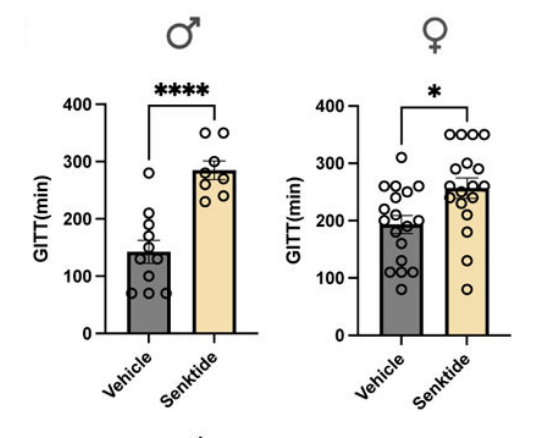
Senktide TFA purchased from MedChemExpress. Usage Cited in: Neuron. 2026 Jan 8:S0896-6273(25)00927-4. [Abstract]
GITT in adult males (n = 8–11/group) and females (n = 18/group) following administration of TACR3 agonist senktide (5 mg/kg) or vehicle.
-
FASEB J
Neurokinin 3 receptor agonist senktide stimulates GnRH release in isolated hypogonadotropic hypogonadism mice. [Abstract]2025 Mar 31;39(6):e70498. PMID: 40135619

Protocols
-
Research Protocol for Neurological Diseases
PINK1/Parkin-mediated mitophagy pathway is a mitochondrial quality-control signaling axis in which mitochondrial depolarization stabilizes PINK1 on damaged mitochondria, activates Parkin recruitment and E3 ubiquitin ligase activity, promotes ubiquitination of outer mitochondrial membrane proteins, recruits selective autophagy adaptors, and drives lysosomal degradation of damaged mitochondria. In neurological disease research, this pathway is experimentally important because neurons, especially dopaminergic neurons, are highly dependent on mitochondrial integrity, and defective mitochondrial turnover can lead to mitochondrial dysfunction, oxidative stress, impaired neuronal survival, α-synuclein accumulation, and neuroinflammatory damage-associated signals. The genetic disease link is strongest in Parkinson’s disease because mutations in PRKN/parkin cause autosomal recessive juvenile parkinsonism, mutations in PINK1 cause hereditary early-onset Parkinson’s disease, and Drosophila studie


Purity & Documentation
References
[1]. Byk G, et al. Synthesis and biological activity of NK-1 selective, N-backbone cyclic analogs of the C-terminal hexapeptide of substance P. J Med Chem. 1996 Aug 2;39(16):3174-8. [Content Brief]
[2]. Sarau HM, et al. Nonpeptide tachykinin receptor antagonists: I. Pharmacological and pharmacokinetic characterization of SB 223412, a novel, potent and selective neurokinin-3 receptor antagonist. J Pharmacol Exp Ther. 1997 Jun;281(3):1303-11. [Content Brief]
[3]. Harrison T, et al. High affinity, selective neurokinin 2 and neurokinin 3 receptor antagonists from a common structural template. Bioorg Med Chem Lett. 1998 Jun 2;8(11):1343-8. [Content Brief]

Calculators
Concentration (start) × Volume (start) = Concentration (final) × Volume (final)


Senktide TFA Related Classifications
HY-W755425 Related Classifications
 Powered by Bioz