



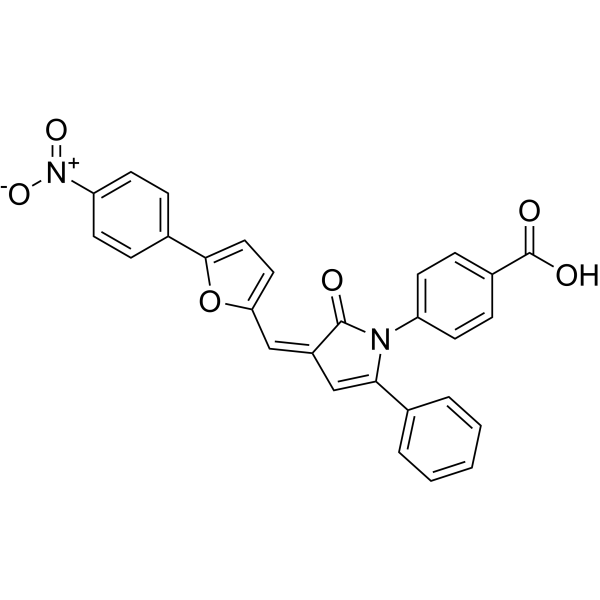
4E1RCat
Based on 3 publication(s) in Google Scholar
4E1RCat is an inhibitor of cap-dependent translation, and inhibits eIF4E:eIF4GI interaction, with an IC50 an of ~4 μM.
For research use only. We do not sell to patients.
- Purity: 99.04%
- CAS No.: 328998-25-0
- Formula: C28H18N2O6
- Molecular Weight:478.45
-
Storage:Powder -20°C, 3 years , 4°C, 2 years ; In solvent -80°C, 2 years , -20°C, 1 year


-
 Biological Activity
-
Chemical Information
-
Solvent & Solubility
- Protocol
- Purity & Documentation
- References
-
 Help & FAQs
-


Cell Cycle/DNA Damage Compound Library
HY-L004
-
Anti-Cancer Compound Library
HY-L025
-
Autophagy Compound Library
HY-L029
-
Anti-Aging Compound Library
HY-L034
-
Covalent Screening Library
HY-L036
-
Anti-Blood Cancer Compound Library
HY-L079
-
Targeted Diversity Library
HY-L099
-
Cell Death Library
HY-L162
-
Anti-Hematopathy Compound Library
HY-L171
-
Bioactive Compound Library Max
HY-L181
-
Anti-Aging Compound Library Mini
HY-L034M
-
Covalent Screening Library Plus
HY-L036P
-
Bioactive Compound Library
HY-L001
-
High-Throughput Bioactive Compound Library
HY-L205


Publications Citing Use of MedChemExpress (MCE) 4E1RCat
More

Biological Activity
|
eIF4 |
4E1RCat is an inhibitor of eIF4E:eIF4GI interaction, with an IC50 an of ~4 μM. 4E1RCat binding to eIF4E also interferes with eIF4G and 4E-BP binding. 4E1RCat inhibits ribosome recruitment to mRNA in a cap-dependent manner[1]. 4E1RCat blocks the capped mRNA translation, and the translation is activated by CDK1/CYCB1. Nearly all new protein synthesis in both mitosis and interphase is cap-dependent and -sensitive to 4E1RCat treatment, in HeLa and U2OS cells[2].
MedChemExpress (MCE) has not independently confirmed the accuracy of these methods. They are for reference only.
MedChemExpress (MCE) has not independently confirmed the accuracy of these methods. They are for reference only.


Chemical Information
-
CAS No. 328998-25-0
-
Appearance Solid
-
Molecular Weight 478.45
-
Formula C28H18N2O6
-
Color Brown to purplish red
-
SMILES
O=C(O)C1=CC=C(N2C(/C(C=C2C3=CC=CC=C3)=C\C4=CC=C(C5=CC=C([N+]([O-])=O)C=C5)O4)=O)C=C1
-
Shipping
Room temperature in continental US; may vary elsewhere.
-
Storage
Powder -20°C 3 years 4°C 2 years In solvent -80°C 2 years -20°C 1 year


Publications (3)
-
Journal Impact Factor
-
Most Recent
-
Proc Natl Acad Sci U S A
2024 Oct 29;121(44):e2321305121. PMID: 39436655 -
J Mol Med (Berl)
2019 Aug;97(8):1183-1193. PMID: 31201471 -
Front Oncol
Salubrinal in Combination With 4E1RCat Synergistically Impairs Melanoma Development by Disrupting the Protein Synthetic Machinery. [Abstract]2020 Jun 19;10:834. PMID: 32637352


Solvent & Solubility
DMSO : 18.33 mg/mL (38.31 mM; Need ultrasonic; Hygroscopic DMSO has a significant impact on the solubility of product, please use newly opened DMSO)
Please refer to the solubility information to select the appropriate solvent. Once prepared, please aliquot and store the solution to prevent product inactivation from repeated freeze-thaw cycles.
Storage method and period of stock solution: -80°C, 2 years; -20°C, 1 year. When stored at -80°C, please use it within 2 years. When stored at -20°C, please use it within 1 year.
Please refer to the solubility information to select the appropriate solvent. Once prepared, please aliquot and store the solution to prevent product inactivation from repeated freeze-thaw cycles.
Storage method and period of stock solution: -80°C, 2 years; -20°C, 1 year. When stored at -80°C, please use it within 2 years. When stored at -20°C, please use it within 1 year.
Concentration (start) × Volume (start) = Concentration (final) × Volume (final)
Please enter the basic information of animal experiments:
-
-
-
-
Recommended: Prepare an additional quantity of animals to account for potential losses during experiments.
Working solution concentration: 0.22 mg/mL

Protocol
TSC2+/-Eμ-Myc and Eμ-Myc lymphomas are seeded in 96-well plates at 106 cells/mL in the presence of increasing concentrations of doxorubicin (Dxr) (ranging from 3.9 nM to 250 nM) and 4E1RCat (ranging from 78.13 nM to 10 000 nM) at a constant ratio of either 20:1 or 40:1. Twenty four hours later, a MTS assay is performed. To this end, Cell Proliferation Assay is added to the plates and the plates further incubated for up to 3 h, followed by measuring the OD490. Values obtained are standardized against DMSO controls[1].
MedChemExpress (MCE) has not independently confirmed the accuracy of these methods. They are for reference only.
Mice[1]
One million secondary Pten+/-Eμ-Myc, Tsc2+/-Eμ-Myc, or Eμ-Myc lymphoma cells are injected into the tail vein of 6-8 week old female C57BL/6 mice. When tumors are palpable, mice are treated with rapamycin (4 mg/kg daily for 5 d), 4E1RCat (15 mg/kg daily for 5 d), or doxorubicin (once at 10 mg/kg). Compounds are administered via intraperitoneal (i.p.) injection in 5.2% PEG 400/ 5.2% Tween 80. For combination studies, rapamycin or 4E1RCat are injected i.p. daily for five consecutive days, with doxorubicin being administered once on day two. Animals are palpated daily to monitor for the onset of tumors. Tumor-free survival is defined as the time between disappearance and reappearance of tumors. Data is analyzed using the log-rank test for statistical significance presented in Kaplan-Meier format[1].
MedChemExpress (MCE) has not independently confirmed the accuracy of these methods. They are for reference only.


Purity & Documentation
-
Data Sheet (277 KB)
-
SDS (393 KB)
- English - EN (393 KB)
- Français - FR (393 KB)
- Deutsch - DE (393 KB)
- Norwegian - NO (393 KB)
- Español - ES (393 KB)
- Swedish - SV (393 KB)
- Italian - IT (393 KB)
- Portuguese - PT (393 KB)
-
Handling Instructions (2659 KB)
References
[1]. Cencic R, et al. Reversing chemoresistance by small molecule inhibition of the translation initiation complex eIF4F. Proc Natl Acad Sci U S A. 2011 Jan 18;108(3):1046-51. [Content Brief]
[2]. Shuda M, et al. CDK1 substitutes for mTOR kinase to activate mitotic cap-dependent protein translation. Proc Natl Acad Sci U S A. 2015 May 12;112(19):5875-82. [Content Brief]


Complete Stock Solution Preparation Table
Please refer to the solubility information to select the appropriate solvent. Once prepared, please aliquot and store the solution to prevent product inactivation from repeated freeze-thaw cycles.
Storage method and period of stock solution: -80°C, 2 years; -20°C, 1 year. When stored at -80°C, please use it within 2 years. When stored at -20°C, please use it within 1 year.
| Optional Solvent | Concentration Solvent Mass | 1 mg | 5 mg | 10 mg | 25 mg |
|---|---|---|---|---|---|
| DMSO | 1 mM | 2.0901 mL | 10.4504 mL | 20.9008 mL | 52.2521 mL |
| 5 mM | 0.4180 mL | 2.0901 mL | 4.1802 mL | 10.4504 mL | |
| 10 mM | 0.2090 mL | 1.0450 mL | 2.0901 mL | 5.2252 mL | |
| 15 mM | 0.1393 mL | 0.6967 mL | 1.3934 mL | 3.4835 mL | |
| 20 mM | 0.1045 mL | 0.5225 mL | 1.0450 mL | 2.6126 mL | |
| 25 mM | 0.0836 mL | 0.4180 mL | 0.8360 mL | 2.0901 mL | |
| 30 mM | 0.0697 mL | 0.3483 mL | 0.6967 mL | 1.7417 mL |


 Powered by Bioz