



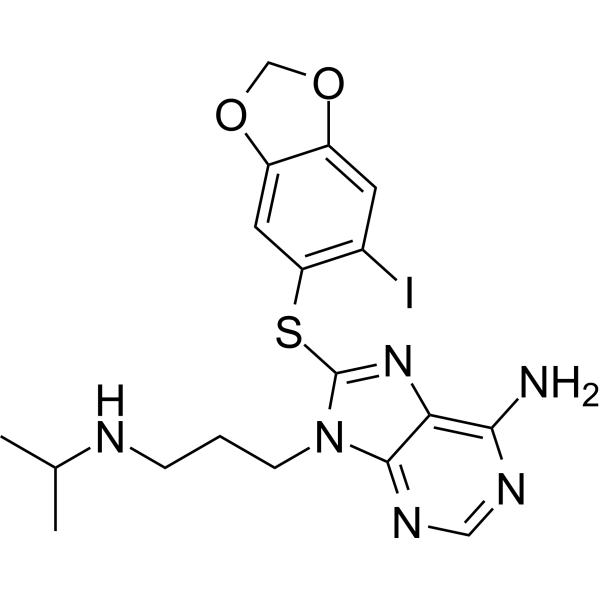
Zelavespib
Based on 13 publication(s) in Google Scholar
Zelavespib (PU-H71) is a potent Hsp90 inhibitor, with an IC50 of 51 nM in MDA-MB-468 cells.
For research use only. We do not sell to patients.
- Purity: 99.93%
- CAS No.: 873436-91-0
- Formula: C18H21IN6O2S
- Molecular Weight:512.37
-
Storage:Powder -20°C, 3 years , 4°C, 2 years ; In solvent -80°C, 6 months , -20°C, 1 month

To place orders, for customer services and technical support, please contact: MedChemExpress USA
Tel: 609-228-6898 E-mail: [email protected] [email protected]


-
 Biological Activity
-
Chemical Information
-
Solvent & Solubility
- Protocol
- Purity & Documentation
- References
-
 Help & FAQs


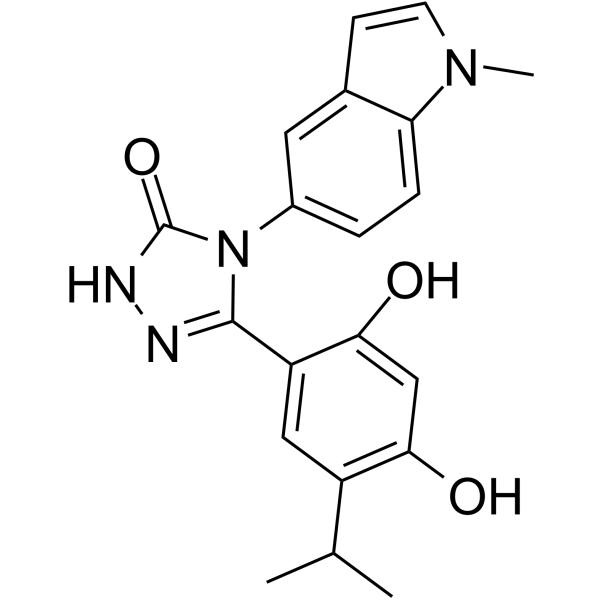
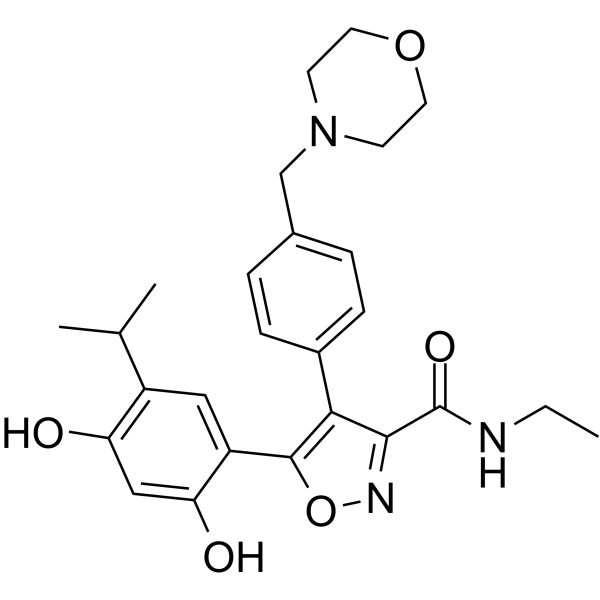
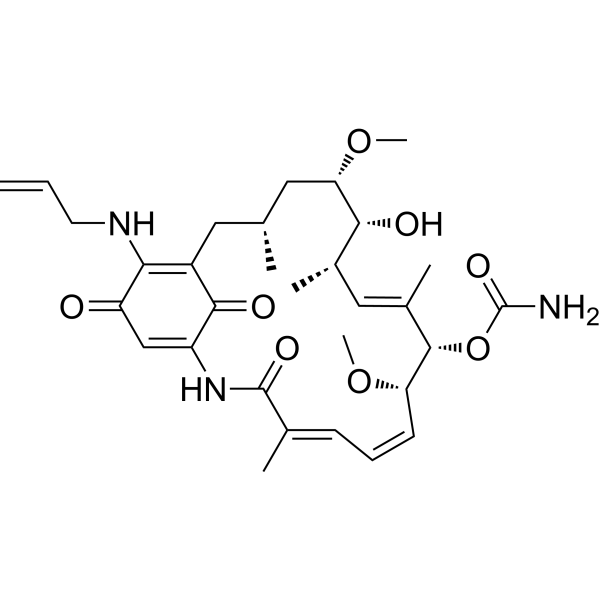
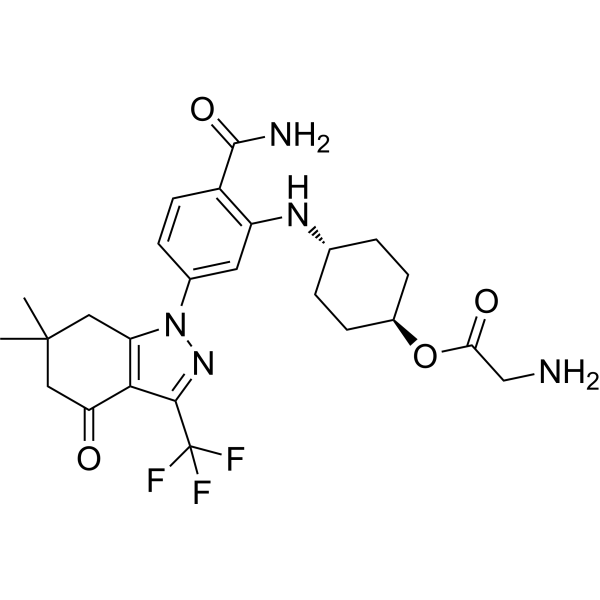
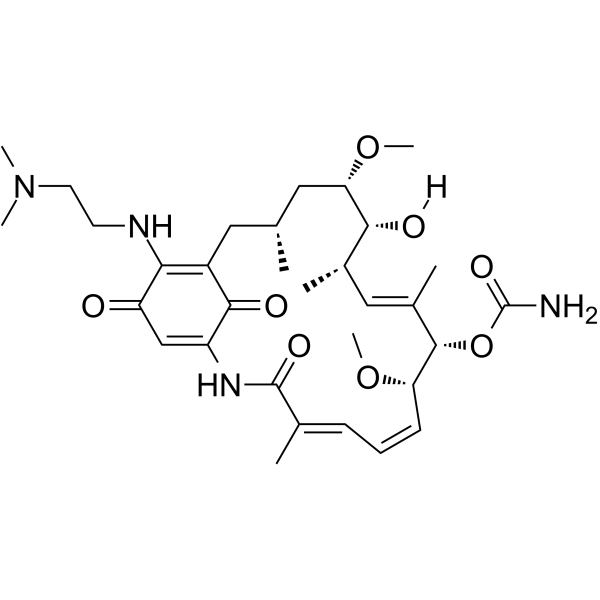
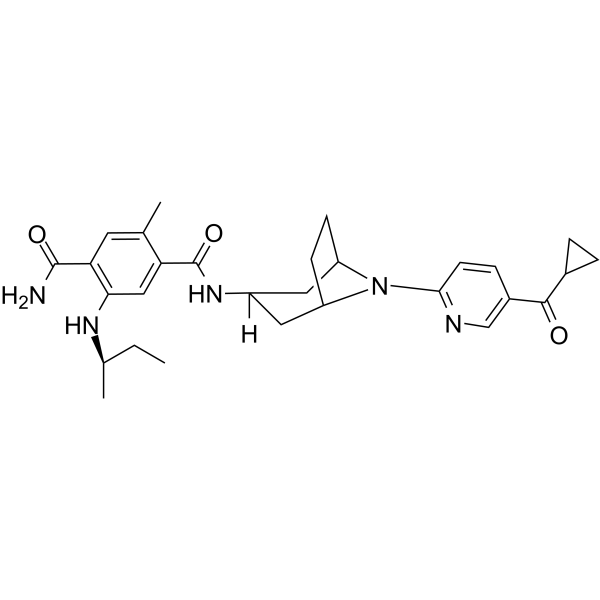
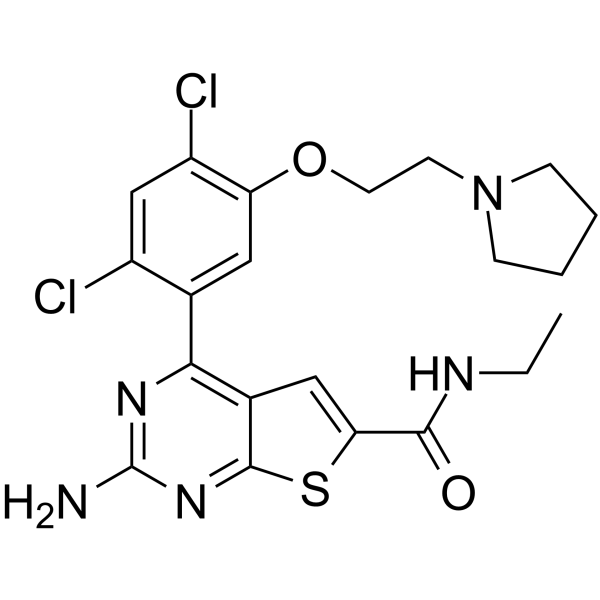
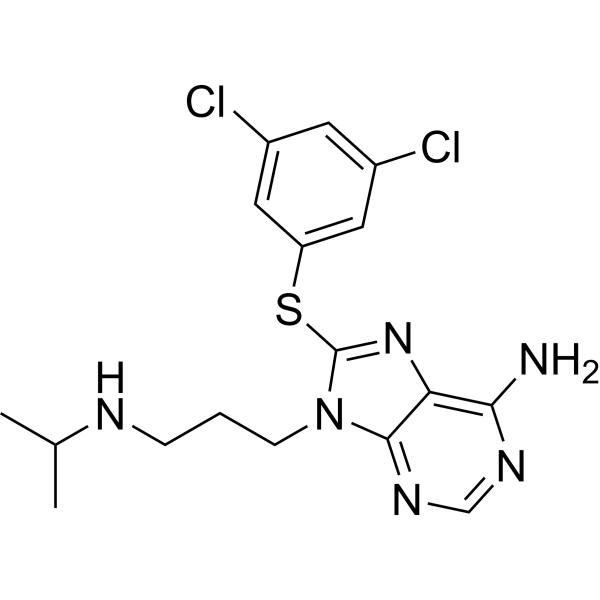
Publications Citing Use of MedChemExpress (MCE) Zelavespib
More- Signal Transduct Target Ther. 2025 Dec 15;10(1):406. [Abstract]
- Nat Commun. 2017 Sep 4;8(1):422. [Abstract]
- Theranostics. 2019 Aug 12;9(20):5769-5783. [Abstract]
- Theranostics. 2019 Jan 1;9(2):554-572. [Abstract]
- J Control Release. 2026 May 10:393:114828. [Abstract]
- Pharmacol Res. 2020 Jan:151:104512. [Abstract]
- Int J Biol Macromol. 2025 Dec 3;337(Pt 1):149421. [Abstract]
- Br J Pharmacol. 2021 Nov;178(22):4485-4500. [Abstract]
- Curr Issues Mol Biol. 2024 Mar 29;46(4):2946-2960. [Abstract]
- Curr Issues Mol Biol. 2023 Aug 23;45(9):7011-7026. [Abstract]
- Viruses. 2021 Apr 2;13(4):610. [Abstract]
- Authorea. April 10, 2021.
- bioRxiv. 2021 Jan 27.
 Customer Validation & Images

-
WB

-
RT-PCR

-
Cell Proliferation/Viability Assay


Biological Activity
|
HSP90 51 nM (IC50, MDA-MB-468 cells) |
|
Cell Line

|
Type | Value | Description | References |
|---|---|---|---|---|
| 786-0 | GI50 |
0.513 μM
Compound: PU-H71
|
Cytotoxicity against human 786-0 cells after 48 hrs by sulforhodamine B assay
Cytotoxicity against human 786-0 cells after 48 hrs by sulforhodamine B assay
|
[PMID: 27914802] |
| A498 | GI50 |
0.437 μM
Compound: PU-H71
|
Cytotoxicity against human A498 cells after 48 hrs by sulforhodamine B assay
Cytotoxicity against human A498 cells after 48 hrs by sulforhodamine B assay
|
[PMID: 27914802] |
| A549 | GI50 |
0.087 μM
Compound: PU-H71
|
Cytotoxicity against human A549/ATCC cells after 48 hrs by sulforhodamine B assay
Cytotoxicity against human A549/ATCC cells after 48 hrs by sulforhodamine B assay
|
[PMID: 27914802] |
| ACHN | GI50 |
0.295 μM
Compound: PU-H71
|
Cytotoxicity against human ACHN cells after 48 hrs by sulforhodamine B assay
Cytotoxicity against human ACHN cells after 48 hrs by sulforhodamine B assay
|
[PMID: 27914802] |
| BT-549 | GI50 |
1.514 μM
Compound: PU-H71
|
Cytotoxicity against human BT549 cells after 48 hrs by sulforhodamine B assay
Cytotoxicity against human BT549 cells after 48 hrs by sulforhodamine B assay
|
[PMID: 27914802] |
| CAKI-1 | GI50 |
0.525 μM
Compound: PU-H71
|
Cytotoxicity against human Caki1 cells after 48 hrs by sulforhodamine B assay
Cytotoxicity against human Caki1 cells after 48 hrs by sulforhodamine B assay
|
[PMID: 27914802] |
| CCRF-CEM | GI50 |
0.427 μM
Compound: PU-H71
|
Cytotoxicity against human CCRF-CEM cells after 48 hrs by sulforhodamine B assay
Cytotoxicity against human CCRF-CEM cells after 48 hrs by sulforhodamine B assay
|
[PMID: 27914802] |
| COLO 205 | GI50 |
0.048 μM
Compound: PU-H71
|
Cytotoxicity against human COLO205 cells after 48 hrs by sulforhodamine B assay
Cytotoxicity against human COLO205 cells after 48 hrs by sulforhodamine B assay
|
[PMID: 27914802] |
| DU-145 | GI50 |
0.048 μM
Compound: PU-H71
|
Cytotoxicity against human DU145 cells after 48 hrs by sulforhodamine B assay
Cytotoxicity against human DU145 cells after 48 hrs by sulforhodamine B assay
|
[PMID: 27914802] |
| EKVX | GI50 |
2.512 μM
Compound: PU-H71
|
Cytotoxicity against human EKVX cells after 48 hrs by sulforhodamine B assay
Cytotoxicity against human EKVX cells after 48 hrs by sulforhodamine B assay
|
[PMID: 27914802] |
| HCC 2998 | GI50 |
0.282 μM
Compound: PU-H71
|
Cytotoxicity against human HCC2998 cells after 48 hrs by sulforhodamine B assay
Cytotoxicity against human HCC2998 cells after 48 hrs by sulforhodamine B assay
|
[PMID: 27914802] |
| HCT-116 | GI50 |
0.063 μM
Compound: PU-H71
|
Cytotoxicity against human HCT116 cells after 48 hrs by sulforhodamine B assay
Cytotoxicity against human HCT116 cells after 48 hrs by sulforhodamine B assay
|
[PMID: 27914802] |
| HCT-15 | GI50 |
0.437 μM
Compound: PU-H71
|
Cytotoxicity against human HCT15 cells after 48 hrs by sulforhodamine B assay
Cytotoxicity against human HCT15 cells after 48 hrs by sulforhodamine B assay
|
[PMID: 27914802] |
| HeLa | IC50 |
226.5 nM
Compound: 5; PU-H71
|
Antiproliferative activity against human HeLa cells by MTT assay
Antiproliferative activity against human HeLa cells by MTT assay
|
[PMID: 31839539] |
| HL-60(TB) | GI50 |
0.063 μM
Compound: PU-H71
|
Cytotoxicity against human HL-60(TB) cells after 48 hrs by sulforhodamine B assay
Cytotoxicity against human HL-60(TB) cells after 48 hrs by sulforhodamine B assay
|
[PMID: 27914802] |
| HOP-62 | GI50 |
0.263 μM
Compound: PU-H71
|
Cytotoxicity against human HOP62 cells after 48 hrs by sulforhodamine B assay
Cytotoxicity against human HOP62 cells after 48 hrs by sulforhodamine B assay
|
[PMID: 27914802] |
| HOP-92 | GI50 |
0.288 μM
Compound: PU-H71
|
Cytotoxicity against human HOP92 cells after 48 hrs by sulforhodamine B assay
Cytotoxicity against human HOP92 cells after 48 hrs by sulforhodamine B assay
|
[PMID: 27914802] |
| Hs-578T | GI50 |
1.288 μM
Compound: PU-H71
|
Cytotoxicity against human Hs 578T cells after 48 hrs by sulforhodamine B assay
Cytotoxicity against human Hs 578T cells after 48 hrs by sulforhodamine B assay
|
[PMID: 27914802] |
| HT-29 | GI50 |
0.038 μM
Compound: PU-H71
|
Cytotoxicity against human HT-29 cells after 48 hrs by sulforhodamine B assay
Cytotoxicity against human HT-29 cells after 48 hrs by sulforhodamine B assay
|
[PMID: 27914802] |
| IGROV-1 | GI50 |
0.089 μM
Compound: PU-H71
|
Cytotoxicity against human IGROV1 cells after 48 hrs by sulforhodamine B assay
Cytotoxicity against human IGROV1 cells after 48 hrs by sulforhodamine B assay
|
[PMID: 27914802] |
| K562 | GI50 |
0.071 μM
Compound: PU-H71
|
Cytotoxicity against human K562 cells after 48 hrs by sulforhodamine B assay
Cytotoxicity against human K562 cells after 48 hrs by sulforhodamine B assay
|
[PMID: 27914802] |
| KM12 | GI50 |
0.059 μM
Compound: PU-H71
|
Cytotoxicity against human KM12 cells after 48 hrs by sulforhodamine B assay
Cytotoxicity against human KM12 cells after 48 hrs by sulforhodamine B assay
|
[PMID: 27914802] |
| LOX IMVI | GI50 |
0.079 μM
Compound: PU-H71
|
Cytotoxicity against human LOXIMVI cells after 48 hrs by sulforhodamine B assay
Cytotoxicity against human LOXIMVI cells after 48 hrs by sulforhodamine B assay
|
[PMID: 27914802] |
| M14 | GI50 |
0.234 μM
Compound: PU-H71
|
Cytotoxicity against human M14 cells after 48 hrs by sulforhodamine B assay
Cytotoxicity against human M14 cells after 48 hrs by sulforhodamine B assay
|
[PMID: 27914802] |
| Malme-3M | GI50 |
0.123 μM
Compound: PU-H71
|
Cytotoxicity against human MALME-3M cells after 48 hrs by sulforhodamine B assay
Cytotoxicity against human MALME-3M cells after 48 hrs by sulforhodamine B assay
|
[PMID: 27914802] |
| MCF7 | IC50 |
0.043 μM
Compound: 5, PU-H71
|
Inhibition of Hsp90 in human MCF7 cell lysates assessed as interaction with Cy3b-conjugated geldanamycin by FP assay
Inhibition of Hsp90 in human MCF7 cell lysates assessed as interaction with Cy3b-conjugated geldanamycin by FP assay
|
[PMID: 18571929] |
| MCF7 | IC50 |
0.06 μM
Compound: 5, PU-H71
|
Inhibition of Hsp90 in human MCF7 cells assessed as Her2 level after 24 hrs by Western blot
Inhibition of Hsp90 in human MCF7 cells assessed as Her2 level after 24 hrs by Western blot
|
[PMID: 18571929] |
| MCF7 | GI50 |
0.046 μM
Compound: PU-H71
|
Cytotoxicity against human MCF7 cells after 48 hrs by sulforhodamine B assay
Cytotoxicity against human MCF7 cells after 48 hrs by sulforhodamine B assay
|
[PMID: 27914802] |
| MCF7 | IC50 |
90 nM
Compound: 16; PU-H71
|
Antiproliferative activity against human MCF7 cells
Antiproliferative activity against human MCF7 cells
|
[PMID: 31663736] |
| MDA-MB-231 | GI50 |
0.479 μM
Compound: PU-H71
|
Cytotoxicity against human MDA-MB-231 cells after 48 hrs by sulforhodamine B assay
Cytotoxicity against human MDA-MB-231 cells after 48 hrs by sulforhodamine B assay
|
[PMID: 27914802] |
| MDA-MB-435 | GI50 |
0.091 μM
Compound: PU-H71
|
Cytotoxicity against human MDA-MB-435 cells after 48 hrs by sulforhodamine B assay
Cytotoxicity against human MDA-MB-435 cells after 48 hrs by sulforhodamine B assay
|
[PMID: 27914802] |
| MDA-MB-468 | EC50 |
10.2 nM
Compound: 11
|
Inhibitory activity against Hsp90 in human breast cancer MDA-MB-468 cell line
Inhibitory activity against Hsp90 in human breast cancer MDA-MB-468 cell line
|
[PMID: 16392823] |
| MDA-MB-468 | IC50 |
58 nM
Compound: 11
|
Growth inhibition in human breast cancer MDA-MB-468 cell line using SRB
Growth inhibition in human breast cancer MDA-MB-468 cell line using SRB
|
[PMID: 16392823] |
| MDA-MB-468 | IC50 |
70 nM
Compound: 11
|
Antimitotic activity in human breast cancer MDA-MB-468 cell line
Antimitotic activity in human breast cancer MDA-MB-468 cell line
|
[PMID: 16392823] |
| MDA-MB-468 | GI50 |
0.083 μM
Compound: PU-H71
|
Growth inhibition of human MDA-MB-468 cells after 48 hrs by sulforhodamine B assay
Growth inhibition of human MDA-MB-468 cells after 48 hrs by sulforhodamine B assay
|
[PMID: 27914802] |
| MOLT-4 | GI50 |
0.091 μM
Compound: PU-H71
|
Cytotoxicity against human MOLT4 cells after 48 hrs by sulforhodamine B assay
Cytotoxicity against human MOLT4 cells after 48 hrs by sulforhodamine B assay
|
[PMID: 27914802] |
| MRC5 | IC50 |
1 μM
Compound: 11
|
Cytotoxicity against normal lung fibroblast MRC5 cell line
Cytotoxicity against normal lung fibroblast MRC5 cell line
|
[PMID: 16392823] |
| NCI/ADR-RES | GI50 |
3.631 μM
Compound: PU-H71
|
Cytotoxicity against human NCI-ADR-RES cells after 48 hrs by sulforhodamine B assay
Cytotoxicity against human NCI-ADR-RES cells after 48 hrs by sulforhodamine B assay
|
[PMID: 27914802] |
| NCI-H226 | GI50 |
0.759 μM
Compound: PU-H71
|
Cytotoxicity against human NCI-H226 cells after 48 hrs by sulforhodamine B assay
Cytotoxicity against human NCI-H226 cells after 48 hrs by sulforhodamine B assay
|
[PMID: 27914802] |
| NCI-H23 | GI50 |
0.089 μM
Compound: PU-H71
|
Cytotoxicity against human NCI-H23 cells after 48 hrs by sulforhodamine B assay
Cytotoxicity against human NCI-H23 cells after 48 hrs by sulforhodamine B assay
|
[PMID: 27914802] |
| NCI-H322M | GI50 |
0.17 μM
Compound: PU-H71
|
Cytotoxicity against human NCI-H322M cells after 48 hrs by sulforhodamine B assay
Cytotoxicity against human NCI-H322M cells after 48 hrs by sulforhodamine B assay
|
[PMID: 27914802] |
| NCI-H460 | GI50 |
0.058 μM
Compound: PU-H71
|
Cytotoxicity against human NCI-H460 cells after 48 hrs by sulforhodamine B assay
Cytotoxicity against human NCI-H460 cells after 48 hrs by sulforhodamine B assay
|
[PMID: 27914802] |
| NCI-H522 | GI50 |
0.059 μM
Compound: PU-H71
|
Cytotoxicity against human NCI-H522 cells after 48 hrs by sulforhodamine B assay
Cytotoxicity against human NCI-H522 cells after 48 hrs by sulforhodamine B assay
|
[PMID: 27914802] |
| OVCAR-3 | GI50 |
0.589 μM
Compound: PU-H71
|
Cytotoxicity against human OVCAR3 cells after 48 hrs by sulforhodamine B assay
Cytotoxicity against human OVCAR3 cells after 48 hrs by sulforhodamine B assay
|
[PMID: 27914802] |
| OVCAR-4 | GI50 |
33.113 μM
Compound: PU-H71
|
Cytotoxicity against human OVCAR4 cells after 48 hrs by sulforhodamine B assay
Cytotoxicity against human OVCAR4 cells after 48 hrs by sulforhodamine B assay
|
[PMID: 27914802] |
| OVCAR-5 | GI50 |
3.02 μM
Compound: PU-H71
|
Cytotoxicity against human OVCAR5 cells after 48 hrs by sulforhodamine B assay
Cytotoxicity against human OVCAR5 cells after 48 hrs by sulforhodamine B assay
|
[PMID: 27914802] |
| OVCAR-8 | GI50 |
0.155 μM
Compound: PU-H71
|
Cytotoxicity against human OVCAR8 cells after 48 hrs by sulforhodamine B assay
Cytotoxicity against human OVCAR8 cells after 48 hrs by sulforhodamine B assay
|
[PMID: 27914802] |
| PC-3 | GI50 |
0.132 μM
Compound: PU-H71
|
Cytotoxicity against human PC3 cells after 48 hrs by sulforhodamine B assay
Cytotoxicity against human PC3 cells after 48 hrs by sulforhodamine B assay
|
[PMID: 27914802] |
| PC-3 | IC50 |
363 nM
Compound: 5; PU-H71
|
Antiproliferative activity against human PC3 cells by MTT assay
Antiproliferative activity against human PC3 cells by MTT assay
|
[PMID: 31839539] |
| RPMI-8226 | GI50 |
1.514 μM
Compound: PU-H71
|
Cytotoxicity against human RPMI8226 cells after 48 hrs by sulforhodamine B assay
Cytotoxicity against human RPMI8226 cells after 48 hrs by sulforhodamine B assay
|
[PMID: 27914802] |
| RXF 393 | GI50 |
0.759 μM
Compound: PU-H71
|
Cytotoxicity against human RXF393 cells after 48 hrs by sulforhodamine B assay
Cytotoxicity against human RXF393 cells after 48 hrs by sulforhodamine B assay
|
[PMID: 27914802] |
| SF-268 | GI50 |
2.089 μM
Compound: PU-H71
|
Cytotoxicity against human SF268 cells after 48 hrs by sulforhodamine B assay
Cytotoxicity against human SF268 cells after 48 hrs by sulforhodamine B assay
|
[PMID: 27914802] |
| SF-295 | GI50 |
0.145 μM
Compound: PU-H71
|
Cytotoxicity against human SF295 cells after 48 hrs by sulforhodamine B assay
Cytotoxicity against human SF295 cells after 48 hrs by sulforhodamine B assay
|
[PMID: 27914802] |
| SF-539 | GI50 |
0.851 μM
Compound: PU-H71
|
Cytotoxicity against human SF539 cells after 48 hrs by sulforhodamine B assay
Cytotoxicity against human SF539 cells after 48 hrs by sulforhodamine B assay
|
[PMID: 27914802] |
| SK-BR-3 | IC50 |
50 nM
Compound: 11
|
Growth inhibition in human breast cancer SKBr3 cell line using SRB
Growth inhibition in human breast cancer SKBr3 cell line using SRB
|
[PMID: 16392823] |
| SK-BR-3 | EC50 |
50 nM
Compound: 26, PU-H71
|
Inhibition of Hsp90 in human SKBR3 cells assessed as Her2 degradation
Inhibition of Hsp90 in human SKBR3 cells assessed as Her2 degradation
|
[PMID: 19017562] |
| SK-MEL-2 | GI50 |
0.355 μM
Compound: PU-H71
|
Cytotoxicity against human SK-MEL-2 cells after 48 hrs by sulforhodamine B assay
Cytotoxicity against human SK-MEL-2 cells after 48 hrs by sulforhodamine B assay
|
[PMID: 27914802] |
| SK-MEL-28 | GI50 |
0.417 μM
Compound: PU-H71
|
Cytotoxicity against human SK-MEL-28 cells after 48 hrs by sulforhodamine B assay
Cytotoxicity against human SK-MEL-28 cells after 48 hrs by sulforhodamine B assay
|
[PMID: 27914802] |
| SK-MEL-5 | GI50 |
0.457 μM
Compound: PU-H71
|
Cytotoxicity against human SK-MEL-5 cells after 48 hrs by sulforhodamine B assay
Cytotoxicity against human SK-MEL-5 cells after 48 hrs by sulforhodamine B assay
|
[PMID: 27914802] |
| SK-OV-3 | GI50 |
0.045 μM
Compound: PU-H71
|
Cytotoxicity against human SKOV3 cells after 48 hrs by sulforhodamine B assay
Cytotoxicity against human SKOV3 cells after 48 hrs by sulforhodamine B assay
|
[PMID: 27914802] |
| SN12C | GI50 |
0.174 μM
Compound: PU-H71
|
Cytotoxicity against human SN12C cells after 48 hrs by sulforhodamine B assay
Cytotoxicity against human SN12C cells after 48 hrs by sulforhodamine B assay
|
[PMID: 27914802] |
| SNB-19 | GI50 |
0.646 μM
Compound: PU-H71
|
Cytotoxicity against human SNB19 cells after 48 hrs by sulforhodamine B assay
Cytotoxicity against human SNB19 cells after 48 hrs by sulforhodamine B assay
|
[PMID: 27914802] |
| SNB-75 | GI50 |
0.724 μM
Compound: PU-H71
|
Cytotoxicity against human SNB75 cells after 48 hrs by sulforhodamine B assay
Cytotoxicity against human SNB75 cells after 48 hrs by sulforhodamine B assay
|
[PMID: 27914802] |
| SR | GI50 |
0.06 μM
Compound: PU-H71
|
Cytotoxicity against human SR cells after 48 hrs by sulforhodamine B assay
Cytotoxicity against human SR cells after 48 hrs by sulforhodamine B assay
|
[PMID: 27914802] |
| SW-620 | GI50 |
0.059 μM
Compound: PU-H71
|
Cytotoxicity against human SW620 cells after 48 hrs by sulforhodamine B assay
Cytotoxicity against human SW620 cells after 48 hrs by sulforhodamine B assay
|
[PMID: 27914802] |
| T47D | GI50 |
0.155 μM
Compound: PU-H71
|
Cytotoxicity against human T47D cells after 48 hrs by sulforhodamine B assay
Cytotoxicity against human T47D cells after 48 hrs by sulforhodamine B assay
|
[PMID: 27914802] |
| TK-10 | GI50 |
0.162 μM
Compound: PU-H71
|
Cytotoxicity against human TK10 cells after 48 hrs by sulforhodamine B assay
Cytotoxicity against human TK10 cells after 48 hrs by sulforhodamine B assay
|
[PMID: 27914802] |
| U-251 | GI50 |
0.129 μM
Compound: PU-H71
|
Cytotoxicity against human U251 cells after 48 hrs by sulforhodamine B assay
Cytotoxicity against human U251 cells after 48 hrs by sulforhodamine B assay
|
[PMID: 27914802] |
| UACC-257 | GI50 |
0.309 μM
Compound: PU-H71
|
Cytotoxicity against human UACC257 cells after 48 hrs by sulforhodamine B assay
Cytotoxicity against human UACC257 cells after 48 hrs by sulforhodamine B assay
|
[PMID: 27914802] |
| UACC-62 | GI50 |
0.372 μM
Compound: PU-H71
|
Cytotoxicity against human UACC62 cells after 48 hrs by sulforhodamine B assay
Cytotoxicity against human UACC62 cells after 48 hrs by sulforhodamine B assay
|
[PMID: 27914802] |
| UO-31 | GI50 |
0.324 μM
Compound: PU-H71
|
Cytotoxicity against human UO31 cells after 48 hrs by sulforhodamine B assay
Cytotoxicity against human UO31 cells after 48 hrs by sulforhodamine B assay
|
[PMID: 27914802] |
Zelavespib is a potent Hsp90 inhibitor, with an IC50 of 51 nM in MDA-MB-468 cells. Zelavespib inhibits the growth of several tumor cells, such as MDA-MB-468, MDA-MB-231 and HCC-1806 cells, with IC50s of 65 ± 8 nM, 140 ± 5 nM and 87 ± 3 nM, respectively, and such inhibition is associated with a G2-M block arrest. Zelavespib (10-1000 nM) induces significant apoptosis in triple-negative breast cancers (TNBCs). Zelavespib (0.5, 1 μM) also downregulates oncoproteins involved in the invasive potential of TNBCs[1]. Zelavespib (0.5 μM) decreases and depletes the BCR signaling kinases. Zelavespib (0.25-10 μM) is cytotoxic to CLL cells but shows minimal effects on PBMC or resting B cells. In addition, Zelavespib (0-1 μM) reduces CLL viability via the induction of mitochondrial apoptosis, and antagonizes the survival signals from CLL microenvironment at 0.5 μM[2]. Zelavespib (0.05 μM) induces apoptosis of MDA-MB-231, BT-474, and MCF7 cells, and such induction is enhanced by TNF-α. Zelavespib (0.05 μM) degradates IKKβ, and down-regulates the NF-κB transcriptional activity induced by TNF-α treatment[3].
MedChemExpress (MCE) has not independently confirmed the accuracy of these methods. They are for reference only.
MedChemExpress (MCE) has not independently confirmed the accuracy of these methods. They are for reference only.
| NCT Number | Sponsor | Condition | Start Date |
Phase
|
|---|---|---|---|---|
| NCT01329991 | Plexxikon| | 2011-05 | PHASE1 |


Chemical Information
-
CAS No. 873436-91-0
-
Appearance Solid
-
Molecular Weight 512.37
-
Formula C18H21IN6O2S
-
Color White to off-white
-
SMILES
CC(C)NCCCN1C(SC2=C(C=C3OCOC3=C2)I)=NC4=C(N=CN=C14)N
-
Synonyms
PU-H71
-
Shipping
Room temperature in continental US; may vary elsewhere.
-
Storage
Powder -20°C 3 years 4°C 2 years In solvent -80°C 6 months -20°C 1 month


Publications (13)
-
Journal Impact Factor
-
Most Recent
-
Signal Transduct Target Ther
Selective depletion of tumor-associated SAMHD1 enhances chemotherapeutic efficacy and antitumor immune responses. [Abstract]2025 Dec 15;10(1):406. PMID: 41392286
Zelavespib purchased from MedChemExpress. Usage Cited in: Signal Transduct Target Ther. 2025 Dec 15;10(1):406. [Abstract]
Inoculation of THP-1 cells into 12-well cell culture plates and treated with indicated doses of Pimitespib, IPI-504, PU-H71 (0, 15, 30, 62.5, 125, 250, 500, 1000 nM), or STA-9090 for 18 h. SAMHD1 protein levels were analyzed by western blot.
Zelavespib purchased from MedChemExpress. Usage Cited in: Signal Transduct Target Ther. 2025 Dec 15;10(1):406. [Abstract]
RT-qPCR analysis of SAMHD1 mRNA levels in THP-1 cells treated with indicated concentrations of HSP90 inhibitors (IPI-504 (125, 250, 500 nM), PU-H71, or STA-9090) for 18 h.
Zelavespib purchased from MedChemExpress. Usage Cited in: Signal Transduct Target Ther. 2025 Dec 15;10(1):406. [Abstract]
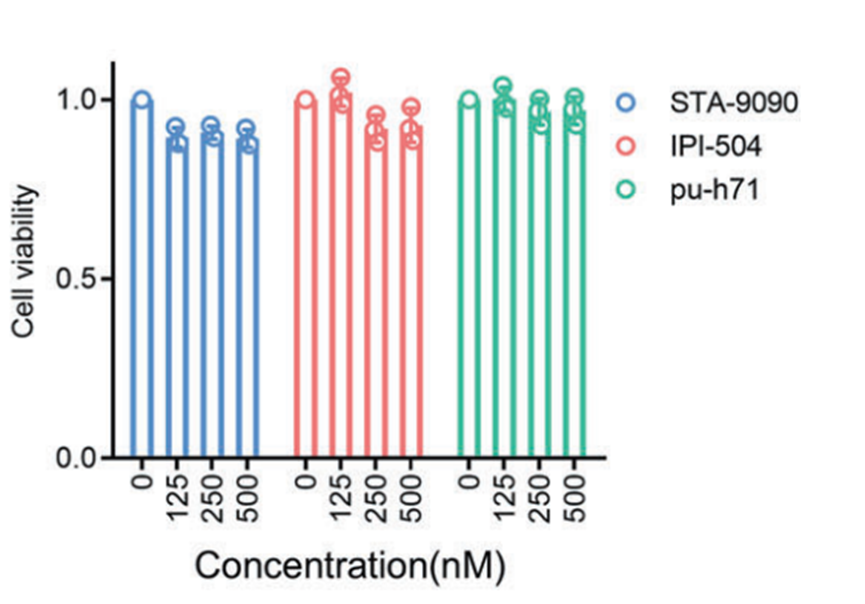
MTT assay measuring THP-1 cell viability after 18-hour treatment with PU-H71 (0, 125, 250, 500 nM).
-
Nat Commun
2017 Sep 4;8(1):422. PMID: 28871086 -
Theranostics
Inhibition of HSP90β Improves Lipid Disorders by Promoting Mature SREBPs Degradation via the Ubiquitin-proteasome System. [Abstract]2019 Aug 12;9(20):5769-5783. PMID: 31534518 -
Theranostics
2019 Jan 1;9(2):554-572. PMID: 30809293 -
J Control Release
The HSP90-dependent bioorthogonal PROTAC prodrug system enables tumor-selective and enhanced protein degradation. [Abstract]2026 May 10:393:114828. PMID: 41839264 -
Pharmacol Res
Destabilization of ROR1 enhances activity of Ibrutinib against chronic lymphocytic leukemia in vivo. [Abstract]2020 Jan:151:104512. PMID: 31726100 -
Int J Biol Macromol
17-AAG promotes the degradation of HSP90 client METTL3 to suppress MYC RNA m6A modification and expression in colorectal cancer. [Abstract]2025 Dec 3;337(Pt 1):149421. PMID: 41349747 -
Br J Pharmacol
Inhibition of heat shock protein (HSP) 90 reverses signal transducer and activator of transcription (STAT) 3-mediated muscle wasting in cancer cachexia mice. [Abstract]2021 Nov;178(22):4485-4500. PMID: 34265073 -
Curr Issues Mol Biol
FLT3 and IRAK4 Inhibitor Emavusertib in Combination with BH3-Mimetics in the Treatment of Acute Myeloid Leukemia. [Abstract]2024 Mar 29;46(4):2946-2960. PMID: 38666914 -
Curr Issues Mol Biol
HSP90 Inhibitor PU-H71 in Combination with BH3-Mimetics in the Treatment of Acute Myeloid Leukemia. [Abstract]2023 Aug 23;45(9):7011-7026. PMID: 37754227 -
Viruses
Deep Transfer Learning Approach for Automatic Recognition of Drug Toxicity and Inhibition of SARS-CoV-2. [Abstract]2021 Apr 2;13(4):610. PMID: 33918368 -
-


Solvent & Solubility
DMSO : ≥ 100 mg/mL (195.17 mM; Hygroscopic DMSO has a significant impact on the solubility of product, please use newly opened DMSO)
* "≥" means soluble, but saturation unknown.
Please refer to the solubility information to select the appropriate solvent. Once prepared, please aliquot and store the solution to prevent product inactivation from repeated freeze-thaw cycles.
Storage method and period of stock solution: -80°C, 6 months; -20°C, 1 month. When stored at -80°C, please use it within 6 months. When stored at -20°C, please use it within 1 month.
Please refer to the solubility information to select the appropriate solvent. Once prepared, please aliquot and store the solution to prevent product inactivation from repeated freeze-thaw cycles.
Storage method and period of stock solution: -80°C, 6 months; -20°C, 1 month. When stored at -80°C, please use it within 6 months. When stored at -20°C, please use it within 1 month.
Concentration (start) × Volume (start) = Concentration (final) × Volume (final)
Select the appropriate dissolution method based on your experimental animal and administration route.
- For the following dissolution methods, please ensure to first prepare a clear stock solution using an In Vitro approach and then sequentially add co-solvents:
- To ensure reliable experimental results, the clarified stock solution can be appropriately stored based on storage conditions. As for the working solution for In Vivo experiments, it is recommended to prepare freshly and use it on the same day.
- The percentages shown for the solvents indicate their volumetric ratio in the final prepared solution. If precipitation or phase separation occurs during preparation, heat and/or sonication can be used to aid dissolution.
Add each solvent one by one: 10% DMSO 40% PEG300 5% Tween-80 45% Saline
Solubility: ≥ 2.5 mg/mL (4.88 mM); Clear solution
This protocol yields a clear solution of ≥ 2.5 mg/mL (saturation unknown).
Taking 1 mL working solution as an example, add 100 μL DMSO stock solution (25.0 mg/mL) to 400 μL PEG300, and mix evenly; then add 50 μL Tween-80 and mix evenly; then add 450 μL Saline to adjust the volume to 1 mL.
Preparation of Saline: Dissolve 0.9 g sodium chloride in ddH₂O and dilute to 100 mL to obtain a clear Saline solution.
Add each solvent one by one: 10% DMSO 90% (20% SBE-β-CD in Saline)
Solubility: ≥ 2.5 mg/mL (4.88 mM); Clear solution
This protocol yields a clear solution of ≥ 2.5 mg/mL (saturation unknown).
Taking 1 mL working solution as an example, add 100 μL DMSO stock solution (25.0 mg/mL) to 900 μL 20% SBE-β-CD in Saline, and mix evenly.
Preparation of 20% SBE-β-CD in Saline (4°C, storage for one week): 2 g SBE-β-CD powder is dissolved in 10 mL Saline, completely dissolve until clear.
Please enter the basic information of animal experiments:
-
-
-
-
Recommended: Prepare an additional quantity of animals to account for potential losses during experiments.
Please enter your animal formula composition:
-
%DMSO +
Recommended: Keep the proportion of DMSO in working solution below 2% if your animal is weak.
-
%+
-
+%Tween-80 + +
-
%Saline +
The co-solvents required include: DMSO, . All of co-solvents are available by MedChemExpress (MCE). , Tween 80. All of co-solvents are available by MedChemExpress (MCE).
Working solution concentration: 0.22 mg/mL
Method for preparing stock solution: mg drug dissolved in μL DMSO. Stock solution concentration: mg/mL.
1. Take μL DMSO stock solution;
2. Add μL .
μL , mix evenly;
3. Then add μL Tween 80, mix evenly;
4. Then add μL
Please ensure that the stock solution in the first step is dissolved to a clear state, and add co-solvents in sequence. You can use ultrasonic heating (ultrasonic cleaner, recommended frequency 20-40 kHz), vortexing, etc. to assist dissolution.

Protocol
Measurements are performed in black 96-well microtiter plates. In short, cell lysates are prepared by rupturing cellular membranes by freezing at -70°C and dissolving the cellular extract in HFB [20 mM Hepes (K), pH 7.3, 50 mM KCl, 5 mM MgCl2, 20 mM Na2MoO4, 0.01% Nonidet P-40] with added protease and phosphatase inhibitors (Zelavespib, etc.). Saturation curves are recorded in which fluorescently labeled geldanamycin (Cy3B-GM) (3 nM) is treated with increasing amounts of cellular lysates. The amount of lysate that results in polarization (mP) readings corresponding to 90%-99% bound ligand is chosen for the competition study. Here, each 96-well plate contains 3 nM Cy3B-GM, cellular lysate and tested Hsp90 inhibitor in a final volume of 100 μL. The plate is left for 24 h on a shaker at 4°C, and the fluorescence polarization (FP) values in mP are recorded. EC50 values are determined as the competitor concentrations at which 50% of the Cy3B-GM is displaced. FP measurements are performed on an Analyst GT microplate reader[1].
MedChemExpress (MCE) has not independently confirmed the accuracy of these methods. They are for reference only.
The antiproliferative effects of select Hsp90 inhibitors is evaluated using the CellTiter-Glo Luminescent Cell Viability Assay kit. Briefly, exponentially growing MDA-MB-468, MDA-MB-231, and HCC-1806 cells are seeded into black 96-well microtiter plates and incubated in medium containing either vehicle control (DMSO) or Zelavespib for the indicated time at 37°C. Plates containing 3 replicate wells per assay condition are seeded at a density of 8 × 10³ cells for each cell line in 100 μL medium. After exposure of cells to the Hsp90 inhibitors, plates are equilibrated to room temperature (20-25°C) for approximately 30 min, and 100 μL CellTiter-Glo reagent are added to each well. Plates are mixed for 2 min on an orbital shaker and then incubated for 15 min to 2 h at room temperature. The luminescence signal in each well is measured in an Analyst GT microplate reader. The percentage cell growth inhibition is calculated by comparing luminescence readings obtained from treated versus control cells, accounting for initial cell population (time 0). The IC50 is calculated as the drug concentration that inhibits cell growth by 50%[1].
MedChemExpress (MCE) has not independently confirmed the accuracy of these methods. They are for reference only.
Mice[1]
Mice bearing MDA-MB-468 tumors reaching a volume of 100-150 mm3 are treated i.p. using different doses and schedules: Group 01 (n = 8) PBS; group 02 (n = 8) Zelavespib at 50 mg/kg on alternate days; group 03 (n = 8) Zelavespib at 50 mg/kg 5xqd; group 04 (n = 8) Zelavespib at 75 mg/kg 3 week; group 05 (n = 8) Zelavespib at 75 mg/kg on alternate days. Mice bearing HCC-1806 or MDA-MB-231 xenografted tumors receive Zelavespib at 75 mg/kg on alternate days. Tumor volume is determined by measurement with Vernier calipers, and tumor volume is calculated as the product of its length × width2 × 0.4. Tumor volume is expressed on indicated days as the median tumor volume ± SD indicated for groups of mice[1].
MedChemExpress (MCE) has not independently confirmed the accuracy of these methods. They are for reference only.


Purity & Documentation
-
Data Sheet (285 KB)
-
SDS (393 KB)
- English - EN (393 KB)
- Français - FR (393 KB)
- Deutsch - DE (393 KB)
- Norwegian - NO (393 KB)
- Español - ES (393 KB)
- Swedish - SV (393 KB)
- Italian - IT (393 KB)
- Korean - KR (393 KB)
- Portuguese - PT (393 KB)
-
Handling Instructions (2659 KB)
References
[1]. Caldas-Lopes E, et al. Hsp90 inhibitor PU-H71, a multimodal inhibitor of malignancy, induces complete responses in triple-negative breast cancer models. Proc Natl Acad Sci U S A. 2009 May 19;106(20):8368-73. [Content Brief]
[2]. Guo A, et al. HSP90 stabilizes B-cell receptor kinases in a multi-client interactome: PU-H71 induces CLL apoptosis in a cytoprotective microenvironment. Oncogene. 2017 Jun 15;36(24):3441-3449. [Content Brief]
[3]. Qu Z, et al. PU-H71 effectively induces degradation of IκB kinase β in the presence of TNF-α. Mol Cell Biochem. 2014 Jan;386(1-2):135-42. [Content Brief]


Complete Stock Solution Preparation Table
Please refer to the solubility information to select the appropriate solvent. Once prepared, please aliquot and store the solution to prevent product inactivation from repeated freeze-thaw cycles.
Storage method and period of stock solution: -80°C, 6 months; -20°C, 1 month. When stored at -80°C, please use it within 6 months. When stored at -20°C, please use it within 1 month.
| Optional Solvent | Concentration Solvent Mass | 1 mg | 5 mg | 10 mg | 25 mg |
|---|---|---|---|---|---|
| DMSO | 1 mM | 1.9517 mL | 9.7586 mL | 19.5171 mL | 48.7929 mL |
| 5 mM | 0.3903 mL | 1.9517 mL | 3.9034 mL | 9.7586 mL | |
| 10 mM | 0.1952 mL | 0.9759 mL | 1.9517 mL | 4.8793 mL | |
| 15 mM | 0.1301 mL | 0.6506 mL | 1.3011 mL | 3.2529 mL | |
| 20 mM | 0.0976 mL | 0.4879 mL | 0.9759 mL | 2.4396 mL | |
| 25 mM | 0.0781 mL | 0.3903 mL | 0.7807 mL | 1.9517 mL | |
| 30 mM | 0.0651 mL | 0.3253 mL | 0.6506 mL | 1.6264 mL | |
| 40 mM | 0.0488 mL | 0.2440 mL | 0.4879 mL | 1.2198 mL | |
| 50 mM | 0.0390 mL | 0.1952 mL | 0.3903 mL | 0.9759 mL | |
| 60 mM | 0.0325 mL | 0.1626 mL | 0.3253 mL | 0.8132 mL | |
| 80 mM | 0.0244 mL | 0.1220 mL | 0.2440 mL | 0.6099 mL | |
| 100 mM | 0.0195 mL | 0.0976 mL | 0.1952 mL | 0.4879 mL |


Zelavespib Related Classifications
HY-11038 Related Classifications
 Powered by Bioz