



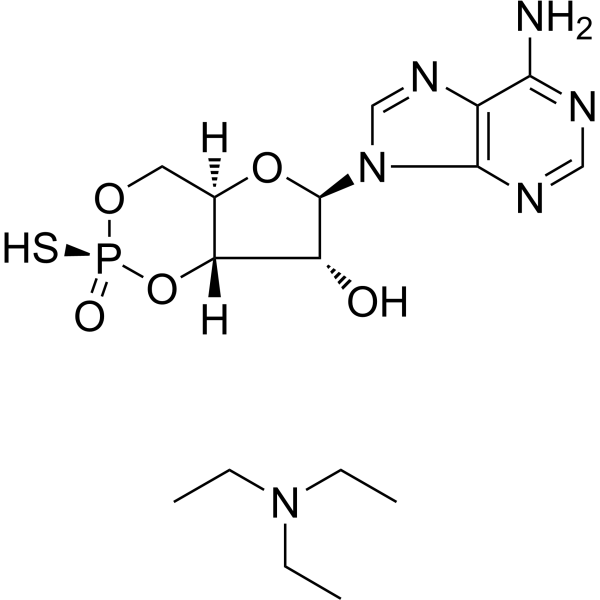
Sp-cGMPS
Sp-cGMPS is an activator of cGMP-dependent protein kinases (PKGs). Sp-cGMPS can be used in cardiovascular disease-related research.
商品は「研究用試薬」です。人や動物の医療用・臨床診断用・食品用の製品ではありません。
研究用途以外に使用した場合、当社は一切の責任を負いかねます。
- CAS 番号: 86562-10-9
- 分子式: C10H12N5O6PS
- 分子量:361.27
-
保管条件:
Please store the product under the recommended conditions in the Certificate of Analysis.


To place orders, for customer services and technical support, please contact: MedChemExpress USA
Tel: 609-228-6898 E-mail: [email protected] [email protected]


-
 生物活性
生物活性
-
化学情報
- プロトコル
- 純度とドキュメンテーション
- 参考文献
-
 Help & FAQs




生物活性
製品説明


化学情報
-
CAS 番号 86562-10-9
-
分子量 361.27
-
分子式 C10H12N5O6PS
-
SMILES
O=C1C2=C(NC(N)=N1)N([C@@](O[C@@](CO3)([H])[C@@]4([H])O[P@]3(S)=O)([H])[C@@H]4O)C=N2
-
輸送条件
Room temperature in continental US; may vary elsewhere.
-
保管条件
Please store the product under the recommended conditions in the Certificate of Analysis.


純度とドキュメンテーション
参考文献
[1]. Archer SL,et al. Nitric oxide and cGMP cause vasorelaxation by activation of a charybdotoxin-sensitive K channel by cGMP-dependent protein kinase. Proc Natl Acad Sci U S A. 1994 Aug 2;91(16):7583-7. [Content Brief]
[2]. Butt E, et al. Inhibition of cyclic GMP-dependent protein kinase-mediated effects by (Rp)-8-bromo-PET-cyclic GMPS. Br J Pharmacol. 1995 Dec;116(8):3110-6. [Content Brief]

Calculators
濃度 (開始) × 体積 (開始) = 濃度 (終了) × 体積 (終了)


Sp-cGMPS 関連分類
HY-137622 関連分類
 Powered by Bioz