



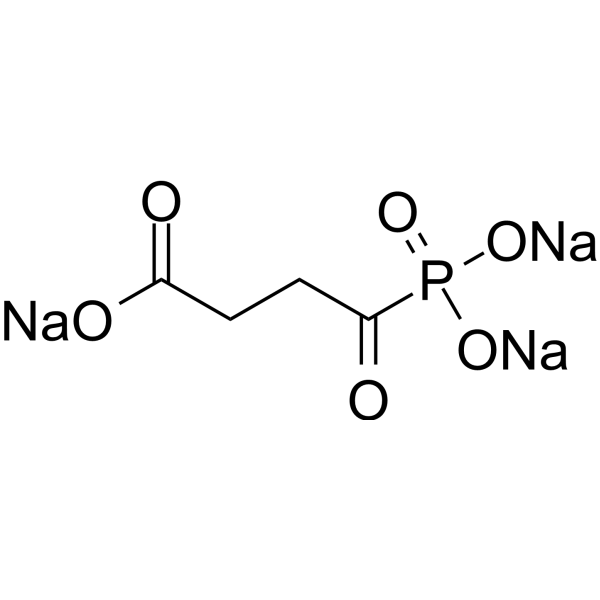
Succinyl phosphonate trisodium salt
Based on 14 publication(s) in Google Scholar
Succinyl phosphonate trisodium salt is a α-Ketoglutarate Dehydrogenase Complex (KGDHC) modulator with neuroprotective activity. Succinyl phosphonate trisodium salt protects this complex, reduces cellular succinyl-CoA concentration, downregulates protein succinylation levels, and inhibits the activity of the α-ketoglutarate dehydrogenase complex. Succinyl phosphonate trisodium salt corrects hypoxic or ethanol-induced behavioral impairments, modulates exploratory behavior and emotional stress responses, and improves hypoxia tolerance. Succinyl phosphonate trisodium salt reduces glutamate excitotoxicity, restores the activity of the α-ketoglutarate dehydrogenase complex, reverses the changes in glutamate dehydrogenase and glutamine synthetase activities induced by β-amyloid (Amyloid-β), modulates cognitive function, and prevents β-amyloid-induced neuronal damage. Succinyl phosphonate trisodium salt improves microglial senescence, alleviates neuroinflammation, reactive oxygen species (ROS) production, lipid peroxidation, and the expression of proinflammatory cytokines. Succinyl phosphonate trisodium salt can be used in the research of Alzheimer's disease, aging-related neuroinflammation, and Parkinson's disease.
For research use only. We do not sell to patients.
- Purity : 98.0%
- CAS No.: 864167-45-3
- Formula: C4H4Na3O6P
- Molecular Weight:248.01
-
Storage:
4°C, sealed storage, away from moisture
* In solvent : -80°C, 6 months; -20°C, 1 month (sealed storage, away from moisture)

To place orders, for customer services and technical support, please contact: MedChemExpress USA
Tel: 609-228-6898 E-mail: [email protected] [email protected]


-
 Biological Activity
-
Chemical Information
-
Solvent & Solubility
- Purity & Documentation
- References
-
 Help & FAQs


Publications Citing Use of MedChemExpress (MCE) Succinyl phosphonate trisodium salt
More- Cancer Res. 2019 Jul 1;79(13):3281-3293. [Abstract]
- Redox Biol. 2023 Jun:62:102669. [Abstract]
- Cell Death Dis. 2021 Oct 25;12(11):999. [Abstract]
- Free Radic Biol Med. 2016 Jul:96:22-33. [Abstract]
- Planta. 2018 Oct;248(4):963-979. [Abstract]
- Plant Signal Behav. 2019;14(7):1604015. [Abstract]
- J Cell Sci. 2026 Mar 16:jcs.264420. [Abstract]
- ACS Chem Biol. 2020 Aug 21;15(8):2041-2047. [Abstract]
- Exp Cell Res. 2019 Sep 15;382(2):111483. [Abstract]
- Clin Rheumatol. 2025 Nov 20. [Abstract]
- Radiat Med Prot. 2026 May 20.
- bioRxiv. 2024 Jan 15.
- Research Square Preprint. 2022.
- Research Square Print. 2022 May.
 Customer Validation & Images

-
Cell Proliferation/Viability Assay
-
Bio/Physico-chemical Assay
-
IP
-
Cell Proliferation/Viability Assay
-
RT-PCR


Biological Activity
Description
In Vitro
Succinyl phosphonate (10 μM; 72 h) trisodium salt reduces succinylation levels and succinyl-CoA concentrations, mitigates LPS (HY-D1056)-induced reactive oxygen species production, lipid accumulation, lipid peroxidation, and pro-inflammatory cytokine expression in BV2 cells and primary mouse microglia, and reduces senescence in VP-16 (HY-13629)-induced aged BV2 cells[3].
Succinyl phosphonate trisodium salt upregulates active OGDHC quantity in cultured neurons, but this upregulation is impaired by co-treatment with ethanol[4].
MedChemExpress (MCE) has not independently confirmed the accuracy of these methods. They are for reference only.
In Vivo
Succinyl phosphonate (10 nM; intra-CA1; 30 minutes after first Aβ25-35 injection) trisodium salt can block the damaging effects induced by Aβ and neuronal damage, improve the spatial learning and memory abilities of rats, and reverse the decrease in α-KGDHC enzyme activity[2].
Succinyl phosphonate (1 mg/kg; i.c.v.; single injection) trisodium salt reduces LPS (HY-D1056)-induced hippocampal mitochondrial protein succinylation, including succinylation of SDHA and ECHA, in male C57BL/6J mice[3].
MedChemExpress (MCE) has not independently confirmed the accuracy of these methods. They are for reference only.
-
Animal Model:Wistar rats (adult male, 230-250 g, Alzheimer’s disease model via bilateral microinjection of aggregated amyloid-beta25-35 into dorsal CA1 area for 4 consecutive days)[2]
-
Dosage:10 nM
-
Administration:intra-CA1; single dose; 30 minutes after first Aβ25-35 injection
-
Result:Prevented Aβ25-35-induced spatial learning deficits, as shown by significantly reduced AUC of escape latencies and improved escape latencies in specific trials.
Reversed Aβ25-35-induced spatial memory deficits, with time spent in the MWM target quadrant not differing from controls.
Restored hippocampal α-KGDHC activity to control levels.
Reduced elevated GDH activity to control levels.
Prevented the Aβ-induced reduction in GS activity.
Reduced Aβ-induced neuronal damage in the hippocampal CA1, CA3, and DG regions, with significantly more surviving neurons compared to the Aβ-only group.
-
Animal Model:LPS-induced C57BL/6J (2-4 month-old male, wild type)[3]
-
Dosage:1 mg/kg
-
Administration:i.c.v.; single injection
-
Result:Reversed the LPS-induced increase in hippocampal mitochondrial protein succinylation, restoring it to near control levels.
Significantly reduced the LPS-elevated succinylation levels of succinate dehydrogenase (SDHA) and trifunctional enzyme subunit alpha (ECHA) in mouse hippocampus.


Chemical Information
-
CAS No. 864167-45-3
-
Appearance Solid
-
Molecular Weight 248.01
-
Formula C4H4Na3O6P
-
Color White to light yellow
-
SMILES
O=C(O[Na])CCC(P(O[Na])(O[Na])=O)=O
-
Structure Classification
-
Initial Source
-
Shipping
Room temperature in continental US; may vary elsewhere.
-
Storage
4°C, sealed storage, away from moisture
* In solvent : -80°C, 6 months; -20°C, 1 month (sealed storage, away from moisture)


Publications (14)
-
Journal Impact Factor
-
Most Recent
-
Cancer Res
APC/C-CDH1-Regulated IDH3β Coordinates with the Cell Cycle to Promote Cell Proliferation. [Abstract]2019 Jul 1;79(13):3281-3293. PMID: 31053633 -
Redox Biol
2023 Jun:62:102669. PMID: 36933393 -
Cell Death Dis
2021 Oct 25;12(11):999. PMID: 34697294 -
Free Radic Biol Med
Reactive oxygen species production in cardiac mitochondria after complex I inhibition: Modulation by substrate-dependent regulation of the NADH/NAD(+) ratio. [Abstract]2016 Jul:96:22-33. PMID: 27068062 -
Planta
Inhibition of α-ketoglutarate dehydrogenase activity affects adventitious root growth in poplar via changes in GABA shunt. [Abstract]2018 Oct;248(4):963-979. PMID: 29982922 -
Plant Signal Behav
2019;14(7):1604015. PMID: 30999791 -
J Cell Sci
α-Ketoglutarate dehydrogenase complex activity modulates glutamate excitotoxicity via metabotropic regulation of NMDA receptors in primary cultures. [Abstract]2026 Mar 16:jcs.264420. PMID: 41834724
Succinyl phosphonate trisodium salt purchased from MedChemExpress. Usage Cited in: J Cell Sci. 2026 Mar 16:jcs.264420. [Abstract]
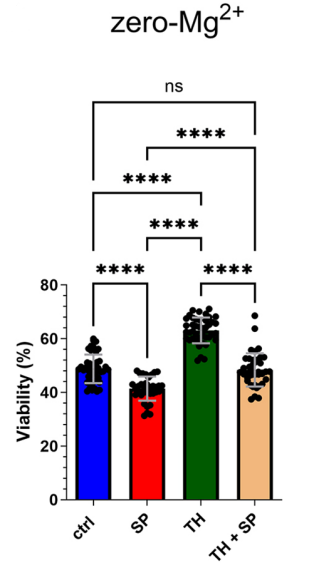
Bar graphs (depicting mean±s.d. together with the individual data points) of neuronal viability determined after exposure to zero-Mg2+-induced excitotoxicity of untreated cultures (ctrl, n=45), cultures pretreated for 36 to 48 h with Succinyl phosphonate trisodium salt (SP, 200 µM) (n=36), with TH (n=42) or with both compounds (TH+SP, n=41) (from three independent culture preparations).
Succinyl phosphonate trisodium salt purchased from MedChemExpress. Usage Cited in: J Cell Sci. 2026 Mar 16:jcs.264420. [Abstract]
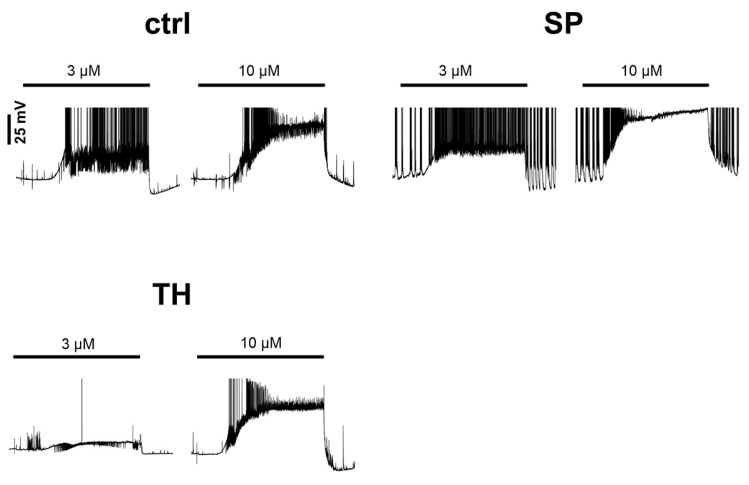
Depiction of representative voltage responses to application of 3 µM and 10 µM glutamate of control neurons, Succinyl phosphonate trisodium salt (SP)-treated neurons and TH-treated neurons. Responses were characterized by triggering of or increase in action potential discharge, and at 10 µM glutamate, by a transition into depolarisation block, which manifests itself in a cessation of discharge activity during sustained depolarization. Action potentials are truncated at −10 mV.
-
ACS Chem Biol
2020 Aug 21;15(8):2041-2047. PMID: 32633484 -
Exp Cell Res
OGDH mediates the inhibition of SIRT5 on cell proliferation and migration of gastric cancer. [Abstract]2019 Sep 15;382(2):111483. PMID: 31247190 -
Clin Rheumatol
High glucose-induced mitophagy accelerates premature aging of T cells in patients with rheumatoid arthritis. [Abstract]2025 Nov 20. PMID: 41261244
Succinyl phosphonate trisodium salt purchased from MedChemExpress. Usage Cited in: Clin Rheumatol. 2025 Nov 20. [Abstract]
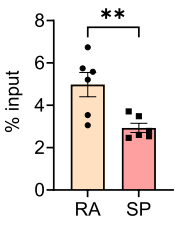
ZNF76 activity quantified upon Succinyl phosphonate trisodium salt (SP) (50 μM) treatment. The results showed that the application of the OGDH inhibitor SP significantly reduced the binding of ZNF76 to the promoter region of the DRP1 gene.
-
-
-
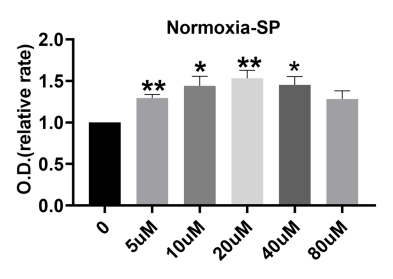
Succinyl phosphonate trisodium salt purchased from MedChemExpress. Usage Cited in: Research Square Preprint. 2022.
Proliferation assay of EPCs treated with vehicle or various concentration of Succinyl phosphonate trisodium salt (SP, 5-80 μM; 3 days) under normoxia (n = 6).
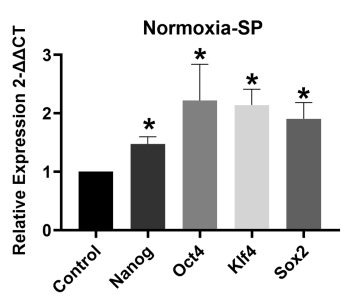
Succinyl phosphonate trisodium salt purchased from MedChemExpress. Usage Cited in: Research Square Preprint. 2022.
qRT-PCR showed higher expression of EPC stemness markers in the presence of 20 uM Succinyl phosphonate trisodium salt (SP) than with vehicle control under normoxia (n=5).
-


Solvent & Solubility
In Vitro:
H2O : 50 mg/mL (201.60 mM; Need ultrasonic)
Please refer to the solubility information to select the appropriate solvent. Once prepared, please aliquot and store the solution to prevent product inactivation from repeated freeze-thaw cycles.
Storage method and period of stock solution: -80°C, 6 months; -20°C, 1 month (sealed storage, away from moisture). When stored at -80°C, please use it within 6 months. When stored at -20°C, please use it within 1 month.
* Note: If you choose water as the stock solution, please dilute it to the working solution, then filter and sterilize it with a 0.22 μm filter before use.
Please refer to the solubility information to select the appropriate solvent. Once prepared, please aliquot and store the solution to prevent product inactivation from repeated freeze-thaw cycles.
Storage method and period of stock solution: -80°C, 6 months; -20°C, 1 month (sealed storage, away from moisture). When stored at -80°C, please use it within 6 months. When stored at -20°C, please use it within 1 month.
* Note: If you choose water as the stock solution, please dilute it to the working solution, then filter and sterilize it with a 0.22 μm filter before use.
Concentration (start) × Volume (start) = Concentration (final) × Volume (final)
In Vivo:
For the following dissolution methods, please prepare the working solution directly:
It is recommended to prepare fresh solutions and use them promptly within a short period of time.
The percentages shown for the solvents indicate their volumetric ratio in the final prepared solution. If precipitation or phase separation occurs during preparation, heat and/or sonication can be used to aid dissolution.
Add each solvent one by one: PBS
Solubility: 25 mg/mL (100.80 mM); Clear solution; Need ultrasonic


Purity & Documentation
-
Data Sheet (281 KB)
-
SDS (252 KB)
- English - EN (252 KB)
- Français - FR (252 KB)
- Deutsch - DE (252 KB)
- Norwegian - NO (252 KB)
- Español - ES (252 KB)
- Swedish - SV (252 KB)
- Italian - IT (252 KB)
- Korean - KR (252 KB)
- Portuguese - PT (252 KB)
-
Handling Instructions (2659 KB)
References
[2]. Sayehmiri F, et al. Phosphonate analog of 2-oxoglutarate regulates glutamate-glutamine homeostasis and counteracts amyloid beta induced learning and memory deficits in rats. Exp Gerontol. 2022;168:111944. [Content Brief]
[3]. Zhao X, et al. Up-regulated succinylation modifications induce a senescence phenotype in microglia by altering mitochondrial energy metabolism. J Neuroinflammation. 2024;21(1):296. Published 2024 Nov 14. [Content Brief]
[4]. Artiukhov AV, et al. Phosphonate Inhibitors of Pyruvate Dehydrogenase Perturb Homeostasis of Amino Acids and Protein Succinylation in the Brain. Int J Mol Sci. 2022;23(21):13186. Published 2022 Oct 29. [Content Brief]


Complete Stock Solution Preparation Table
Please refer to the solubility information to select the appropriate solvent. Once prepared, please aliquot and store the solution to prevent product inactivation from repeated freeze-thaw cycles.
Storage method and period of stock solution: -80°C, 6 months; -20°C, 1 month (sealed storage, away from moisture). When stored at -80°C, please use it within 6 months. When stored at -20°C, please use it within 1 month.
| Optional Solvent | Concentration Solvent Mass | 1 mg | 5 mg | 10 mg | 25 mg |
|---|---|---|---|---|---|
| H2O | 1 mM | 4.0321 mL | 20.1605 mL | 40.3210 mL | 100.8024 mL |
| 5 mM | 0.8064 mL | 4.0321 mL | 8.0642 mL | 20.1605 mL | |
| 10 mM | 0.4032 mL | 2.0160 mL | 4.0321 mL | 10.0802 mL | |
| 15 mM | 0.2688 mL | 1.3440 mL | 2.6881 mL | 6.7202 mL | |
| 20 mM | 0.2016 mL | 1.0080 mL | 2.0160 mL | 5.0401 mL | |
| 25 mM | 0.1613 mL | 0.8064 mL | 1.6128 mL | 4.0321 mL | |
| 30 mM | 0.1344 mL | 0.6720 mL | 1.3440 mL | 3.3601 mL | |
| 40 mM | 0.1008 mL | 0.5040 mL | 1.0080 mL | 2.5201 mL | |
| 50 mM | 0.0806 mL | 0.4032 mL | 0.8064 mL | 2.0160 mL | |
| 60 mM | 0.0672 mL | 0.3360 mL | 0.6720 mL | 1.6800 mL | |
| 80 mM | 0.0504 mL | 0.2520 mL | 0.5040 mL | 1.2600 mL | |
| 100 mM | 0.0403 mL | 0.2016 mL | 0.4032 mL | 1.0080 mL |
* Note: If you choose water as the stock solution, please dilute it to the working solution, then filter and sterilize it with a 0.22 μm filter before use.


Succinyl phosphonate trisodium salt Related Classifications
HY-12688A Related Classifications
 Powered by Bioz