



Sulfoxaflor
Based on 1 publication(s) in Google Scholar
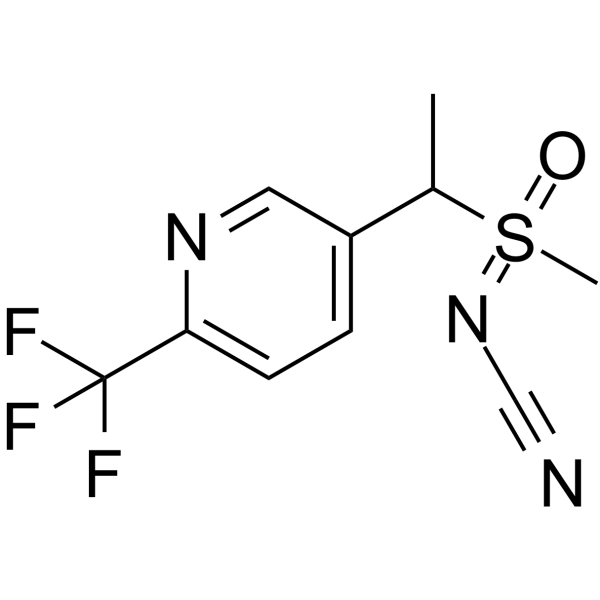
Sulfoxaflor is an orally active full agonist of insect nicotinic acetylcholine receptors (nAChRs), targeting the α-bungarotoxin-insensitive nAChR1 and nAChR2 subtypes. Sulfoxaflor binding to nACh is not inhibited by d-Tubocurarine (HY-125901), but is partially inhibited by Mecamylamine (HY-B1395A). Sulfoxaflor induces inward currents by activating nAChRs, leading to insect neurotoxicity. Sulfoxaflor can be used in the research of agricultural pest control, pesticide toxicology, insect neural receptor pharmacology, etc.
For research use only. We do not sell to patients.
- Purity : 98.01%
- CAS No.: 946578-00-3
- Formula: C10H10F3N3OS
- Molecular Weight:277.27
-
Storage:Powder -20°C, 3 years , 4°C, 2 years ; In solvent -80°C, 6 months , -20°C, 1 month

To place orders, for customer services and technical support, please contact: MedChemExpress USA
Tel: 609-228-6898 E-mail: [email protected] [email protected]


-
 Biological Activity
-
Chemical Information
-
Solvent & Solubility
- Protocols
- Purity & Documentation
- References
-
 Help & FAQs




Publications Citing Use of MedChemExpress (MCE) Sulfoxaflor
More

Biological Activity
Description
In Vitro
Sulfoxaflor (1 mM; 300 ms) fully activates α-Bgt-insensitive nAChRs expressed on cockroach DUM neurons, evokes inward currents with an EC50=153.7±10.2 μM[1].
5 μM Mecamylamine (HY-B1395A) inhibits the current by 60%, while 20 μM d-Tubocurarine (HY-125901) has no blocking effect[1].
MedChemExpress (MCE) has not independently confirmed the accuracy of these methods. They are for reference only. Further protocols information, click here.
In Vivo
MedChemExpress (MCE) has not independently confirmed the accuracy of these methods. They are for reference only.
-
Animal Model:Bombus terrestris audax queens[2]
-
Dosage:5 μg·dm-3 (1.8 M sucrose solution containing acetone)
-
Administration:Providing ad libitum supply of sucrose solution containing sulfoxaflor or control solution daily for 2 weeks
-
Result:Significantly reduced workers than control colonies starting 2-3 weeks after exposure, persisting until near the end of the colony cycle.


Chemical Information
-
CAS No. 946578-00-3
-
Appearance Solid
-
Molecular Weight 277.27
-
Formula C10H10F3N3OS
-
Color White to off-white
-
SMILES
CC(C1=CC=C(C(F)(F)F)N=C1)S(=NC#N)(C)=O
-
Shipping
Room temperature in continental US; may vary elsewhere.
-
Storage
Powder -20°C 3 years 4°C 2 years In solvent -80°C 6 months -20°C 1 month


Publications (1)
-
Journal Impact Factor
-
Most Recent
-
J Hazard Mater
Impact of long-term cadmium exposure on insecticidal cross-resistance and biological traits of Brown planthopper Nilaparvata lugens (Hemiptera: Delphacidae). [Abstract]2025 Jul 15:492:138203. PMID: 40209407


Solvent & Solubility
In Vitro:
DMSO : 50 mg/mL (180.33 mM; Need ultrasonic; Hygroscopic DMSO has a significant impact on the solubility of product, please use newly opened DMSO)
Please refer to the solubility information to select the appropriate solvent. Once prepared, please aliquot and store the solution to prevent product inactivation from repeated freeze-thaw cycles.
Storage method and period of stock solution: -80°C, 6 months; -20°C, 1 month. When stored at -80°C, please use it within 6 months. When stored at -20°C, please use it within 1 month.
Please refer to the solubility information to select the appropriate solvent. Once prepared, please aliquot and store the solution to prevent product inactivation from repeated freeze-thaw cycles.
Storage method and period of stock solution: -80°C, 6 months; -20°C, 1 month. When stored at -80°C, please use it within 6 months. When stored at -20°C, please use it within 1 month.
Concentration (start) × Volume (start) = Concentration (final) × Volume (final)
In Vivo:
Select the appropriate dissolution method based on your experimental animal and administration route.
- For the following dissolution methods, please ensure to first prepare a clear stock solution using an In Vitro approach and then sequentially add co-solvents:
- To ensure reliable experimental results, the clarified stock solution can be appropriately stored based on storage conditions. As for the working solution for In Vivo experiments, it is recommended to prepare freshly and use it on the same day.
- The percentages shown for the solvents indicate their volumetric ratio in the final prepared solution. If precipitation or phase separation occurs during preparation, heat and/or sonication can be used to aid dissolution.
Add each solvent one by one: 10% DMSO 40% PEG300 5% Tween-80 45% Saline
Solubility: ≥ 2.5 mg/mL (9.02 mM); Clear solution
This protocol yields a clear solution of ≥ 2.5 mg/mL (saturation unknown).
Taking 1 mL working solution as an example, add 100 μL DMSO stock solution (25.0 mg/mL) to 400 μL PEG300, and mix evenly; then add 50 μL Tween-80 and mix evenly; then add 450 μL Saline to adjust the volume to 1 mL.
Preparation of Saline: Dissolve 0.9 g sodium chloride in ddH₂O and dilute to 100 mL to obtain a clear Saline solution.
Add each solvent one by one: 10% DMSO 90% (20% SBE-β-CD in Saline)
Solubility: ≥ 2.5 mg/mL (9.02 mM); Clear solution
This protocol yields a clear solution of ≥ 2.5 mg/mL (saturation unknown).
Taking 1 mL working solution as an example, add 100 μL DMSO stock solution (25.0 mg/mL) to 900 μL 20% SBE-β-CD in Saline, and mix evenly.
Preparation of 20% SBE-β-CD in Saline (4°C, storage for one week): 2 g SBE-β-CD powder is dissolved in 10 mL Saline, completely dissolve until clear.
In Vivo Dissolution Calculator
Please enter the basic information of animal experiments:
-
-
-
-
Recommended: Prepare an additional quantity of animals to account for potential losses during experiments.
Please enter your animal formula composition:
-
%DMSO +
Recommended: Keep the proportion of DMSO in working solution below 2% if your animal is weak.
-
%+
-
+%Tween-80 + +
-
%Saline +
The co-solvents required include: DMSO, . All of co-solvents are available by MedChemExpress (MCE). , Tween 80. All of co-solvents are available by MedChemExpress (MCE).
Working solution concentration: 0.22 mg/mL
Method for preparing stock solution: mg drug dissolved in μL DMSO. Stock solution concentration: mg/mL.
1. Take μL DMSO stock solution;
2. Add μL .
μL , mix evenly;
3. Then add μL Tween 80, mix evenly;
4. Then add μL
Please ensure that the stock solution in the first step is dissolved to a clear state, and add co-solvents in sequence. You can use ultrasonic heating (ultrasonic cleaner, recommended frequency 20-40 kHz), vortexing, etc. to assist dissolution.

Protocols
-
Neurotoxicity Study
This protocol assesses in vitro neurotoxicity by combining neuronal viability, mitochondrial/metabolic activity, neurite outgrowth, and optional neuronal network function readouts. Calcein-AM or resazurin/PrestoBlue readouts estimate viable or metabolically active cells; βIII-tubulin immunofluorescence detects neuronal morphology and neurite networks; TMRE detects mitochondrial membrane potential; and MEA recordings detect functional changes in neuronal network activity.
-
Subchronic/Chronic Toxicity Study
A subchronic/chronic oral toxicity study detects systemic adverse effects caused by repeated administration of a test article, using mortality, clinical signs, body weight, food/water intake, ophthalmology, urinalysis, hematology, serum biochemistry, organ weights, gross necropsy, and histopathology as integrated readouts. The readout reflects dose-related physiological injury, target-organ pathology, reversibility after recovery, and derivation of NOAEL, LOAEL, or related point-of-departure values when the dataset supports them.
-
Acute Systemic Toxicity Study
Acute systemic toxicity studies evaluate adverse effects occurring after a single exposure, or repeated exposure within a short acute window, and the main in vivo readouts are mortality, moribund condition, clinical signs, body-weight change, and gross pathological findings; acute oral toxicity methods were developed to replace classical LD50 testing with reduced-animal designs such as fixed-dose procedure, acute toxic class method, and up-and-down procedure. The fixed-dose procedure classifies acute toxicity by administering predefined dose levels and observing evident toxicity rather than using death as the primary endpoint, whereas the acute toxic class method uses sequential groups of three animals per step and the up-and-down procedure doses animals sequentially to estimate an LD50 with fewer animals than conventional LD50 testing.


Purity & Documentation
-
Data Sheet (277 KB)
-
SDS (597 KB)
- English - EN (597 KB)
- Français - FR (597 KB)
- Deutsch - DE (597 KB)
- Norwegian - NO (597 KB)
- Español - ES (597 KB)
- Swedish - SV (597 KB)
- Italian - IT (597 KB)
- Korean - KR (597 KB)
- Portuguese - PT (597 KB)
-
Handling Instructions (2659 KB)
References
[1]. Jean-Noël Houchat, et al. Mode of Action of Sulfoxaflor on α-bungarotoxin-insensitive nAChR1 and nAChR2 Subtypes: Inhibitory Effect of Imidacloprid. Neurotoxicology. 2019 Sep;74:132-138. [Content Brief]
[2]. Siviter H, et al. Sulfoxaflor exposure reduces bumblebee reproductive success. Nature. 2018 Sep;561(7721):109-112. [Content Brief]


Complete Stock Solution Preparation Table
Please refer to the solubility information to select the appropriate solvent. Once prepared, please aliquot and store the solution to prevent product inactivation from repeated freeze-thaw cycles.
Storage method and period of stock solution: -80°C, 6 months; -20°C, 1 month. When stored at -80°C, please use it within 6 months. When stored at -20°C, please use it within 1 month.
| Optional Solvent | Concentration Solvent Mass | 1 mg | 5 mg | 10 mg | 25 mg |
|---|---|---|---|---|---|
| DMSO | 1 mM | 3.6066 mL | 18.0330 mL | 36.0659 mL | 90.1648 mL |
| 5 mM | 0.7213 mL | 3.6066 mL | 7.2132 mL | 18.0330 mL | |
| 10 mM | 0.3607 mL | 1.8033 mL | 3.6066 mL | 9.0165 mL | |
| 15 mM | 0.2404 mL | 1.2022 mL | 2.4044 mL | 6.0110 mL | |
| 20 mM | 0.1803 mL | 0.9016 mL | 1.8033 mL | 4.5082 mL | |
| 25 mM | 0.1443 mL | 0.7213 mL | 1.4426 mL | 3.6066 mL | |
| 30 mM | 0.1202 mL | 0.6011 mL | 1.2022 mL | 3.0055 mL | |
| 40 mM | 0.0902 mL | 0.4508 mL | 0.9016 mL | 2.2541 mL | |
| 50 mM | 0.0721 mL | 0.3607 mL | 0.7213 mL | 1.8033 mL | |
| 60 mM | 0.0601 mL | 0.3005 mL | 0.6011 mL | 1.5027 mL | |
| 80 mM | 0.0451 mL | 0.2254 mL | 0.4508 mL | 1.1271 mL | |
| 100 mM | 0.0361 mL | 0.1803 mL | 0.3607 mL | 0.9016 mL |


Sulfoxaflor Related Classifications
HY-118504 Related Classifications
 Powered by Bioz