



Tempone-15N,d16

Based on 1 Customer Validation
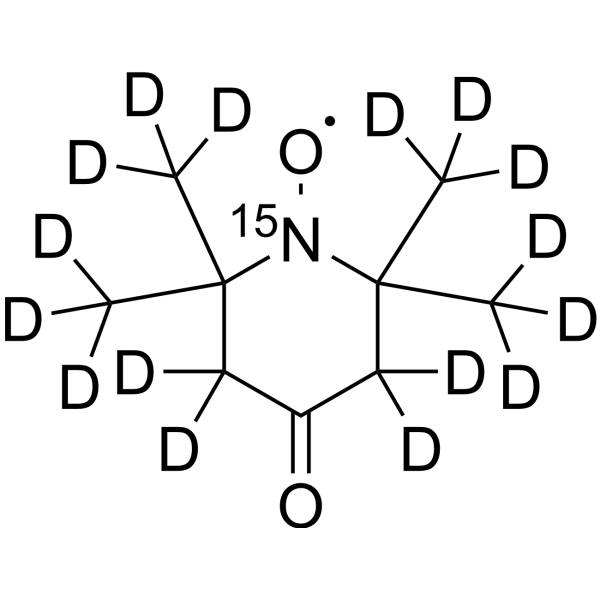
Tempone-15N,d16 (4-Oxo-Tempo 15N,D16) is the deuterated, 15N-labeled Tempone (HY-129242). Tempone (4-Oxo-Tempo) is a nitroxide radical spin label and ROS scavenger. Tempone induces cytotoxicity in lymphoma cells. Tempone serves as a substrate for intracellular reduction to hydroxylamine, rapidly equilibrates between intracellular and extracellular compartments, reduces nitroxide radical spin labels at the ubiquinol site of the respiratory chain, and acts as an alternative terminal electron acceptor when electron flow to oxygen is blocked. Tempone serves as a superoxide sensor, a T2-weighted MRI contrast agent, and a dynamic nuclear polarization polarizing agent for 13C. Tempone inhibits superoxide and peroxynitrite, hydroxyl radical generation, nitrotyrosine formation, and poly (ADP-ribose) formation, and alleviates renal dysfunction and injury in ischemia/reperfusion and hydrogen peroxide-induced injury. Tempone can be used for research on ischemia-reperfusion injury, acute renal failure, and lymphoma.
Nos produits utilisent uniquement pour la recherche. Nous ne vendons pas aux patients.
- Pureté : 98.86%
- CAS No.: 80404-14-4
- Formule: 15NC9D16O2
- Masse moléculaire:187.32
-
Stockage:Powder -20°C, 3 years , 4°C, 2 years ; In solvent -80°C, 6 months , -20°C, 1 month

To place orders, for customer services and technical support, please contact: MedChemExpress USA
Tel: 609-228-6898 E-mail: [email protected] [email protected]


-
 Activité biologique
-
Chemical Information
-
Solvant et solubilité
- Protocole
- Pureté et documentation
- Références
-
 Help & FAQs




Activité biologique
Description
Application
1. This compound can be used as a tracer
2. This compound can be used as an internal standard for quantitative analysis by NMR, GC-MS, or LC-MS.


Chemical Information
-
CAS No. 80404-14-4
-
Unlabeled CAS 2896-70-0
-
Appearance Solid
-
Masse moléculaire 187.32
-
Formule 15NC9D16O2
-
Color Light yellow to yellow
-
SMILES
[O][15N]1C(C([2H])([2H])[2H])(C([2H])([2H])C(C([2H])([2H])C1(C([2H])([2H])[2H])C([2H])([2H])[2H])=O)C([2H])([2H])[2H]
-
Synonyms
4-Oxo-Tempo-15N,d16
-
Livraison
Room temperature in continental US; may vary elsewhere.
-
Stockage
Powder -20°C 3 years 4°C 2 years In solvent -80°C 6 months -20°C 1 month


Solvant et solubilité
In Vitro:
DMSO : 30 mg/mL (160.15 mM; Need ultrasonic and warming; Hygroscopic DMSO has a significant impact on the solubility of product, please use newly opened DMSO)
Please refer to the solubility information to select the appropriate solvent. Once prepared, please aliquot and store the solution to prevent product inactivation from repeated freeze-thaw cycles.
Storage method and period of stock solution: -80°C, 6 months; -20°C, 1 month. When stored at -80°C, please use it within 6 months. When stored at -20°C, please use it within 1 month.
Please refer to the solubility information to select the appropriate solvent. Once prepared, please aliquot and store the solution to prevent product inactivation from repeated freeze-thaw cycles.
Storage method and period of stock solution: -80°C, 6 months; -20°C, 1 month. When stored at -80°C, please use it within 6 months. When stored at -20°C, please use it within 1 month.
Concentration (start) × Volume (start) = Concentration (final) × Volume (final)


Pureté et documentation
-
Fiche technique (284 KB)
-
SDS (458 KB)
- English - EN (458 KB)
- Français - FR (458 KB)
- Deutsch - DE (458 KB)
- Norwegian - NO (458 KB)
- Español - ES (458 KB)
- Swedish - SV (458 KB)
- Italian - IT (458 KB)
- Korean - KR (458 KB)
- Portuguese - PT (458 KB)
-
Instruction de manipulation (2659 KB)
Références
[1]. Guo X, et al. Comparative Genotoxicity of TEMPO and 3 of Its Derivatives in Mouse Lymphoma Cells. Toxicological sciences : an official journal of the Society of Toxicology. 2018 May 01;163(1):214-225. [Content Brief]
[7]. Patel NS, et al. TEMPONE reduces renal dysfunction and injury mediated by oxidative stress of the rat kidney. Free radical biology & medicine. 2002 Dec 01;33(11):1575-89. [Content Brief]


Complete Stock Solution Preparation Table
Please refer to the solubility information to select the appropriate solvent. Once prepared, please aliquot and store the solution to prevent product inactivation from repeated freeze-thaw cycles.
Storage method and period of stock solution: -80°C, 6 months; -20°C, 1 month. When stored at -80°C, please use it within 6 months. When stored at -20°C, please use it within 1 month.
| Optional Solvent | Concentration Solvent Mass | 1 mg | 5 mg | 10 mg | 25 mg |
|---|---|---|---|---|---|
| DMSO | 1 mM | 5.3385 mL | 26.6923 mL | 53.3846 mL | 133.4615 mL |
| 5 mM | 1.0677 mL | 5.3385 mL | 10.6769 mL | 26.6923 mL | |
| 10 mM | 0.5338 mL | 2.6692 mL | 5.3385 mL | 13.3461 mL | |
| 15 mM | 0.3559 mL | 1.7795 mL | 3.5590 mL | 8.8974 mL | |
| 20 mM | 0.2669 mL | 1.3346 mL | 2.6692 mL | 6.6731 mL | |
| 25 mM | 0.2135 mL | 1.0677 mL | 2.1354 mL | 5.3385 mL | |
| 30 mM | 0.1779 mL | 0.8897 mL | 1.7795 mL | 4.4487 mL | |
| 40 mM | 0.1335 mL | 0.6673 mL | 1.3346 mL | 3.3365 mL | |
| 50 mM | 0.1068 mL | 0.5338 mL | 1.0677 mL | 2.6692 mL | |
| 60 mM | 0.0890 mL | 0.4449 mL | 0.8897 mL | 2.2244 mL | |
| 80 mM | 0.0667 mL | 0.3337 mL | 0.6673 mL | 1.6683 mL | |
| 100 mM | 0.0534 mL | 0.2669 mL | 0.5338 mL | 1.3346 mL |


Tempone-15N,d16 Related Classifications
HY-129242S Related Classifications
 Powered by Bioz