



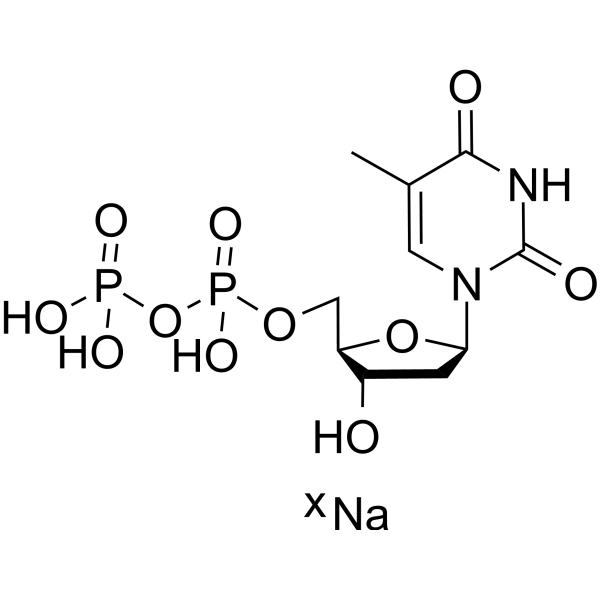
Thymidine 5′-diphosphate sodium

Based on 1 Customer Validation
Thymidine 5′-diphosphate (dTDP) sodium is the key product of pyrimidine synthesis in organisms. Thymidine 5′-diphosphate sodium is produced by thymidylate kinase (TMPK) catalyzed phosphorylation of 5′-thymidine monophosphate (dTMP), which requires ATP and Mg2+. Thymidine 5′-diphosphate sodium is further catalyzed by TMPK to thymidine 5′-triphosphate (dTTP). TMPK activity can be detected by measuring the level of Thymidine 5′-diphosphate.
Para uso exclusivo en investigación. No vendemos a pacientes.
- Pureza : 99%
- No. CAS: 108322-12-9
- Fòrmula: C10H16N2O11P2.xNa
-
Almacenamiento:
-20°C, sealed storage, away from moisture
* In solvent : -80°C, 6 months; -20°C, 1 month (sealed storage, away from moisture)

To place orders, for customer services and technical support, please contact: MedChemExpress USA
Tel: 609-228-6898 E-mail: [email protected] [email protected]


-
 Actividad biológica
-
Chemical Information
-
Solvente y solubilidad
- Protocolo
- Pureza y Documentación
- Referencias
-
 Help & FAQs


-
HY-W010854
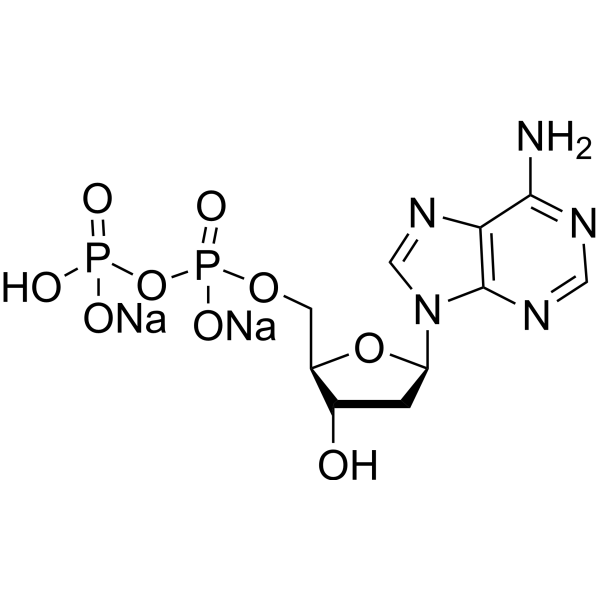
2'-Deoxyadenosine 5'-di-phos-phate disodiumPolynucleotide Phosphorylase Inhibitor, Poly(A) Polymerase Inhibitor -

HY-108213
Inosinic acidNatural Product -

HY-108213R
Inosinic acid (Standard)Natural Product -
HY-W008661
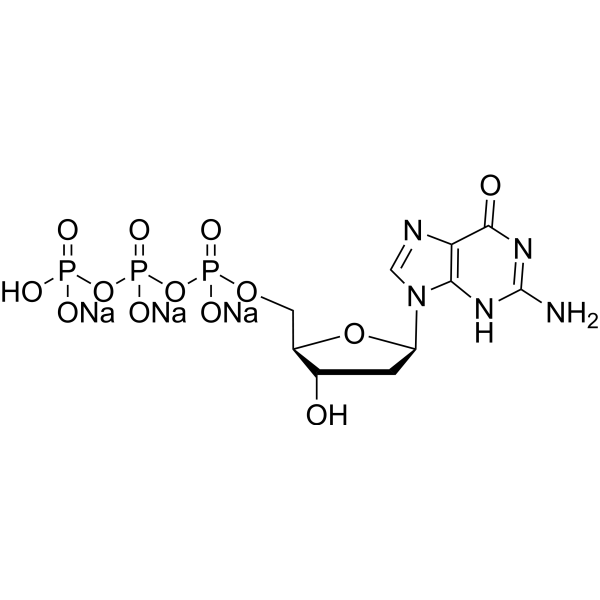
Deoxyguanosine triphosphate trisodium solution (100 mM)Nucleotide Precursor
Ver todos los productos específicos de isoformas Endogenous Metabolite
More

Actividad biológica
Descripciòn
In Vitro
Thymidine 5′-diphosphate is produced by thymidylate kinase (TMPK)-catalyzed phosphorylation of thymidine 5'-monophosphate (dTMP), a process requiring ATP and Mg2+, and is further catalyzed by TMPK into thymidine 5'-triphosphate (dTTP). Detection of Thymidine 5′-diphosphate levels allows the measurement of TMPK activity[1].
MedChemExpress (MCE) has not independently confirmed the accuracy of these methods. They are for reference only. Further protocols information, click here.


Chemical Information
-
No. CAS 108322-12-9
-
Appearance Solid
-
Fòrmula C10H16N2O11P2.xNa
-
Color White to off-white
-
SMILES
O=C(N1)N([C@H]2C[C@H](O)[C@@H](COP(OP(O)(O)=O)(O)=O)O2)C=C(C)C1=O.[Na].[x]
-
Synonyms
dTDP sodium
-
Structure Classification
-
Initial Source
-
Envío
Room temperature in continental US; may vary elsewhere.
-
Almacenamiento
-20°C, sealed storage, away from moisture
* In solvent : -80°C, 6 months; -20°C, 1 month (sealed storage, away from moisture)


Solvente y solubilidad
In Vitro:
H2O : 50 mg/mL (Need ultrasonic and warming)

Protocolo
-
Kinase activity and phosphorylation assays
Kinase activity assays measure the ability of kinases to transfer phosphate groups from ATP to specific substrates, while phosphorylation assays detect the presence and levels of phosphorylated proteins. Common methods include radiolabeled ATP incorporation (e. g. ,), ADP release detection via bioluminescence (e. g. ,[3]), enzyme-linked immunosorbent assays (ELISA) for phospho-specific epitopes (e. g. ,[6]), and microtiter-based formats for high-throughput screening (e. g. ,[8]). The ADP-Glo assay quantifies kinase activity by measuring ADP produced during phosphorylation using a luciferase-based system. Radiometric assays involve autoradiography or scintillation counting after incorporation of 32P-labeled ATP into substrate proteins. ELISA-based approaches rely on phospho-specific antibodies to detect activated kinases in cell lysates or purified samples.
-
Western Blot
Western blotting (WB) is a commonly used experimental method in molecular biology, biochemistry, and immunogenetics for identifying and quantifying target proteins. It combines gel electrophoresis with immunoassay, enabling researchers to analyze protein expression, post-translational modifications, and molecular weight.
-
Protocol for Kinase activity and phosphorylation assays
Kinase activity assays measure transfer of phosphate from ATP to a protein or peptide substrate, generating phosphorylated substrate, ADP, or incorporated radiolabeled phosphate as the readout; phosphorylation assays measure site-specific phosphorylation in cells or tissues as a proxy for kinase-pathway activation, inhibition, or substrate regulation. Phosphorylation can be detected by phospho-specific Western blot, immunoprecipitation kinase assay, phospho-immunofluorescence, phospho-flow cytometry, luminescent ADP detection, radiolabeled ATP incorporation, or reporter-based pathway assays, and these readouts can be applied to cancer cells, primary neurons, mouse tumors, organoids, inflammatory macrophages, ferroptosis studies, and mitophagy studies when the kinase target is biologically relevant.


Pureza y Documentación
-
Ficha de datos (273 KB)
-
SDS (252 KB)
- English - EN (252 KB)
- Français - FR (252 KB)
- Deutsch - DE (252 KB)
- Norwegian - NO (252 KB)
- Español - ES (252 KB)
- Swedish - SV (252 KB)
- Italian - IT (252 KB)
- Korean - KR (252 KB)
- Portuguese - PT (252 KB)
-
Instrucciones de manejo (2659 KB)
Referencias

Calculators
Concentration (start) × Volume (start) = Concentration (final) × Volume (final)


Thymidine 5′-diphosphate sodium Related Classifications
HY-131576A Related Classifications
 Powered by Bioz