



Triticonazole

Based on 1 Customer Validation
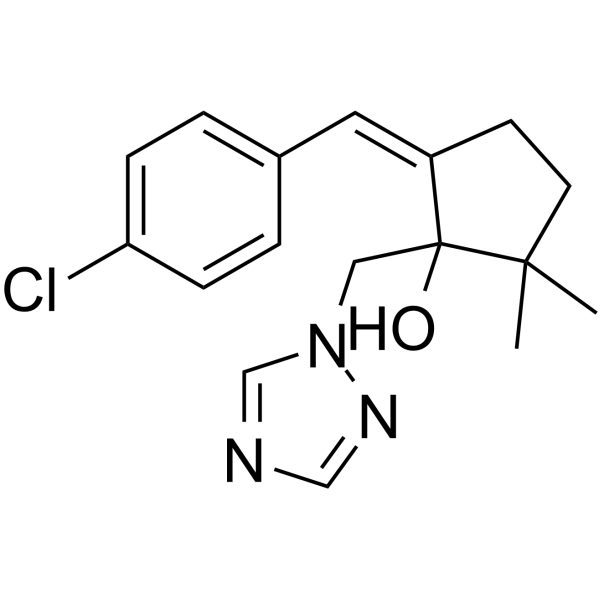
Triticonazole is an orally active triazole fungicide and androgen receptor antagonist. Triticonazole inhibits testosterone-induced androgen receptor activation and reduces basal testosterone secretion. Prenatal exposure to Triticonazole causes shortened anogenital distance in male rat fetuses and induces organ-specific histopathological changes in pigs. Triticonazole can be used for detoxification of seeds contaminated with fungal pathogens, but there is a risk of animal poisoning if the treated seeds are used as animal feed.
Nos produits utilisent uniquement pour la recherche. Nous ne vendons pas aux patients.
- Pureté : 95.73%
- CAS No.: 131983-72-7
- Formule: C17H20ClN3O
- Masse moléculaire:317.81
-
Stockage:Powder -20°C, 3 years , 4°C, 2 years ; In solvent -80°C, 6 months , -20°C, 1 month

To place orders, for customer services and technical support, please contact: MedChemExpress USA
Tel: 609-228-6898 E-mail: [email protected] [email protected]


-
 Activité biologique
-
Chemical Information
-
Solvant et solubilité
- Protocole
- Pureté et documentation
- Références
-
 Help & FAQs





Activité biologique
Description
IC50 & Target
Fungal[2]
In Vitro
Triticonazole (0.2-50 μM; 24 h) potently antagonizes the human androgen receptor in AR-EcoScreen cells with an IC50 of 0.3 μM, shows non-AR-mediated luciferase activation at 25 and 50 μM, and causes no cytotoxicity across tested concentrations[1].
Triticonazole (0.78-50 μM; 48 h) disrupts steroidogenesis in H295R cells by decreasing pregnenolone and corticosteroid levels, increasing sex steroid levels at low doses while decreasing them at 50 μM, increasing 17α-hydroxyprogesterone at 12.5 μM, and leaving DHEA levels unchanged[1].
Triticonazole (10 μM; 48 h) inhibits basal testosterone secretion by murine MA-10 Leydig cells by 44% after 48 hours of exposure[2].
Triticonazole (0.01-100 μM; 1-48 h) does not significantly alter reactive oxygen species production in murine MA-10 Leydig cells at concentrations up to 100 μM and exposure times up to 48 hours[2].
Triticonazole (100 pM-100 μM; 24 h) concentration-dependently inhibits testosterone-induced androgen receptor activation in human T47D-ARE cells with an IC50 of 10.7 μM and a relative effect potency of 0.25 compared to Flutamide (HY-B0022) after 24 hours of exposure[2].
MedChemExpress (MCE) has not independently confirmed the accuracy of these methods. They are for reference only.
In Vivo
Triticonazole (200-2000 mg/kg; p.o.; single dose) induces dose-related gross and histopathological changes across multiple internal organs in Danube White pigs, with key alterations in the liver, kidneys, lungs, lymph nodes, and central nervous system[3].
MedChemExpress (MCE) has not independently confirmed the accuracy of these methods. They are for reference only.
-
Animal Model:Sprague-Dawley rats (Crl:CD(SD), time-mated dams, 10 weeks old at delivery, gestational exposure model)[1]
-
Dosage:150 mg/kg bw/day; 450 mg/kg bw/day
-
Administration:p.o.; daily; gestational day 7 to gestational day 21
-
Result:Reduced fetal male AGD by 10% in the 450 mg/kg bw group.
Reduced fetal male AGD index by 8% in the 450 mg/kg bw group.
Reduced fetal male AGD index by 4% in the 150 mg/kg bw group.
Did not significantly affect female AGD.
Caused no significant changes to measured fetal male plasma hormone levels (pregnenolone, progesterone, corticosterone, testosterone, androstenedione, estrone).
Detected no histopathological changes in fetal testes.
Reached fetal plasma concentrations of 5.26 μM at 150 mg/kg bw and 9.01 μM at 450 mg/kg bw at gestational day 21.
Reached amniotic fluid concentrations of 1.34 μM at 150 mg/kg bw and 2.98 μM at 450 mg/kg bw at gestational day 21.


Chemical Information
-
CAS No. 131983-72-7
-
Appearance Solid
-
Masse moléculaire 317.81
-
Formule C17H20ClN3O
-
Color Off-white to light brown
-
SMILES
OC1(CN2N=CN=C2)C(C)(C)CC/C1=C/C3=CC=C(Cl)C=C3
-
Livraison
Room temperature in continental US; may vary elsewhere.
-
Stockage
Powder -20°C 3 years 4°C 2 years In solvent -80°C 6 months -20°C 1 month


Solvant et solubilité
In Vitro:
DMSO : 100 mg/mL (314.65 mM; Need ultrasonic; Hygroscopic DMSO has a significant impact on the solubility of product, please use newly opened DMSO)
Please refer to the solubility information to select the appropriate solvent. Once prepared, please aliquot and store the solution to prevent product inactivation from repeated freeze-thaw cycles.
Storage method and period of stock solution: -80°C, 6 months; -20°C, 1 month. When stored at -80°C, please use it within 6 months. When stored at -20°C, please use it within 1 month.
Please refer to the solubility information to select the appropriate solvent. Once prepared, please aliquot and store the solution to prevent product inactivation from repeated freeze-thaw cycles.
Storage method and period of stock solution: -80°C, 6 months; -20°C, 1 month. When stored at -80°C, please use it within 6 months. When stored at -20°C, please use it within 1 month.
Concentration (start) × Volume (start) = Concentration (final) × Volume (final)
In Vivo:
Select the appropriate dissolution method based on your experimental animal and administration route.
- For the following dissolution methods, please ensure to first prepare a clear stock solution using an In Vitro approach and then sequentially add co-solvents:
- To ensure reliable experimental results, the clarified stock solution can be appropriately stored based on storage conditions. As for the working solution for In Vivo experiments, it is recommended to prepare freshly and use it on the same day.
- The percentages shown for the solvents indicate their volumetric ratio in the final prepared solution. If precipitation or phase separation occurs during preparation, heat and/or sonication can be used to aid dissolution.
In Vivo Dissolution Calculator
Please enter the basic information of animal experiments:
-
-
-
-
Recommended: Prepare an additional quantity of animals to account for potential losses during experiments.
Please enter your animal formula composition:
-
%DMSO +
Recommended: Keep the proportion of DMSO in working solution below 2% if your animal is weak.
-
%+
-
+%Tween-80 + +
-
%Saline +
The co-solvents required include: DMSO, . All of co-solvents are available by MedChemExpress (MCE). , Tween 80. All of co-solvents are available by MedChemExpress (MCE).
Working solution concentration: 0.22 mg/mL
Method for preparing stock solution: mg drug dissolved in μL DMSO. Stock solution concentration: mg/mL.
1. Take μL DMSO stock solution;
2. Add μL .
μL , mix evenly;
3. Then add μL Tween 80, mix evenly;
4. Then add μL
Please ensure that the stock solution in the first step is dissolved to a clear state, and add co-solvents in sequence. You can use ultrasonic heating (ultrasonic cleaner, recommended frequency 20-40 kHz), vortexing, etc. to assist dissolution.


Pureté et documentation
-
Fiche technique (280 KB)
-
SDS (622 KB)
- English - EN (622 KB)
- Français - FR (622 KB)
- Deutsch - DE (622 KB)
- Norwegian - NO (622 KB)
- Español - ES (622 KB)
- Swedish - SV (622 KB)
- Italian - IT (622 KB)
- Korean - KR (622 KB)
- Portuguese - PT (622 KB)
-
Instruction de manipulation (2659 KB)
Références
[1]. Draskau MK, et al. In vitro and in vivo endocrine disrupting effects of the azole fungicides triticonazole and flusilazole. Environ Pollut. 2019;255(Pt 2):113309. [Content Brief]
[2]. Roelofs MJE, et al. Conazole fungicides inhibit Leydig cell testosterone secretion and androgen receptor activation in vitro. Toxicol Rep. 2014;1:271-283. Published 2014 May 22. [Content Brief]


Complete Stock Solution Preparation Table
Please refer to the solubility information to select the appropriate solvent. Once prepared, please aliquot and store the solution to prevent product inactivation from repeated freeze-thaw cycles.
Storage method and period of stock solution: -80°C, 6 months; -20°C, 1 month. When stored at -80°C, please use it within 6 months. When stored at -20°C, please use it within 1 month.
| Optional Solvent | Concentration Solvent Mass | 1 mg | 5 mg | 10 mg | 25 mg |
|---|---|---|---|---|---|
| DMSO | 1 mM | 3.1465 mL | 15.7327 mL | 31.4653 mL | 78.6634 mL |
| 5 mM | 0.6293 mL | 3.1465 mL | 6.2931 mL | 15.7327 mL | |
| 10 mM | 0.3147 mL | 1.5733 mL | 3.1465 mL | 7.8663 mL | |
| 15 mM | 0.2098 mL | 1.0488 mL | 2.0977 mL | 5.2442 mL | |
| 20 mM | 0.1573 mL | 0.7866 mL | 1.5733 mL | 3.9332 mL | |
| 25 mM | 0.1259 mL | 0.6293 mL | 1.2586 mL | 3.1465 mL | |
| 30 mM | 0.1049 mL | 0.5244 mL | 1.0488 mL | 2.6221 mL | |
| 40 mM | 0.0787 mL | 0.3933 mL | 0.7866 mL | 1.9666 mL | |
| 50 mM | 0.0629 mL | 0.3147 mL | 0.6293 mL | 1.5733 mL | |
| 60 mM | 0.0524 mL | 0.2622 mL | 0.5244 mL | 1.3111 mL | |
| 80 mM | 0.0393 mL | 0.1967 mL | 0.3933 mL | 0.9833 mL | |
| 100 mM | 0.0315 mL | 0.1573 mL | 0.3147 mL | 0.7866 mL |


Triticonazole Related Classifications
HY-B2058 Related Classifications
 Powered by Bioz