



Anticancer agent 160
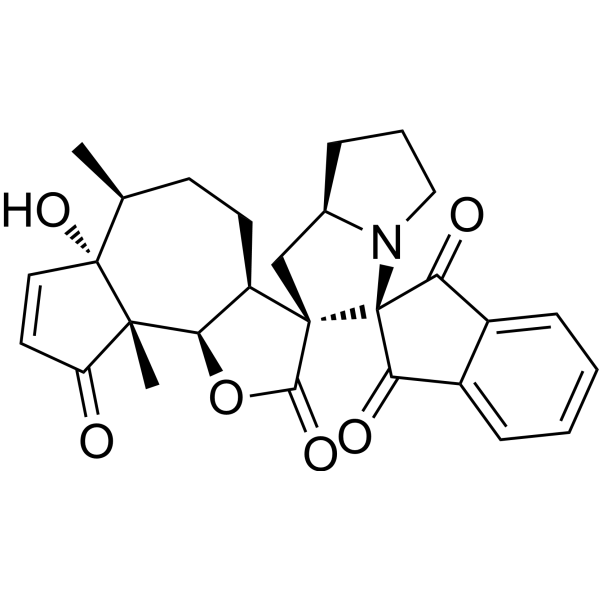
Anticancer agent 160 (Compound 6) is a natural product derived from Parthenium hysterophorus. Anticancer agent 160 is cytotoxic to HCT-116 cells, IC50=5.0 μM.
For research use only. We do not sell to patients.
- CAS No.: 2983122-03-6
- Formula: C28H29NO6
- Molecular Weight:475.53
-
Storage:
Please store the product under the recommended conditions in the Certificate of Analysis.

To place orders, for customer services and technical support, please contact: MedChemExpress USA
Tel: 609-228-6898 E-mail: [email protected] [email protected]


-
 Biological Activity
-
Chemical Information
- Protocols
- Purity & Documentation
- References
-
 Help & FAQs




Biological Activity
Description
IC50 & Target
|
Caspase 3 23.4 nM (EC50) |
In Vitro
M109S (0.1-10000 nM, 24-48 h) can inhibit apoptosis induced by Bax as well as Bak[1].
M109S (0-10μM, 4 h) M109S suppresses Staurosporine (HY-15141 STS)-induced apoptosis in MEFs [1].
M109S (0-10μM, 24 h) inhibits Etoposide(HY-13629)-induced apoptosis in Neuro2a cells[1].
M109S (500 nM, 24 h) inhibits Obatoclax(HY-10969A)-induced apoptosis in ARPE19 cells[1].
M109S (500 nM, 48 h) suppresses the conformation change (N-terminal exposure) [1].
M109S (500 nM, 48 h) suppresses the mitochondrial translocation of Bax[1].
M109S(1.0 μM, 4 h) decreases mitochondrial oxygen consumption and reactive oxygen species, whereas M109S(0.1–1 mM)) increases glycolysis[1].
MedChemExpress (MCE) has not independently confirmed the accuracy of these methods. They are for reference only. Further protocols information, click here.
-
Cell Line:MEF(Wt, Bax only, Bak only)
-
Concentration:0.1 nM, 1 nM, 10 nM, 100 nM, 10000 nM
-
Incubation Time:24 h((WT and Bax-only), 48 h (Bak-only)
-
Result:Showed a dose-dependent suppression of caspase activation in all three types of MEFs.
-
Cell Line:Showed a dose-dependent suppression of caspase activation in all three types of MEFs.
-
Concentration:0 nM, 1.6 nM,8 nM, 40 nM, 200 nM, 10 μM
-
Incubation Time:4 h
-
Result:Suppressed STS-induced caspase activation in a dose-dependent manner.
-
Cell Line:Neuro2a
-
Concentration:0 nM, 40 nM, 200 nM, 10 μM
-
Incubation Time:24 h
-
Result:Suppressed Etoposide -induced caspase activation in a dose-dependent manner.
-
Cell Line:ARPE19
-
Concentration:500 nM
-
Incubation Time:24 h
-
Result:Significantly inhibited Obatoclax-induced apoptosis in ARPE19 cells comparing to control.
-
Cell Line:iBax cells
-
Concentration:500 nM
-
Incubation Time:48 h
-
Result:The frequency of the punctuated staining was significantly reduced by M109S.
In Vivo
M109S(i.p., 1 mg/kg, i.v., 5 mg/kg, or o.p., 10 mg/kg) is an orally bioactive cell death inhibitor penetrating blood-brain/retina-barrier[1].
MedChemExpress (MCE) has not independently confirmed the accuracy of these methods. They are for reference only.
-
Animal Model:Abca4-/-Rdh8-/- mice
-
Dosage:10mg/kg
-
Administration:Oral Gavage (PO)
-
Result:Comparing to micewith M109S, the number of AF spots was similar to that detected in the dark-adapted mice
-
Animal Model:Mice and Rat
-
Dosage:Intraperitoneal injection (IP, 1 mg/kg), Intravenous injection (IV, 5 mg/kg), or Oral gavage (OP, 10 mg/kg).
-
Administration:Intraperitoneal injection (IP, 1 mg/kg), Intravenous injection (IV, 5 mg/kg), or Oral gavage (OP, 10 mg/kg).
-
Result:In mice, M109S reached 1.0 mg/mL (2.6 mM) plasma concentration within 30 min from administration, and it remained at 596± 134 ng/mL (1.6± 0.36 mM) 24 h after the oral gavage administration, the same as in rat. At 24 h after the oral gavage administration, the level of M109S in the plasma was 565.3± 188.3 nM in rats.The level of M109S in the rat retina and brain reached 171.0± 52.0 nM and 222.7± 74.7 nM, respectively, 24 h after its oral administration.


Chemical Information
-
CAS No. 2983122-03-6
-
Molecular Weight 475.53
-
Formula C28H29NO6
-
SMILES
O=C1C=C[C@]2(O)[C@]1(C)[C@H](OC([C@]3(C(C(C4=CC=CC=C45)=O)6C5=O)C[C@@H]7N6CCC7)=O)[C@H]3CC[C@@H]2C
-
Shipping
Room temperature in continental US; may vary elsewhere.
-
Storage
Please store the product under the recommended conditions in the Certificate of Analysis.

Protocols
-
Cell Cytotoxicity Assay
Cytotoxicity assays are usually based on the assessment of cell membrane damage, which can also be indirectly detected by measuring cell viability. Detection methods include MTT assay, CKK-8 assay, LDH assay and ATP assay, etc.
-
Cell Viability Determination by MTT Colorimetric Assay
The following protocol uses the MTT colorimetric assay as a classic literature-established method for assessing cell viability/metabolic activity in cultured mammalian cells. MTT[3-(4,5-dimethylthiazol-2-yl)-2,5-diphenyltetrazolium bromide] is reduced by metabolically active cells to a colored formazan product; the amount of formazan is quantified spectrophotometrically and provides an indirect measure of metabolically active viable cells. Importantly, MTT reduction reflects cellular oxidoreductase/metabolic activity rather than an absolute direct count of living cells, so changes in cellular metabolism can alter the signal independently of cell number.


Purity & Documentation
References

Calculators
Concentration (start) × Volume (start) = Concentration (final) × Volume (final)


Anticancer agent 160 Related Classifications
HY-156186 Related Classifications
 Powered by Bioz