



Sulfinpyrazone
Based on 4 publication(s) in Google Scholar
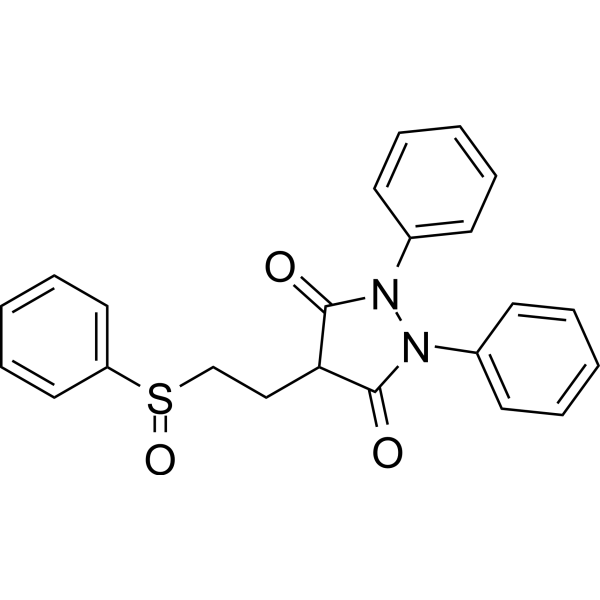
Sulfinpyrazone (G-28315) is an orally active and potent uricosuric agent for chronic and intermittent gouty arthritis. Sulfinpyrazone has antithrombotic and platelet inhibitory effects.
For research use only. We do not sell to patients.
- Purity: 99.01%
- CAS No.: 57-96-5
- Formula: C23H20N2O3S
- Molecular Weight:404.48
-
Storage:Powder -20°C, 3 years , 4°C, 2 years ; In solvent -80°C, 2 years , -20°C, 1 year


-
 Biological Activity
-
Chemical Information
-
Solvent & Solubility
- Purity & Documentation
- References
-
 Help & FAQs
-

FDA-Approved Drug Library
HY-L022
-
Drug Repurposing Compound Library
HY-L035
-
FDA Approved & Pharmacopeial Drug Library
HY-L066
-
Human Metabolite Library
HY-L123
-
Coagulation and Anti-coagulation Compound Library
HY-L136
-
Heterocyclic Compound Library
HY-L138
-
Off-patent Drug Library
HY-L141
-
Bioactive Compound Library Max
HY-L181
-
Drug Repurposing Compound Library Plus
HY-L035P
-
FDA-Approved Drug Library Plus
HY-L022P
-
FDA-Approved Drug Library Mini
HY-L022M
-
Bioactive Compound Library
HY-L001
-
RO5 Drug-like Natural Product Library
HY-L200
-
High-Throughput Bioactive Compound Library
HY-L205
-
Mass Spectrometry Human Metabolite Library
HY-L215
-
Natural Product Diversity Scaffold Library
HY-L245


Publications Citing Use of MedChemExpress (MCE) Sulfinpyrazone
MoreAll Endogenous Metabolite Isoforms
More

Biological Activity
|
Cell Line

|
Type | Value | Description | References |
|---|---|---|---|---|
| HEK293 | IC50 |
100 μM
Compound: sulfinpyrazone
|
Inhibition of human URAT1-mediated urate uptake in HEK293 cells
Inhibition of human URAT1-mediated urate uptake in HEK293 cells
|
[PMID: 17325024] |
| MDCK-II | IC50 |
<100 μM
Compound: Sulfinpyrazone
|
TP_TRANSPORTER: inhibition of PMEA efflux (PMEA: 1 uM) in MRP5-expressing MDCKII cells
TP_TRANSPORTER: inhibition of PMEA efflux (PMEA: 1 uM) in MRP5-expressing MDCKII cells
|
[PMID: 10840050] |
| Platelet | IC50 |
509.1 μM
Compound: sulfinpyrazone
|
Inhibition of thrombin-induced platelet aggregation in human platelets after 5 mins by turbidimetric method
Inhibition of thrombin-induced platelet aggregation in human platelets after 5 mins by turbidimetric method
|
[PMID: 18031002] |
Sulfinpyrazone (G-28315) stimulates fibrinolytic activity[2].
MedChemExpress (MCE) has not independently confirmed the accuracy of these methods. They are for reference only.
MedChemExpress (MCE) has not independently confirmed the accuracy of these methods. They are for reference only.


Chemical Information
-
CAS No. 57-96-5
-
Appearance Solid
-
Molecular Weight 404.48
-
Formula C23H20N2O3S
-
Color White to off-white
-
SMILES
O=C(C1CCS(C2=CC=CC=C2)=O)N(C3=CC=CC=C3)N(C4=CC=CC=C4)C1=O
-
Synonyms
G-28315
-
Structure Classification
-
Initial Source
-
Shipping
Room temperature in continental US; may vary elsewhere.
-
Storage
Powder -20°C 3 years 4°C 2 years In solvent -80°C 2 years -20°C 1 year


Publications (4)
-
Journal Impact Factor
-
Most Recent
-
Nat Commun
2025 Jul 16;16(1):6551. PMID: 40670375 -
Adv Sci (Weinh)
Morphine Tolerance Gated through EZH2-Mediated Suppression of Trpc5 in Spinal GABAergic Interneurons in Male Mice. [Abstract]2025 Oct 20:e07908. PMID: 41111460 -
ACS Environ Au
Machine Learning-Assisted Recognition of Environmental Sulfur-Containing Chemicals in Nontargeted Mass Spectrometry Analysis of Inadequate Mass Resolution. [Abstract]2025 Aug 5;5(6):573-582. PMID: 41277996 -
Anal Chem
Exposome-Scale Investigation of Cl-/Br-Containing Chemicals Using High-Resolution Mass Spectrometry, Multistage Machine Learning, and Cloud Computing. [Abstract]2025 Jun 3;97(21):11099-11109. PMID: 40401576


Solvent & Solubility
DMSO : 33.33 mg/mL (82.40 mM; Need ultrasonic; Hygroscopic DMSO has a significant impact on the solubility of product, please use newly opened DMSO)
Please refer to the solubility information to select the appropriate solvent. Once prepared, please aliquot and store the solution to prevent product inactivation from repeated freeze-thaw cycles.
Storage method and period of stock solution: -80°C, 2 years; -20°C, 1 year. When stored at -80°C, please use it within 2 years. When stored at -20°C, please use it within 1 year.
Please refer to the solubility information to select the appropriate solvent. Once prepared, please aliquot and store the solution to prevent product inactivation from repeated freeze-thaw cycles.
Storage method and period of stock solution: -80°C, 2 years; -20°C, 1 year. When stored at -80°C, please use it within 2 years. When stored at -20°C, please use it within 1 year.
Concentration (start) × Volume (start) = Concentration (final) × Volume (final)
Select the appropriate dissolution method based on your experimental animal and administration route.
- For the following dissolution methods, please ensure to first prepare a clear stock solution using an In Vitro approach and then sequentially add co-solvents:
- To ensure reliable experimental results, the clarified stock solution can be appropriately stored based on storage conditions. As for the working solution for In Vivo experiments, it is recommended to prepare freshly and use it on the same day.
- The percentages shown for the solvents indicate their volumetric ratio in the final prepared solution. If precipitation or phase separation occurs during preparation, heat and/or sonication can be used to aid dissolution.
Add each solvent one by one: 10% DMSO 40% PEG300 5% Tween-80 45% Saline
Solubility: ≥ 2.5 mg/mL (6.18 mM); Clear solution
This protocol yields a clear solution of ≥ 2.5 mg/mL (saturation unknown).
Taking 1 mL working solution as an example, add 100 μL DMSO stock solution (25.0 mg/mL) to 400 μL PEG300, and mix evenly; then add 50 μL Tween-80 and mix evenly; then add 450 μL Saline to adjust the volume to 1 mL.
Preparation of Saline: Dissolve 0.9 g sodium chloride in ddH₂O and dilute to 100 mL to obtain a clear Saline solution.
Add each solvent one by one: 10% DMSO 90% (20% SBE-β-CD in Saline)
Solubility: 2.5 mg/mL (6.18 mM); Suspended solution; Need ultrasonic
This protocol yields a suspended solution of 2.5 mg/mL. Suspended solution can be used for oral and intraperitoneal injection.
Taking 1 mL working solution as an example, add 100 μL DMSO stock solution (25.0 mg/mL) to 900 μL 20% SBE-β-CD in Saline, and mix evenly.
Preparation of 20% SBE-β-CD in Saline (4°C, storage for one week): 2 g SBE-β-CD powder is dissolved in 10 mL Saline, completely dissolve until clear.
Please enter the basic information of animal experiments:
-
-
-
-
Recommended: Prepare an additional quantity of animals to account for potential losses during experiments.
Please enter your animal formula composition:
-
%DMSO +
Recommended: Keep the proportion of DMSO in working solution below 2% if your animal is weak.
-
%+
-
+%Tween-80 + +
-
%Saline +
The co-solvents required include: DMSO, . All of co-solvents are available by MedChemExpress (MCE). , Tween 80. All of co-solvents are available by MedChemExpress (MCE).
Working solution concentration: 0.22 mg/mL
Method for preparing stock solution: mg drug dissolved in μL DMSO. Stock solution concentration: mg/mL.
1. Take μL DMSO stock solution;
2. Add μL .
μL , mix evenly;
3. Then add μL Tween 80, mix evenly;
4. Then add μL
Please ensure that the stock solution in the first step is dissolved to a clear state, and add co-solvents in sequence. You can use ultrasonic heating (ultrasonic cleaner, recommended frequency 20-40 kHz), vortexing, etc. to assist dissolution.


Purity & Documentation
-
Data Sheet (277 KB)
-
SDS (393 KB)
- English - EN (393 KB)
- Français - FR (393 KB)
- Deutsch - DE (393 KB)
- Norwegian - NO (393 KB)
- Español - ES (393 KB)
- Swedish - SV (393 KB)
- Italian - IT (393 KB)
- Portuguese - PT (393 KB)
-
Handling Instructions (2659 KB)
References
[1]. Margulies EH, White AM, Sherry S. Sulfinpyrazone: a review of its pharmacological properties and therapeutic use. Drugs. 1980;20(3):179‐197. [Content Brief]
[2]. Rüegg M. Antithrombotic effects of sulfinpyrazone in animals: influence on fibrinolysis and sodium arachidonate-induced pulmonary embolism. Pharmacology. 1976;14(6):522‐536. [Content Brief]


Complete Stock Solution Preparation Table
Please refer to the solubility information to select the appropriate solvent. Once prepared, please aliquot and store the solution to prevent product inactivation from repeated freeze-thaw cycles.
Storage method and period of stock solution: -80°C, 2 years; -20°C, 1 year. When stored at -80°C, please use it within 2 years. When stored at -20°C, please use it within 1 year.
| Optional Solvent | Concentration Solvent Mass | 1 mg | 5 mg | 10 mg | 25 mg |
|---|---|---|---|---|---|
| DMSO | 1 mM | 2.4723 mL | 12.3616 mL | 24.7231 mL | 61.8078 mL |
| 5 mM | 0.4945 mL | 2.4723 mL | 4.9446 mL | 12.3616 mL | |
| 10 mM | 0.2472 mL | 1.2362 mL | 2.4723 mL | 6.1808 mL | |
| 15 mM | 0.1648 mL | 0.8241 mL | 1.6482 mL | 4.1205 mL | |
| 20 mM | 0.1236 mL | 0.6181 mL | 1.2362 mL | 3.0904 mL | |
| 25 mM | 0.0989 mL | 0.4945 mL | 0.9889 mL | 2.4723 mL | |
| 30 mM | 0.0824 mL | 0.4121 mL | 0.8241 mL | 2.0603 mL | |
| 40 mM | 0.0618 mL | 0.3090 mL | 0.6181 mL | 1.5452 mL | |
| 50 mM | 0.0494 mL | 0.2472 mL | 0.4945 mL | 1.2362 mL | |
| 60 mM | 0.0412 mL | 0.2060 mL | 0.4121 mL | 1.0301 mL | |
| 80 mM | 0.0309 mL | 0.1545 mL | 0.3090 mL | 0.7726 mL |


 Powered by Bioz