



Cytisinicline
Based on 2 publication(s) in Google Scholar
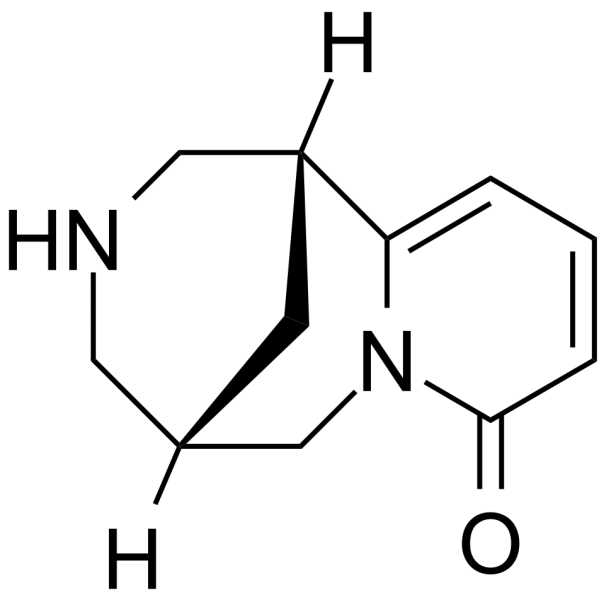
Cytisinicline (Cytisine) is an alkaloid. Cytisinicline (Cytisine) is a partial agonist of α4β2 nAChRs, and partial to full agonist at β4 containing receptors and α7 receptors. Has been used medically to help with smoking cessation.
For research use only. We do not sell to patients.
- Purity : 99.98%
- CAS No.: 485-35-8
- Formula: C11H14N2O
- Molecular Weight:190.25
-
Storage:Powder -20°C, 3 years , 4°C, 2 years ; In solvent -80°C, 2 years , -20°C, 1 year

To place orders, for customer services and technical support, please contact: MedChemExpress USA
Tel: 609-228-6898 E-mail: [email protected] [email protected]


-
 Biological Activity
-
Chemical Information
-
Solvent & Solubility
- Purity & Documentation
- References
-
 Help & FAQs


-
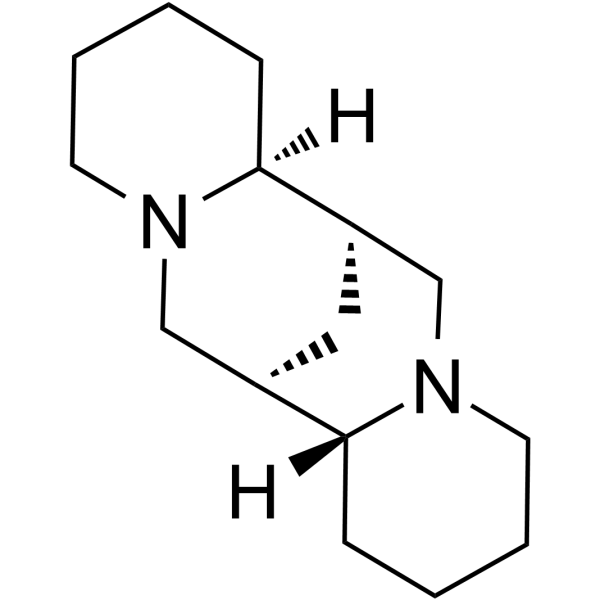
HY-W008350
(+)-Sparteine -
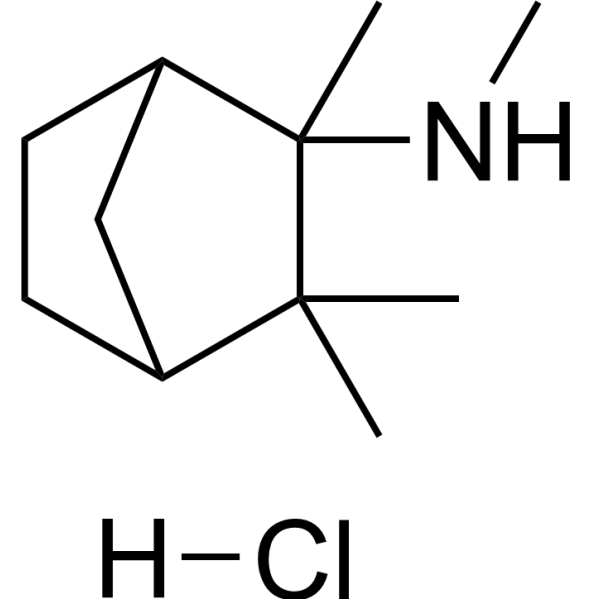
HY-B1395
Mecamylamine hydrochloridenAChR Antagonist -
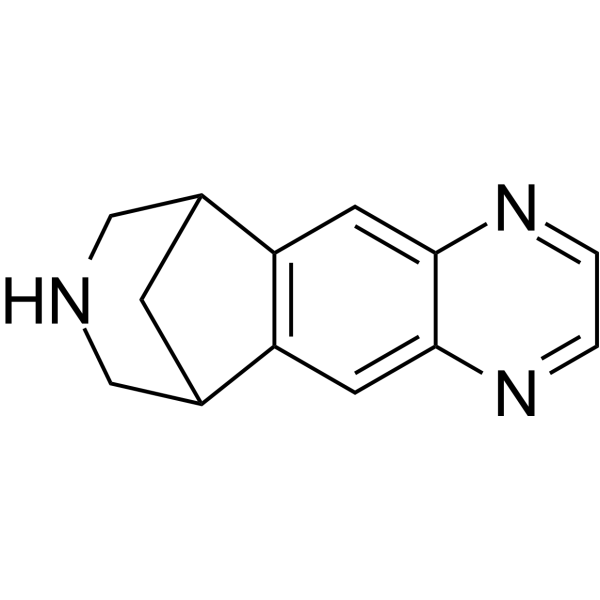
HY-10019
Vareniclineα4β2 nAChR Agonist -
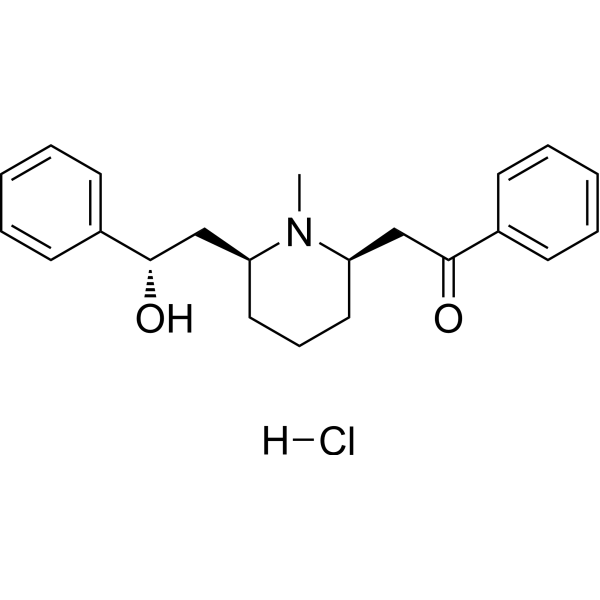
HY-B0979
Lobeline hydrochlorideNicotinic Receptor Agonist -
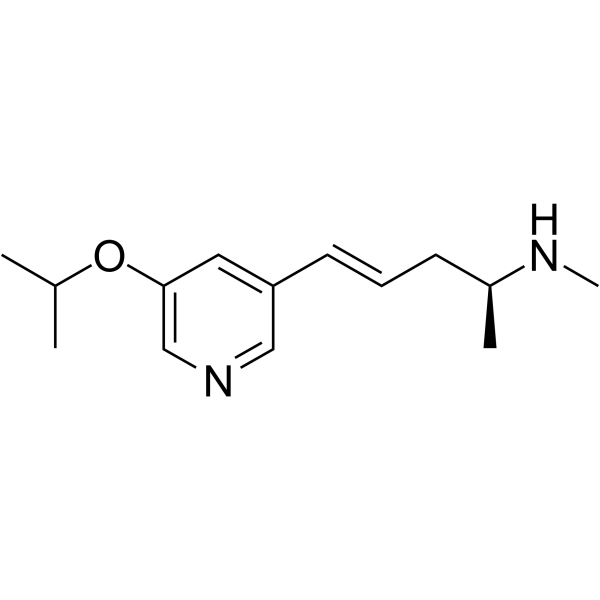
HY-10063
Isproniclineα4β2 nAChR Agonist -
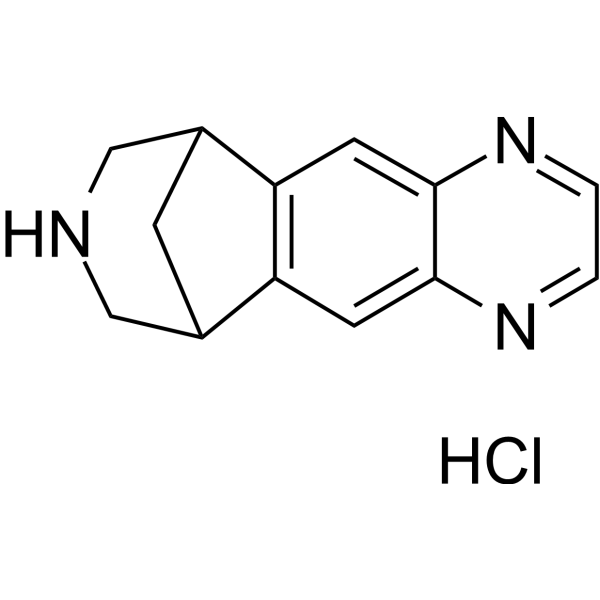
HY-10020
Varenicline Hydrochlorideα4β2 nAChR Agonist -
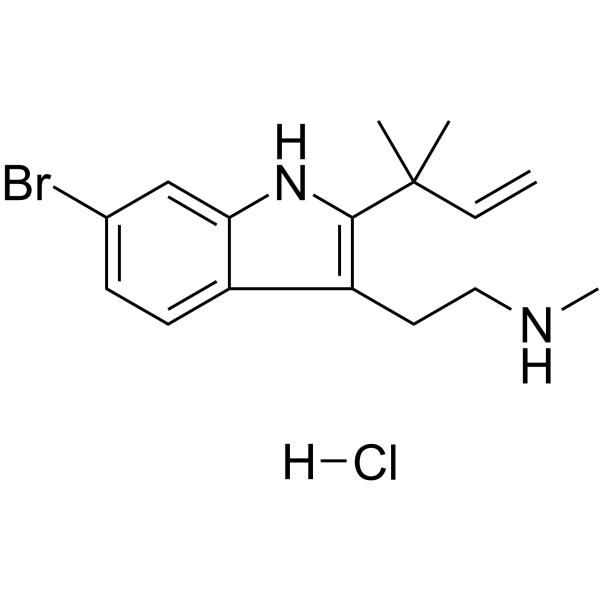
HY-107675
Desformylflustrabromine hydrochloridenAChR Agonist -

HY-N0175R
Cytisinicline (Standard)nAChR Agonist -
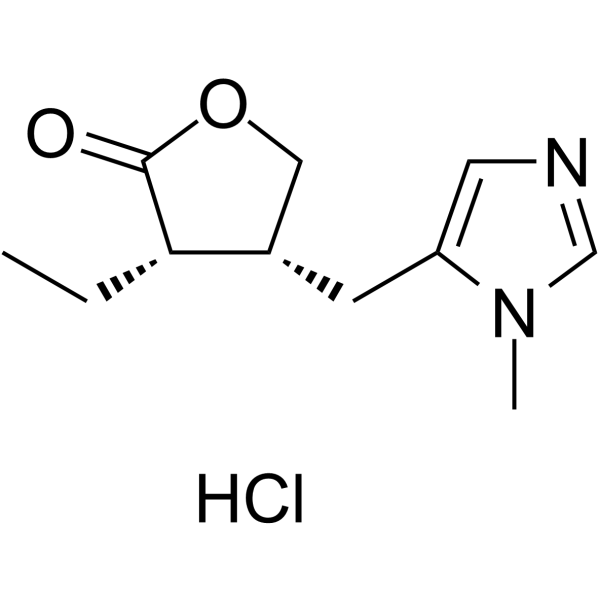
HY-B0726
Pilocarpine HydrochloridemAChR Agonist -
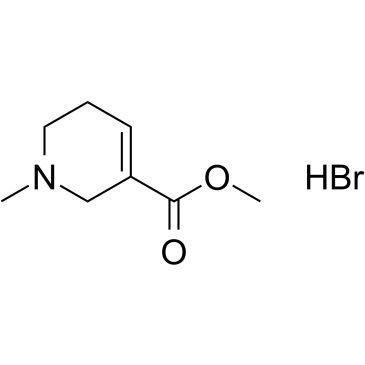
HY-B0489
Arecoline hydrobromidenAChR/mAChR Agonist -
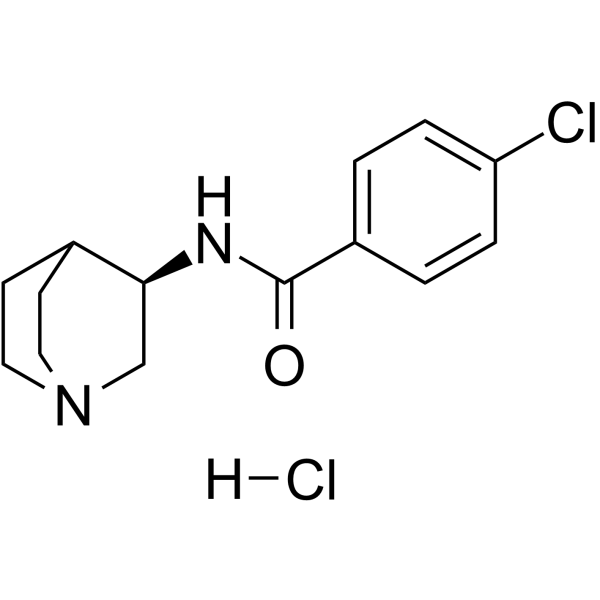
HY-12560A
PNU-282987α7 nAChR Agonist/5-HT3 antagonist
Publications Citing Use of MedChemExpress (MCE) Cytisinicline
More

Biological Activity
Description
IC50 & Target
α4β2 nAChRs[1].
Cellular Effect
|
Cell Line

|
Type | Value | Description | References |
|---|---|---|---|---|
| MDCK | CC50 |
>80 μM
Compound: 5
|
Cytotoxicity against MDCK cells assessed as reduction in cell viability after 48 hrs by CellTiter-Glo assay
Cytotoxicity against MDCK cells assessed as reduction in cell viability after 48 hrs by CellTiter-Glo assay
|
[PMID: 25147619] |
| MDCK | EC50 |
>80 μM
Compound: 5
|
Antiviral activity against Influenza A virus (A/Puerto Rico/8/34(H1N1)) infected in MDCK cells assessed as inhibition of virus-induced cytocidal activity after 48 hrs by CellTiter-Glo assay
Antiviral activity against Influenza A virus (A/Puerto Rico/8/34(H1N1)) infected in MDCK cells assessed as inhibition of virus-induced cytocidal activity after 48 hrs by CellTiter-Glo assay
|
[PMID: 25147619] |
| Oocyte | EC50 |
0.9 μM
Compound: 5
|
Effective concentration against Nicotinic acetylcholine receptor alpha4-beta4 expressed in xenopus oocytes
Effective concentration against Nicotinic acetylcholine receptor alpha4-beta4 expressed in xenopus oocytes
|
[PMID: 16033252] |
| Oocyte | EC50 |
2.7 μM
Compound: 5
|
Effective concentration against Nicotinic acetylcholine receptor alpha4-beta2 expressed in xenopus oocytes
Effective concentration against Nicotinic acetylcholine receptor alpha4-beta2 expressed in xenopus oocytes
|
[PMID: 16033252] |
| Oocyte | EC50 |
39 μM
Compound: 5
|
Effective concentration against Nicotinic acetylcholine receptor alpha2-beta4 expressed in xenopus oocytes
Effective concentration against Nicotinic acetylcholine receptor alpha2-beta4 expressed in xenopus oocytes
|
[PMID: 16033252] |
| Oocyte | EC50 |
67 μM
Compound: 5
|
Effective concentration against Nicotinic acetylcholine receptor alpha3-beta2 expressed in xenopus oocytes
Effective concentration against Nicotinic acetylcholine receptor alpha3-beta2 expressed in xenopus oocytes
|
[PMID: 16033252] |
| Oocyte | EC50 |
71 μM
Compound: 5
|
Effective concentration against Nicotinic acetylcholine receptor alpha 7 expressed in xenopus oocytes
Effective concentration against Nicotinic acetylcholine receptor alpha 7 expressed in xenopus oocytes
|
[PMID: 16033252] |
| Oocyte | EC50 |
72 μM
Compound: 5
|
Effective concentration against Nicotinic acetylcholine receptor alpha3-beta4 expressed in xenopus oocytes
Effective concentration against Nicotinic acetylcholine receptor alpha3-beta4 expressed in xenopus oocytes
|
[PMID: 16033252] |
| PC-12 | EC50 |
10 μM
Compound: 7
|
Compound was evaluated for functional potencies and efficacies at rat Nicotinic acetylcholine receptor subtype PC12 (ganglionic)
Compound was evaluated for functional potencies and efficacies at rat Nicotinic acetylcholine receptor subtype PC12 (ganglionic)
|
[PMID: 9435889] |
| TE-671 | EC50 |
11 nM
Compound: Cytisine (1)
|
Change in membrane potential in TE-671 cells expressing acetylcholine neuromuscular receptors
Change in membrane potential in TE-671 cells expressing acetylcholine neuromuscular receptors
|
[PMID: 15686946] |
In Vitro
Cytisinicline (Cytisine) (2.5, 5 and 10 mM) is capable of inducing apoptosis in HepG2 cells[4].
Treatment with Cytisinicline (Cytisine) increases the percentage of cells in the sub-G1 phase (P<0.01). The preincubation of HepG2 cells with Cytisinicline (Cytisine) (2.5, 5 and 10 mM) significantly increases the sub-G1 cell population[4].
MedChemExpress (MCE) has not independently confirmed the accuracy of these methods. They are for reference only.
In Vivo
Total pellet intake increases during Cytisinicline (Cytisine) substitution relative to nicotine and animals self-administered Cytisine significantly less than nicotine[2].
MedChemExpress (MCE) has not independently confirmed the accuracy of these methods. They are for reference only.
Clinical Trial
| NCT Number | Sponsor | Condition | Start Date |
Phase
|
|---|---|---|---|---|
| NCT01329991 | 2011-05 | PHASE1 |


Chemical Information
-
CAS No. 485-35-8
-
Appearance Solid
-
Molecular Weight 190.25
-
Formula C11H14N2O
-
Color White to light yellow
-
SMILES
O=C1N(C[C@@]2([H])C[C@]3([H])CNC2)C3=CC=C1
-
Synonyms
Cytisine; Sophorine; Baptitoxine
-
Structure Classification
-
Initial Source
-
Shipping
Room temperature in continental US; may vary elsewhere.
-
Storage
Powder -20°C 3 years 4°C 2 years In solvent -80°C 2 years -20°C 1 year


Publications (2)
-
Journal Impact Factor
-
Most Recent
-
J Ethnopharmacol
Isoxanthohumol, a component of Sophora flavescens, promotes the activation of the NLRP3 inflammasome and induces idiosyncratic hepatotoxicity. [Abstract]2022 Mar 1:285:114796. PMID: 34740771 -


Solvent & Solubility
In Vitro:
H2O : ≥ 100 mg/mL (525.64 mM)
DMSO : 100 mg/mL (525.64 mM; Need ultrasonic; Hygroscopic DMSO has a significant impact on the solubility of product, please use newly opened DMSO)
* "≥" means soluble, but saturation unknown.
Please refer to the solubility information to select the appropriate solvent. Once prepared, please aliquot and store the solution to prevent product inactivation from repeated freeze-thaw cycles.
Storage method and period of stock solution: -80°C, 2 years; -20°C, 1 year. When stored at -80°C, please use it within 2 years. When stored at -20°C, please use it within 1 year.
* Note: If you choose water as the stock solution, please dilute it to the working solution, then filter and sterilize it with a 0.22 μm filter before use.
Please refer to the solubility information to select the appropriate solvent. Once prepared, please aliquot and store the solution to prevent product inactivation from repeated freeze-thaw cycles.
Storage method and period of stock solution: -80°C, 2 years; -20°C, 1 year. When stored at -80°C, please use it within 2 years. When stored at -20°C, please use it within 1 year.
* Note: If you choose water as the stock solution, please dilute it to the working solution, then filter and sterilize it with a 0.22 μm filter before use.
Concentration (start) × Volume (start) = Concentration (final) × Volume (final)
In Vivo:
Select the appropriate dissolution method based on your experimental animal and administration route.
- For the following dissolution methods, please ensure to first prepare a clear stock solution using an In Vitro approach and then sequentially add co-solvents:
- To ensure reliable experimental results, the clarified stock solution can be appropriately stored based on storage conditions. As for the working solution for In Vivo experiments, it is recommended to prepare freshly and use it on the same day.
- The percentages shown for the solvents indicate their volumetric ratio in the final prepared solution. If precipitation or phase separation occurs during preparation, heat and/or sonication can be used to aid dissolution.
Add each solvent one by one: 10% DMSO 40% PEG300 5% Tween-80 45% Saline
Solubility: ≥ 2.08 mg/mL (10.93 mM); Clear solution
This protocol yields a clear solution of ≥ 2.08 mg/mL (saturation unknown).
Taking 1 mL working solution as an example, add 100 μL DMSO stock solution (20.8 mg/mL) to 400 μL PEG300, and mix evenly; then add 50 μL Tween-80 and mix evenly; then add 450 μL Saline to adjust the volume to 1 mL.
Preparation of Saline: Dissolve 0.9 g sodium chloride in ddH₂O and dilute to 100 mL to obtain a clear Saline solution.
Add each solvent one by one: 10% DMSO 90% (20% SBE-β-CD in Saline)
Solubility: ≥ 2.08 mg/mL (10.93 mM); Clear solution
This protocol yields a clear solution of ≥ 2.08 mg/mL (saturation unknown).
Taking 1 mL working solution as an example, add 100 μL DMSO stock solution (20.8 mg/mL) to 900 μL 20% SBE-β-CD in Saline, and mix evenly.
Preparation of 20% SBE-β-CD in Saline (4°C, storage for one week): 2 g SBE-β-CD powder is dissolved in 10 mL Saline, completely dissolve until clear.
In Vivo Dissolution Calculator
Please enter the basic information of animal experiments:
-
-
-
-
Recommended: Prepare an additional quantity of animals to account for potential losses during experiments.
Working solution concentration: 0.22 mg/mL
This product has good water solubility, please refer to the measured solubility data in water/PBS/Saline for details.


Purity & Documentation
-
Data Sheet (281 KB)
-
SDS (420 KB)
- English - EN (420 KB)
- Français - FR (420 KB)
- Deutsch - DE (420 KB)
- Norwegian - NO (420 KB)
- Español - ES (420 KB)
- Swedish - SV (420 KB)
- Italian - IT (420 KB)
- Korean - KR (420 KB)
- Portuguese - PT (420 KB)
-
Handling Instructions (2659 KB)
References
[1]. Pabreza LA, et al. [3H]cytisine binding to nicotinic cholinergic receptors in brain. Mol Pharmacol. 1991 Jan;39(1):9-12. [Content Brief]
[2]. Grebenstein PE, et al. The effects of noncontingent and self-administered cytisine on body weight and meal patterns in male Sprague-Dawley rats. Pharmacol Biochem Behav. 2013 Sep;110:192-200. [Content Brief]
[3]. Walker N, et al. Cytisine versus nicotine for smoking cessation. N Engl J Med. 2014 Dec 18;371(25):2353-62. [Content Brief]
[4]. Yu L, et al. Cytisine induces endoplasmic reticulum stress caused by calcium overload in HepG2 cells. Oncol Rep. 2018 Mar;39(3):1475-1484. [Content Brief]


Complete Stock Solution Preparation Table
Please refer to the solubility information to select the appropriate solvent. Once prepared, please aliquot and store the solution to prevent product inactivation from repeated freeze-thaw cycles.
Storage method and period of stock solution: -80°C, 2 years; -20°C, 1 year. When stored at -80°C, please use it within 2 years. When stored at -20°C, please use it within 1 year.
| Optional Solvent | Concentration Solvent Mass | 1 mg | 5 mg | 10 mg | 25 mg |
|---|---|---|---|---|---|
| H2O / DMSO | 1 mM | 5.2564 mL | 26.2818 mL | 52.5635 mL | 131.4088 mL |
| 5 mM | 1.0513 mL | 5.2564 mL | 10.5127 mL | 26.2818 mL | |
| 10 mM | 0.5256 mL | 2.6282 mL | 5.2564 mL | 13.1409 mL | |
| 15 mM | 0.3504 mL | 1.7521 mL | 3.5042 mL | 8.7606 mL | |
| 20 mM | 0.2628 mL | 1.3141 mL | 2.6282 mL | 6.5704 mL | |
| 25 mM | 0.2103 mL | 1.0513 mL | 2.1025 mL | 5.2564 mL | |
| 30 mM | 0.1752 mL | 0.8761 mL | 1.7521 mL | 4.3803 mL | |
| 40 mM | 0.1314 mL | 0.6570 mL | 1.3141 mL | 3.2852 mL | |
| 50 mM | 0.1051 mL | 0.5256 mL | 1.0513 mL | 2.6282 mL | |
| 60 mM | 0.0876 mL | 0.4380 mL | 0.8761 mL | 2.1901 mL | |
| 80 mM | 0.0657 mL | 0.3285 mL | 0.6570 mL | 1.6426 mL | |
| 100 mM | 0.0526 mL | 0.2628 mL | 0.5256 mL | 1.3141 mL |
* Note: If you choose water as the stock solution, please dilute it to the working solution, then filter and sterilize it with a 0.22 μm filter before use.


Cytisinicline Related Classifications
HY-N0175 Related Classifications
 Powered by Bioz