



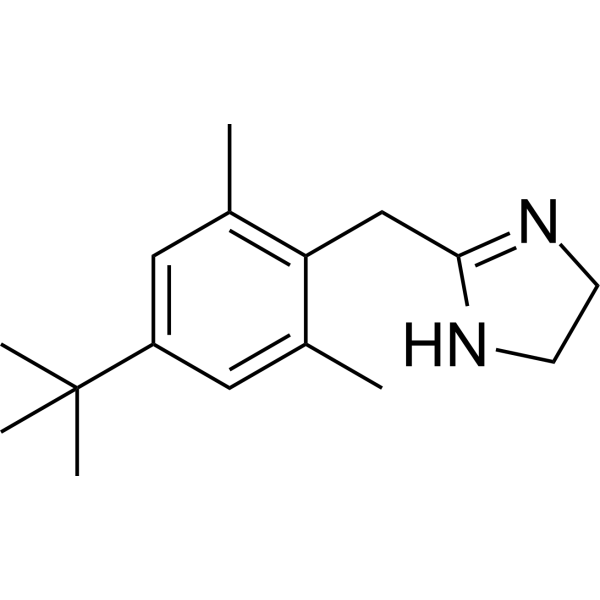
Xylometazoline
Xylometazoline is an α-adrenergic receptor agonist (Ki=0.05-1.7 μM). Xylometazoline can constrict nasal blood vessels and increase nasal airflow. Xylometazoline hydrochloride can be used in nose stuffiness and runny nose research.
For research use only. We do not sell to patients.
- CAS No.: 526-36-3
- Formula: C16H24N2
- Molecular Weight:244.38
-
Storage:
Please store the product under the recommended conditions in the Certificate of Analysis.

To place orders, for customer services and technical support, please contact: MedChemExpress USA
Tel: 609-228-6898 E-mail: [email protected] [email protected]


-
 Biological Activity
-
Chemical Information
- Purity & Documentation
- References
-
 Help & FAQs


All Adrenergic Receptor Isoforms
More

Biological Activity
Description
IC50 & Target
[2]|
Alpha-1A adrenergic receptor 0.05 μM (Ki) |
Alpha-1B adrenergic receptor 0.30 μM (Ki) |
Alpha-1D adrenergic receptor 0.15 μM (Ki) |
Alpha-2A adrenergic receptor 0.88 μM (Ki) |
Alpha-2B adrenergic receptor 1.7 μM (Ki) |
Alpha-2C adrenergic receptor 0.19 μM (Ki) |
In Vitro
Xylometazoline has affinity for α1A-adrenoceptor and α2B-adrenoceptor in HEK293 cells[2].
MedChemExpress (MCE) has not independently confirmed the accuracy of these methods. They are for reference only.
In Vivo
Xylometazoline and its excipients, when used for prolonged periods, may cause ophthalmic problems such as dry eyes, corneal edema, cataracts, retinal nerve fiber layer damage, and vascular damage[4].
MedChemExpress (MCE) has not independently confirmed the accuracy of these methods. They are for reference only.
-
Animal Model:SpragueDawley rat induced by platelet-activating factor[3]
-
Dosage:1 mg/mL; single dose
-
Administration:Intranasal administration
-
Result:Showed almost no vascular congestion, little infiltration, and the epithelium was completely intact.
Clinical Trial
| NCT Number | Sponsor | Condition | Start Date |
Phase

|
|---|---|---|---|---|
| NCT01329991 | Plexxikon| | 2011-05 | PHASE1 |


Chemical Information
-
CAS No. 526-36-3
-
Molecular Weight 244.38
-
Formula C16H24N2
-
SMILES
CC1=C(CC2=NCCN2)C(C)=CC(C(C)(C)C)=C1
-
Shipping
Room temperature in continental US; may vary elsewhere.
-
Storage
Please store the product under the recommended conditions in the Certificate of Analysis.


Purity & Documentation
References
[1]. Ronald Eccles, et al. The nasal decongestant effect of xylometazoline in the common cold. Am J Rhinol. 2008 Sep-Oct;22(5):491-6. [Content Brief]
[2]. Britta Haenisch, et al. Alpha-adrenoceptor agonistic activity of oxymetazoline and xylometazoline. Fundam Clin Pharmacol. 2010 Dec;24(6):729-39. [Content Brief]
[3]. M Kar, et al. Development of an intranasal formulation containing indomethacin and xylometazoline for rhinosinusitis treatment. Eur Rev Med Pharmacol Sci. 2022 Dec;26(2 Suppl):65-71. [Content Brief]
[4]. Ayse Ipek Akyuz Unsal, et al. Ophthalmic adverse effects of nasal decongestants on an experimental rat model. Arq Bras Oftalmol. 2018 Jan-Feb;81(1):53-58. [Content Brief]

Calculators
Concentration (start) × Volume (start) = Concentration (final) × Volume (final)


Xylometazoline Related Classifications
HY-B0475A Related Classifications
 Powered by Bioz