



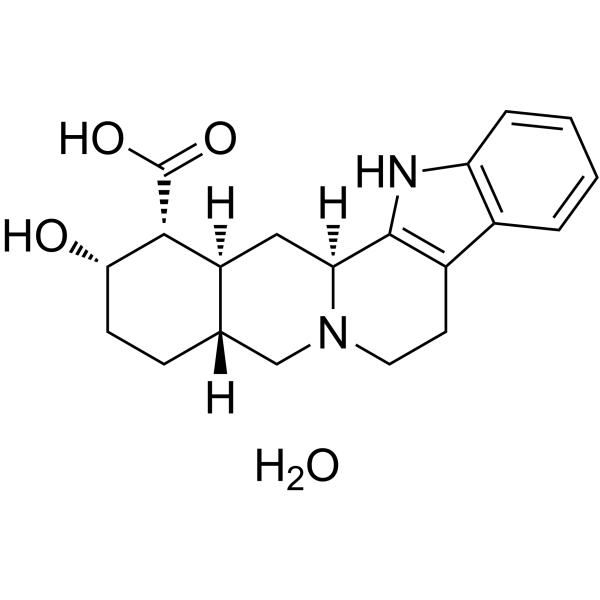
Yohimbic acid hydrate

Based on 1 Customer Validation
Yohimbic acid hydrate is a derivative of Yohimbine Hydrochloride (HY-N0127). Yohimbic acid hydrate exhibits vasodilatory and anticancer activities. Yohimbic acid hydrate can be used for the research of cancer, inflammation and cardiovascular disease.
For research use only. We do not sell to patients.
- Purity : 99.96%
- CAS No.: 207801-27-2
- Formula: C20H26N2O4
- Molecular Weight:358.43
-
Storage:
-20°C, sealed storage, away from moisture and light
* In solvent : -80°C, 6 months; -20°C, 1 month (sealed storage, away from moisture and light)

To place orders, for customer services and technical support, please contact: MedChemExpress USA
Tel: 609-228-6898 E-mail: [email protected] [email protected]


-
 Biological Activity
-
Chemical Information
-
Solvent & Solubility
- Protocols
- Purity & Documentation
- References
-
 Help & FAQs


All Adrenergic Receptor Isoforms
More

Biological Activity
Description
In Vitro
Yohimbic acid hydrate binds potently to the ccRCC-associated oncoprotein SLC25A37 and shows inhibitory activity in ccRCC cells[2].
MedChemExpress (MCE) has not independently confirmed the accuracy of these methods. They are for reference only. Further protocols information, click here.


Chemical Information
-
CAS No. 207801-27-2
-
Appearance Solid
-
Molecular Weight 358.43
-
Formula C20H26N2O4
-
Color White to off-white
-
SMILES
[H][C@]12C3=C(CCN1C[C@]4([H])CC[C@@H]([C@@H]([C@@]4([H])C2)C(O)=O)O)C(C=CC=C5)=C5N3.O
-
Structure Classification
-
Initial Source
-
Shipping
Room temperature in continental US; may vary elsewhere.
-
Storage
-20°C, sealed storage, away from moisture and light
* In solvent : -80°C, 6 months; -20°C, 1 month (sealed storage, away from moisture and light)


Solvent & Solubility
In Vitro:
DMSO : 100 mg/mL (278.99 mM; Need ultrasonic; Hygroscopic DMSO has a significant impact on the solubility of product, please use newly opened DMSO)
Please refer to the solubility information to select the appropriate solvent. Once prepared, please aliquot and store the solution to prevent product inactivation from repeated freeze-thaw cycles.
Storage method and period of stock solution: -80°C, 6 months; -20°C, 1 month (sealed storage, away from moisture and light). When stored at -80°C, please use it within 6 months. When stored at -20°C, please use it within 1 month.
Please refer to the solubility information to select the appropriate solvent. Once prepared, please aliquot and store the solution to prevent product inactivation from repeated freeze-thaw cycles.
Storage method and period of stock solution: -80°C, 6 months; -20°C, 1 month (sealed storage, away from moisture and light). When stored at -80°C, please use it within 6 months. When stored at -20°C, please use it within 1 month.
Concentration (start) × Volume (start) = Concentration (final) × Volume (final)

Protocols
-
Research Protocol for Cardiovascular Diseases
Cardiovascular disease can be modeled as maladaptive cardiac remodeling, where ischemic injury or pressure overload activates inflammatory signaling, fibroblast activation, extracellular-matrix deposition, cardiomyocyte hypertrophy, vascular remodeling, and progressive ventricular dysfunction. The TGF-β/SMAD axis is a central profibrotic pathway after myocardial injury and pressure overload, while innate immune and cytokine pathways regulate leukocyte recruitment, scar formation, and adverse remodeling. Key unresolved questions include which inflammatory signals are reparative versus harmful, when fibrosis is protective versus maladaptive, and whether pathway inhibition improves function without weakening necessary infarct healing or compensatory remodeling.
-
Research Protocol for Inflammation-related Diseases
The NLRP3 inflammasome is a cytosolic innate immune signaling platform that integrates priming signals and danger-signal activation to promote caspase-1 activation, maturation of IL-1β and IL-18, and gasdermin D-mediated pyroptotic cell death. The core experimental logic is to determine whether inflammatory disease phenotypes are driven by increased NLRP3 expression, ASC-containing inflammasome assembly, caspase-1 cleavage, GSDMD cleavage, and extracellular release of IL-1β/IL-18 rather than by nonspecific cell injury alone. The pathway is strongly linked to inflammation-related disease phenotypes because monosodium urate crystals activate NALP3/NLRP3 inflammasome signaling in gout-like crystal inflammation, cholesterol crystals activate NLRP3 inflammasomes in atherogenesis models, and DSS-induced intestinal inflammation has been reported to involve NLRP3 inflammasome activity. However, experimental colitis studies also show context-dependent protective effects of NLRP3 inflammasome co


Purity & Documentation
-
Data Sheet (276 KB)
-
SDS (480 KB)
- English - EN (480 KB)
- Français - FR (480 KB)
- Deutsch - DE (480 KB)
- Norwegian - NO (480 KB)
- Español - ES (480 KB)
- Swedish - SV (480 KB)
- Italian - IT (480 KB)
- Korean - KR (480 KB)
- Portuguese - PT (480 KB)
-
Handling Instructions (2659 KB)
References
[1]. Wang S, et, al. Significantly dysregulated genes in osteoarthritic labrum cells identified through gene expression profiling. Mol Med Rep. 2019 Aug; 20(2): 1716-1724. [Content Brief]
[2]. Dai H, et al. Integrating single-cell multi-omics and machine learning to reveal triaptosis heterogeneity in clear cell renal cell carcinoma. Hum Genomics. Published online May 7, 2026. [Content Brief]
[3]. RAYMOND HAMET. [Demonstration of the direct vasodilatory action of yohimbic acid and Py-tetrahydroquinoline]. C R Hebd Seances Acad Sci. 1960 Jun 27;250:4473-5. [Content Brief]


Complete Stock Solution Preparation Table
Please refer to the solubility information to select the appropriate solvent. Once prepared, please aliquot and store the solution to prevent product inactivation from repeated freeze-thaw cycles.
Storage method and period of stock solution: -80°C, 6 months; -20°C, 1 month (sealed storage, away from moisture and light). When stored at -80°C, please use it within 6 months. When stored at -20°C, please use it within 1 month.
| Optional Solvent | Concentration Solvent Mass | 1 mg | 5 mg | 10 mg | 25 mg |
|---|---|---|---|---|---|
| DMSO | 1 mM | 2.7899 mL | 13.9497 mL | 27.8995 mL | 69.7486 mL |
| 5 mM | 0.5580 mL | 2.7899 mL | 5.5799 mL | 13.9497 mL | |
| 10 mM | 0.2790 mL | 1.3950 mL | 2.7899 mL | 6.9749 mL | |
| 15 mM | 0.1860 mL | 0.9300 mL | 1.8600 mL | 4.6499 mL | |
| 20 mM | 0.1395 mL | 0.6975 mL | 1.3950 mL | 3.4874 mL | |
| 25 mM | 0.1116 mL | 0.5580 mL | 1.1160 mL | 2.7899 mL | |
| 30 mM | 0.0930 mL | 0.4650 mL | 0.9300 mL | 2.3250 mL | |
| 40 mM | 0.0697 mL | 0.3487 mL | 0.6975 mL | 1.7437 mL | |
| 50 mM | 0.0558 mL | 0.2790 mL | 0.5580 mL | 1.3950 mL | |
| 60 mM | 0.0465 mL | 0.2325 mL | 0.4650 mL | 1.1625 mL | |
| 80 mM | 0.0349 mL | 0.1744 mL | 0.3487 mL | 0.8719 mL | |
| 100 mM | 0.0279 mL | 0.1395 mL | 0.2790 mL | 0.6975 mL |


Yohimbic acid hydrate Related Classifications
HY-121936A Related Classifications
 Powered by Bioz