



Zacopride hydrochloride
Based on 1 publication(s) in Google Scholar
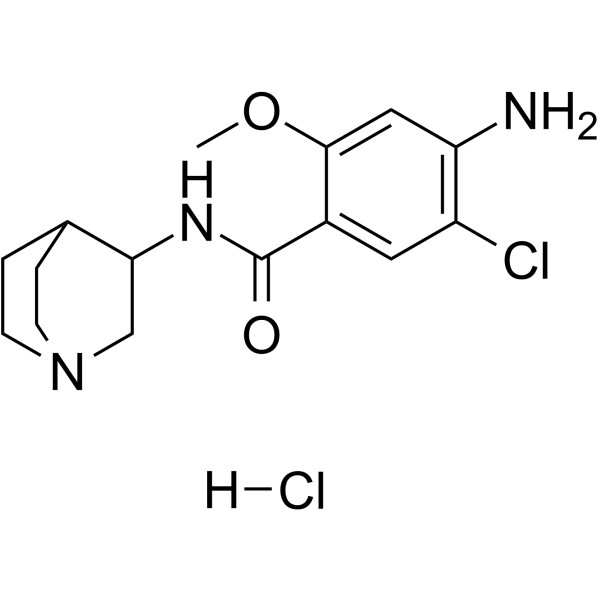
Zacopride hydrochloride is an orally active 5-HT3 receptor (Ki of 0.38 nM) antagonist and 5-HT4 receptor (Ki of 373 nM) agonist. Zacopride hydrochloride exhibits multiple activities, such as regulating gastrointestinal motility, affecting cardiac function, and exerting anxiolytic and antiemetic effects. Zacopride hydrochloride is currently mainly used in the research of gastrointestinal diseases, cardiovascular diseases, and psychiatric diseases such as anxiety.
For research use only. We do not sell to patients.
- Purity : 99.69%
- CAS No.: 101303-98-4
- Formula: C15H21Cl2N3O2
- Molecular Weight:346.25
-
Storage:
4°C, sealed storage, away from moisture
* In solvent : -80°C, 6 months; -20°C, 1 month (sealed storage, away from moisture)

To place orders, for customer services and technical support, please contact: MedChemExpress USA
Tel: 609-228-6898 E-mail: [email protected] [email protected]


-
 Biological Activity
-
Chemical Information
-
Solvent & Solubility
- Purity & Documentation
- References
-
 Help & FAQs


Publications Citing Use of MedChemExpress (MCE) Zacopride hydrochloride
MoreAll 5-HT Receptor Isoforms
More

Biological Activity
Description
In Vitro
Zacopride (3-30 μM) hydrochloride reduces the 5-HT-induced maximum contraction response of guinea pig colon in a concentration-dependent manner[3].
Zacopride hydrochloride produces 5-HT4 receptor-mediated relaxation of the rat esophagus with an EC50 value of 0.5 μM[3].
Zacopride hydrochloride (10 μM) shortens duration of action potentials in guinea pig isolated papillary muscles[11].
MedChemExpress (MCE) has not independently confirmed the accuracy of these methods. They are for reference only.
In Vivo
Zacopride (0.1 mg/kg; intraperitoneal injection; single dose) hydrochloride can completely block the vomiting induced by oral administration of 0.1 mg/kg Zacopride in ferrets[4].
Zacopride hydrochloride (0.1 mg/kg; intraperitoneal injection; single dose) hydrochloride can significantly attenuate the increase in extracellular dopamine levels in the nucleus accumbens induced by cocaine in rats[5].
Zacopride (Zacopride chlorhydrate, 1.0 mg/kg; intraperitoneal injection; single dose) hydrochloride combined with Tacrine can improve the accuracy of rats at the shortest delay (0-4 s) in a spatial working memory task[6].
Zacopride hydrochloride (0.01-31.6 mg/kg; p.o.; multiple doses until vomiting occurs) induces vomiting in 100% of ferrets at a cumulative dose of 0.11 mg/kg[7].
Zacopride hydrochloride (0.5 mg/kg; intravenous injection; single dose) combined with Etorphine can alleviate the decrease in respiratory rate caused by Etorphine in goats, increase hemoglobin oxygen saturation and arterial oxygen tension, while reducing carbon dioxide tension and improving ventilation[8].
Zacopride (0.1-1.0 mg/kg; intraperitoneal injection; single dose) hydrochloride exhibits anxiolytic effects in mice (social interaction and elevated plus maze test)[9].
Zacopride (0.0001-10 mg/kg; intraperitoneal injection; single dose) hydrochloride can enhance the exploratory behavior (black-white test box test) and social interaction (social interaction test with rats) of mice[10].
MedChemExpress (MCE) has not independently confirmed the accuracy of these methods. They are for reference only.
-
Animal Model:Male Kuo:Wistar rats (weight: at the beginning of training, 3-month-old rats were used, weight information not specified further), spatial working memory task model[6].
-
Dosage:0.0025-1.0 mg/kg (intraperitoneal, zacopride); 1.0 mg/kg (intraperitoneal, zacopride in combination with tacrine)
-
Administration:Intraperitoneal injection (single dose)
-
Result:Had no significant effect on the percent correct responses in the spatial working memory task at 0.0025-1.0 mg/kg.
Increased the percent correct responses at the shortest delays (0-4 s) but not at the longest delays (8-30 s) when combined with Tacrine (1.0 mg/kg).


Chemical Information
-
CAS No. 101303-98-4
-
Appearance Solid
-
Molecular Weight 346.25
-
Formula C15H21Cl2N3O2
-
Color White to off-white
-
SMILES
O=C(NC1CN2CCC1CC2)C3=CC(Cl)=C(N)C=C3OC.[H]Cl
-
Shipping
Room temperature in continental US; may vary elsewhere.
-
Storage
4°C, sealed storage, away from moisture
* In solvent : -80°C, 6 months; -20°C, 1 month (sealed storage, away from moisture)


Publications (1)
-
Journal Impact Factor
-
Most Recent
-
Front Immunol
TENS alleviates CP/CPPS-related inflammation and pain by modulating Kir2.1-dependent macrophage polarization. [Abstract]2026 Jan 12:16:1683500. PMID: 41624842


Solvent & Solubility
In Vitro:
DMSO : 100 mg/mL (288.81 mM; Need ultrasonic; Hygroscopic DMSO has a significant impact on the solubility of product, please use newly opened DMSO)
Please refer to the solubility information to select the appropriate solvent. Once prepared, please aliquot and store the solution to prevent product inactivation from repeated freeze-thaw cycles.
Storage method and period of stock solution: -80°C, 6 months; -20°C, 1 month (sealed storage, away from moisture). When stored at -80°C, please use it within 6 months. When stored at -20°C, please use it within 1 month.
Please refer to the solubility information to select the appropriate solvent. Once prepared, please aliquot and store the solution to prevent product inactivation from repeated freeze-thaw cycles.
Storage method and period of stock solution: -80°C, 6 months; -20°C, 1 month (sealed storage, away from moisture). When stored at -80°C, please use it within 6 months. When stored at -20°C, please use it within 1 month.
Concentration (start) × Volume (start) = Concentration (final) × Volume (final)
In Vivo:
Select the appropriate dissolution method based on your experimental animal and administration route.
- For the following dissolution methods, please ensure to first prepare a clear stock solution using an In Vitro approach and then sequentially add co-solvents:
- To ensure reliable experimental results, the clarified stock solution can be appropriately stored based on storage conditions. As for the working solution for In Vivo experiments, it is recommended to prepare freshly and use it on the same day.
- The percentages shown for the solvents indicate their volumetric ratio in the final prepared solution. If precipitation or phase separation occurs during preparation, heat and/or sonication can be used to aid dissolution.
Add each solvent one by one: 10% DMSO 40% PEG300 5% Tween-80 45% Saline
Solubility: ≥ 2.5 mg/mL (7.22 mM); Clear solution
This protocol yields a clear solution of ≥ 2.5 mg/mL (saturation unknown).
Taking 1 mL working solution as an example, add 100 μL DMSO stock solution (25.0 mg/mL) to 400 μL PEG300, and mix evenly; then add 50 μL Tween-80 and mix evenly; then add 450 μL Saline to adjust the volume to 1 mL.
Preparation of Saline: Dissolve 0.9 g sodium chloride in ddH₂O and dilute to 100 mL to obtain a clear Saline solution.
Add each solvent one by one: 10% DMSO 90% (20% SBE-β-CD in Saline)
Solubility: ≥ 2.5 mg/mL (7.22 mM); Clear solution
This protocol yields a clear solution of ≥ 2.5 mg/mL (saturation unknown).
Taking 1 mL working solution as an example, add 100 μL DMSO stock solution (25.0 mg/mL) to 900 μL 20% SBE-β-CD in Saline, and mix evenly.
Preparation of 20% SBE-β-CD in Saline (4°C, storage for one week): 2 g SBE-β-CD powder is dissolved in 10 mL Saline, completely dissolve until clear.
In Vivo Dissolution Calculator
Please enter the basic information of animal experiments:
-
-
-
-
Recommended: Prepare an additional quantity of animals to account for potential losses during experiments.
Please enter your animal formula composition:
-
%DMSO +
Recommended: Keep the proportion of DMSO in working solution below 2% if your animal is weak.
-
%+
-
+%Tween-80 + +
-
%Saline +
The co-solvents required include: DMSO, . All of co-solvents are available by MedChemExpress (MCE). , Tween 80. All of co-solvents are available by MedChemExpress (MCE).
Working solution concentration: 0.22 mg/mL
Method for preparing stock solution: mg drug dissolved in μL DMSO. Stock solution concentration: mg/mL. * In solvent : -80°C, 6 months; -20°C, 1 month (sealed storage, away from moisture)
1. Take μL DMSO stock solution;
2. Add μL .
μL , mix evenly;
3. Then add μL Tween 80, mix evenly;
4. Then add μL
Please ensure that the stock solution in the first step is dissolved to a clear state, and add co-solvents in sequence. You can use ultrasonic heating (ultrasonic cleaner, recommended frequency 20-40 kHz), vortexing, etc. to assist dissolution.


Purity & Documentation
-
Data Sheet (281 KB)
-
SDS (252 KB)
- English - EN (252 KB)
- Français - FR (252 KB)
- Deutsch - DE (252 KB)
- Norwegian - NO (252 KB)
- Español - ES (252 KB)
- Swedish - SV (252 KB)
- Italian - IT (252 KB)
- Korean - KR (252 KB)
- Portuguese - PT (252 KB)
-
Handling Instructions (2659 KB)
References
[1]. Neumann J, et al. Zacopride stimulates 5-HT4 serotonin receptors in the human atrium. Naunyn Schmiedebergs Arch Pharmacol. 2024 Sep;397(9):6821-6835. [Content Brief]
[3]. Nagakura Y, et al. Pharmacological properties of a novel gastrointestinal prokinetic benzamide selective for human 5-HT4 receptor versus human 5-HT3 receptor. Pharmacol Res. 1999 May;39(5):375-82. [Content Brief]
[4]. Sancilio LF, et al. Emetic activity of zacopride in ferrets and its antagonism by pharmacological agents. Eur J Pharmacol. 1990 Jun 8;181(3):303-6. [Content Brief]
[5]. McNeish CS, et al. The 5-HT3 antagonist zacopride attenuates cocaine-induced increases in extracellular dopamine in rat nucleus accumbens. Pharmacol Biochem Behav. 1993 Aug;45(4):759-63. [Content Brief]
[6]. Jäkälä P, et al. The effects of tacrine and zacopride on the performance of adult rats in the working memory task. Gen Pharmacol. 1993 May;24(3):675-9. [Content Brief]
[7]. Sancilio LF, et al. Studies on the emetic and antiemetic properties of zacopride and its enantiomers. Eur J Pharmacol. 1991 Jan 17;192(3):365-9. [Content Brief]
[8]. Meyer LC, et al. Zacopride and 8-OH-DPAT reverse opioid-induced respiratory depression and hypoxia but not catatonic immobilization in goats. Am J Physiol Regul Integr Comp Physiol. 2006 Feb;290(2):R405-13. [Content Brief]
[10]. Costall B, et al. Zacopride: anxiolytic profile in rodent and primate models of anxiety. J Pharm Pharmacol. 1988 Apr;40(4):302-5. [Content Brief]
[11]. Kii Y, et al. Effects of 5-HT4-receptor agonists, cisapride, mosapride citrate, and zacopride, on cardiac action potentials in guinea pig isolated papillary muscles. J Cardiovasc Pharmacol. 1997 May;29(5):670-5. [Content Brief]


Complete Stock Solution Preparation Table
Please refer to the solubility information to select the appropriate solvent. Once prepared, please aliquot and store the solution to prevent product inactivation from repeated freeze-thaw cycles.
Storage method and period of stock solution: -80°C, 6 months; -20°C, 1 month (sealed storage, away from moisture). When stored at -80°C, please use it within 6 months. When stored at -20°C, please use it within 1 month.
| Optional Solvent | Concentration Solvent Mass | 1 mg | 5 mg | 10 mg | 25 mg |
|---|---|---|---|---|---|
| DMSO | 1 mM | 2.8881 mL | 14.4404 mL | 28.8809 mL | 72.2022 mL |
| 5 mM | 0.5776 mL | 2.8881 mL | 5.7762 mL | 14.4404 mL | |
| 10 mM | 0.2888 mL | 1.4440 mL | 2.8881 mL | 7.2202 mL | |
| 15 mM | 0.1925 mL | 0.9627 mL | 1.9254 mL | 4.8135 mL | |
| 20 mM | 0.1444 mL | 0.7220 mL | 1.4440 mL | 3.6101 mL | |
| 25 mM | 0.1155 mL | 0.5776 mL | 1.1552 mL | 2.8881 mL | |
| 30 mM | 0.0963 mL | 0.4813 mL | 0.9627 mL | 2.4067 mL | |
| 40 mM | 0.0722 mL | 0.3610 mL | 0.7220 mL | 1.8051 mL | |
| 50 mM | 0.0578 mL | 0.2888 mL | 0.5776 mL | 1.4440 mL | |
| 60 mM | 0.0481 mL | 0.2407 mL | 0.4813 mL | 1.2034 mL | |
| 80 mM | 0.0361 mL | 0.1805 mL | 0.3610 mL | 0.9025 mL | |
| 100 mM | 0.0289 mL | 0.1444 mL | 0.2888 mL | 0.7220 mL |


Zacopride hydrochloride Related Classifications
HY-103137 Related Classifications
 Powered by Bioz