



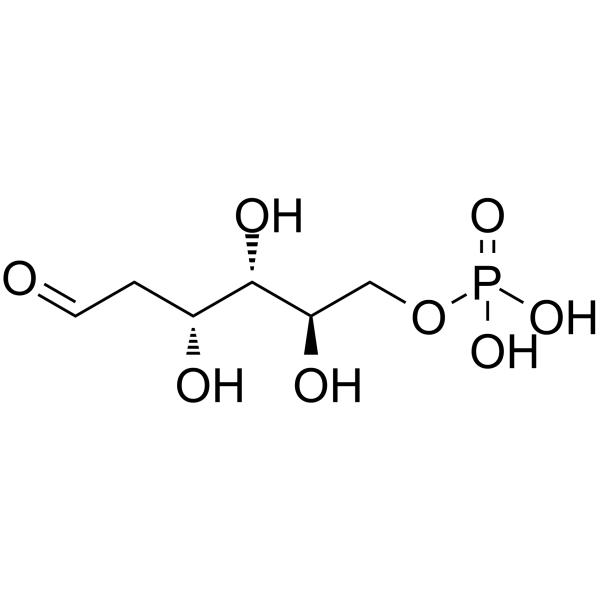
2-Deoxy-D-glucose 6-phosphate
Based on 2 publication(s) in Google Scholar
2-Deoxy-D-glucose 6-phosphate disodium is an ATP-competitive and 2-deoxy-D-glucose non-competitive Hexokinase inhibitor, with a Ki value of 1.45 mM against bovine heart hexokinase. 2-Deoxy-D-glucose 6-phosphate disodium exerts ATP-competitive and 2-deoxy-D-glucose non-competitive inhibitory effects on bovine heart hexokinase. 2-DG inhibits glycolysis via the generation and intracellular accumulation of 2-Deoxy-D-glucose 6-phosphate disodium, thereby inhibiting the functions of hexokinase and Glucose-6-phosphate isomerase, and inducing cell death. 2-Deoxy-D-glucose 6-phosphate disodium can be used in cancer-related research.
For research use only. We do not sell to patients.
- CAS No.: 3573-50-0
- Formula: C6H13O8P
- Molecular Weight:244.14
-
Storage:
Please store the product under the recommended conditions in the Certificate of Analysis.

To place orders, for customer services and technical support, please contact: MedChemExpress USA
Tel: 609-228-6898 E-mail: [email protected] [email protected]


-
 Biological Activity
-
Chemical Information
- Protocols
- Purity & Documentation
- References
-
 Help & FAQs


Publications Citing Use of MedChemExpress (MCE) 2-Deoxy-D-glucose 6-phosphate
More

Biological Activity
Description
In Vitro
2-Deoxy-D-glucose 6-phosphate inhibits 2DG phosphorylation by bovine heart hexokinase via a competitive mechanism with ATP and non-competitive mechanism with 2DG, with an average inhibition constant (Ki) of 1.45 mM[2].
MedChemExpress (MCE) has not independently confirmed the accuracy of these methods. They are for reference only. Further protocols information, click here.


Chemical Information
-
CAS No. 3573-50-0
-
Molecular Weight 244.14
-
Formula C6H13O8P
-
SMILES
O=P(O)(O)OC[C@@H](O)[C@@H](O)[C@H](O)CC=O
-
Shipping
Room temperature in continental US; may vary elsewhere.
-
Storage
Please store the product under the recommended conditions in the Certificate of Analysis.


Publications (2)
-
Journal Impact Factor
-
Most Recent
-
Anal Chem
Streamlined Methods for Profiling Targeted Michael Acceptor Molecules Reveal Natural PTP1B Covalent Inhibitors. [Abstract]2025 Oct 1. PMID: 41035255 -
Toxicol Appl Pharmacol
Exploring the potential use of Caenorhabditis elegans as an animal model for evaluating chemical-induced intestinal dysfunction. [Abstract]2024 Dec:493:117140. PMID: 39500396

Protocols
-
Cell Cytotoxicity Assay
Cytotoxicity assays are usually based on the assessment of cell membrane damage, which can also be indirectly detected by measuring cell viability. Detection methods include MTT assay, CKK-8 assay, LDH assay and ATP assay, etc.
-
Mammalian live/dead viability and cytotoxicity staining
Live/dead viability and cytotoxicity staining assays are based on the simultaneous detection of intracellular esterase activity in metabolically active (viable) cells and membrane integrity loss in non-viable cells. In commonly used dual-staining approaches, membrane-permeant fluorogenic substrates are converted by intracellular esterases into fluorescent products in live cells, while impermeant DNA-binding dyes selectively enter cells with compromised plasma membranes and label nucleic acids in dead or dying cells, enabling discrimination between viable and non-viable populations by fluorescence microscopy or flow cytometry.
-
Apoptosis Solutions
Apoptosis is a regulated, generally non-lytic cell-death pathway that removes unwanted, damaged, infected, or abnormal cells through coordinated morphological changes, caspase activation, DNA fragmentation, and membrane remodeling. The intrinsic apoptosis pathway is controlled mainly by mitochondrial outer membrane permeabilization, BCL-2 family proteins, cytochrome c release, apoptosome formation, caspase-9 activation, and downstream executioner caspase-3/7 activation. The extrinsic apoptosis pathway is initiated by death receptors such as Fas, TNFR, and TRAIL receptors, which recruit adaptor proteins and activate caspase-8 before engaging executioner caspases or mitochondrial amplification through BID cleavage. Apoptosis is linked to many phenotypes, including cancer cell killing, tissue homeostasis, immune regulation, neurodegeneration, infection response, and treatment-induced cytotoxicity; unresolved questions include how apoptosis interacts with necroptosis, pyroptosis, ferroptos


Purity & Documentation
References
[1]. Pajak B, et al. 2-Deoxy-d-Glucose and Its Analogs: From Diagnostic to Therapeutic Agents. Int J Mol Sci. 2019;21(1):234. Published 2019 Dec 29. [Content Brief]
[2]. Chen W, et al. The inhibition of bovine heart hexokinase by 2-deoxy-D-glucose-6-phosphate: characterization by 31P NMR and metabolic implications. Biochimie. 1992;74(9-10):867-873. [Content Brief]

Calculators
Concentration (start) × Volume (start) = Concentration (final) × Volume (final)


2-Deoxy-D-glucose 6-phosphate Related Classifications
HY-139409 Related Classifications
 Powered by Bioz