



2-Hydroxybenzimidazole

Based on 1 Customer Validation
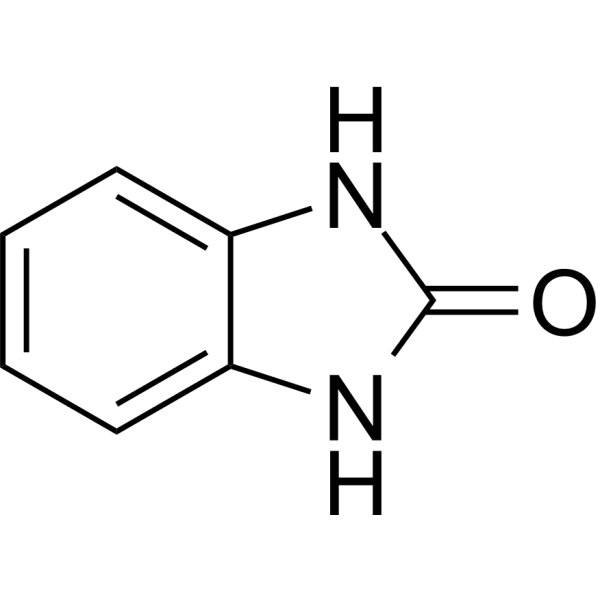
2-Hydroxybenzimidazole is a metabolite of Carbendazim (HY-13582). 2-Hydroxybenzimidazole is produced by the degradation of Carbendazim (HY-13582) by mycobacteria. 2-Hydroxybenzimidazole does not induce CYP1A1 protein expression and does not significantly reduce mortality in mice after influenza virus challenge following intranasal administration. 2-Hydroxybenzimidazole can be used in research on tobacco mosaic virus infection and influenza.
Nur für Forschungszwecke. Wir verkaufen nicht an Patienten.
- Reinheit : 99.98%
- CAS. Nr.: 615-16-7
- Formel: C7H6N2O
- Molecular Weight:134.14
-
Speicherung:Powder -20°C, 3 years , 4°C, 2 years ; In solvent -80°C, 6 months , -20°C, 1 month

To place orders, for customer services and technical support, please contact: MedChemExpress USA
Tel: 609-228-6898 E-mail: [email protected] [email protected]


-
 Biologische Aktivität
-
Chemical Information
-
Lösungsmittel & Löslichkeit
- Protokoll
- Reinheit & Dokumentation
- Verweise
-
 Help & FAQs


-

HY-W008003R
2-Hydroxybenzimidazole (Standard)Reference Standard -
HY-B0223
AlbendazoleParasiticide -
HY-B0413
FenbendazoleAntibiotic -

HY-Y1825
BenzimidazoleBiochemical Reagent -

HY-B0223R
Albendazole (Standard)Parasiticide -

HY-B0413R
Fenbendazole (Standard)Antibiotic -
![5,6-Dimethyl-1H-benzo[d]imidazole](https://file.medchemexpress.com/product_pic/hy-w017511.gif)
HY-W017511
5,6-Dimethyl-1H-benzo[d]imidazoleBenzimidazole Derivative -

HY-Y0410
2-AminobenzimidazoleBiochemical Reagent -
HY-109654
EnsulizoleSulfonated UV Absorber -

HY-Y1825R
Benzimidazole (Standard)Biochemical Reagent -

HY-W010372
1-MethylbenzimidazoleImidazole Compound -
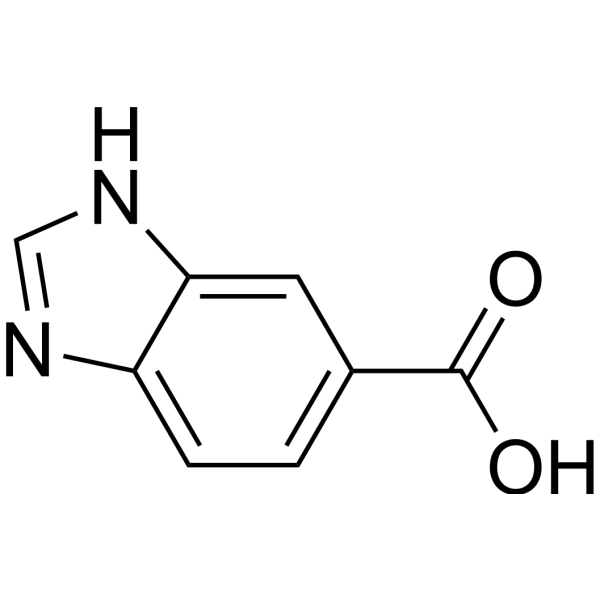
HY-W002064
1H-Benzimidazole-6-carboxylic acidBiochemical Reagent


Biologische Aktivität
Beschreibung
IC50 & Target
|
CYP1A1 |
Cellular Effect
|
Cell Line

|
Type | Value | Description | References |
|---|---|---|---|---|
| HEK293 | IC50 |
>100 μM
Compound: 7
|
Inhibition of human recombinant DAAO expressed in HEK293 cells using D-serine as substrate after 20 mins by horseradish peroxidase-coupled assay
Inhibition of human recombinant DAAO expressed in HEK293 cells using D-serine as substrate after 20 mins by horseradish peroxidase-coupled assay
|
[PMID: 23243487] |
In Vitro
2-Hydroxybenzimidazole (200 μM; 24 h) does not induce CYP1A1 protein expression in rat hepatoma H4IIE cells[8].
MedChemExpress (MCE) has not independently confirmed the accuracy of these methods. They are for reference only. Further protocols information, click here.
-
Cell Line:rat hepatoma H4IIE cells
-
Concentration:200 μM
-
Incubation Time:24 h
-
Result:Was ineffective in producing an immunoreactive CYP1A1 band at a concentration of 200 μM.
In Vivo
MedChemExpress (MCE) has not independently confirmed the accuracy of these methods. They are for reference only.
-
Animal Model:Swiss albino mice (female, 15-17 g)[9]
-
Dosage:0.05 mg per dose
-
Administration:i.n.; daily; 4 days
-
Result:Did not significantly reduce mortality in several experiments.


Chemical Information
-
CAS. Nr. 615-16-7
-
Appearance Solid
-
Molecular Weight 134.14
-
Formel C7H6N2O
-
Color Off-white to light brown
-
SMILES
O=C1NC2=CC=CC=C2N1
-
Versand
Room temperature in continental US; may vary elsewhere.
-
Speicherung
Powder -20°C 3 years 4°C 2 years In solvent -80°C 6 months -20°C 1 month


Lösungsmittel & Löslichkeit
In Vitro:
DMSO : 50 mg/mL (372.74 mM; Need ultrasonic; Hygroscopic DMSO has a significant impact on the solubility of product, please use newly opened DMSO)
Please refer to the solubility information to select the appropriate solvent. Once prepared, please aliquot and store the solution to prevent product inactivation from repeated freeze-thaw cycles.
Storage method and period of stock solution: -80°C, 6 months; -20°C, 1 month. When stored at -80°C, please use it within 6 months. When stored at -20°C, please use it within 1 month.
Please refer to the solubility information to select the appropriate solvent. Once prepared, please aliquot and store the solution to prevent product inactivation from repeated freeze-thaw cycles.
Storage method and period of stock solution: -80°C, 6 months; -20°C, 1 month. When stored at -80°C, please use it within 6 months. When stored at -20°C, please use it within 1 month.
Konzentration (Stammlösung) × Volumen (Stammlösung) = Konzentration (Ziellösung) × Volumen (Ziellösung)
In Vivo:
Select the appropriate dissolution method based on your experimental animal and administration route.
- For the following dissolution methods, please ensure to first prepare a clear stock solution using an In Vitro approach and then sequentially add co-solvents:
- To ensure reliable experimental results, the clarified stock solution can be appropriately stored based on storage conditions. As for the working solution for In Vivo experiments, it is recommended to prepare freshly and use it on the same day.
- The percentages shown for the solvents indicate their volumetric ratio in the final prepared solution. If precipitation or phase separation occurs during preparation, heat and/or sonication can be used to aid dissolution.
Add each solvent one by one: 10% DMSO 40% PEG300 5% Tween-80 45% Saline
Solubility: 5 mg/mL (37.27 mM); Clear solution; Need ultrasonic
This protocol yields a clear solution of 5 mg/mL.
Taking 1 mL working solution as an example, add 100 μL DMSO stock solution (50.0 mg/mL) to 400 μL PEG300, and mix evenly; then add 50 μL Tween-80 and mix evenly; then add 450 μL Saline to adjust the volume to 1 mL.
Preparation of Saline: Dissolve 0.9 g sodium chloride in ddH₂O and dilute to 100 mL to obtain a clear Saline solution.
In Vivo Dissolution Calculator
Please enter the basic information of animal experiments:
-
-
-
-
Recommended: Prepare an additional quantity of animals to account for potential losses during experiments.
Please enter your animal formula composition:
-
%DMSO +
Recommended: Keep the proportion of DMSO in working solution below 2% if your animal is weak.
-
%+
-
+%Tween-80 + +
-
%Saline +
The co-solvents required include: DMSO, . All of co-solvents are available by MedChemExpress (MCE). , Tween 80. All of co-solvents are available by MedChemExpress (MCE).
Working solution concentration: 0.22 mg/mL
Method for preparing stock solution: mg drug dissolved in μL DMSO. Stock solution concentration: mg/mL.
1. Take μL DMSO stock solution;
2. Add μL .
μL , mix evenly;
3. Then add μL Tween 80, mix evenly;
4. Then add μL
Please ensure that the stock solution in the first step is dissolved to a clear state, and add co-solvents in sequence. You can use ultrasonic heating (ultrasonic cleaner, recommended frequency 20-40 kHz), vortexing, etc. to assist dissolution.

Protokoll
-
RNA extraction experimental
By lysing cells, releasing RNA, and removing impurities such as proteins and DNA, high-purity RNA products are finally obtained. The commonly used traditional method is the guanidine isothiocyanate/phenol/chloroform method (Trizol), which is suitable for a variety of animal materials including animal tissues, microorganisms, cultured cells, etc., and most plant materials.
-
Western Blot
Western blotting (WB) is a commonly used experimental method in molecular biology, biochemistry, and immunogenetics for identifying and quantifying target proteins. It combines gel electrophoresis with immunoassay, enabling researchers to analyze protein expression, post-translational modifications, and molecular weight.
-
Research Protocol for Infectious Diseases
Infectious-disease experiments test how pathogens interact with host barriers, innate immune receptors, inflammatory signaling, pathogen replication, and tissue injury; pattern-recognition receptors such as TLRs, RIG-I-like receptors, NOD-like receptors, and inflammasomes detect microbial molecules and activate NF-κB, interferon, and cytokine responses. The central hypothesis is that infection severity reflects the balance between pathogen burden and host response: protective inflammation restricts pathogen growth, whereas excessive or mislocalized inflammation contributes to tissue damage and disease phenotype. Unresolved questions include which host pathways are protective versus pathogenic, why some infection models fail to translate to human disease, and which combined readouts best predict clinically relevant infection outcomes.
-
Protocol For Protein Expression And Purification
Recombinant protein expression in Escherichia coli followed by purification of a His-tagged soluble protein by immobilized metal affinity chromatography (IMAC), with optional MBP fusion and TEV tag removal when the construct includes these elements. The biological readout is production of the encoded target protein, detected as an inducible band at the expected molecular mass by SDS-PAGE and quantified by total protein assay or chromatographic absorbance; the purification readout is enrichment of the target protein in elution fractions after selective binding of polyhistidine residues to immobilized Ni2+/metal-chelate resin and elution by imidazole-containing buffer. Expression is driven by an inducible bacterial expression system, commonly T7/lac-based, in which IPTG or lactose/auto-induction activates transcription and translation of the cloned gene; lower induction temperature, lower inducer concentration, induction timing, and solubility-enhancing fusion tags can influence the frac


Reinheit & Dokumentation
-
Data Sheet (276 KB)
-
SDS (393 KB)
- English - EN (393 KB)
- Français - FR (393 KB)
- Deutsch - DE (393 KB)
- Norwegian - NO (393 KB)
- Español - ES (393 KB)
- Swedish - SV (393 KB)
- Italian - IT (393 KB)
- Korean - KR (393 KB)
- Portuguese - PT (393 KB)
-
Handling Instructions (2659 KB)
Verweise
[3]. Bai N, et al. Rhamnolipid-aided biodegradation of carbendazim by Rhodococcus sp. D-1: Characteristics, products, and phytotoxicity. Science of the Total Environment. 2017 Jul 15;590:343-51. [Content Brief]
[5]. Yang Y, et al. Effects of superabsorbent polymers on the fate of fungicidal carbendazim in soils. Journal of hazardous materials. 2017 Apr 15;328:70-79. [Content Brief]
[6]. Wang Z, et al. Biodegradation of carbendazim by a novel actinobacterium Rhodococcus jialingiae djl-6-2. Chemosphere. 2010 Oct;81(5):639-44. [Content Brief]
[7]. Zhang X, et al. Isolation and characterization of carbendazim-degrading Rhodococcus erythropolis djl-11. PloS one. 2013;8(10):e74810. [Content Brief]
[8]. Backlund M, et al. Structural and mechanistic aspects of transcriptional induction of cytochrome P450 1A1 by benzimidazole derivatives in rat hepatoma H4IIE cells. European Journal of Biochemistry. 1999 Mar 19;261(1):66-71. [Content Brief]
[9]. Takano K, et al. Nucleic acid-induced resistance to viral infection. Journal of Bacteriology. 1965 Dec;90(6):1542-7. [Content Brief]


Complete Stock Solution Preparation Table
Please refer to the solubility information to select the appropriate solvent. Once prepared, please aliquot and store the solution to prevent product inactivation from repeated freeze-thaw cycles.
Storage method and period of stock solution: -80°C, 6 months; -20°C, 1 month. When stored at -80°C, please use it within 6 months. When stored at -20°C, please use it within 1 month.
| Optional Solvent | Concentration Solvent Mass | 1 mg | 5 mg | 10 mg | 25 mg |
|---|---|---|---|---|---|
| DMSO | 1 mM | 7.4549 mL | 37.2745 mL | 74.5490 mL | 186.3724 mL |
| 5 mM | 1.4910 mL | 7.4549 mL | 14.9098 mL | 37.2745 mL | |
| 10 mM | 0.7455 mL | 3.7274 mL | 7.4549 mL | 18.6372 mL | |
| 15 mM | 0.4970 mL | 2.4850 mL | 4.9699 mL | 12.4248 mL | |
| 20 mM | 0.3727 mL | 1.8637 mL | 3.7274 mL | 9.3186 mL | |
| 25 mM | 0.2982 mL | 1.4910 mL | 2.9820 mL | 7.4549 mL | |
| 30 mM | 0.2485 mL | 1.2425 mL | 2.4850 mL | 6.2124 mL | |
| 40 mM | 0.1864 mL | 0.9319 mL | 1.8637 mL | 4.6593 mL | |
| 50 mM | 0.1491 mL | 0.7455 mL | 1.4910 mL | 3.7274 mL | |
| 60 mM | 0.1242 mL | 0.6212 mL | 1.2425 mL | 3.1062 mL | |
| 80 mM | 0.0932 mL | 0.4659 mL | 0.9319 mL | 2.3297 mL | |
| 100 mM | 0.0745 mL | 0.3727 mL | 0.7455 mL | 1.8637 mL |


2-Hydroxybenzimidazole Related Classifications
HY-W008003 Related Classifications
 Powered by Bioz
Keywords