



3-Oxo deoxycholic acid
Based on 1 publication(s) in Google Scholar
3-Oxo deoxycholic acid is a secondary bile acid and a metabolic intermediate of Deoxycholic acid (HY-N0593) under the action of gut microbiota. 3-Oxo deoxycholic acid enhances the intestinal barrier by upregulating tight junction proteins, and maintains bile acid homeostasis and reduces toxicity via the gut bacterial enzyme system. 3-Oxo deoxycholic acid can be used in research on colonic barrier dysfunction and colonic inflammation.
For research use only. We do not sell to patients.
- Purity : 99.88%
- CAS No.: 4185-01-7
- Formula: C24H38O4
- Molecular Weight:390.56
-
Storage:
Store at room temperature 3 years.
In solvent -80°C, 2 years , -20°C, 1 year


To place orders, for customer services and technical support, please contact: MedChemExpress USA
Tel: 609-228-6898 E-mail: [email protected] [email protected]


-
 Biological Activity
-
Chemical Information
-
Solvent & Solubility
- Protocols
- Purity & Documentation
- References
-
 Help & FAQs


-

HY-145656
3-Oxochenodeoxycholic acidEndogenous Metabolite -
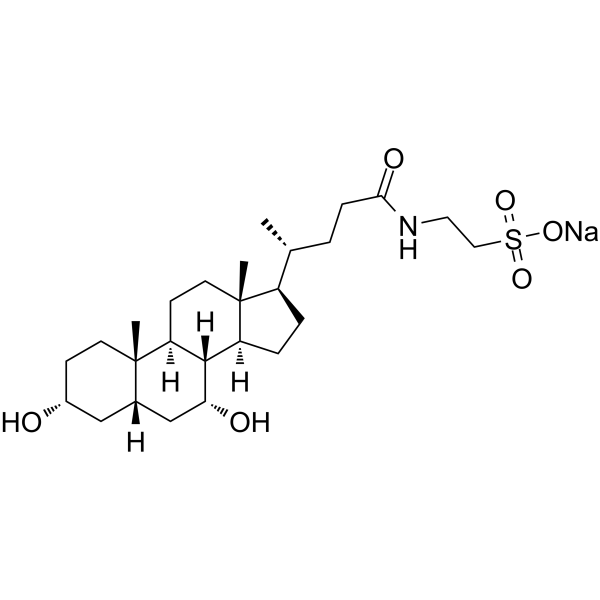
HY-N1429
Taurochenodeoxycholic acid sodiumAnti-inflammatory Drug -

HY-N15317
Phocaecholic acidBile Acid -
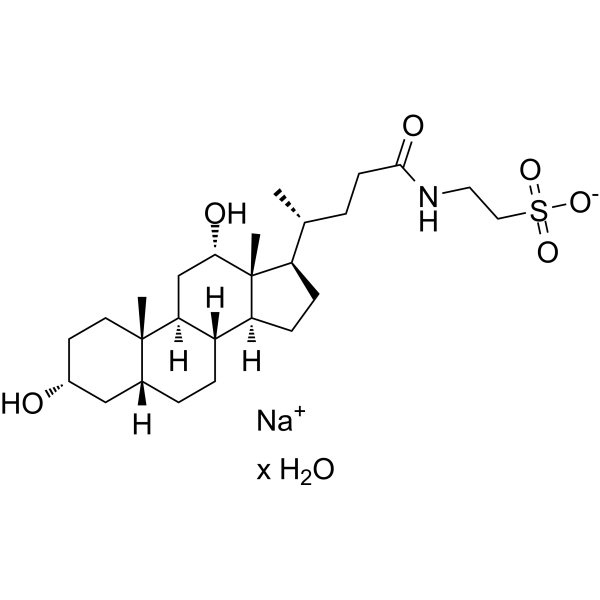
HY-W089835
Sodium taurodeoxycholate hydrateAnti-inflammatory Agent -

HY-N1429R
Taurochenodeoxycholic acid sodium (Standard)Anti-inflammatory Drug -

HY-W089835R
Sodium taurodeoxycholate hydrate (Standard)Bile Acid
Publications Citing Use of MedChemExpress (MCE) 3-Oxo deoxycholic acid
MoreAll Endogenous Metabolite Isoforms
More

Biological Activity
Description
IC50 & Target
[5]|
Claudin-1 |
In Vitro
3-Oxo deoxycholic acid (10-500 μM; 24 h) maintained cell viability without obvious toxicity at concentrations of 10-100 μM in human colon adenocarcinoma cells Caco-2, whereas at high concentrations (>100 μM) it inhibited cell viability in a concentration-dependent manner and caused cell death[5].
3-Oxo deoxycholic acid (100 μM; 24 h) upregulates the mRNA and protein expression levels of the tight junction proteins ZO-1, Occludin, and Claudin-1 in human colon adenocarcinoma cells Caco-2[5].
3-Oxo deoxycholic acid (100 μM; pretreatment for 24 h, followed by exposure to 2.5% DSS for 6 h) increased baseline transepithelial electrical resistance (TEER) and significantly inhibited DSS (HY-116282C)-induced decrease in transepithelial electrical resistance in differentiated monolayers of human colon adenocarcinoma Caco-2 cells, protecting the intestinal barrier from permeability damage[5].
3-Oxo-deoxycholic acid (50 μM; 12 h) was reduced to deoxycholic acid (DCA) in the presence of NADPH in a reaction system using recombinant 3α-HSDH (CDD59474) expressed and purified from Escherichia coli[6].
3-Oxo-deoxycholic acid (50 μM; 12 h) was reduced in a recombinant 3β-HSDH (CDD59473) enzyme reaction system expressed and purified in Escherichia coli in the presence of NADPH to generate iso-deoxycholic acid (iso-DCA) and trace amounts of DCA[6].
MedChemExpress (MCE) has not independently confirmed the accuracy of these methods. They are for reference only. Further protocols information, click here.
-
Cell Line:Caco-2
-
Concentration:10 μM, 50 μM, 100 μM, 200 μM, 300 μM, 500 μM
-
Incubation Time:24 h
-
Result:Did not inhibit cell viability at concentrations between 10 μM and 100 μM, maintaining cell survival near 100%; however, 3-oxo deoxycholic acid significantly decreased cell viability and induced massive cell death at concentrations exceeding 100 μM.
-
Cell Line:Caco-2
-
Concentration:100 μM
-
Incubation Time:24 h
-
Result:Markedly upregulated the mRNA transcription levels of tight junction protein genes ZO1, OCLN, and CLDN1.
-
Cell Line:Caco-2
-
Concentration:100 μM
-
Incubation Time:24 h
-
Result:Elevated the relative protein levels of tight junction markers ZO-1, Occludin, and Claudin1.


Chemical Information
-
CAS No. 4185-01-7
-
Appearance Solid
-
Molecular Weight 390.56
-
Formula C24H38O4
-
Color White to off-white
-
SMILES
C[C@@H]([C@H]1CC[C@]2([C@@]3(CC[C@@]4(CC(CC[C@@]4([C@]3(C[C@@H]([C@]12C)O)[H])C)=O)[H])[H])[H])CCC(O)=O
-
Shipping
Room temperature in continental US; may vary elsewhere.
-
Storage
Store at room temperature 3 years
In solvent -80°C 2 years -20°C 1 year


Publications (1)
-
Journal Impact Factor
-
Most Recent
-
Trends Biotechnol
Engineering Bacillus subtilis as a sustainable platform for the production of functional bile acids. [Abstract]2026 Apr 15:S0167-7799(26)00130-7. PMID: 41991462


Solvent & Solubility
In Vitro:
DMSO : 100 mg/mL (256.04 mM; Need ultrasonic; Hygroscopic DMSO has a significant impact on the solubility of product, please use newly opened DMSO)
Please refer to the solubility information to select the appropriate solvent. Once prepared, please aliquot and store the solution to prevent product inactivation from repeated freeze-thaw cycles.
Storage method and period of stock solution: -80°C, 2 years; -20°C, 1 year. When stored at -80°C, please use it within 2 years. When stored at -20°C, please use it within 1 year.
Please refer to the solubility information to select the appropriate solvent. Once prepared, please aliquot and store the solution to prevent product inactivation from repeated freeze-thaw cycles.
Storage method and period of stock solution: -80°C, 2 years; -20°C, 1 year. When stored at -80°C, please use it within 2 years. When stored at -20°C, please use it within 1 year.
Concentration (start) × Volume (start) = Concentration (final) × Volume (final)
In Vivo:
Select the appropriate dissolution method based on your experimental animal and administration route.
- For the following dissolution methods, please ensure to first prepare a clear stock solution using an In Vitro approach and then sequentially add co-solvents:
- To ensure reliable experimental results, the clarified stock solution can be appropriately stored based on storage conditions. As for the working solution for In Vivo experiments, it is recommended to prepare freshly and use it on the same day.
- The percentages shown for the solvents indicate their volumetric ratio in the final prepared solution. If precipitation or phase separation occurs during preparation, heat and/or sonication can be used to aid dissolution.
In Vivo Dissolution Calculator
Please enter the basic information of animal experiments:
-
-
-
-
Recommended: Prepare an additional quantity of animals to account for potential losses during experiments.
Please enter your animal formula composition:
-
%DMSO +
Recommended: Keep the proportion of DMSO in working solution below 2% if your animal is weak.
-
%+
-
+%Tween-80 + +
-
%Saline +
The co-solvents required include: DMSO, . All of co-solvents are available by MedChemExpress (MCE). , Tween 80. All of co-solvents are available by MedChemExpress (MCE).
Working solution concentration: 0.22 mg/mL
Method for preparing stock solution: mg drug dissolved in μL DMSO. Stock solution concentration: mg/mL.
1. Take μL DMSO stock solution;
2. Add μL .
μL , mix evenly;
3. Then add μL Tween 80, mix evenly;
4. Then add μL
Please ensure that the stock solution in the first step is dissolved to a clear state, and add co-solvents in sequence. You can use ultrasonic heating (ultrasonic cleaner, recommended frequency 20-40 kHz), vortexing, etc. to assist dissolution.

Protocols
-
Research Protocol for Microbiome Analysis
Microbiome analysis characterizes microbial communities in biological or environmental samples by measuring community composition, diversity, taxonomic structure, functional potential, and associations with host or environmental phenotypes. 16S rRNA gene amplicon sequencing is commonly used for bacterial and archaeal taxonomic profiling, while shotgun metagenomics provides higher taxonomic resolution and direct functional information, including microbial genes, pathways, viruses, fungi, and antimicrobial-resistance genes when sequencing depth and host-DNA contamination are adequately controlled. Microbiome results are strongly affected by sample collection, storage, DNA extraction, contamination, sequencing method, reference database, and bioinformatic pipeline; therefore, standardized protocols, negative controls, mock communities, and transparent analysis workflows are required. Unresolved issues include low-biomass contamination, compositional-data bias, inconsistent species-level c
-
Research Protocol for Inflammation-related Diseases
The NLRP3 inflammasome is a cytosolic innate immune signaling platform that integrates priming signals and danger-signal activation to promote caspase-1 activation, maturation of IL-1β and IL-18, and gasdermin D-mediated pyroptotic cell death. The core experimental logic is to determine whether inflammatory disease phenotypes are driven by increased NLRP3 expression, ASC-containing inflammasome assembly, caspase-1 cleavage, GSDMD cleavage, and extracellular release of IL-1β/IL-18 rather than by nonspecific cell injury alone. The pathway is strongly linked to inflammation-related disease phenotypes because monosodium urate crystals activate NALP3/NLRP3 inflammasome signaling in gout-like crystal inflammation, cholesterol crystals activate NLRP3 inflammasomes in atherogenesis models, and DSS-induced intestinal inflammation has been reported to involve NLRP3 inflammasome activity. However, experimental colitis studies also show context-dependent protective effects of NLRP3 inflammasome co


Purity & Documentation
-
Data Sheet (293 KB)
-
SDS (394 KB)
- English - EN (394 KB)
- Français - FR (394 KB)
- Deutsch - DE (394 KB)
- Norwegian - NO (394 KB)
- Español - ES (394 KB)
- Swedish - SV (394 KB)
- Italian - IT (394 KB)
- Korean - KR (394 KB)
- Portuguese - PT (394 KB)
-
Handling Instructions (2659 KB)
References


Complete Stock Solution Preparation Table
Please refer to the solubility information to select the appropriate solvent. Once prepared, please aliquot and store the solution to prevent product inactivation from repeated freeze-thaw cycles.
Storage method and period of stock solution: -80°C, 2 years; -20°C, 1 year. When stored at -80°C, please use it within 2 years. When stored at -20°C, please use it within 1 year.
| Optional Solvent | Concentration Solvent Mass | 1 mg | 5 mg | 10 mg | 25 mg |
|---|---|---|---|---|---|
| DMSO | 1 mM | 2.5604 mL | 12.8021 mL | 25.6043 mL | 64.0107 mL |
| 5 mM | 0.5121 mL | 2.5604 mL | 5.1209 mL | 12.8021 mL | |
| 10 mM | 0.2560 mL | 1.2802 mL | 2.5604 mL | 6.4011 mL | |
| 15 mM | 0.1707 mL | 0.8535 mL | 1.7070 mL | 4.2674 mL | |
| 20 mM | 0.1280 mL | 0.6401 mL | 1.2802 mL | 3.2005 mL | |
| 25 mM | 0.1024 mL | 0.5121 mL | 1.0242 mL | 2.5604 mL | |
| 30 mM | 0.0853 mL | 0.4267 mL | 0.8535 mL | 2.1337 mL | |
| 40 mM | 0.0640 mL | 0.3201 mL | 0.6401 mL | 1.6003 mL | |
| 50 mM | 0.0512 mL | 0.2560 mL | 0.5121 mL | 1.2802 mL | |
| 60 mM | 0.0427 mL | 0.2134 mL | 0.4267 mL | 1.0668 mL | |
| 80 mM | 0.0320 mL | 0.1600 mL | 0.3201 mL | 0.8001 mL | |
| 100 mM | 0.0256 mL | 0.1280 mL | 0.2560 mL | 0.6401 mL |


3-Oxo deoxycholic acid Related Classifications
HY-W391635 Related Classifications
 Powered by Bioz