



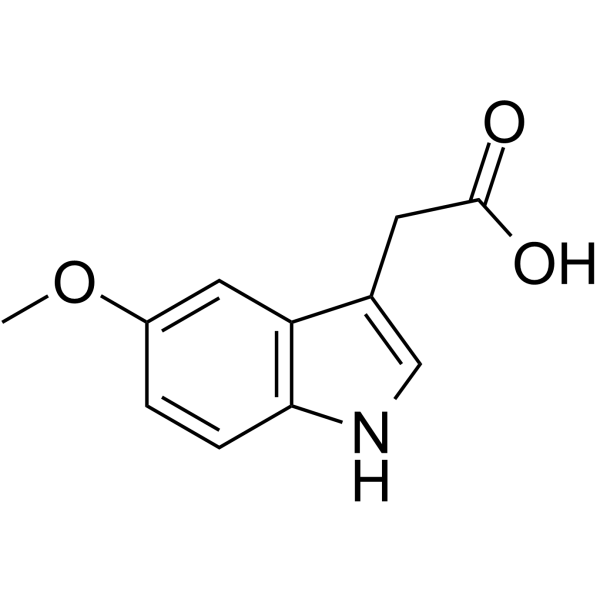
5-Methoxyindole-3-acetic acid
Based on 1 publication(s) in Google Scholar
5-Methoxyindole-3-acetic acid is a metabolite of Melatonin (HY-B0075). 5-Methoxyindole-3-acetic acid significantly prolongs the estrous cycle, increases uterine weight, and induces ovarian follicular cysts in female rats, while also regulating the levels of related hormones.
For research use only. We do not sell to patients.
- Purity : 99.60%
- CAS No.: 3471-31-6
- Formula: C11H11NO3
- Molecular Weight:205.21
-
Storage:Powder -20°C, 3 years , 4°C, 2 years ; In solvent -80°C, 6 months , -20°C, 1 month

To place orders, for customer services and technical support, please contact: MedChemExpress USA
Tel: 609-228-6898 E-mail: [email protected] [email protected]


-
 Biological Activity
-
Chemical Information
-
Solvent & Solubility
- Purity & Documentation
- References
-
 Help & FAQs


-
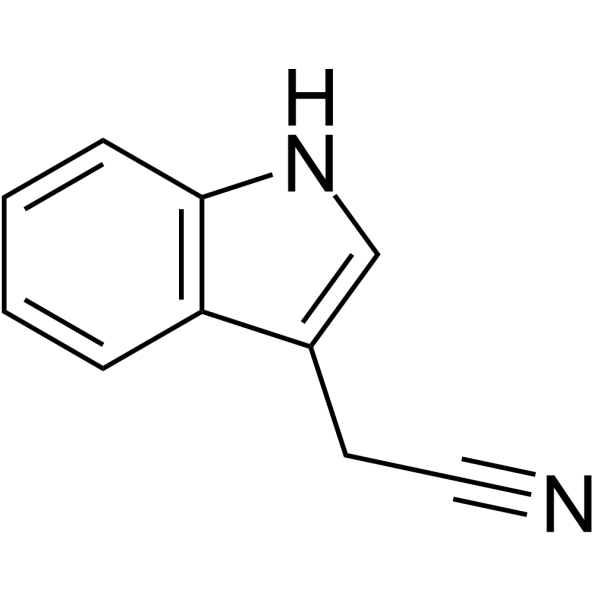
HY-Y0136
3-IndoleacetonitrileAntiviral Agent -

HY-W007566R
5-Methoxyindole-3-acetic acid (Standard) -
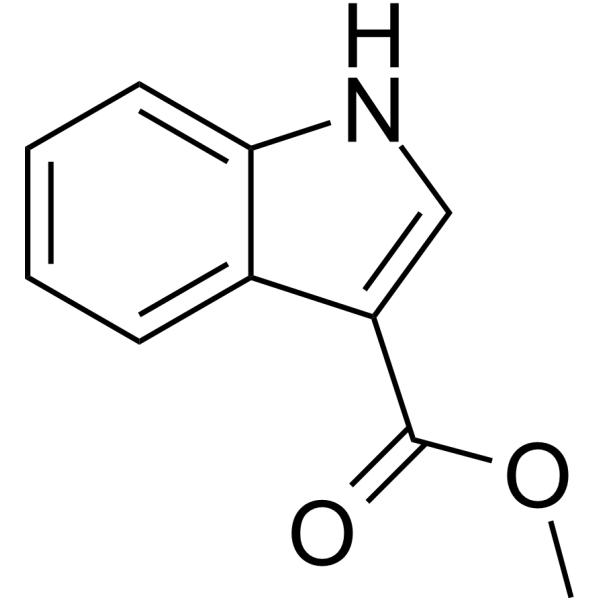
HY-79635
Methyl indole-3-carboxylateSorangium Metabolite -
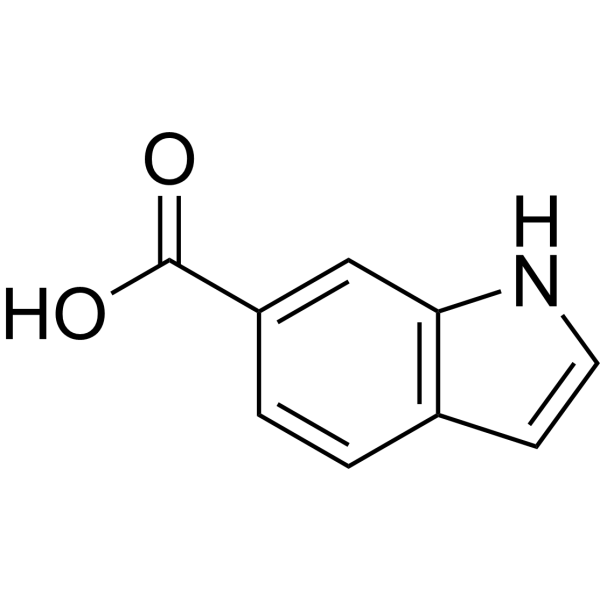
HY-W015420
1H-Indole-6-carboxylic acidHIV-1 Protease Allosteric Binder -
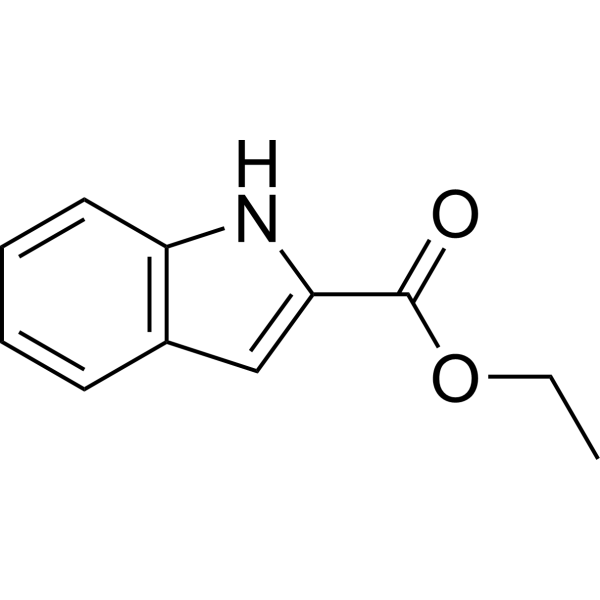
HY-34696
Ethyl indole-2-carboxylateBiochemical Reagent -

HY-W010283
2,3-DimethylindoleLiquid Hydrogen Carrier -

HY-79635R
Methyl indole-3-carboxylate (Standard)Standard of Methyl indole-3-carboxylate
Publications Citing Use of MedChemExpress (MCE) 5-Methoxyindole-3-acetic acid
MoreAll Endogenous Metabolite Isoforms
More

Biological Activity
Description
IC50 & Target
|
Human Endogenous Metabolite |
In Vivo
MedChemExpress (MCE) has not independently confirmed the accuracy of these methods. They are for reference only.
-
Animal Model:Female Wistar albino rats, 80-90 days old, with 4-5 day estrous cycles before treatment[2]
-
Dosage:50 μg, 100 μg, 200 μg
-
Administration:Subcutaneous injection, 4 weeks
-
Result:Had no significant differences in ovarian weight, uterine weight, and estrous cycle compared with the control group (50 μg).
Significantly prolonged the estrous cycle, reduced the cornification index (15.20 for 100 μg, 7.36 for 200 μg vs 25.34 for control) and index of regularity (0.29 for 100 μg, 0.17 for 200 μg vs 0.85 for control), and increased the percentage of days in diestrus (76.95% for 100 μg, 85.25% for 200 μg vs 54.37% for control).
Caused the ovaries to produce a large number of follicles.
Caused follicular cysts, and significantly increased the weight of the uterus.


Chemical Information
-
CAS No. 3471-31-6
-
Appearance Solid
-
Molecular Weight 205.21
-
Formula C11H11NO3
-
Color Pink to red
-
SMILES
O=C(O)CC1=CNC2=C1C=C(OC)C=C2
-
Structure Classification
-
Initial Source
-
Shipping
Room temperature in continental US; may vary elsewhere.
-
Storage
Powder -20°C 3 years 4°C 2 years In solvent -80°C 6 months -20°C 1 month


Publications (1)
-
Journal Impact Factor
-
Most Recent
-
Pest Manag Sci
The native rice leaf folder can enhance rice resistance against the invasive fall armyworm by inducing the jasmonate-mediated tryptophan metabolism pathway. [Abstract]2026 May;82(5):5026-5039. PMID: 41635108


Solvent & Solubility
In Vitro:
DMSO : 100 mg/mL (487.31 mM; Need ultrasonic; Hygroscopic DMSO has a significant impact on the solubility of product, please use newly opened DMSO)
Please refer to the solubility information to select the appropriate solvent. Once prepared, please aliquot and store the solution to prevent product inactivation from repeated freeze-thaw cycles.
Storage method and period of stock solution: -80°C, 6 months; -20°C, 1 month. When stored at -80°C, please use it within 6 months. When stored at -20°C, please use it within 1 month.
Please refer to the solubility information to select the appropriate solvent. Once prepared, please aliquot and store the solution to prevent product inactivation from repeated freeze-thaw cycles.
Storage method and period of stock solution: -80°C, 6 months; -20°C, 1 month. When stored at -80°C, please use it within 6 months. When stored at -20°C, please use it within 1 month.
Concentration (start) × Volume (start) = Concentration (final) × Volume (final)
In Vivo:
Select the appropriate dissolution method based on your experimental animal and administration route.
- For the following dissolution methods, please ensure to first prepare a clear stock solution using an In Vitro approach and then sequentially add co-solvents:
- To ensure reliable experimental results, the clarified stock solution can be appropriately stored based on storage conditions. As for the working solution for In Vivo experiments, it is recommended to prepare freshly and use it on the same day.
- The percentages shown for the solvents indicate their volumetric ratio in the final prepared solution. If precipitation or phase separation occurs during preparation, heat and/or sonication can be used to aid dissolution.
Add each solvent one by one: 10% DMSO 40% PEG300 5% Tween-80 45% Saline
Solubility: ≥ 2.5 mg/mL (12.18 mM); Clear solution
This protocol yields a clear solution of ≥ 2.5 mg/mL (saturation unknown).
Taking 1 mL working solution as an example, add 100 μL DMSO stock solution (25.0 mg/mL) to 400 μL PEG300, and mix evenly; then add 50 μL Tween-80 and mix evenly; then add 450 μL Saline to adjust the volume to 1 mL.
Preparation of Saline: Dissolve 0.9 g sodium chloride in ddH₂O and dilute to 100 mL to obtain a clear Saline solution.
Add each solvent one by one: 10% DMSO 90% (20% SBE-β-CD in Saline)
Solubility: ≥ 2.5 mg/mL (12.18 mM); Clear solution
This protocol yields a clear solution of ≥ 2.5 mg/mL (saturation unknown).
Taking 1 mL working solution as an example, add 100 μL DMSO stock solution (25.0 mg/mL) to 900 μL 20% SBE-β-CD in Saline, and mix evenly.
Preparation of 20% SBE-β-CD in Saline (4°C, storage for one week): 2 g SBE-β-CD powder is dissolved in 10 mL Saline, completely dissolve until clear.
In Vivo Dissolution Calculator
Please enter the basic information of animal experiments:
-
-
-
-
Recommended: Prepare an additional quantity of animals to account for potential losses during experiments.
Please enter your animal formula composition:
-
%DMSO +
Recommended: Keep the proportion of DMSO in working solution below 2% if your animal is weak.
-
%+
-
+%Tween-80 + +
-
%Saline +
The co-solvents required include: DMSO, . All of co-solvents are available by MedChemExpress (MCE). , Tween 80. All of co-solvents are available by MedChemExpress (MCE).
Working solution concentration: 0.22 mg/mL
Method for preparing stock solution: mg drug dissolved in μL DMSO. Stock solution concentration: mg/mL.
1. Take μL DMSO stock solution;
2. Add μL .
μL , mix evenly;
3. Then add μL Tween 80, mix evenly;
4. Then add μL
Please ensure that the stock solution in the first step is dissolved to a clear state, and add co-solvents in sequence. You can use ultrasonic heating (ultrasonic cleaner, recommended frequency 20-40 kHz), vortexing, etc. to assist dissolution.


Purity & Documentation
-
Data Sheet (275 KB)
-
SDS (396 KB)
- English - EN (396 KB)
- Français - FR (396 KB)
- Deutsch - DE (396 KB)
- Norwegian - NO (396 KB)
- Español - ES (396 KB)
- Swedish - SV (396 KB)
- Italian - IT (396 KB)
- Korean - KR (396 KB)
- Portuguese - PT (396 KB)
-
Handling Instructions (2659 KB)
References
[1]. KVEDER S, et al. The metabolism of melatonin (N-acetyl-5-methoxytryptamine) and 5-methoxytryptamine. J Biol Chem. 1961 Dec;236:3214-20. [Content Brief]
[2]. Ocal-Irez T, et al. Effect of a pineal indolamine, 5-methoxyindole-3-acetic acid, on the estrous cycle and reproductive organs of female Wistar albino rats. Brain Res. 1989 Jul 24;493(1):1-7. [Content Brief]
[3]. Higa S, et al. Identification and quantification of 5-methoxyindole-3-acetic acid in human urine. Anal Biochem. 1985 Jan;144(1):86-93. [Content Brief]


Complete Stock Solution Preparation Table
Please refer to the solubility information to select the appropriate solvent. Once prepared, please aliquot and store the solution to prevent product inactivation from repeated freeze-thaw cycles.
Storage method and period of stock solution: -80°C, 6 months; -20°C, 1 month. When stored at -80°C, please use it within 6 months. When stored at -20°C, please use it within 1 month.
| Optional Solvent | Concentration Solvent Mass | 1 mg | 5 mg | 10 mg | 25 mg |
|---|---|---|---|---|---|
| DMSO | 1 mM | 4.8731 mL | 24.3653 mL | 48.7306 mL | 121.8264 mL |
| 5 mM | 0.9746 mL | 4.8731 mL | 9.7461 mL | 24.3653 mL | |
| 10 mM | 0.4873 mL | 2.4365 mL | 4.8731 mL | 12.1826 mL | |
| 15 mM | 0.3249 mL | 1.6244 mL | 3.2487 mL | 8.1218 mL | |
| 20 mM | 0.2437 mL | 1.2183 mL | 2.4365 mL | 6.0913 mL | |
| 25 mM | 0.1949 mL | 0.9746 mL | 1.9492 mL | 4.8731 mL | |
| 30 mM | 0.1624 mL | 0.8122 mL | 1.6244 mL | 4.0609 mL | |
| 40 mM | 0.1218 mL | 0.6091 mL | 1.2183 mL | 3.0457 mL | |
| 50 mM | 0.0975 mL | 0.4873 mL | 0.9746 mL | 2.4365 mL | |
| 60 mM | 0.0812 mL | 0.4061 mL | 0.8122 mL | 2.0304 mL | |
| 80 mM | 0.0609 mL | 0.3046 mL | 0.6091 mL | 1.5228 mL | |
| 100 mM | 0.0487 mL | 0.2437 mL | 0.4873 mL | 1.2183 mL |


5-Methoxyindole-3-acetic acid Related Classifications
HY-W007566 Related Classifications
 Powered by Bioz