



6-Mercaptopurine (Standard)

Based on 1 Customer Validation
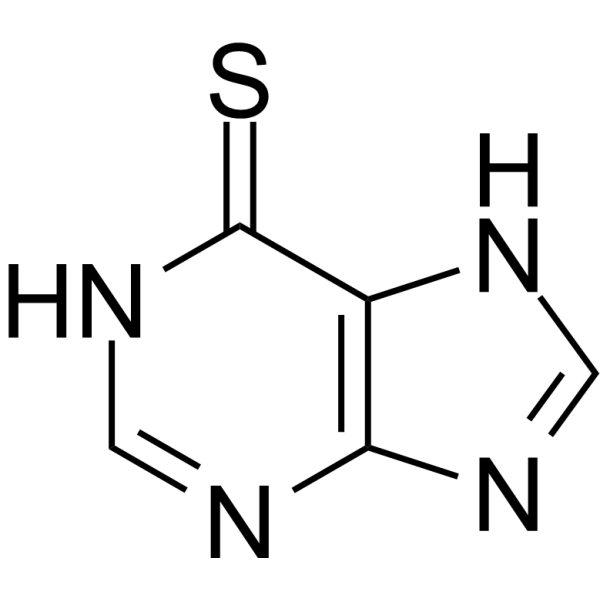
6-Mercaptopurine (Standard) is the analytical standard of 6-Mercaptopurine. This product is intended for research and analytical applications. 6-Mercaptopurine is a purine analogue which acts as an antagonist of the endogenous purines and has been widely used as antileukemic agent and immunosuppressive drug.
For research use only. We do not sell to patients.
- CAS No.: 50-44-2
- Formula: C5H4N4S
- Molecular Weight:152.18
-
Storage:
Please store the product under the recommended conditions in the Certificate of Analysis.


To place orders, for customer services and technical support, please contact: MedChemExpress USA
Tel: 609-228-6898 E-mail: [email protected] [email protected]


-
 Product Information
-
Chemical Information
- Purity & Documentation
-
 Help & FAQs






Product Information
Information
Application
The compound is the grade of analytical standard, which is the reference standard supplied assay. It is commonly used in qualitative, quantitative and methodological research experiments in HPLC, GC and MS.


Chemical Information
-
CAS No. 50-44-2
-
Appearance Solid
-
Molecular Weight 152.18
-
Formula C5H4N4S
-
Color Light yellow to yellow
-
SMILES
S=C1NC=NC2=C1NC=N2
-
Synonyms
Mercaptopurine (Standard); 6-MP (Standard)
-
Structure Classification
-
Initial Source
-
Shipping
Room temperature in continental US; may vary elsewhere.
-
Storage
Please store the product under the recommended conditions in the Certificate of Analysis.


Purity & Documentation
-
SDS (644 KB)
- English - EN (644 KB)
- Français - FR (644 KB)
- Deutsch - DE (644 KB)
- Norwegian - NO (644 KB)
- Español - ES (644 KB)
- Swedish - SV (644 KB)
- Italian - IT (644 KB)
- Korean - KR (644 KB)
- Portuguese - PT (644 KB)
-
Handling Instructions (2659 KB)
References
[1]. Sahasranaman S, et al. Clinical pharmacology and pharmacogenetics of thiopurines. Eur J Clin Pharmacol. 2008 Aug;64(8):753-67. [Content Brief]
[2]. Liu Q, et al. 6-Mercaptopurine augments glucose transport activity in skeletal muscle cells in part via a mechanism dependent upon orphan nuclear receptor NR4A3. Am J Physiol Endocrinol Metab. 2013 Nov 1;305(9):E1081-92. [Content Brief]
[3]. Kanemitsu H, et al. 6-Mercaptopurine (6-MP) induces cell cycle arrest and apoptosis of neural progenitor cells in the developing fetal rat brain. Neurotoxicol Teratol. 2009 Mar-Apr;31(2):104-9. [Content Brief]

Calculators
Concentration (start) × Volume (start) = Concentration (final) × Volume (final)


6-Mercaptopurine (Standard) Related Classifications
HY-13677R Related Classifications
 Powered by Bioz