



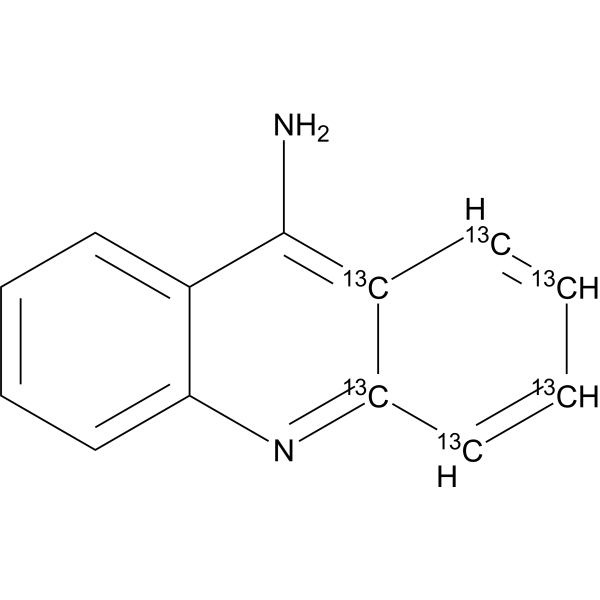
9-Aminoacridine-13C6
9-Aminoacridine-13C6 is the 13C-labeled 9-Aminoacridine(HY-B1422). 9-Aminoacridine, a fluorescent probe, acts as an indicator of pH for quantitative determination of transmembrane pH gradients (inside acidic). 9-Aminoacridine is an antimicrobial. 9-Aminoacridine exerts its antimicrobial activity by interacting with specific bacterial DNA and disrupting the proton motive force in K. pneumoniae. 9-Aminoacridine is a HIV-1 inhibitor and inhibits HIV LTR transcription highly dependent on the presence and location of the amino moiety. 9-Aminoacridine inhibits virus replication in HIV-1 infected cell lines. 9-Aminoacridine is used as a Rifampin (RIF; HY-B0272) adjuvant for the multidrug-resistant K. pneumoniae infections.
For research use only. We do not sell to patients.
- Formula: C713C6H10N2
- Molecular Weight:200.19
-
Storage:
Please store the product under the recommended conditions in the Certificate of Analysis.

To place orders, for customer services and technical support, please contact: MedChemExpress USA
Tel: 609-228-6898 E-mail: [email protected] [email protected]


-
 Biological Activity
-
Chemical Information
- Protocols
- Purity & Documentation
- References
-
 Help & FAQs




Biological Activity
Description
Application
1. This compound can be used as a tracer
2. This compound can be used as an internal standard for quantitative analysis by NMR, GC-MS, or LC-MS.


Chemical Information
-
Unlabeled CAS 90-45-9
-
Molecular Weight 200.19
-
Formula C713C6H10N2
-
SMILES
NC1=[13C]([13CH]=[13CH][13CH]=[13CH]2)[13C]2=NC3=CC=CC=C31
-
Synonyms
Aminacrine-13C6
-
Shipping
Room temperature in continental US; may vary elsewhere.
-
Storage
Please store the product under the recommended conditions in the Certificate of Analysis.

Protocols
-
Research Protocol for Infectious Diseases
Infectious-disease experiments test how pathogens interact with host barriers, innate immune receptors, inflammatory signaling, pathogen replication, and tissue injury; pattern-recognition receptors such as TLRs, RIG-I-like receptors, NOD-like receptors, and inflammasomes detect microbial molecules and activate NF-κB, interferon, and cytokine responses. The central hypothesis is that infection severity reflects the balance between pathogen burden and host response: protective inflammation restricts pathogen growth, whereas excessive or mislocalized inflammation contributes to tissue damage and disease phenotype. Unresolved questions include which host pathways are protective versus pathogenic, why some infection models fail to translate to human disease, and which combined readouts best predict clinically relevant infection outcomes.


Purity & Documentation
References
[1]. Grzesiek S,et al. The 'delta pH'-probe 9-aminoacridine: response time, binding behaviour and dimerization at the membrane. Biochim Biophys Acta. 1988 Mar 3;938(3):411-24. [Content Brief]
[2]. She P, et al. Repurposing 9-Aminoacridine as an Adjuvant Enhances the Antimicrobial Effects of Rifampin against Multidrug-Resistant Klebsiella pneumoniae. Microbiol Spectr. 2023 Jun 15;11(3):e0447422. [Content Brief]
[3]. Guendel I, et al. 9-Aminoacridine inhibition of HIV-1 Tat dependent transcription. Virol J. 2009 Jul 24;6:114. [Content Brief]

Calculators
Concentration (start) × Volume (start) = Concentration (final) × Volume (final)


9-Aminoacridine-13C6 Related Classifications
HY-B1422S Related Classifications
 Powered by Bioz