



BM212
Based on 4 publication(s) in Google Scholar
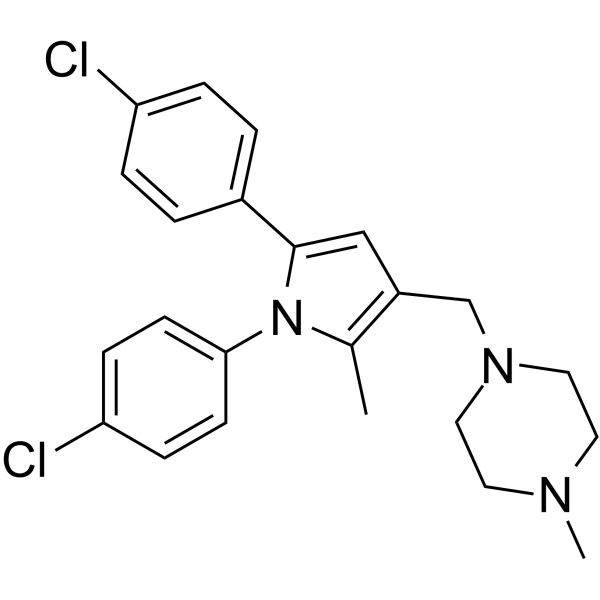
BM212 is a potent Mycobacterial membrane protein Large 3 (MmpL3) inhibitor. BM212 has strong bactericidal activity against both M. tuberculosis and some nontuberculosis mycobacteria. BM212 exhibits antimycobacterial activity against M. tuberculosis H37Rv with an MIC of 5 µM.
For research use only. We do not sell to patients.
- Purity : 99.56%
- CAS No.: 146204-42-4
- Formula: C23H25Cl2N3
- Molecular Weight:414.37
-
Storage:Powder -20°C, 3 years , 4°C, 2 years ; In solvent -80°C, 2 years , -20°C, 1 year

To place orders, for customer services and technical support, please contact: MedChemExpress USA
Tel: 609-228-6898 E-mail: [email protected] [email protected]


-
 Biological Activity
-
Chemical Information
-
Solvent & Solubility
- Protocols
- Purity & Documentation
- References
-
 Help & FAQs



Publications Citing Use of MedChemExpress (MCE) BM212
More

Biological Activity
Description
IC50 & Target
M. tuberculosis[1]
Cellular Effect
|
Cell Line

|
Type | Value | Description | References |
|---|---|---|---|---|
| A549 | IC50 |
91.55 μM
Compound: 1; BM212
|
Cytotoxicity against human A549 cells measured after 48 hrs by MTT assay
Cytotoxicity against human A549 cells measured after 48 hrs by MTT assay
|
[PMID: 27476117] |
| HepG2 | IC50 |
7.8 μM
Compound: BM212
|
Cytotoxicity against human HepG2 cells after 48 hrs by CellTiter-Glo assay
Cytotoxicity against human HepG2 cells after 48 hrs by CellTiter-Glo assay
|
[PMID: 28778369] |
| HepG2 | IC50 |
71 μM
Compound: 1; BM212
|
Cytotoxicity against human HepG2 cells measured after 48 hrs by MTT assay
Cytotoxicity against human HepG2 cells measured after 48 hrs by MTT assay
|
[PMID: 27476117] |
| RAW264.7 | GI50 |
19 μg/mL
Compound: 1; BM212
|
Cytotoxic activity against mouse RAW264.7 cells assessed as reduction in cell viability incubated for 48 hrs by trypan blue based assay
Cytotoxic activity against mouse RAW264.7 cells assessed as reduction in cell viability incubated for 48 hrs by trypan blue based assay
|
[PMID: 26907951] |
| THP-1 | GI50 |
3.2311 μg/mL
Compound: 1; BM212
|
Cytotoxic activity against human THP1 cells assessed as reduction in cell viability incubated for 48 hrs by trypan blue based assay
Cytotoxic activity against human THP1 cells assessed as reduction in cell viability incubated for 48 hrs by trypan blue based assay
|
[PMID: 26907951] |
In Vitro
BM212 (2 μg/mL and 8 μg/mL) leads to major structural changes in the cell of M. abscessus CIP104536T S and R variants and results in the complete loss of the hydrophobic nanodomains observed on S cells but no significantly affect on R cells at dose of 2 μg/mL[3].
BM212 (0.5-10 μg/mL, 7 days) inhibits the activity of Mycobacterium avium in U937 cells in a dose-dependent manner with a MIC of 0.5 μg/mL and 100% inhibition starting at a concentration of 1 μg/mL[4].
MedChemExpress (MCE) has not independently confirmed the accuracy of these methods. They are for reference only.


Chemical Information
-
CAS No. 146204-42-4
-
Appearance Solid
-
Molecular Weight 414.37
-
Formula C23H25Cl2N3
-
Color White to off-white
-
SMILES
CN1CCN(CC2=C(C)N(C3=CC=C(Cl)C=C3)C(C4=CC=C(Cl)C=C4)=C2)CC1
-
Shipping
Room temperature in continental US; may vary elsewhere.
-
Storage
Powder -20°C 3 years 4°C 2 years In solvent -80°C 2 years -20°C 1 year


Publications (4)
-
Journal Impact Factor
-
Most Recent
-
Nanoscale Horiz
Fast chemical force microscopy demonstrates that glycopeptidolipids define nanodomains of varying hydrophobicity on mycobacteria. [Abstract]2020 Jun 1;5(6):944-953. PMID: 32314749 -
ACS Infect Dis
Two-Way Regulation of MmpL3 Expression Identifies and Validates Inhibitors of MmpL3 Function in Mycobacterium tuberculosis. [Abstract]2021 Jan 8;7(1):141-152. PMID: 33319550 -
Antimicrob Agents Chemother
Protective mechanism of action of the antifungal drug naftifine against Mycobacterium abscessus infection. [Abstract]2026 Feb 4;70(2):e0110525. PMID: 41532771 -


Solvent & Solubility
In Vitro:
Ethanol : 5.56 mg/mL (13.42 mM; Need ultrasonic)
DMSO : 5 mg/mL (12.07 mM; ultrasonic and warming and heat to 60°C; Hygroscopic DMSO has a significant impact on the solubility of product, please use newly opened DMSO)
Please refer to the solubility information to select the appropriate solvent. Once prepared, please aliquot and store the solution to prevent product inactivation from repeated freeze-thaw cycles.
Storage method and period of stock solution: -80°C, 2 years; -20°C, 1 year. When stored at -80°C, please use it within 2 years. When stored at -20°C, please use it within 1 year.
Please refer to the solubility information to select the appropriate solvent. Once prepared, please aliquot and store the solution to prevent product inactivation from repeated freeze-thaw cycles.
Storage method and period of stock solution: -80°C, 2 years; -20°C, 1 year. When stored at -80°C, please use it within 2 years. When stored at -20°C, please use it within 1 year.
Concentration (start) × Volume (start) = Concentration (final) × Volume (final)
In Vivo:
Select the appropriate dissolution method based on your experimental animal and administration route.
- For the following dissolution methods, please ensure to first prepare a clear stock solution using an In Vitro approach and then sequentially add co-solvents:
- To ensure reliable experimental results, the clarified stock solution can be appropriately stored based on storage conditions. As for the working solution for In Vivo experiments, it is recommended to prepare freshly and use it on the same day.
- The percentages shown for the solvents indicate their volumetric ratio in the final prepared solution. If precipitation or phase separation occurs during preparation, heat and/or sonication can be used to aid dissolution.
Add each solvent one by one: 10% EtOH 40% PEG300 5% Tween-80 45% Saline
Solubility: ≥ 0.56 mg/mL (1.35 mM); Clear solution
This protocol yields a clear solution of ≥ 0.56 mg/mL (saturation unknown).
Taking 1 mL working solution as an example, add 100 μL EtOH stock solution (5.6 mg/mL) to 400 μL PEG300, and mix evenly; then add 50 μL Tween-80 and mix evenly; then add 450 μL Saline to adjust the volume to 1 mL.
Preparation of Saline: Dissolve 0.9 g sodium chloride in ddH₂O and dilute to 100 mL to obtain a clear Saline solution.
Add each solvent one by one: 10% EtOH 90% (20% SBE-β-CD in Saline)
Solubility: ≥ 0.56 mg/mL (1.35 mM); Clear solution
This protocol yields a clear solution of ≥ 0.56 mg/mL (saturation unknown).
Taking 1 mL working solution as an example, add 100 μL EtOH stock solution (5.6 mg/mL) to 900 μL 20% SBE-β-CD in Saline, and mix evenly.
Preparation of 20% SBE-β-CD in Saline (4°C, storage for one week): 2 g SBE-β-CD powder is dissolved in 10 mL Saline, completely dissolve until clear.
Add each solvent one by one: 10% EtOH 90% Corn Oil
Solubility: ≥ 0.56 mg/mL (1.35 mM); Clear solution
This protocol yields a clear solution of ≥ 0.56 mg/mL (saturation unknown). If the continuous dosing period exceeds half a month, please choose this protocol carefully.
Taking 1 mL working solution as an example, add 100 μL EtOH stock solution (5.6 mg/mL) to 900 μL Corn oil, and mix evenly.
Add each solvent one by one: 10% DMSO 40% PEG300 5% Tween-80 45% Saline
Solubility: ≥ 0.5 mg/mL (1.21 mM); Clear solution
This protocol yields a clear solution of ≥ 0.5 mg/mL (saturation unknown).
Taking 1 mL working solution as an example, add 100 μL DMSO stock solution (5.0 mg/mL) to 400 μL PEG300, and mix evenly; then add 50 μL Tween-80 and mix evenly; then add 450 μL Saline to adjust the volume to 1 mL.
Preparation of Saline: Dissolve 0.9 g sodium chloride in ddH₂O and dilute to 100 mL to obtain a clear Saline solution.
Add each solvent one by one: 10% DMSO 90% (20% SBE-β-CD in Saline)
Solubility: ≥ 0.5 mg/mL (1.21 mM); Clear solution
This protocol yields a clear solution of ≥ 0.5 mg/mL (saturation unknown).
Taking 1 mL working solution as an example, add 100 μL DMSO stock solution (5.0 mg/mL) to 900 μL 20% SBE-β-CD in Saline, and mix evenly.
Preparation of 20% SBE-β-CD in Saline (4°C, storage for one week): 2 g SBE-β-CD powder is dissolved in 10 mL Saline, completely dissolve until clear.
In Vivo Dissolution Calculator
Please enter the basic information of animal experiments:
-
-
-
-
Recommended: Prepare an additional quantity of animals to account for potential losses during experiments.
Please enter your animal formula composition:
-
%DMSO +
Recommended: Keep the proportion of DMSO in working solution below 2% if your animal is weak.
-
%+
-
+%Tween-80 + +
-
%Saline +
The co-solvents required include: DMSO, . All of co-solvents are available by MedChemExpress (MCE). , Tween 80. All of co-solvents are available by MedChemExpress (MCE).
Working solution concentration: 0.22 mg/mL
Method for preparing stock solution: mg drug dissolved in μL DMSO. Stock solution concentration: mg/mL.
1. Take μL DMSO stock solution;
2. Add μL .
μL , mix evenly;
3. Then add μL Tween 80, mix evenly;
4. Then add μL
Please ensure that the stock solution in the first step is dissolved to a clear state, and add co-solvents in sequence. You can use ultrasonic heating (ultrasonic cleaner, recommended frequency 20-40 kHz), vortexing, etc. to assist dissolution.


Purity & Documentation
-
Data Sheet (280 KB)
-
SDS (393 KB)
- English - EN (393 KB)
- Français - FR (393 KB)
- Deutsch - DE (393 KB)
- Norwegian - NO (393 KB)
- Español - ES (393 KB)
- Swedish - SV (393 KB)
- Italian - IT (393 KB)
- Korean - KR (393 KB)
- Portuguese - PT (393 KB)
-
Handling Instructions (2659 KB)
References
[1]. Deidda D et al. Bactericidal activities of the pyrrole derivative BM212 against multidrug-resistant and intramacrophagic Mycobacterium tuberculosis strains. Antimicrob Agents Chemother. 1998 Nov;42(11):3035-7. [Content Brief]
[2]. Poce G et al. Improved BM212 MmpL3 inhibitor analogue shows efficacy in acute murine model of tuberculosis infection. PLoS One. 2013;8(2) [Content Brief]
[3]. Albertus Viljoen, et al. Fast chemical force microscopy demonstrates that glycopeptidolipids define nanodomains of varying hydrophobicity on mycobacteria. Nanoscale Horiz. 2020 Jun 1;5(6):944-953. [Content Brief]
[4]. Delia Deidda, et al. Bactericidal activities of the pyrrole derivative BM212 against multidrug-resistant and intramacrophagic Mycobacterium tuberculosis strains. Antimicrob Agents Chemother. 1998 Nov;42(11):3035-7. [Content Brief]


Complete Stock Solution Preparation Table
Please refer to the solubility information to select the appropriate solvent. Once prepared, please aliquot and store the solution to prevent product inactivation from repeated freeze-thaw cycles.
Storage method and period of stock solution: -80°C, 2 years; -20°C, 1 year. When stored at -80°C, please use it within 2 years. When stored at -20°C, please use it within 1 year.
| Optional Solvent | Concentration Solvent Mass | 1 mg | 5 mg | 10 mg | 25 mg |
|---|---|---|---|---|---|
| DMSO / Ethanol | 1 mM | 2.4133 mL | 12.0665 mL | 24.1330 mL | 60.3326 mL |
| 5 mM | 0.4827 mL | 2.4133 mL | 4.8266 mL | 12.0665 mL | |
| 10 mM | 0.2413 mL | 1.2067 mL | 2.4133 mL | 6.0333 mL |


BM212 Related Classifications
HY-100725 Related Classifications
 Powered by Bioz