



Cholestenone

Based on 1 Customer Validation
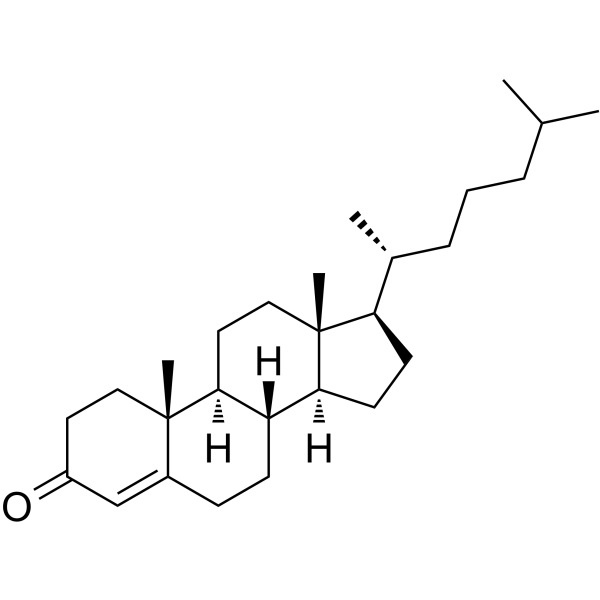
Cholestenone (4-cholesten-3-one) is an orally available antimicrobial agent that is metabolized primarily in the liver as an intermediate oxidation product of cholesterol. Cholestenone inhibits human dermal fibroblast migration and fights Helicobacter pylori infection in vitro and in mouse models by inhibiting cholesterol-α-D-glucopyranoside (CGL). Cholestenone also alleviates metabolic disorders caused by obesity in db/db mice.
For research use only. We do not sell to patients.
- Purity : 99.95%
- CAS No.: 601-57-0
- Formula: C27H44O
- Molecular Weight:384.64
-
Storage:Powder -20°C, 3 years , 4°C, 2 years ; In solvent -80°C, 6 months , -20°C, 1 month

To place orders, for customer services and technical support, please contact: MedChemExpress USA
Tel: 609-228-6898 E-mail: [email protected] [email protected]


-
 Biological Activity
-
Chemical Information
-
Solvent & Solubility
- Protocols
- Purity & Documentation
- References
-
 Help & FAQs




All Endogenous Metabolite Isoforms
More

Biological Activity
Description
IC50 & Target
|
Human Endogenous Metabolite |
Cellular Effect
|
Cell Line

|
Type | Value | Description | References |
|---|---|---|---|---|
| DU-145 | IC50 |
20.3 μM
Compound: 8
|
Cytotoxicity against human DU145 cells after 72 hrs by MTS assay
Cytotoxicity against human DU145 cells after 72 hrs by MTS assay
|
[PMID: 21036050] |
| DU-4475 | IC50 |
6.74 μM
Compound: 8
|
Cytotoxicity against human DU4475 cells after 72 hrs by MTS assay
Cytotoxicity against human DU4475 cells after 72 hrs by MTS assay
|
[PMID: 21036050] |
| HCT-116 | IC50 |
9.58 μM
Compound: 8
|
Cytotoxicity against human HCT116 cells after 72 hrs by MTS assay
Cytotoxicity against human HCT116 cells after 72 hrs by MTS assay
|
[PMID: 21036050] |
| LNCaP-Clone-FGC | IC50 |
5.96 μM
Compound: 8
|
Cytotoxicity against human LNCaP-FGC cells after 72 hrs by MTS assay
Cytotoxicity against human LNCaP-FGC cells after 72 hrs by MTS assay
|
[PMID: 21036050] |
| MDA-MB-231 | IC50 |
13.51 μM
Compound: 8
|
Cytotoxicity against human MDA-MB-231 cells after 72 hrs by MTS assay
Cytotoxicity against human MDA-MB-231 cells after 72 hrs by MTS assay
|
[PMID: 21036050] |
| MDA-MB-468 | IC50 |
6.09 μM
Compound: 8
|
Cytotoxicity against human MDA-MB-468 cells after 72 hrs by MTS assay
Cytotoxicity against human MDA-MB-468 cells after 72 hrs by MTS assay
|
[PMID: 21036050] |
| PC-3 | IC50 |
>25 μM
Compound: 8
|
Cytotoxicity against human PC3 cells after 72 hrs by MTS assay
Cytotoxicity against human PC3 cells after 72 hrs by MTS assay
|
[PMID: 21036050] |
In Vitro
Cholestenone (4.7-150μM, 4 days) inhibits the growth of Helicobacter pylori in a dose-dependent manner[1].
Cholestenone (150 μM, 2 days) inhibits the expression of CGL in Helicobacter pylori[1].
Cholestenone affects the ordering ability of the remaining cholesterol, increases N-palmitoyl-sphingomyelin (PSM) in a short period of time, and increases the turnover rate of cholesterol after replacing 25% of cholesterol[2].
Cholestenone (treated with 10U/mL coase for 1 hour; treated with 0.5mM MBDC for 5 minutes) inhibits the migration of human dermal fibroblasts.
MedChemExpress (MCE) has not independently confirmed the accuracy of these methods. They are for reference only.
-
Cell Line:HDFs
-
Concentration:25% cholesterol consumption (Cholesterol oxidase (HY-P2848) (10 U/ml; 1 h), Methyl-β-cyclodextrin (HY-101461) (0.5 mM; 5 min))
-
Incubation Time:0 and 22 h
-
Result:Reduced the amount of cell migration.
-
Cell Line:Helicobacter pylori ATCC 43504; Helicobacter pylori 2460
-
Concentration:4.7-150 μM
-
Incubation Time:0, 1, 2, 3, 4 days
-
Result:Inhibited the growth of Helicobacter pylori in a dose-dependent manner.
In Vivo
Cholestenone (oral; 1 g, once every eight hours, 17 consecutive days for dog; 1% cholestenone, 10 and 16 days for chicken) reduces plasma cholesterol levels in dogs and chickens, but does not reduce total cholesterol levels[3].
Cholestenone (oral, 0.25% cholestenone, 4 weeks) can alleviate obesity-related metabolic disorders in db/db mice[4].
MedChemExpress (MCE) has not independently confirmed the accuracy of these methods. They are for reference only.
-
Animal Model:Infected 5-wk-old C57BL/6 mice with two doses of 3 × 10⁷ H. pylori strain SS1[1]
-
Dosage:0.5% wt/wt
-
Administration:Oral; 4 weeks
-
Result:Inhibited the number of Helicobacter pylori.
-
Animal Model:dog; chicken[3]
-
Dosage:1 g, once every eight hours,17 consecutive days for dog; 1% cholestenone, 10 and 16 days for chicken
-
Administration:Oral
-
Result:Reduced plasma cholesterol, total cholesterol levels did not decrease.
-
Animal Model:Obese diabetic db/db mice[4]
-
Dosage:0.25% cholestenone; 4 weeks
-
Administration:Oral
-
Result:Relieved hyperlipidemia, hepatic cholesterol accumulation, and hyperinsulinemia, insufficient to improve hepatic triglyceride accumulation or obesity.
Increased fecal free fatty acids and neutral steroids.
Decreased plasma desmosterol, but not liver.


Chemical Information
-
CAS No. 601-57-0
-
Appearance Solid
-
Molecular Weight 384.64
-
Formula C27H44O
-
Color White to off-white
-
SMILES
CC(C)CCC[C@@H](C)[C@H]1CC[C@@]2([H])[C@]3([H])CCC4=CC(CC[C@]4(C)[C@@]3([H])CC[C@]12C)=O
-
Synonyms
4-Cholesten-3-one
-
Structure Classification
-
Initial Source
-
Shipping
Room temperature in continental US; may vary elsewhere.
-
Storage
Powder -20°C 3 years 4°C 2 years In solvent -80°C 6 months -20°C 1 month


Solvent & Solubility
In Vitro:
Ethanol : 50 mg/mL (129.99 mM; Need ultrasonic)
DMSO : 2 mg/mL (5.20 mM; ultrasonic and warming and heat to 60°C; Hygroscopic DMSO has a significant impact on the solubility of product, please use newly opened DMSO)
Please refer to the solubility information to select the appropriate solvent. Once prepared, please aliquot and store the solution to prevent product inactivation from repeated freeze-thaw cycles.
Storage method and period of stock solution: -80°C, 6 months; -20°C, 1 month. When stored at -80°C, please use it within 6 months. When stored at -20°C, please use it within 1 month.
Please refer to the solubility information to select the appropriate solvent. Once prepared, please aliquot and store the solution to prevent product inactivation from repeated freeze-thaw cycles.
Storage method and period of stock solution: -80°C, 6 months; -20°C, 1 month. When stored at -80°C, please use it within 6 months. When stored at -20°C, please use it within 1 month.
Concentration (start) × Volume (start) = Concentration (final) × Volume (final)
In Vivo:
Select the appropriate dissolution method based on your experimental animal and administration route.
- For the following dissolution methods, please ensure to first prepare a clear stock solution using an In Vitro approach and then sequentially add co-solvents:
- To ensure reliable experimental results, the clarified stock solution can be appropriately stored based on storage conditions. As for the working solution for In Vivo experiments, it is recommended to prepare freshly and use it on the same day.
- The percentages shown for the solvents indicate their volumetric ratio in the final prepared solution. If precipitation or phase separation occurs during preparation, heat and/or sonication can be used to aid dissolution.
Add each solvent one by one: 10% EtOH 40% PEG300 5% Tween-80 45% Saline
Solubility: ≥ 2.5 mg/mL (6.50 mM); Clear solution
This protocol yields a clear solution of ≥ 2.5 mg/mL (saturation unknown).
Taking 1 mL working solution as an example, add 100 μL EtOH stock solution (25.0 mg/mL) to 400 μL PEG300, and mix evenly; then add 50 μL Tween-80 and mix evenly; then add 450 μL Saline to adjust the volume to 1 mL.
Preparation of Saline: Dissolve 0.9 g sodium chloride in ddH₂O and dilute to 100 mL to obtain a clear Saline solution.
Add each solvent one by one: 10% EtOH 90% (20% SBE-β-CD in Saline)
Solubility: 2.5 mg/mL (6.50 mM); Suspended solution; Need ultrasonic
This protocol yields a suspended solution of 2.5 mg/mL. Suspended solution can be used for oral and intraperitoneal injection.
Taking 1 mL working solution as an example, add 100 μL EtOH stock solution (25.0 mg/mL) to 900 μL 20% SBE-β-CD in Saline, and mix evenly.
Preparation of 20% SBE-β-CD in Saline (4°C, storage for one week): 2 g SBE-β-CD powder is dissolved in 10 mL Saline, completely dissolve until clear.
Add each solvent one by one: 10% EtOH 90% Corn Oil
Solubility: ≥ 2.5 mg/mL (6.50 mM); Clear solution
This protocol yields a clear solution of ≥ 2.5 mg/mL (saturation unknown). If the continuous dosing period exceeds half a month, please choose this protocol carefully.
Taking 1 mL working solution as an example, add 100 μL EtOH stock solution (25.0 mg/mL) to 900 μL Corn oil, and mix evenly.
In Vivo Dissolution Calculator
Please enter the basic information of animal experiments:
-
-
-
-
Recommended: Prepare an additional quantity of animals to account for potential losses during experiments.
Please enter your animal formula composition:
-
%DMSO +
Recommended: Keep the proportion of DMSO in working solution below 2% if your animal is weak.
-
%+
-
+%Tween-80 + +
-
%Saline +
The co-solvents required include: DMSO, . All of co-solvents are available by MedChemExpress (MCE). , Tween 80. All of co-solvents are available by MedChemExpress (MCE).
Working solution concentration: 0.22 mg/mL
Method for preparing stock solution: mg drug dissolved in μL DMSO. Stock solution concentration: mg/mL.
1. Take μL DMSO stock solution;
2. Add μL .
μL , mix evenly;
3. Then add μL Tween 80, mix evenly;
4. Then add μL
Please ensure that the stock solution in the first step is dissolved to a clear state, and add co-solvents in sequence. You can use ultrasonic heating (ultrasonic cleaner, recommended frequency 20-40 kHz), vortexing, etc. to assist dissolution.


Purity & Documentation
-
Data Sheet (279 KB)
-
SDS (396 KB)
- English - EN (396 KB)
- Français - FR (396 KB)
- Deutsch - DE (396 KB)
- Norwegian - NO (396 KB)
- Español - ES (396 KB)
- Swedish - SV (396 KB)
- Italian - IT (396 KB)
- Korean - KR (396 KB)
- Portuguese - PT (396 KB)
-
Handling Instructions (2659 KB)
References
[1]. unichi Kobayashi, et al. Cholestenone functions as an antibiotic against Helicobacter pylori by inhibiting biosynthesis of the cell wall component CGL. Proc Natl Acad Sci U S A. 2021 Apr 20;118(16):e2016469118. [Content Brief]
[2]. Maarit Neuvonen, et al. Enzymatic oxidation of cholesterol: properties and functional effects of cholestenone in cell membranes. 2014 Aug 26;9(8):e103743. [Content Brief]
[3]. G M TOMKINS, et al. Use of delta 4-cholestenone to reduce the level of serum cholesterol in man. Science. 1957 May 10;125(3254):936-7. [Content Brief]
[4]. Mina Higuchi, et al. Dietary Cholest-4-en-3-one, a Cholesterol Metabolite of Gut Microbiota, Alleviates Hyperlipidemia, Hepatic Cholesterol Accumulation, and Hyperinsulinemia in Obese, Diabetic db/db Mice. Metabolites. 2024 Jun 3;14(6):321. [Content Brief]


Complete Stock Solution Preparation Table
Please refer to the solubility information to select the appropriate solvent. Once prepared, please aliquot and store the solution to prevent product inactivation from repeated freeze-thaw cycles.
Storage method and period of stock solution: -80°C, 6 months; -20°C, 1 month. When stored at -80°C, please use it within 6 months. When stored at -20°C, please use it within 1 month.
| Optional Solvent | Concentration Solvent Mass | 1 mg | 5 mg | 10 mg | 25 mg |
|---|---|---|---|---|---|
| DMSO / Ethanol | 1 mM | 2.5998 mL | 12.9992 mL | 25.9983 mL | 64.9958 mL |
| 5 mM | 0.5200 mL | 2.5998 mL | 5.1997 mL | 12.9992 mL | |
| Ethanol | 10 mM | 0.2600 mL | 1.2999 mL | 2.5998 mL | 6.4996 mL |
| 15 mM | 0.1733 mL | 0.8666 mL | 1.7332 mL | 4.3331 mL | |
| 20 mM | 0.1300 mL | 0.6500 mL | 1.2999 mL | 3.2498 mL | |
| 25 mM | 0.1040 mL | 0.5200 mL | 1.0399 mL | 2.5998 mL | |
| 30 mM | 0.0867 mL | 0.4333 mL | 0.8666 mL | 2.1665 mL | |
| 40 mM | 0.0650 mL | 0.3250 mL | 0.6500 mL | 1.6249 mL | |
| 50 mM | 0.0520 mL | 0.2600 mL | 0.5200 mL | 1.2999 mL | |
| 60 mM | 0.0433 mL | 0.2167 mL | 0.4333 mL | 1.0833 mL | |
| 80 mM | 0.0325 mL | 0.1625 mL | 0.3250 mL | 0.8124 mL | |
| 100 mM | 0.0260 mL | 0.1300 mL | 0.2600 mL | 0.6500 mL |


Cholestenone Related Classifications
HY-113365 Related Classifications
 Powered by Bioz