



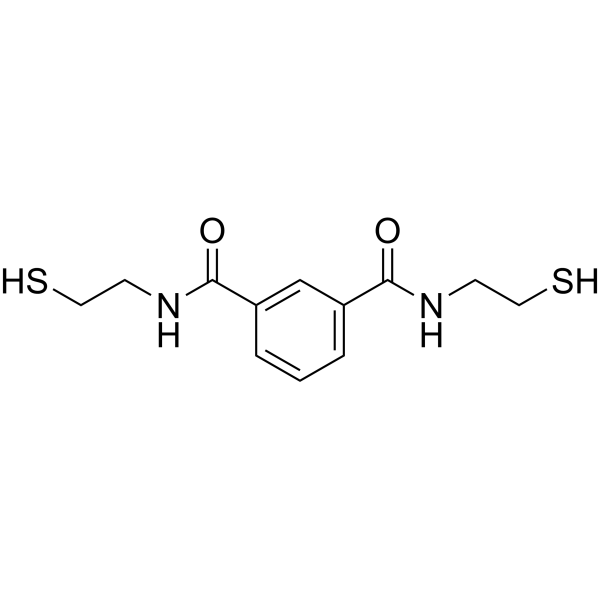
Emeramide

Based on 1 Customer Validation
Emeramide is a thiol-redox antioxidant and heavy metal chelator.
For research use only. We do not sell to patients.
- Purity : 99.74%
- CAS No.: 351994-94-0
- Formula: C12H16N2O2S2
- Molecular Weight:284.40
-
Storage:Powder -20°C, 3 years , 4°C, 2 years
* The compound is unstable in solutions, freshly prepared is recommended.

To place orders, for customer services and technical support, please contact: MedChemExpress USA
Tel: 609-228-6898 E-mail: [email protected] [email protected]


-
 Biological Activity
-
Chemical Information
-
Solvent & Solubility
- Protocols
- Purity & Documentation
- References
-
 Help & FAQs




Biological Activity
Description
In Vitro
Emeramide (50 μM, 1 h) protects cell from Bleomycin (HY-108345)-induced cell (BPAECs) morphology alterations and cytotoxicity, and inhibits ROS generation, attenuates the Bleomycin-induced loss of cellular total thiols[2].
Emeramide (0-100 μM, pretreated for 24 h) inhibits Pb-induced neuroinflammation by reducing IL-1β and GFAP expression levels in U-87 MG cells[3].
MedChemExpress (MCE) has not independently confirmed the accuracy of these methods. They are for reference only.
In Vivo
MedChemExpress (MCE) has not independently confirmed the accuracy of these methods. They are for reference only.
Clinical Trial
| NCT Number | Sponsor | Condition | Start Date |
Phase

|
|---|---|---|---|---|
| NCT01329991 | Plexxikon| | 2011-05 | PHASE1 |


Chemical Information
-
CAS No. 351994-94-0
-
Appearance Solid
-
Molecular Weight 284.40
-
Formula C12H16N2O2S2
-
Color White to off-white
-
SMILES
O=C(C1=CC=CC(C(NCCS)=O)=C1)NCCS
-
Synonyms
NBMI; BDTH2
-
Shipping
Room temperature in continental US; may vary elsewhere.
-
Storage
Powder -20°C 3 years 4°C 2 years * The compound is unstable in solutions, freshly prepared is recommended.


Solvent & Solubility
In Vitro:
DMSO : 100 mg/mL (351.62 mM; Need ultrasonic and warming; Hygroscopic DMSO has a significant impact on the solubility of product, please use newly opened DMSO)
H2O : < 0.1 mg/mL (insoluble)
Please refer to the solubility information to select the appropriate solvent. The compound is unstable in solutions, freshly prepared is recommended.
Please refer to the solubility information to select the appropriate solvent. The compound is unstable in solutions, freshly prepared is recommended.
Concentration (start) × Volume (start) = Concentration (final) × Volume (final)
In Vivo:
Select the appropriate dissolution method based on your experimental animal and administration route.
- For the following dissolution methods, please ensure to first prepare a clear stock solution using an In Vitro approach and then sequentially add co-solvents:
- To ensure reliable experimental results, the clarified stock solution can be appropriately stored based on storage conditions. As for the working solution for In Vivo experiments, it is recommended to prepare freshly and use it on the same day.
- The percentages shown for the solvents indicate their volumetric ratio in the final prepared solution. If precipitation or phase separation occurs during preparation, heat and/or sonication can be used to aid dissolution.
Add each solvent one by one: 10% DMSO 40% PEG300 5% Tween-80 45% Saline
Solubility: ≥ 2.08 mg/mL (7.31 mM); Clear solution
This protocol yields a clear solution of ≥ 2.08 mg/mL (saturation unknown).
Taking 1 mL working solution as an example, add 100 μL DMSO stock solution (20.8 mg/mL) to 400 μL PEG300, and mix evenly; then add 50 μL Tween-80 and mix evenly; then add 450 μL Saline to adjust the volume to 1 mL.
Preparation of Saline: Dissolve 0.9 g sodium chloride in ddH₂O and dilute to 100 mL to obtain a clear Saline solution.
In Vivo Dissolution Calculator
Please enter the basic information of animal experiments:
-
-
-
-
Recommended: Prepare an additional quantity of animals to account for potential losses during experiments.
Please enter your animal formula composition:
-
%DMSO +
Recommended: Keep the proportion of DMSO in working solution below 2% if your animal is weak.
-
%+
-
+%Tween-80 + +
-
%Saline +
The co-solvents required include: DMSO, . All of co-solvents are available by MedChemExpress (MCE). , Tween 80. All of co-solvents are available by MedChemExpress (MCE).
Working solution concentration: 0.22 mg/mL
Method for preparing stock solution: mg drug dissolved in μL DMSO. Stock solution concentration: mg/mL. * The compound is unstable in solutions, freshly prepared is recommended.
1. Take μL DMSO stock solution;
2. Add μL .
μL , mix evenly;
3. Then add μL Tween 80, mix evenly;
4. Then add μL
Please ensure that the stock solution in the first step is dissolved to a clear state, and add co-solvents in sequence. You can use ultrasonic heating (ultrasonic cleaner, recommended frequency 20-40 kHz), vortexing, etc. to assist dissolution.


Purity & Documentation
-
Data Sheet (270 KB)
-
SDS (393 KB)
- English - EN (393 KB)
- Français - FR (393 KB)
- Deutsch - DE (393 KB)
- Norwegian - NO (393 KB)
- Español - ES (393 KB)
- Swedish - SV (393 KB)
- Italian - IT (393 KB)
- Korean - KR (393 KB)
- Portuguese - PT (393 KB)
-
Handling Instructions (2659 KB)
References
[1]. Secor JD, et al. Novel lipid-soluble thiol-redox antioxidant and heavy metal chelator, N,N'-bis(2-mercaptoethyl)isophthalamide (NBMI) and phospholipase D-specific inhibitor, 5-fluoro-2-indolyl des-chlorohalopemide (FIPI) attenuate mercury-induced lipid signaling leading to protection against cytotoxicity in aortic endothelial cells. Int J Toxicol. 2011 Dec;30(6):619-38. [Content Brief]
[2]. Patel RB, et al. Thiol-redox antioxidants protect against lung vascular endothelial cytoskeletal alterations caused by pulmonary fibrosis inducer, bleomycin: comparison between classical thiol-protectant, N-acetyl-L-cysteine, and novel thiol antioxidant, N,N'-bis-2-mercaptoethyl isophthalamide. Toxicol Mech Methods. 2012 Jun;22(5):383-96. [Content Brief]
[3]. Gadde R, et al. N,N'bis-(2-mercaptoethyl) isophthalamide (NBMI) exerts neuroprotection against lead-induced toxicity in U-87 MG cells. Arch Toxicol. 2021 Aug;95(8):2643-2657. [Content Brief]
[4]. Cheng R, et al. Reversal of genetic brain iron accumulation by N,N'-bis(2-mercaptoethyl)isophthalamide, a lipophilic metal chelator, in mice. Arch Toxicol. 2022 Jul;96(7):1951-1962. [Content Brief]


Complete Stock Solution Preparation Table
Please refer to the solubility information to select the appropriate solvent. The compound is unstable in solutions, freshly prepared is recommended.
| Optional Solvent | Concentration Solvent Mass | 1 mg | 5 mg | 10 mg | 25 mg |
|---|---|---|---|---|---|
| DMSO | 1 mM | 3.5162 mL | 17.5809 mL | 35.1617 mL | 87.9044 mL |
| 5 mM | 0.7032 mL | 3.5162 mL | 7.0323 mL | 17.5809 mL | |
| 10 mM | 0.3516 mL | 1.7581 mL | 3.5162 mL | 8.7904 mL | |
| 15 mM | 0.2344 mL | 1.1721 mL | 2.3441 mL | 5.8603 mL | |
| 20 mM | 0.1758 mL | 0.8790 mL | 1.7581 mL | 4.3952 mL | |
| 25 mM | 0.1406 mL | 0.7032 mL | 1.4065 mL | 3.5162 mL | |
| 30 mM | 0.1172 mL | 0.5860 mL | 1.1721 mL | 2.9301 mL | |
| 40 mM | 0.0879 mL | 0.4395 mL | 0.8790 mL | 2.1976 mL | |
| 50 mM | 0.0703 mL | 0.3516 mL | 0.7032 mL | 1.7581 mL | |
| 60 mM | 0.0586 mL | 0.2930 mL | 0.5860 mL | 1.4651 mL | |
| 80 mM | 0.0440 mL | 0.2198 mL | 0.4395 mL | 1.0988 mL | |
| 100 mM | 0.0352 mL | 0.1758 mL | 0.3516 mL | 0.8790 mL |


Emeramide Related Classifications
HY-16739 Related Classifications
 Powered by Bioz