



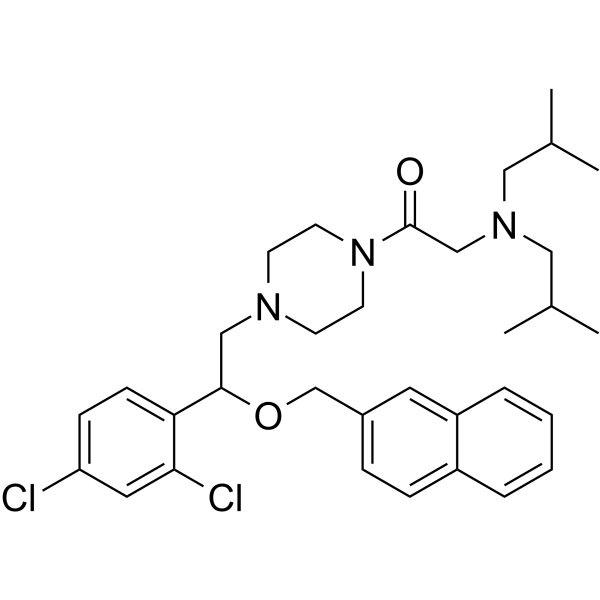
LYN-1604
Based on 7 publication(s) in Google Scholar
LYN-1604 is a potent UNC-51-like kinase 1 (ULK1) activator (EC50=18.94 nM) for the research of triple negative breast cancer (TNBC).
For research use only. We do not sell to patients.
- Purity : 99.73%
- CAS No.: 2088939-99-3
- Formula: C33H43Cl2N3O2
- Molecular Weight:584.62
-
Storage:Pure form -20°C, 3 years , 4°C, 2 years ; In solvent -80°C, 6 months , -20°C, 1 month

To place orders, for customer services and technical support, please contact: MedChemExpress USA
Tel: 609-228-6898 E-mail: [email protected] [email protected]


-
 Biological Activity
-
Chemical Information
-
Solvent & Solubility
- Protocols
- Purity & Documentation
- References
-
 Help & FAQs


-
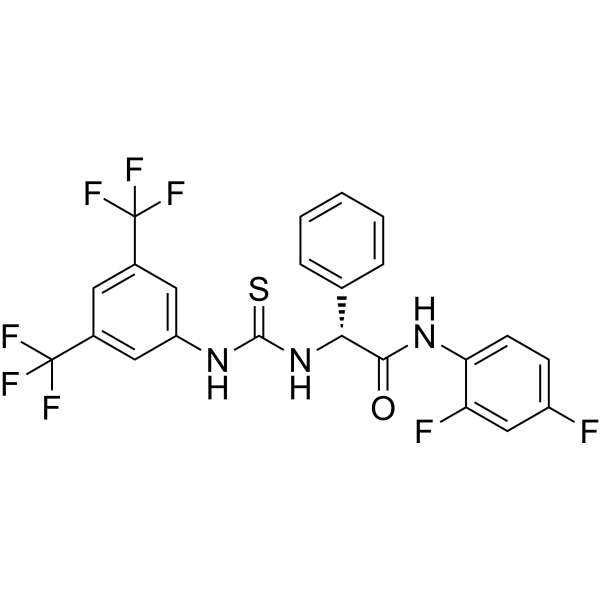
HY-124729
BL-918ULK1 Activator -
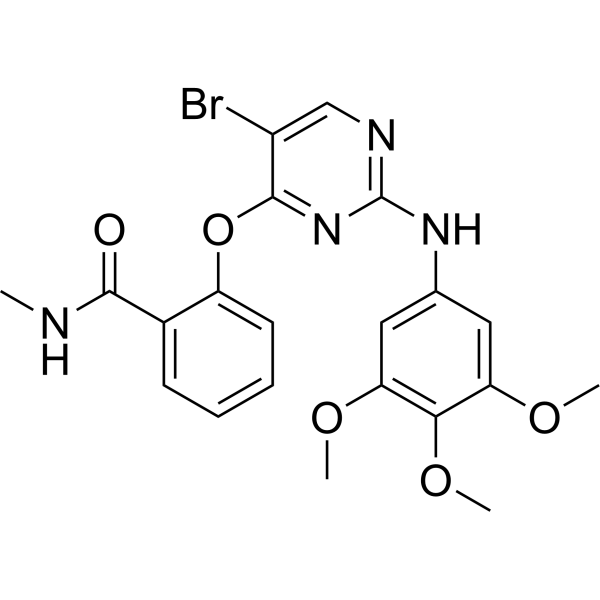
HY-16966
SBI-0206965ULK1/AMPK Inhibitor -
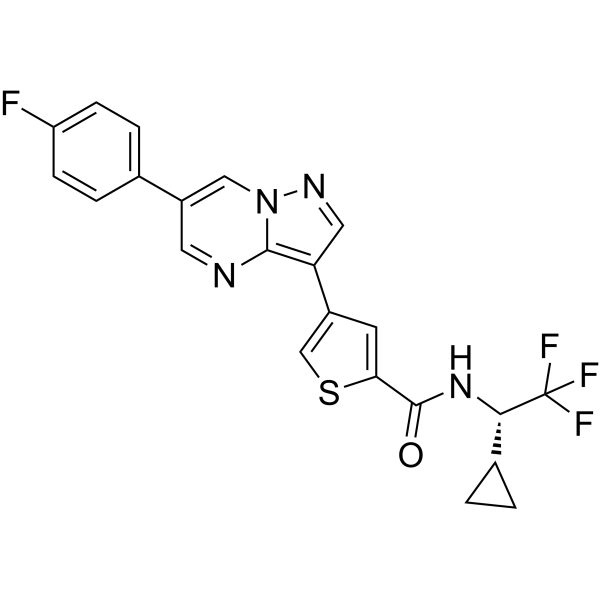
HY-114490
ULK-101ULK1 Inhibitor -
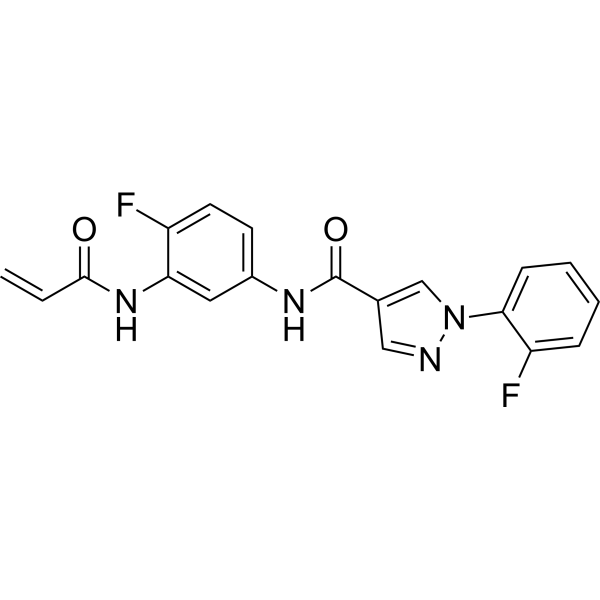
HY-128892
EN6Autophagy Activator -

HY-101923R
LYN-1604 (Standard)Reference Standard -
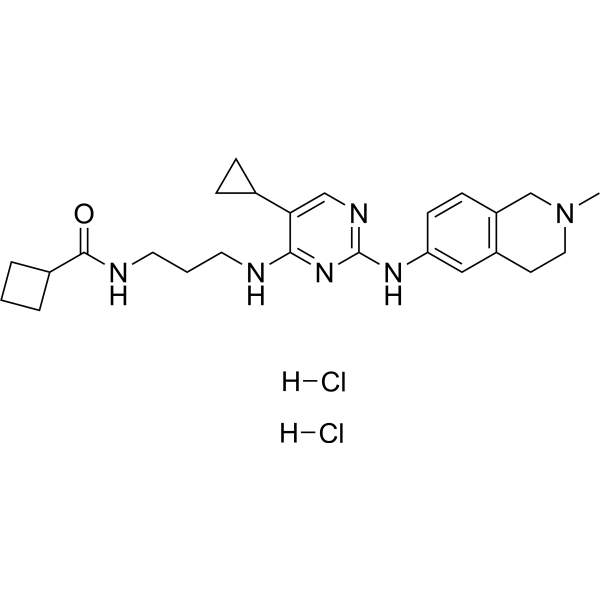
HY-100006A
MRT68921 dihydrochlorideNUAK1/ULK1 Inhibitor -
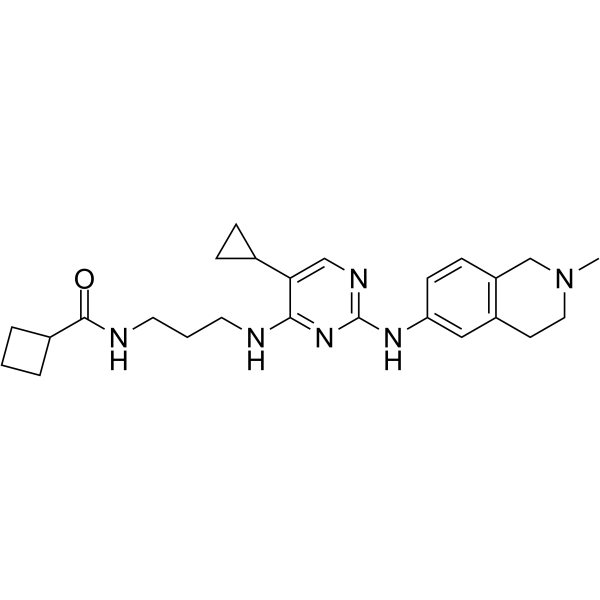
HY-100006
MRT68921NUAK1/ULK1 Inhibitor -
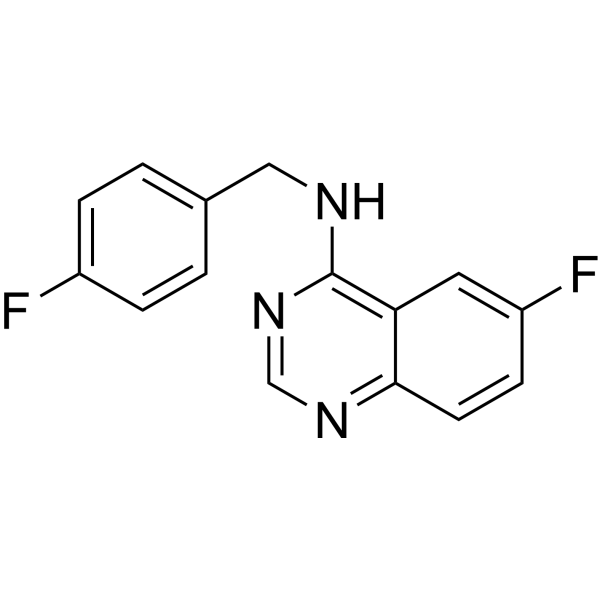
HY-12990
Spautin-1Autophagy Inhibitor -
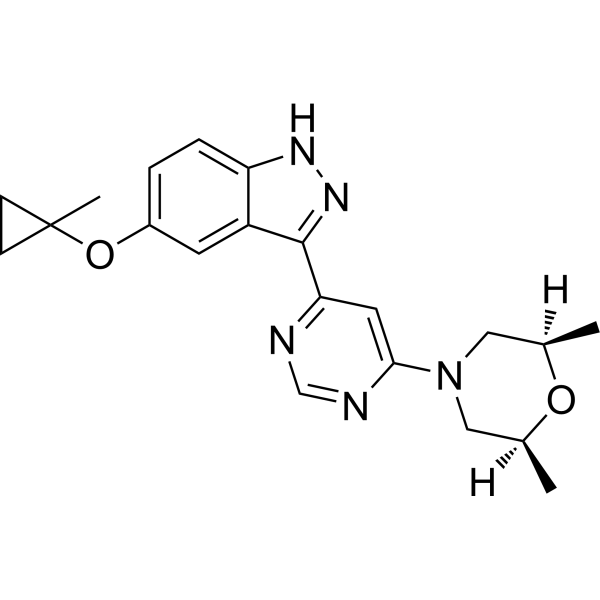
HY-100411
MLi-2LRRK2 Inhibitor -
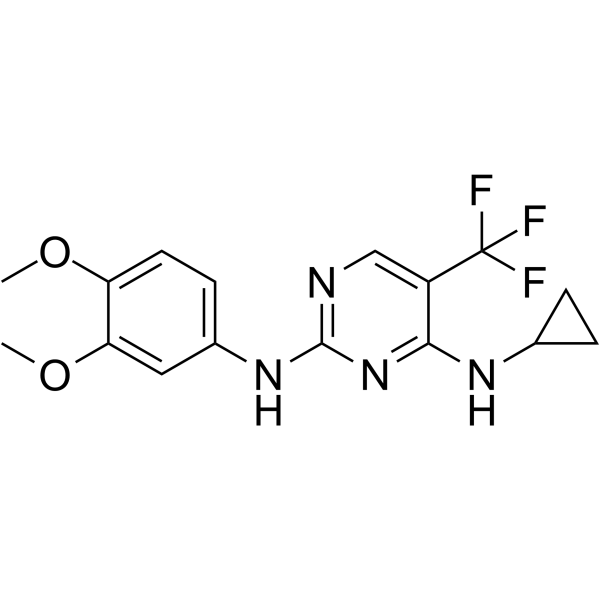
HY-137742
SBP-7455ULK1/ULK2 Autophagy Inhibitor -
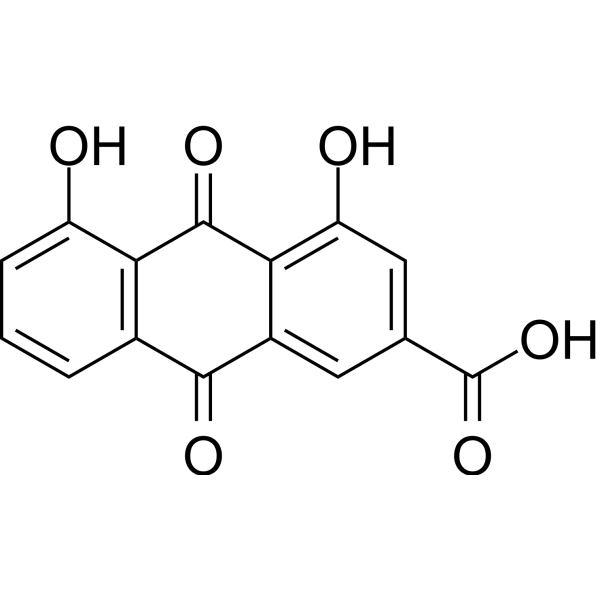
HY-N0105
RheinAntioxidant -
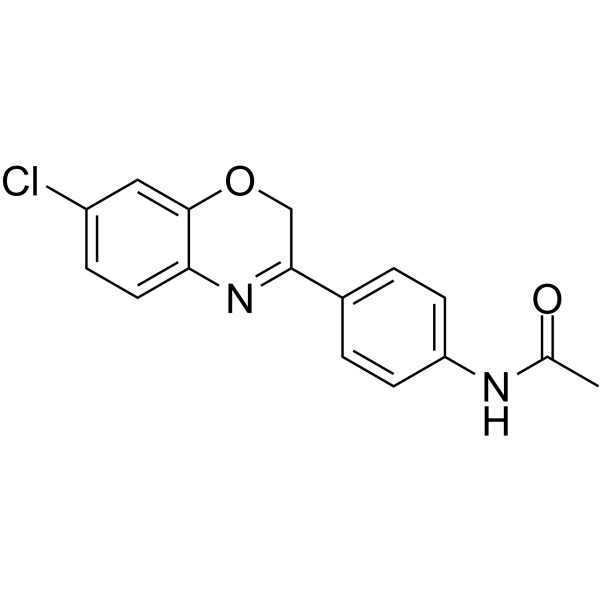
HY-112483
QX77CMA activator
Publications Citing Use of MedChemExpress (MCE) LYN-1604
More- Nat Aging. 2026 May 14. [Abstract]
- J Transl Med. 2025 Oct 21;23(1):1144. [Abstract]
- Antioxidants (Basel). 2025 Nov 19;14(11):1381. [Abstract]
- Med Oncol. 2026 Mar 3;43(4):163. [Abstract]
- Cell Signal. 2024 Jun:118:111136. [Abstract]
- Biochem J. 2019 Mar 12;476(5):875-887. [Abstract]
- Oxid Med Cell Longev. 2021 Nov 15:2021:2896674. [Abstract]
 Customer Validation & Images

-
WB
-
IF


Biological Activity
Description
IC50 & Target
[1]|
ULK1 18.94 nM (EC50) |
Cellular Effect
|
Cell Line

|
Type | Value | Description | References |
|---|---|---|---|---|
| MDA-MB-231 | IC50 |
1.66 μM
Compound: 8; LYN-1604
|
Antiproliferative activity against human MDA-MB-231 cells by MTT assay
Antiproliferative activity against human MDA-MB-231 cells by MTT assay
|
[PMID: 29509411] |
| MDA-MB-231 | IC50 |
1.66 μM
Compound: 12; LYN-1604
|
Antiproliferative activity against human MDA-MB-231 cells assessed reduction in cell viability incubated for 24 hrs by MTT assay
Antiproliferative activity against human MDA-MB-231 cells assessed reduction in cell viability incubated for 24 hrs by MTT assay
|
[PMID: 37595546] |
| MDA-MB-231 | IC50 |
1.66 μM
Compound: LYN-1604
|
Antiproliferative activity against human MDA-MB-231 cells
Antiproliferative activity against human MDA-MB-231 cells
|
[PMID: 38432059] |
In Vitro
LYN-1604 is a potential ULK1 agonist (enzymatic activity=195.7% at 100 nM and IC50=1.66 μM against MDA-MB-231 cells) [1].
LYN-1604 binds to wild-type ULK1 with a binding affinity in the nanomole range (KD=291.4 nM) [1].
LYN-1604 (0.5, 1.0 and 2.0 μM) induces cell death via the ULK complex in MDA-MB-231 cells[1].
LYN-1604 (0.5-2 μM, 24 hours) induces remarkable up-regulation of Beclin-1 and degradation of p62, as well as transformation of LC3-I to LC3-II in MDA-MB-231 cells[1].
LYN-1604 induces ATG5-dependent autophagy via the ULK complex[1].
LYN-1604 can also increase cleavage of caspase3 and induce apoptosis[1].
MedChemExpress (MCE) has not independently confirmed the accuracy of these methods. They are for reference only.
-
Cell Line:MDA-MB-231 cells
-
Concentration:0.5, 1.0 and 2.0 μM
-
Incubation Time:
-
Result:Induced cell death. Autophagy ratio was increased in a dose-dependent manner.
-
Cell Line:MDA-MB-231 cells
-
Concentration:0, 0.5, 1, and 2 μM
-
Incubation Time:24 hours
-
Result:Induced remarkable up-regulation of Beclin-1 and degradation of p62, as well as transformation of LC3-I to LC3-II.
In Vivo
MedChemExpress (MCE) has not independently confirmed the accuracy of these methods. They are for reference only.
-
Animal Model:24 female nude mice (BALB/c, 6-8 weeks, 20-22 g)[1]
-
Dosage:Low dose, 25 mg/kg; median dose, 50 mg/kg; high dose, 100 mg/kg
-
Administration:Intragastric administration; once a day for 14 days
-
Result:Significantly inhibited the growth of xenograft MDA-MB-231 cells. The body weights of mice were stable. By the end of the experiment, the liver and spleen weight indexes of mice were slightly increased in parts of the groups, while the kidney weight index was not affected in all dose groups.


Chemical Information
-
CAS No. 2088939-99-3
-
Appearance Oil
-
Molecular Weight 584.62
-
Formula C33H43Cl2N3O2
-
Color Colorless to light yellow
-
SMILES
ClC1=CC=C(C(CN2CCN(C(CN(CC(C)C)CC(C)C)=O)CC2)OCC3=CC=C(C=CC=C4)C4=C3)C(Cl)=C1
-
Shipping
Room temperature in continental US; may vary elsewhere.
-
Storage
Pure form -20°C 3 years 4°C 2 years In solvent -80°C 6 months -20°C 1 month


Publications (7)
-
Journal Impact Factor
-
Most Recent
-
Nat Aging
2026 May 14. PMID: 42135576 -
J Transl Med
Pbk positively regulates myoblast differentiation and muscle regeneration via enhancing AMPK/ULK1 mediated myogenic autophagy. [Abstract]2025 Oct 21;23(1):1144. PMID: 41121382
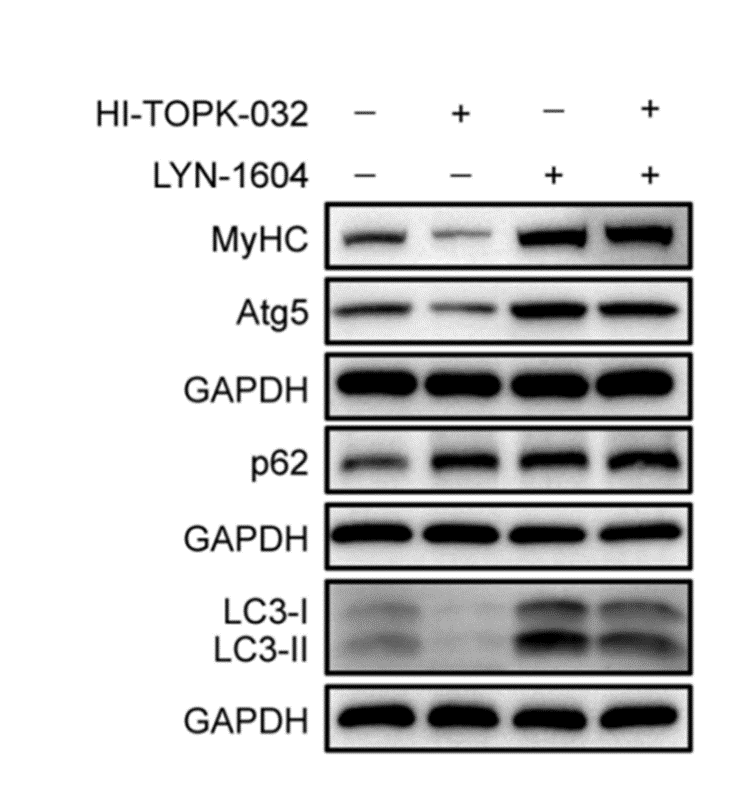
LYN-1604 purchased from MedChemExpress. Usage Cited in: J Transl Med. 2025 Oct 21;23(1):1144. [Abstract]
C2C12 cells treated with or without HI-TOPK-032 (2 μM) and LYN-1604 (2 μM) were induced to differentiation for 3 days. After that, cells were harvested and subjected to western blot to detect and quantify the protein levels of MyHC and autophagy related genes.
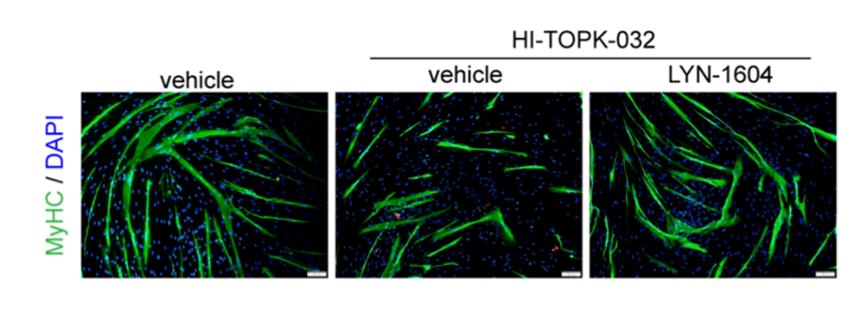
LYN-1604 purchased from MedChemExpress. Usage Cited in: J Transl Med. 2025 Oct 21;23(1):1144. [Abstract]
C2C12 cells treated with or without HI-TOPK-032 (2 μM) and LYN-1604 (2 μM) were induced to differentiation for 3 days. Then cells were fixed and stained for MyHC (green) and DAPI (blue) to detect and quantify the differentiation index and fusion index of differentiating C2C12 cells.
-
Antioxidants (Basel)
Hyperosmolarity-Induced Oxidative Stress Leads to Senescence in Human Corneal Epithelial Cells (HCEPC) via DNA Damage, Metabolic Disturbance and Mitophagy Decline. [Abstract]2025 Nov 19;14(11):1381. PMID: 41300537 -
Med Oncol
ULK1-driven autophagy modulation alters tumor-promoting pathways in triple-negative breast cancer. [Abstract]2026 Mar 3;43(4):163. PMID: 41774346 -
Cell Signal
microRNA-125b-1-3p mediates autophagy via the RRAGD/mTOR/ULK1 signaling pathway and mitigates atherosclerosis progression. [Abstract]2024 Jun:118:111136. PMID: 38471617 -
Biochem J
Conservation of structure, function and inhibitor binding in UNC-51-like kinase 1 and 2 (ULK1/2). [Abstract]2019 Mar 12;476(5):875-887. PMID: 30782972 -
Oxid Med Cell Longev
ULK1 Suppresses Osteoclast Differentiation and Bone Resorption via Inhibiting Syk-JNK through DOK3. [Abstract]2021 Nov 15:2021:2896674. PMID: 34820053


Solvent & Solubility
In Vitro:
DMSO : 100 mg/mL (171.05 mM; Need ultrasonic; Hygroscopic DMSO has a significant impact on the solubility of product, please use newly opened DMSO)
Please refer to the solubility information to select the appropriate solvent. Once prepared, please aliquot and store the solution to prevent product inactivation from repeated freeze-thaw cycles.
Storage method and period of stock solution: -80°C, 6 months; -20°C, 1 month. When stored at -80°C, please use it within 6 months. When stored at -20°C, please use it within 1 month.
Please refer to the solubility information to select the appropriate solvent. Once prepared, please aliquot and store the solution to prevent product inactivation from repeated freeze-thaw cycles.
Storage method and period of stock solution: -80°C, 6 months; -20°C, 1 month. When stored at -80°C, please use it within 6 months. When stored at -20°C, please use it within 1 month.
Concentration (start) × Volume (start) = Concentration (final) × Volume (final)


Purity & Documentation
-
Data Sheet (281 KB)
-
SDS (396 KB)
- English - EN (396 KB)
- Français - FR (396 KB)
- Deutsch - DE (396 KB)
- Norwegian - NO (396 KB)
- Español - ES (396 KB)
- Swedish - SV (396 KB)
- Italian - IT (396 KB)
- Korean - KR (396 KB)
- Portuguese - PT (396 KB)
-
Handling Instructions (2659 KB)
References


Complete Stock Solution Preparation Table
Please refer to the solubility information to select the appropriate solvent. Once prepared, please aliquot and store the solution to prevent product inactivation from repeated freeze-thaw cycles.
Storage method and period of stock solution: -80°C, 6 months; -20°C, 1 month. When stored at -80°C, please use it within 6 months. When stored at -20°C, please use it within 1 month.
| Optional Solvent | Concentration Solvent Mass | 1 mg | 5 mg | 10 mg | 25 mg |
|---|---|---|---|---|---|
| DMSO | 1 mM | 1.7105 mL | 8.5526 mL | 17.1051 mL | 42.7628 mL |
| 5 mM | 0.3421 mL | 1.7105 mL | 3.4210 mL | 8.5526 mL | |
| 10 mM | 0.1711 mL | 0.8553 mL | 1.7105 mL | 4.2763 mL | |
| 15 mM | 0.1140 mL | 0.5702 mL | 1.1403 mL | 2.8509 mL | |
| 20 mM | 0.0855 mL | 0.4276 mL | 0.8553 mL | 2.1381 mL | |
| 25 mM | 0.0684 mL | 0.3421 mL | 0.6842 mL | 1.7105 mL | |
| 30 mM | 0.0570 mL | 0.2851 mL | 0.5702 mL | 1.4254 mL | |
| 40 mM | 0.0428 mL | 0.2138 mL | 0.4276 mL | 1.0691 mL | |
| 50 mM | 0.0342 mL | 0.1711 mL | 0.3421 mL | 0.8553 mL | |
| 60 mM | 0.0285 mL | 0.1425 mL | 0.2851 mL | 0.7127 mL | |
| 80 mM | 0.0214 mL | 0.1069 mL | 0.2138 mL | 0.5345 mL | |
| 100 mM | 0.0171 mL | 0.0855 mL | 0.1711 mL | 0.4276 mL |


LYN-1604 Related Classifications
HY-101923 Related Classifications
 Powered by Bioz