



Cancer Targeted Therapy
Cancer targeted therapy is the foundation of precision medicine; it uses drugs or other substances to target specific genes and proteins that control cancer cells’ growth, division and spreading. Compared to traditional chemotherapy drugs, targeted-drugs can specifically act on cancer cells with high efficacy without damaging normal cells. Drugs used in cancer targeted therapy mainly includes small molecules and macromolecules (e.g., monoclonal antibodies), which can target cancer cells and constituents in the tumor microenvironment to activate the immune system. Anti-angiogenesis drugs, such as those targeting vascular endothelial growth factor (VEGF), epidermal growth factor receptor (EGFR), transforming growth factor (TGF)-α, TGF-β, Tumor necrosis factor (TNF)-α, and platelet-derived endothelial growth factor (PDGFR) inhibit the proliferation and metastasis of cancer cells. In recent years, the proportion of antibody drugs in cancer treatment has gradually become prominent. Antibody-drug conjugates (ADCs) are a new type of targeted drugs that are composed of monoclonal antibody, cytotoxic drug and linker. ADCs can deliver drugs to tumor cells and minimize the toxicity to normal tissues. Proteolysis-targeting chimera (PROTAC) is a useful technology for targeted protein degradation. PROTAC exploits the ubiquitin-proteasome system and forms a ternary complex with a hijacked E3 ubiquitin ligase and target protein, leading to polyubiquitination and degradation of the target protein.
Targeted therapy is a useful strategy in treatment of cancer either alone or in combination with standard chemotherapy. At present, targeted therapy has proved significant clinical success in the treatment of many types of cancer, including breast cancer, colorectal cancer, leukemia, ovarian cancer and lung cancer.
-
VTP50469 mesylate
 0 ImagesCat. No.: HY-114162BCAS No.: 2169919-27-9Synonyms: SNDX-50469 mesylate
VTP50469 mesylate is a potent, and selective Menin-MLL1 inhibitor that effectively targets MLL-rearranged and NPM1c+ leukemia. VTP50469 mesylate selectively kills cell lines with MLL rearrangements and NPM1c+ mutations. VTP50469 mesylate displaces Menin from protein complexes and inhibits MLL's chromatin occupancy at specific genes, leading to significant changes in gene expression, differentiation, and apoptosis. VTP50469 demonstrates dramatic reductions in leukemia burden in patient-derived xenograft models of MLL-r acute myeloid leukemia and MLL-r acute lymphoblastic leukemia, with some mice remaining disease-free for over a year post-treatment.
-
hsa-miR-3978 inhibitor
 0 ImagesCat. No.: HY-RI00916
hsa-miR-3978 inhibitors are chemically-modified oligonucleotides that hybridize with mature miRNAs. The miRNA inhibitors have full-length nucleotide 2'-methoxy modification. The miRNA inhibitors strongly compete with mature miRNAs to prevent the complementary pairing of miRNAs and their target genes, thereby inhibiting miRNAs from functioning.
-
hsa-miR-510-3p antagomir
 0 ImagesCat. No.: HY-RI01536A
hsa-miR-510-3p antagomirs are chemically-modified oligonucleotides that hybridize with mature miRNAs. The miRNA antagomirs have 2 phosphorothioates at the 5' end, 4 phosphorothioates at the 3' end, 1 cholesterol group at the 3' end, and full-length nucleotide 2'-methoxy modification. The miRNA antagomirs strongly compete with mature miRNAs to prevent the complementary pairing of miRNAs and their target genes, thereby inhibiting miRNAs from functioning. Stability of miRNA antagomirs appears to be significantly higher than miRNA inhibitors, they exhibits enhanced cellular uptake, stability and regulatory activity in vivo.
-
PROTAC EZH2 Degrader-29
 0 ImagesCat. No.: HY-181357CAS No.: 3093642-30-6
PROTAC EZH2 Degrader-29 (compound 66) is a is a PROTAC protein degrader targeting EZH2 with an IC50 of 24.53 μM against diffuse large B-cell lymphoma cells. PROTAC EZH2 Degrader-29 can be used in studies related to diffuse large B-cell lymphoma.
-
hsa-miR-12120 antagomir
 0 ImagesCat. No.: HY-RI00096A
hsa-miR-12120 antagomirs are chemically-modified oligonucleotides that hybridize with mature miRNAs. The miRNA antagomirs have 2 phosphorothioates at the 5' end, 4 phosphorothioates at the 3' end, 1 cholesterol group at the 3' end, and full-length nucleotide 2'-methoxy modification. The miRNA antagomirs strongly compete with mature miRNAs to prevent the complementary pairing of miRNAs and their target genes, thereby inhibiting miRNAs from functioning. Stability of miRNA antagomirs appears to be significantly higher than miRNA inhibitors, they exhibits enhanced cellular uptake, stability and regulatory activity in vivo.
-
hsa-miR-3529-3p inhibitor
 0 ImagesCat. No.: HY-RI00719
hsa-miR-3529-3p inhibitors are chemically-modified oligonucleotides that hybridize with mature miRNAs. The miRNA inhibitors have full-length nucleotide 2'-methoxy modification. The miRNA inhibitors strongly compete with mature miRNAs to prevent the complementary pairing of miRNAs and their target genes, thereby inhibiting miRNAs from functioning.
-
8-Allylthioadenosine
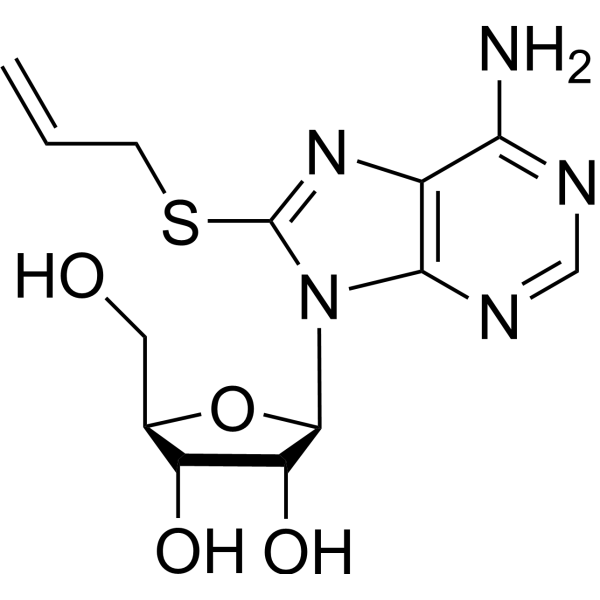 0 ImagesCat. No.: HY-152542CAS No.: 75059-23-3
8-Allylthioadenosine is an adenosine analog. Adenosine analogs mostly act as smooth muscle vasodilators and have also been shown to inhibit cancer progression. Its popular products are adenosine phosphate, Acadesine (HY-13417), Clofarabine (HY-A0005), Fludarabine phosphate (HY-B0028) and Vidarabine (HY-B0277).
-
YN14 (mixture of diastereomers)
 0 ImagesCat. No.: HY-155356ACAS No.: 3053689-54-3
YN14 mixture of diastereomers is a diastereomer mixture of YN14 (HY-155356). YN14 is a KRASG12C PROTAC degrader that recruits E3 ubiquitin ligase to induce the polyubiquitination and proteasomal degradation of KRASG12C. YN14 induces tumor cell apoptosis, cell cycle arrest, and cell migration inhibition. YN14 exhibits in vivo antitumor proliferative activity in tumor cell xenograft nude mice. YN14 can be used in cancer-related research.
-
Antitumor agent-28
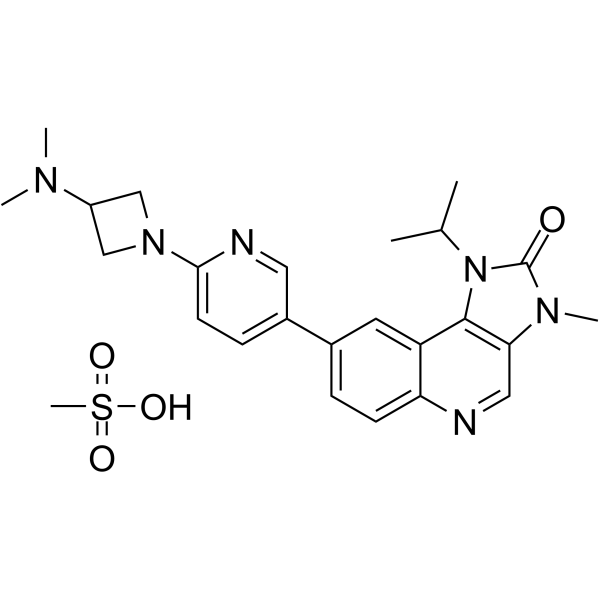 0 ImagesCat. No.: HY-141478CAS No.: 2097499-67-5
-
HIF-2α-IN-13
 0 ImagesCat. No.: HY-163600CAS No.: 3034488-42-8
HIF-2α-IN-13 (18) is a HIF-2α inhibitor, with an IC50 of 2.7 μM.
-
Cytochalasin B (Standard)
 0 ImagesCat. No.: HY-16928RCAS No.: 14930-96-2Synonyms: Phomin (Standard)
(R)-Duloxetine (Standard) is the analytical standard of (R)-Duloxetine. This product is intended for research and analytical applications. (R)-Duloxetine is a form of Duloxetine (HY-B0161) that causes tonic and usage-dependent impairment of neuronal Na+ channels. (R)-Duloxetine can be used in pain research.
-
Sudemycin K
 0 ImagesCat. No.: HY-122637CAS No.: 2071636-70-7
Sudemycin K is a selective splicing inhibitor targeting SF3B1. Sudemycin K blocks U2 snRNP recognition of branch point sequences in pre-mRNA, inducing tumor-specific splicing deregulation and apoptosis. Sudemycin K is promising for research of SF3B1-mutated malignancies such as chronic lymphocytic leukemia (CLL) and myelodysplastic syndromes (MDS).
-
USP1-IN-8
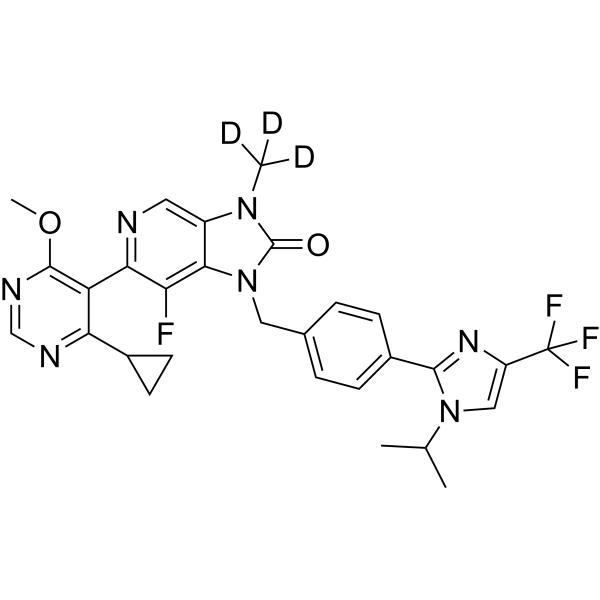 0 ImagesCat. No.: HY-161447CAS No.: 3033480-77-9
USP1-IN-8 (Compound 16) is an inhibitor for ubiquitin specific peptidase 1 (USP1) and its cofactor UAF1, with IC50 ≤50 nM. USP1-IN-8 inhibits proliferation of MDA-MB-436 with IC50 ≤50 nM.
-
ASN-001
 0 ImagesCat. No.: HY-164457CAS No.: 1429329-63-4
ASN-001 is an orally active CYP-17A1 lyase inhibitor that selectively inhibits testosterone synthesis. ASN-001 has anticancer activity and can be used for research in the field of prostate cancer.

-
Maleimide-DTPA TFA
 0 ImagesCat. No.: HY-W738256APurity: 98.06%Synonyms: MDTPA TFA
Maleimide-DTPA (MDTPA) TFA is a monoreactive DTPA derivative (MDTPA) with maleimide group as peptide binding site, which can be combined with radionuclides to prepare radionuclide conjugates (RDC). Maleimide-DTPA TFA can chelate indium-111 (111In) and label peptides and peptides with indium-111. For example, it has high stability when combined with OST7 incubated in human serum, which is better than cyclic cDTPA. Maleimide-DTPA TFA is a good material for medical imaging or treatment.
-
mmu-miR-1306-5p antagomir
 0 ImagesCat. No.: HY-RI02661A
mmu-miR-1306-5p antagomirs are chemically-modified oligonucleotides that hybridize with mature miRNAs. The miRNA antagomirs have 2 phosphorothioates at the 5' end, 4 phosphorothioates at the 3' end, 1 cholesterol group at the 3' end, and full-length nucleotide 2'-methoxy modification. The miRNA antagomirs strongly compete with mature miRNAs to prevent the complementary pairing of miRNAs and their target genes, thereby inhibiting miRNAs from functioning. Stability of miRNA antagomirs appears to be significantly higher than miRNA inhibitors, they exhibits enhanced cellular uptake, stability and regulatory activity in vivo.
-
mmu-miR-5135 inhibitor
 0 ImagesCat. No.: HY-RI03283
mmu-miR-5135 inhibitors are chemically-modified oligonucleotides that hybridize with mature miRNAs. The miRNA inhibitors have full-length nucleotide 2'-methoxy modification. The miRNA inhibitors strongly compete with mature miRNAs to prevent the complementary pairing of miRNAs and their target genes, thereby inhibiting miRNAs from functioning.
-
mmu-miR-7081-5p antagomir
 0 ImagesCat. No.: HY-RI03908A
mmu-miR-7081-5p antagomirs are chemically-modified oligonucleotides that hybridize with mature miRNAs. The miRNA antagomirs have 2 phosphorothioates at the 5' end, 4 phosphorothioates at the 3' end, 1 cholesterol group at the 3' end, and full-length nucleotide 2'-methoxy modification. The miRNA antagomirs strongly compete with mature miRNAs to prevent the complementary pairing of miRNAs and their target genes, thereby inhibiting miRNAs from functioning. Stability of miRNA antagomirs appears to be significantly higher than miRNA inhibitors, they exhibits enhanced cellular uptake, stability and regulatory activity in vivo.



