



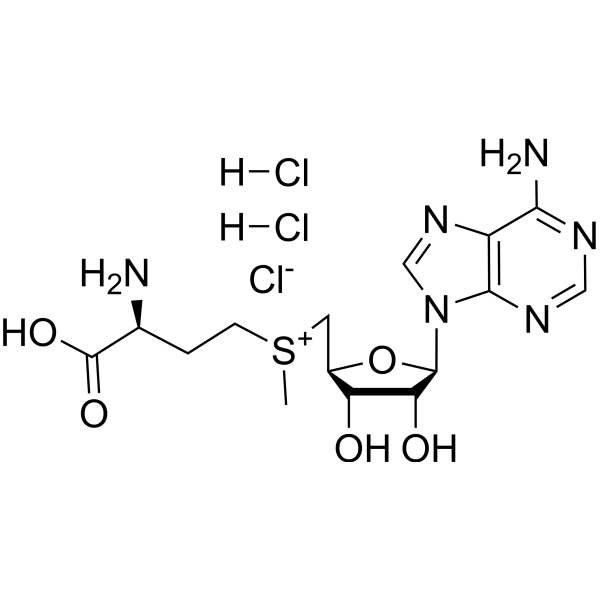
S-Adenosyl-L-methionine chloride dihydrochloride
Based on 10 publication(s) in Google Scholar
S-Adenosyl-L-methionine (S-Adenosyl methionine) chloride dihydrochloride is an orally active methyl group donor. S-Adenosyl-L-methionine chloride dihydrochloride is a dietary supplement with potent antidepressant effects. S-Adenosyl-L-methionine chloride dihydrochloride also has anti‑proliferative, pro‑apoptotic and anti‑metastatic roles in cancers. S-Adenosyl-L-methionine chloride dihydrochloride has the potential for, cancer, liver disease and osteoarthritis research.
For research use only. We do not sell to patients.
- Purity : 75.0%
- CAS No.: 86867-01-8
- Formula: C15H25Cl3N6O5S
- Molecular Weight:507.82
-
Storage:
-20°C, sealed storage, away from moisture
* In solvent : -80°C, 6 months; -20°C, 1 month (sealed storage, away from moisture)

To place orders, for customer services and technical support, please contact: MedChemExpress USA
Tel: 609-228-6898 E-mail: [email protected] [email protected]


-
 Biological Activity
-
Chemical Information
-
Solvent & Solubility
- Purity & Documentation
- References
-
 Help & FAQs




Publications Citing Use of MedChemExpress (MCE) S-Adenosyl-L-methionine chloride dihydrochloride
More- Autophagy. 2026 May 17:1-23. [Abstract]
- Nat Commun. 2024 Nov 12;15(1):9529. [Abstract]
- MedComm (2020). 2026 Jul 5;7(7):e70831.
- Environ Sci Technol. 2025 Jan 14;59(1):268-278. [Abstract]
- Pharmacol Res. 2024 Nov:209:107420. [Abstract]
- Int J Biol Macromol. 2026 Apr:355:151129. [Abstract]
- Food Funct. 2025 Oct 27. [Abstract]
- Plant J. 2025 Apr;122(2):e70182. [Abstract]
- SSRN. 2026 Jun 23.
- bioRxiv. 2025 Jun 27.
 Customer Validation & Images

-
Flow Cytometry
-
Cell Proliferation/Viability Assay
-
WB
All Endogenous Metabolite Isoforms
More

Biological Activity
Description
In Vitro
S-Adenosyl-L-methionine (300 µM, 24 or 48 h) chloride dihydrochloride induces cell apoptosis, and promotes the cell cycle arrest in Cal-33 and JHU-SCC-011 cells[4].
S-Adenosyl-L-methionine (300 µM, 24 h) chloride dihydrochloride decreases the migration of the Cal-33 and JHU-SCC-011 cells[4].
S-Adenosyl-L-methionine (5-40 μg/mL, 48 h) chloride dihydrochloride protects the anticancer effect of 5‑FU by regulating the expression of DNMTs[5].
MedChemExpress (MCE) has not independently confirmed the accuracy of these methods. They are for reference only.
-
Cell Line:Cal-33 and JHU-SCC-011 cells
-
Concentration:300 µM
-
Incubation Time:24 h (Cal-33) or 48 h (HU-SCC-011)
-
Result:Showed an approximately 10% and 3%of apoptotic cells respectively.
-
Cell Line:Cal-33 and JHU-SCC-011 cells
-
Concentration:300 µM
-
Incubation Time:24 h (Cal-33) or 48 h (HU-SCC-011)
-
Result:Decreased the expression of cyclin B1, E1 and D1 in the Cal-33 and JHU-SCC-011 cells.
In Vivo
S-Adenosyl-L-methionine (50 and 100 mg/kg, p.o.) chloride dihydrochloride shows antiepileptic, memory-enhancing, and antioxidant properties in a Pentylenetetrazole-induced rat epilepsy model[7].
MedChemExpress (MCE) has not independently confirmed the accuracy of these methods. They are for reference only.
-
Animal Model:Valproic acid treated young mice[6]
-
Dosage:30 mg/kg
-
Administration:p.o., for 3 days
-
Result:Alleviated most ASD like neurobehavioral symptoms.
Normalized the redox potential in the prefrontal cortex.


Chemical Information
-
CAS No. 86867-01-8
-
Appearance Solid
-
Molecular Weight 507.82
-
Formula C15H25Cl3N6O5S
-
Color White to light yellow
-
SMILES
O[C@H]1[C@@H](O)[C@H](N2C=NC3=C2N=CN=C3N)O[C@@H]1C[S+](CC[C@H](N)C(O)=O)C.[H]Cl.[H]Cl.[Cl-]
-
Synonyms
S-Adenosyl methionine chloride dihydrochloride; Ademetionine chloride dihydrochloride; AdoMet chloride dihydrochloride
-
Shipping
Room temperature in continental US; may vary elsewhere.
-
Storage
-20°C, sealed storage, away from moisture
* In solvent : -80°C, 6 months; -20°C, 1 month (sealed storage, away from moisture)


Publications (10)
-
Journal Impact Factor
-
Most Recent
-
Autophagy
SETDB1 enhances starvation-induced lipophagy by inhibiting m6A-mediated mRNA decay via DDX5 methylation. [Abstract]2026 May 17:1-23. PMID: 42087801 -
Nat Commun
2024 Nov 12;15(1):9529. PMID: 39532843 -
-
Environ Sci Technol
Arsenic Exposure Triggers Nonalcoholic Fatty Liver Disease through Repressing S-Adenosylmethionine-Dependent Histone Methylation in Rats. [Abstract]2025 Jan 14;59(1):268-278. PMID: 39746780 -
Pharmacol Res
Developing patient-derived organoids to demonstrate JX24120 inhibits SAMe synthesis in endometrial cancer by targeting MAT2B. [Abstract]2024 Nov:209:107420. PMID: 39293586
S-Adenosyl-L-methionine chloride dihydrochloride purchased from MedChemExpress. Usage Cited in: Pharmacol Res. 2024 Nov:209:107420. [Abstract]
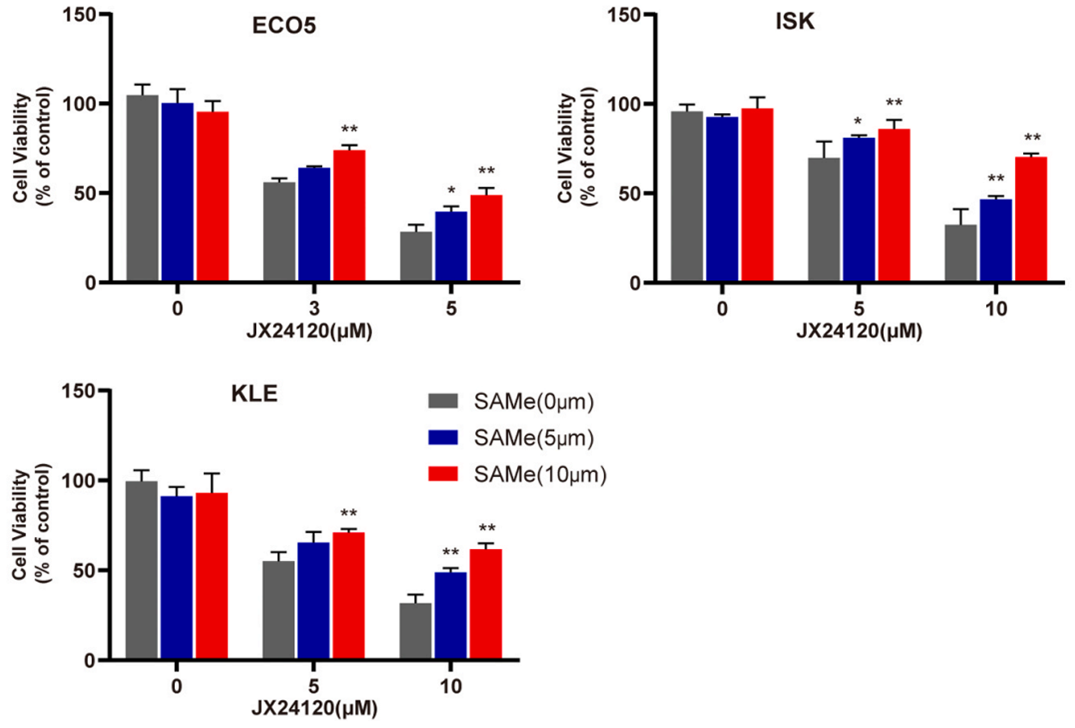
Cell viability was determined in response to JX24120 with the supplement of exogenous S-Adenosyl-L-methionine disulfate tosylate (SAMe, 5-10 μM). The results demonstrated that SAMe effectively reversed the cytotoxicity induced by JX24120 in endometrial cancer organoids and cell lines.
S-Adenosyl-L-methionine chloride dihydrochloride purchased from MedChemExpress. Usage Cited in: Pharmacol Res. 2024 Nov:209:107420. [Abstract]
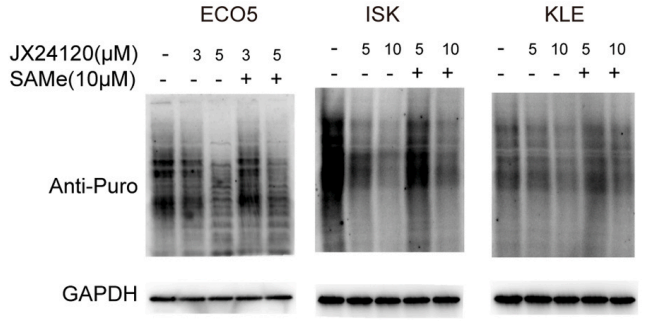
The protein synthesis rates of treated organoids, ISK and KLE were examined by puromycin incorporation assay. In organoids and cell lines, JX24120 inhibited protein synthesis in a dose-dependent manner, which was also rescued by exogenous supplementation with S-Adenosyl-L-methionine disulfate tosylate (SAMe, 10 μM).
-
Int J Biol Macromol
Targeting OXCT1 with the methyl donor S-adenosylmethionine as a therapeutic strategy for cerebral cavernous malformations. [Abstract]2026 Apr:355:151129. PMID: 41865434 -
Food Funct
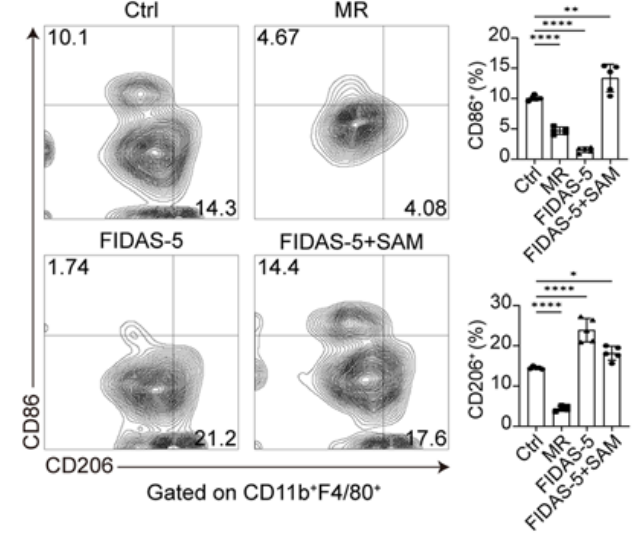
Methionine restriction attenuates renal injury by suppressing macrophage polarization via IRF1 downregulation. [Abstract]2025 Oct 27. PMID: 41140247
S-Adenosyl-L-methionine chloride dihydrochloride purchased from MedChemExpress. Usage Cited in: Food Funct. 2025 Oct 27. [Abstract]
Representative flow cytometry plots of CD86+ and CD206+ BMDMs cultured under different treatment conditions (n = 5). The results showed that S-Adenosyl-L-methionine disulfate tosylate (SAM, 100 μM) supplementation reversed the aberrant polarization phenotype of BMDMs.
-
Plant J
Transcriptomic and metabolomic analyses unveil TaASMT3-mediated wheat resistance against stripe rust by promoting melatonin biosynthesis. [Abstract]2025 Apr;122(2):e70182. PMID: 40298361 -
-


Solvent & Solubility
In Vitro:
DMSO : 100 mg/mL (196.92 mM; Need ultrasonic; Hygroscopic DMSO has a significant impact on the solubility of product, please use newly opened DMSO)
H2O : ≥ 50 mg/mL (98.46 mM)
* "≥" means soluble, but saturation unknown.
Please refer to the solubility information to select the appropriate solvent. Once prepared, please aliquot and store the solution to prevent product inactivation from repeated freeze-thaw cycles.
Storage method and period of stock solution: -80°C, 6 months; -20°C, 1 month (sealed storage, away from moisture). When stored at -80°C, please use it within 6 months. When stored at -20°C, please use it within 1 month.
* Note: If you choose water as the stock solution, please dilute it to the working solution, then filter and sterilize it with a 0.22 μm filter before use.
Please refer to the solubility information to select the appropriate solvent. Once prepared, please aliquot and store the solution to prevent product inactivation from repeated freeze-thaw cycles.
Storage method and period of stock solution: -80°C, 6 months; -20°C, 1 month (sealed storage, away from moisture). When stored at -80°C, please use it within 6 months. When stored at -20°C, please use it within 1 month.
* Note: If you choose water as the stock solution, please dilute it to the working solution, then filter and sterilize it with a 0.22 μm filter before use.
Concentration (start) × Volume (start) = Concentration (final) × Volume (final)
In Vivo:
Select the appropriate dissolution method based on your experimental animal and administration route.
- For the following dissolution methods, please ensure to first prepare a clear stock solution using an In Vitro approach and then sequentially add co-solvents:
- To ensure reliable experimental results, the clarified stock solution can be appropriately stored based on storage conditions. As for the working solution for In Vivo experiments, it is recommended to prepare freshly and use it on the same day.
- The percentages shown for the solvents indicate their volumetric ratio in the final prepared solution. If precipitation or phase separation occurs during preparation, heat and/or sonication can be used to aid dissolution.
Add each solvent one by one: 10% DMSO 40% PEG300 5% Tween-80 45% Saline
Solubility: ≥ 2.5 mg/mL (4.92 mM); Clear solution
This protocol yields a clear solution of ≥ 2.5 mg/mL (saturation unknown).
Taking 1 mL working solution as an example, add 100 μL DMSO stock solution (25.0 mg/mL) to 400 μL PEG300, and mix evenly; then add 50 μL Tween-80 and mix evenly; then add 450 μL Saline to adjust the volume to 1 mL.
Preparation of Saline: Dissolve 0.9 g sodium chloride in ddH₂O and dilute to 100 mL to obtain a clear Saline solution.
Add each solvent one by one: 10% DMSO 90% (20% SBE-β-CD in Saline)
Solubility: ≥ 2.5 mg/mL (4.92 mM); Clear solution
This protocol yields a clear solution of ≥ 2.5 mg/mL (saturation unknown).
Taking 1 mL working solution as an example, add 100 μL DMSO stock solution (25.0 mg/mL) to 900 μL 20% SBE-β-CD in Saline, and mix evenly.
Preparation of 20% SBE-β-CD in Saline (4°C, storage for one week): 2 g SBE-β-CD powder is dissolved in 10 mL Saline, completely dissolve until clear.
In Vivo Dissolution Calculator
Please enter the basic information of animal experiments:
-
-
-
-
Recommended: Prepare an additional quantity of animals to account for potential losses during experiments.
Working solution concentration: 0.22 mg/mL
This product has good water solubility, please refer to the measured solubility data in water/PBS/Saline for details.


Purity & Documentation
-
Data Sheet (283 KB)
-
SDS (393 KB)
- English - EN (393 KB)
- Français - FR (393 KB)
- Deutsch - DE (393 KB)
- Norwegian - NO (393 KB)
- Español - ES (393 KB)
- Swedish - SV (393 KB)
- Italian - IT (393 KB)
- Korean - KR (393 KB)
- Portuguese - PT (393 KB)
-
Handling Instructions (2659 KB)
References
[1]. Dai M, et al. Amperometric sensing of norepinephrine at picomolar concentrations using screen printed, high surface area mesoporous carbon. Anal Chim Acta. 2013 Jul 25;788:32-8. [Content Brief]
[2]. Wadie I Najm, et al. S-adenosyl methionine (SAMe) versus celecoxib for the treatment of osteoarthritis symptoms: a double-blind cross-over trial. [ISRCTN36233495]. BMC Musculoskelet Disord. 2004 Feb 26;5:6. [Content Brief]
[3]. Shelly C Lu, et al. S-adenosylmethionine in liver health, injury, and cancer. Physiol Rev. 2012 Oct;92(4):1515-42. [Content Brief]
[4]. Mosca L, et al. Effects of S‑adenosyl‑L‑methionine on the invasion and migration of head and neck squamous cancer cells and analysis of the underlying mechanisms. Int J Oncol. 2020 May;56(5):1212-1224. [Content Brief]
[5]. Ham MS, et al. S-adenosyl methionine specifically protects the anticancer effect of 5-FU via DNMTs expression in human A549 lung cancer cells. Mol Clin Oncol. 2013 Mar;1(2):373-378. [Content Brief]
[6]. Ornoy A, et al. S-adenosyl methionine prevents ASD like behaviors triggered by early postnatal valproic acid exposure in very young mice. Neurotoxicol Teratol. 2019 Jan-Feb;71:64-74. [Content Brief]
[7]. Dhediya RM, et al. Evaluation of antiepileptic effect of S-adenosyl methionine and its role in memory impairment in pentylenetetrazole-induced kindling model in rats. Epilepsy Behav. 2016 Aug;61:153-157. [Content Brief]


Complete Stock Solution Preparation Table
Please refer to the solubility information to select the appropriate solvent. Once prepared, please aliquot and store the solution to prevent product inactivation from repeated freeze-thaw cycles.
Storage method and period of stock solution: -80°C, 6 months; -20°C, 1 month (sealed storage, away from moisture). When stored at -80°C, please use it within 6 months. When stored at -20°C, please use it within 1 month.
| Optional Solvent | Concentration Solvent Mass | 1 mg | 5 mg | 10 mg | 25 mg |
|---|---|---|---|---|---|
| H2O / DMSO | 1 mM | 1.9692 mL | 9.8460 mL | 19.6920 mL | 49.2300 mL |
| 5 mM | 0.3938 mL | 1.9692 mL | 3.9384 mL | 9.8460 mL | |
| 10 mM | 0.1969 mL | 0.9846 mL | 1.9692 mL | 4.9230 mL | |
| 15 mM | 0.1313 mL | 0.6564 mL | 1.3128 mL | 3.2820 mL | |
| 20 mM | 0.0985 mL | 0.4923 mL | 0.9846 mL | 2.4615 mL | |
| 25 mM | 0.0788 mL | 0.3938 mL | 0.7877 mL | 1.9692 mL | |
| 30 mM | 0.0656 mL | 0.3282 mL | 0.6564 mL | 1.6410 mL | |
| 40 mM | 0.0492 mL | 0.2462 mL | 0.4923 mL | 1.2308 mL | |
| 50 mM | 0.0394 mL | 0.1969 mL | 0.3938 mL | 0.9846 mL | |
| 60 mM | 0.0328 mL | 0.1641 mL | 0.3282 mL | 0.8205 mL | |
| 80 mM | 0.0246 mL | 0.1231 mL | 0.2462 mL | 0.6154 mL | |
| DMSO | 100 mM | 0.0197 mL | 0.0985 mL | 0.1969 mL | 0.4923 mL |
* Note: If you choose water as the stock solution, please dilute it to the working solution, then filter and sterilize it with a 0.22 μm filter before use.


S-Adenosyl-L-methionine chloride dihydrochloride Related Classifications
HY-14614A Related Classifications
 Powered by Bioz