



FGFR
Fibroblast growth factor receptor
FGFR (Fibroblast growth factor receptors) are the receptors that bind to members of the fibroblast growth factor family of proteins. Some of these receptors are involved in pathological conditions. A point mutation in FGFR3 can lead to achondroplasia. Five distinct membrane FGFR have been identified in vertebrates and all of them belong to the tyrosine kinase superfamily (FGFR1, FGFR2, FGFR3, FGFR4, FGFR6). The fibroblast growth factor family constitutes one of the most important groups of paracrine factors that act during development. They are responsible for determining certain cells to become mesoderm, for the production of blood vessels, for limb outgrowth, and for the growth and differentiation of numerous cell types.
All Product Categories
-
FGFR Inhibitors
(322)
View all products
-
FGFR Agonists
(4)
View all products
-
FGFR Antagonist
(1)
View all products
-
FGFR Activators
(6)
View all products
-
FGFR Modulators
(3)
View all products
-
FGFR Degraders
(11)
View all products
-
FGFR Control
(1)
View all products
-
FGFR Ligands
(2)
View all products
-
FGFR Proteins
(97)
View all products
-
FGFR-1 Proteins
(20)
View all products
-
FGFR-2 Proteins
(31)
View all products
-
FGFR-3 Proteins
(26)
View all products
-
FGFR-4 Proteins
(18)
View all products
-
FGFR Related Products (391)
Related Products (391)

-
Recombinant Proteins (97)
-
Antibodies (11)
-
INCB126503
 0 ImagesCat. No.: HY-174154CAS No.: 2640089-88-7INCB126503 is an orally activeM, selective FGFR2/3 Inhibitor with IC50 values of 70 nM (FGFR1), 2.1 nM (FGFR2), 1.2 nM (FGFR3), 0.92 nM (FGFR3-V555L), 0.85 nM (FGFR3-V555M) and 64 nM (FGFR4). INCB126503 suppresses FGFR signaling in vivo without causing hyperphosphatemia and shows antitumor efficacy in xenograft models harboring FGFR3 genetic alterations.
-
FGFR3 V555M Recombinant Human Active Protein Kinase
 0 ImagesCat. No.: HY-E70829FGFR3 kinase mutations are associated with a variety of malignancies. FGFR3 V555M mutation leads to resistance to FGFR inhibitors. FGFR3 V555M Recombinant Human Active Protein Kinase is a recombinant FGFR3 V555M protein that can be used to study FGFR3 V555M-related functions.
-
FGFR4-IN-17
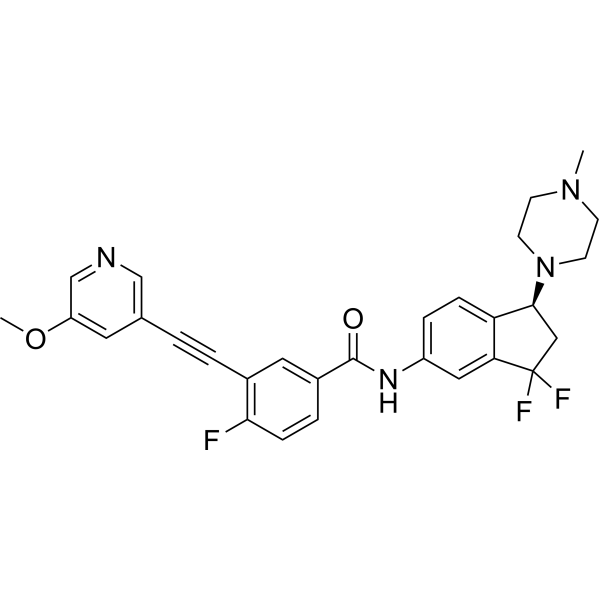 0 ImagesCat. No.: HY-163273CAS No.: 3011805-61-8FGFR4-IN-17 (Compound (S)-23) is a piperazinyl diflurindan derivative containing pyridinyl. FGFR4-IN-17 is a FGFR inhibitor with IC50 values of 24.2, 16.1, 78.0, and 68.0 nM for FGFR1, FGFR2, FGFR3, and FGFR4, respectively. FGFR4-IN-17 has antitumor activity.
-
FGFR3 V555L Recombinant Human Active Protein Kinase
 0 ImagesCat. No.: HY-E70828FGFR3 kinase mutations are associated with a variety of malignancies. FGFR3 V555L mutation leads to resistance to FGFR inhibitors. FGFR3 V555L Recombinant Human Active Protein Kinase is a recombinant FGFR3 V555L protein that can be used to study FGFR3 V555L-related functions.
-
HuGAL-F2
 0 ImagesCat. No.: HY-P990597Purity: 98.30%
-
FGFR3-IN-7
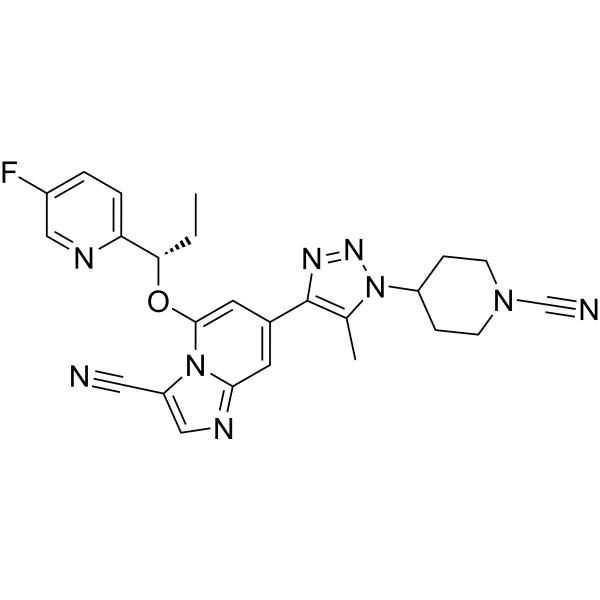 0 ImagesCat. No.: HY-156791CAS No.: 2833703-79-8
-
CXF-009
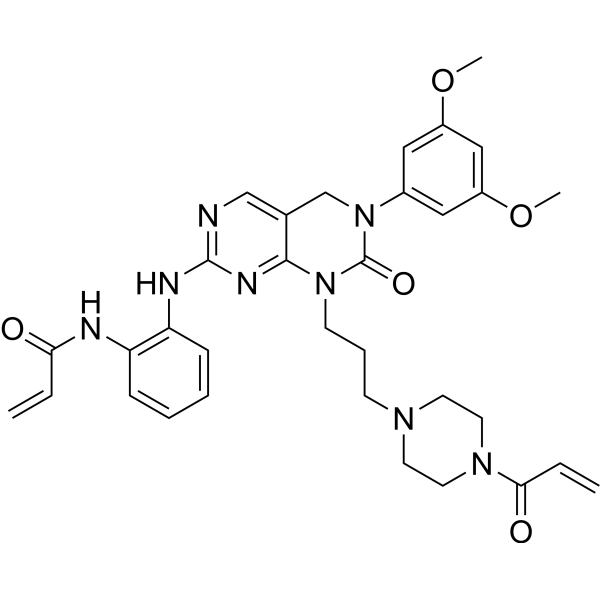 0 ImagesCat. No.: HY-160621CAS No.: 2727084-00-4CXF-009 is a selective and covalent FGFR4 inhibitor, with the IC50 of 48 nM. CXF-009 targeting Cys477 and Cys552 of FGFR4, and can be used for the study of hepatocellular carcinoma.
-
Regorafenib monohydrate (Standard)
 0 ImagesSynonyms: BAY 73-4506 monohydrate (Standard)Regorafenib (monohydrate) (Standard) is the analytical standard of Regorafenib (monohydrate). This product is intended for research and analytical applications. Regorafenib (BAY 73-4506) monohydrate is an orally active and potent multi-targeted receptor tyrosine kinase inhibitor, with IC50 values of 13/4.2/46, 22, 7, 1.5 and 2.5 nM for VEGFR1/2/3, PDGFRβ, Kit, RET and Raf-1, respectively. Regorafenib monohydrate shows very robust antitumor and antiangiogenic activity.
-
cRY9M
 0 ImagesCat. No.: HY-P11853cRY9M is a cyclic peptide that binds to FGFR1, with a KD value of 58 nM. cRY9M binds specifically to FGFR1, exhibits enhanced in vivo stability, and shows extremely low degradation in blood, urine and liver homogenate after injection. cRY9M displays significant specific uptake in FGFR1-positive tumor xenograft models, while its uptake decreases in FGFR1-negative tumor models and blocking models. The NOTA-chelated precursor of cRY9M can be labeled with 68Ga to obtain [68Ga]Ga-NOTA-cRY9M, which is used for research on non-invasive imaging of FGFR1 expression in non-small cell lung cancer.
-
FGFR1 inhibitor-13
 0 ImagesCat. No.: HY-W801893CAS No.: 670266-26-9FGFR1 inhibitor-13 (compound 1) is an FGFR1 inhibitor with an IC50 of 4.2 μM.
-
AXL/Angiokinase-IN-1
 0 ImagesCat. No.: HY-170776AXL/Angiokinase-IN-1 (compound 11b) is an AXL/triple angiokinase inhibitor, IC50=3.75 nM (AXL expression). AXL/Angiokinase-IN-1 inhibits epithelial-mesenchymal transition (EMT) in Bxpc-3, blocking lung cancer cell metastasis. AXL/Angiokinase-IN-1 also inhibits vascular and fibroblast functions, promoting apoptosis (apoptosis) in cancer cells and fibroblasts. AXL/Angiokinase-IN-1 features low toxicity and good metabolic stability.
-
FGFR-IN-26
 0 ImagesCat. No.: HY-182915CAS No.: 2823290-68-0
-
FGFR2 V564F Recombinant Human Active Protein Kinase
 0 ImagesCat. No.: HY-E70825FGFR2 is a receptor tyrosine kinase that is involved in many human cancers such as intrahepatic cholangiocarcinomas and hepatocellular carcinomas. FGFR2 V564F is a mutant of FGFR3. FGFR2 V564F Recombinant Human Active Protein Kinase is a recombinant FGFR2 V564F protein that can be used to study FGFR2 V564F-related functions.
-
FGFR-IN-24
 0 ImagesCat. No.: HY-181031FGFR-IN-24 (Compound 8r) is a FGFR inhibitor. FGFR-IN-24 potently inhibits FGFR1/2/3 with IC50 values of 10.0, 6.9, and 30.2 nM, respectively. FGFR-IN-24 exhibits superior inhibitory activity toward FGFR1V561M, FGFR2V564F, and FGFR2N549K mutations with IC50 values of 6.8, 0.7, and 0.8 nM, respectively. FGFR-IN-24 induces Apoptosis. FGFR-IN-24 efficiently suppresses the phosphorylation of FGFR2 and its downstream signaling mediators (AKT and MAPK). FGFR-IN-24 demonstrates favorable antitumor efficacy in an RT112/84 bladder cancer xenograft model.
-
FGFR3-IN-9
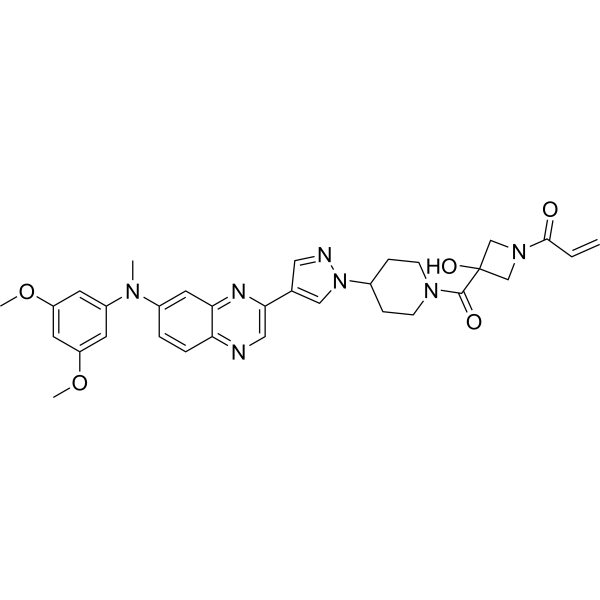 0 ImagesCat. No.: HY-158011CAS No.: 2446523-17-5FGFR3-IN-9 (example27) is a selective FGFR3 inhibitor.
-
FGFR2/3-IN-1
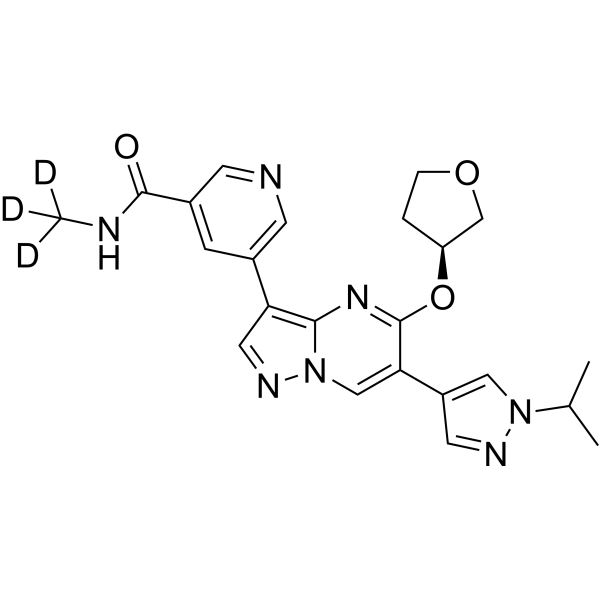 0 ImagesCat. No.: HY-151903SCAS No.: 2640352-86-7FGFR2/3-IN-1 is a potent and selective FGFR2 and FGFR3 (FGFR) inhibitor with IC50s of 1 nM and 0.5 nM, respectively. FGFR2/3-IN-1 displays >40-fold selectivity over FGFR1/FGFR4 and other kinome. FGFR2/3-IN-1 also inhibits FGFR3 V555L and V555M mutants with IC50s of 2.7 nM and 6.1 nM, respectively.
-
IUB288
 0 ImagesCat. No.: HY-P11881Purity: 98.88%IUB288 is a stable and long-acting glucagon-modified peptide, as well as a highly selective Glucagon Receptor agonist. IUB288 stimulates the production of cAMP, increases the expression levels of FGF21 in plasma and liver, regulates bile acid metabolism, and inhibits the expression of hepatic HMGCR. IUB288 improves hypercholesterolemia, enhances insulin sensitivity, increases core body temperature, boosts energy expenditure, suppresses food intake, and can also induce hyperglycemia and glucose intolerance. IUB288 is applicable to the research of diet-induced obesity, type 2 diabetes, and obesity-related glucose intolerance.
-
FGFR2/3-IN-3
 0 ImagesCat. No.: HY-176547CAS No.: 3069945-78-1FGFR2/3-IN-3 is a dual-target FGFR2/3 inhibitor with IC50s of 2.7 nM (TEL-FGFR2) and 3.9 nM (TEL-FGFR3), respectively. FGFR2/3-IN-3 has effective activity against both wild-type and mutant FGFR3. FGFR2/3-IN-3 has low CYP3A4 inhibitory effect and hERG toxicity. FGFR2/3-IN-3 improves the imbalance between chondrocyte proliferation and differentiation and promotes bone growth by inhibiting the signaling pathway mediated by mutant FGFR3. FGFR2/3-IN-3 shows a growth-promoting effect in a dwarfism mouse model and has the potential to study bone development disorder-related diseases such as achondroplasia (ACH).
-
FGFR-IN-23
 0 ImagesCat. No.: HY-178059FGFR-IN-23 (Compound 9p) is a covalent pan FGFR inhibitor with IC50s of 14, 4.2, 5 and 220 nM for FGFR1, FGFR2, FGFR3 and FGFR4, respectively. FGFR-IN-23 also has potent inhibitory activity against gatekeeper mutants, such as FGFR1V561M and FGFR3V555M. FGFR-IN-23 suppresses the activation of FGFR-mediated signaling and induces apoptosis. FGFR-IN-23 shows significant antitumor efficacy in RT112 xenograft mouse models. FGFR-IN-23 can be used for cancers and its drug resistance research.
-
FGFR4-IN-13
 0 ImagesCat. No.: HY-153502CAS No.: 2020395-38-2FGFR4-IN-13 (Compound 6) is a selective FGFR4 inhibitor. FGFR4-IN-13 is applicable to the research of hepatocellular carcinoma.




