Fluorescent Dye
Fluorescence is a phenomenon of photoluminescence in luminescence. When an atom is irradiated by light, some electrons around the nucleus jump from their original orbitals to higher energy orbitals under the influence of light energy, i.e., from the ground state to the first or second excited single-line state, etc. Due to the instability of the first or second excited singlet state, the electron returns from the excited singlet state to the ground state accompanied by released energy, resulting in fluorescence.
Fluorescent dyes can be covalently bound or physically adsorbed in the structure of the substance. The fluorescence properties allow for the characterization, localization and quantitative analysis of the labeled object. Fluorescent dyes have shown great potential for the detection of proteins, nucleic acids, cells, and immunoassays, attributed to the advantages in non-radioactive contamination, simple experimental operation and easy observation.
Fluorescent dyes have penetrated many fields such as pharmacology, physiology, environmental science, and information science, as well as functional studies of proteins and drug screening.
All Product Categories
-
Fluorescent Dye Related Products (4914)
Related Products (4914)

-
Antibodies (4)
-
Cy3 labled Vutrisiran sodium
 0 ImagesCat. No.: HY-132589ECy3 labled Vutrisiran sodium is a Cy3 labled Vutrisiran sodium.
-
AMCA-PEG4-propargyl
 0 ImagesCat. No.: HY-D3344AMCA-PEG4-propargyl is a derivative of AMCA featuring a propargyl group for CuAAC click chemistry reactions. It incorporates a PEG4 linker to enhance solubility and reduce steric hindrance. AMCA-PEG4-propargyl is primarily used for click chemistry-based bioconjugation (Ex/Em = 347/444 nm).

-
Mito-RhFe
 0 ImagesCat. No.: HY-D3128CAS No.: 2348351-60-8Mito-RhFe is a Fluorescent probe for mitochondrial labile Fe³⁺ monitoring via imaging and flow cytometry. This probe is a rhodamine-based construct with a spirolactam fluorescence signaling group and an N2-hydroxyethyldiethylenetriamine chelator; its delocalized positive charge enables mitochondria-targeting ability in live cells, and it exhibits fine cell membrane permeability. In its native state, it exists in the non-fluorescent spirolactam form, but upon binding to Fe³⁺, it undergoes a ring-opening conversion to the fluorescent rhodamine form, triggering a turn-on fluorescent response; this process is reversible, as the addition of the metal chelator TPEN removes Fe³⁺ and converts the probe back to its non-fluorescent spirolactam form, and re-addition of Fe³⁺ restores fluorescence. The probe shows high selectivity for Fe³⁺ over most other metal cations present in living systems, with a ~90-fold fluorescence enhancement upon binding to 20 equiv of Fe³⁺. Mito-RhFe has excitation/emission wavelengths of Ex/Em = 540/578 nm, with an ~8 nm bathochromic shift in emission upon Fe³⁺ binding, and it can also be excited at 543 nm for confocal imaging with emission detected at 570-620 nm[1].
-
Cy3 labled Vesleteplirsen sodium
 0 ImagesCat. No.: HY-132585ECy3 labled Vesleteplirsen sodium is a Cy3 labled Vesleteplirsen sodium.
-
AM1-44
 0 ImagesCat. No.: HY-D3422AM1-44 is a fixable, cationic styryl fluorescent dye primarily used for labeling nerve terminals and synaptic vesicles. In its free state, AM1-44 exhibits extremely weak fluorescence; upon insertion into the cell membrane, its fluorescence increases, and after endocytosis into vesicles and release via exocytosis, its fluorescence decreases. Therefore, it can be used to study synaptic activity, synaptic vesicle cycling, neurotransmitter release, and synaptic plasticity (Ex/Em = 480/598-600 nm in membrane environment).
-
FAM labled ALN-12115 sodium
 0 ImagesCat. No.: HY-177613CFAM labled ALN-12115 sodiumis a FAM labled ALN-12115 sodium.
-
ICR-191 dihydrochloride
 0 ImagesCat. No.: HY-W414334CAS No.: 17070-45-0ICR-191 dihydrochloride enhances Cisplatin (HY-17394)- DNA binding and sensitizes cells to cisplatin. ICR-191 dihydrochloride induces a significant increase in the expression of phosphorylated H2AX (γH2AX), particularly in DNA-replicating cells. ICR-191 dihydrochloride can be used for the study of leukemia.
-
ATTO 680
 0 ImagesCat. No.: HY-D2071CAS No.: 422310-48-3ATTO 680 is a new type of fluorescent dye with high fluorescence yield, which can be used for most labeling applications, maximum excitation/emission wavelength: 681/698 nm.
-
Mito-VR2
 0 ImagesCat. No.: HY-D3098Mito‑VR2 is a mitochondria-targeted molecular rotor-type viscosity fluorescent probe with high responsiveness to microenvironmental viscosity, which is suitable for synchronous imaging of mitochondrial viscosity during autophagy in living cells. Mito-VR2 achieves specific targeting of mitochondria through its hydrophobic cationic structure, and its fluorescence intensity responds only to microenvironmental viscosity. Mito-VR2 emits almost no fluorescence in low-viscosity media, but its fluorescence emission is significantly enhanced in high-viscosity environments.
-
FAM labled Zerlasiran sodium
 0 ImagesCat. No.: HY-147425DSynonyms: FAM labled SLN360 sodiumFAM labled Zerlasiran sodium is a FAM labled Zerlasiran sodium (HY-147425A). Zerlasiran sodium is a siRNA targeting apolipoprotein A (ApoA). Zerlasiran sodium targets hepatic ApoA synthesis via RNA interference to degrade encoding mRNA. Zerlasiran sodium can be used for the research of atherosclerotic cardiovascular disease and elevated ApoA levels.
-
AQC (solution)
 0 ImagesCat. No.: HY-DY1070CAS No.: 148757-94-2AQC (6-Aminoquinolyl-N-hydroxysccinimidyl carbamate) (solution) is a reagent used for amino acid or protein sequence analysis by HPLC with fluorescence detection. AQC reacts with primary and secondary amino acids to yield fluorescent derivates, allowing amino acid detection at under-picomolar levels.
Solvent and concentration: DMSO: 10 mM
The 1 mL volume is defined as the base specification. All larger sizes correspond to incremental volumes of this base.
-
Cy7.5 alkyne chloride
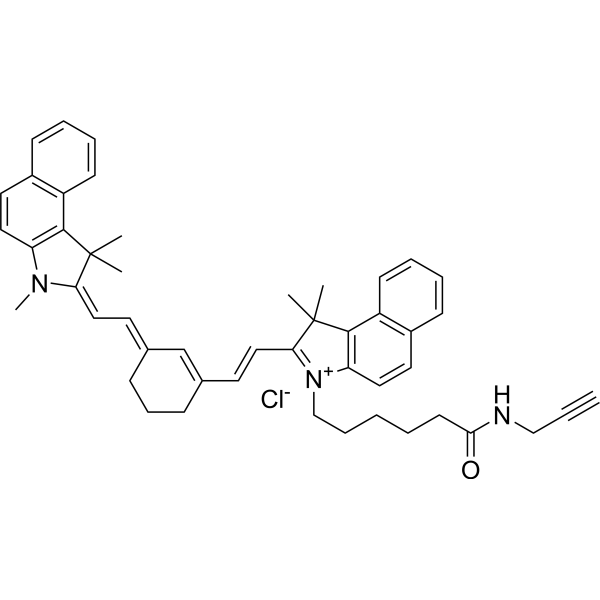 0 ImagesCat. No.: HY-D1862Cy7.5 alkyne chloride is a dye derivative of Cyanine 7.5 (Cy7.5) (HY-D0926) containing a sulfonate ion and an alkyne functional group. Cy7.5 is a near-infrared fluorescent dye commonly used for biolabeling and cell imaging. The alkyne functional group of Cy7.5 alkyne chloride can react with molecules containing the azide functional group to form covalent bonds. Cy7.5 alkyne chloride can bind to biological molecules such as proteins and antibodies to track their location and dynamic changes in biological samples.
-
BODIPY FL Cholesterol
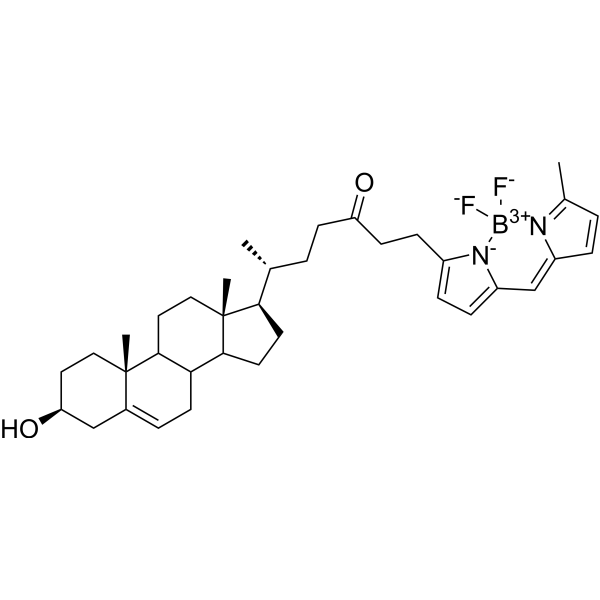 0 ImagesCat. No.: HY-D1595BODIPY FL Cholesterol is a green fluorescent, lipophilic probe. BODIPY FL Cholesterol can be used for the research of lipid transport processes and lipid-protein interactions.
-
BPN-01
 0 ImagesCat. No.: HY-172534BPN-01 is a fluorescent probe targeting translocator protein (TSPO) and human epidermal growth factor receptor 2 (HER2) with binding affinities of -10.7 kcal/mol for TSPO and -11.3 kcal/mol for HER2. BPN-01 is promising for research of solid tumor imaging during fluorescence image-guided surgery (FIGS) (Ex/Em = 475/510 nm).

-
CDr15
 0 ImagesCat. No.: HY-D3195CAS No.: 2028316-19-8CDr15 is a deep-red fluorescent probe (Ex=733 nm) that can selectively intercalate into and label bacterial extracellular DNA (eDNA). CDr15 exhibits extremely high specificity for biofilm imaging and cannot effectively bind to mammalian nuclear DNA. CDr15 enables real-time visualization of the microcolony structure and developmental process of three-dimensional *Pseudomonas aeruginosa* biofilms, and accurately localizes biofilm-forming regions of microorganisms in a mouse corneal infection model. With low background interference signals, CDr15 serves as an ideal diagnostic tool for research fields including bacterial biofilms and corneal infections.